Legal due diligence AI is software that reads a target's contracts and corporate documents in a data room, finds the clauses a buyer's lawyers look for, such as change of control, assignment, exclusivity, liability caps and termination rights, and reports them with their location. It can do in hours the finding and extracting that takes associates weeks. It is hard to buy well because the published research shows these systems still miss clauses and, in legal research tools, invent details, while regulators hold the firm, not the software, responsible for decisions taken with it. Botminds' Virtual Data Room Due Diligence is built around that tension: eight AI agents read the whole data room and cite every finding to its page, each agent has written limits, and the deal lead decides, releases and signs.
Where the guide shows the product, it uses a fictional sample deal run through the solution: Quillfield Private Equity Fund V buying Skarvik Logistik AB, a Swedish contract-logistics company, from a data room of 5,418 documents in six languages. The deal, the people and the figures are sample data, not a customer's result.
What the research says about AI on legal text
17–33%
of the time, leading AI legal research tools hallucinated, in a preregistered study
47.8%
area under the precision-recall curve for the best model on a 41-clause contract benchmark (2021)
57.8%
the same measure for the best model reading merger agreement deal points (2023)
10,000+hours
of law students’ and lawyers’ work to label 152 merger agreements for that benchmark
Can AI do legal due diligence?
AI can do the reading part of legal due diligence, finding and extracting clauses across thousands of contracts, and it cannot do the judging part, deciding what a clause means for this buyer and what to do about it. The authors of the main contract-review benchmark draw the same line. They describe the lowest level of contract work as finding "needles in a haystack", whether a clause exists and what it says, and call that "contract analysis"; the highest level, advising on risk, they call "counseling", and note: "This risk assessment work is highly contextual and depends on the industry, the business model, the risk tolerance and the priorities of a company." Their aim was to automate contract review and "the low level part of the “contract analysis” work" (Hendrycks et al., CUAD).
That division is the right design brief for a deal team. Let software find every clause in every language and cite it; let a person decide what each one means. A tool sold as replacing the lawyer's judgement is selling the part the research does not support.
How accurate is AI contract review, according to the research?
Accurate enough to change how contracts are read, and not accurate enough to go unchecked. On CUAD, 510 contracts labelled by legal experts for 41 kinds of clause, the best model the authors tested reached an area under the precision-recall curve of 47.8%; when tuned to find 90% of the relevant clauses, only 17.8% of what it returned was correct. On MAUD, a merger-agreement benchmark built on 152 agreements, the best model reached 57.8%, and the authors concluded that on many of the questions the models still had a long way to go (Wang et al., MAUD, EMNLP 2023).
Two contract benchmarks: better than chance, far from perfect
Two things in these papers matter more to a buyer than the headline numbers. First, results vary widely by clause type: in CUAD, "some close to the ceiling of 100% AUPR and others much lower at only around 20% AUPR", with change of control among the harder ones, which the guide to change of control clauses takes up. Second, building trustworthy answers is expensive: MAUD took "over 10,000 hours by law students and experienced lawyers", and each law student first had 70 to 100 hours of training. Your firm's equivalent is cheaper and closer to home: the report your committee received on a deal you have already closed.
Does AI hallucinate in legal work?
Yes. Specialist tools do it less often than general chatbots, but often enough to matter. In the first preregistered evaluation of commercial AI legal research tools, Magesh and colleagues found the specialist products wrong less often than GPT-4, yet still producing unsupported answers on roughly one query in six to one in three, and that providers' claims of hallucination-free citations were "overstated" (Journal of Empirical Legal Studies, 2025). That study tested legal research, not data-room review, but the failure it measures, a confident statement with no support in the source, is the one a red-flag report cannot carry.
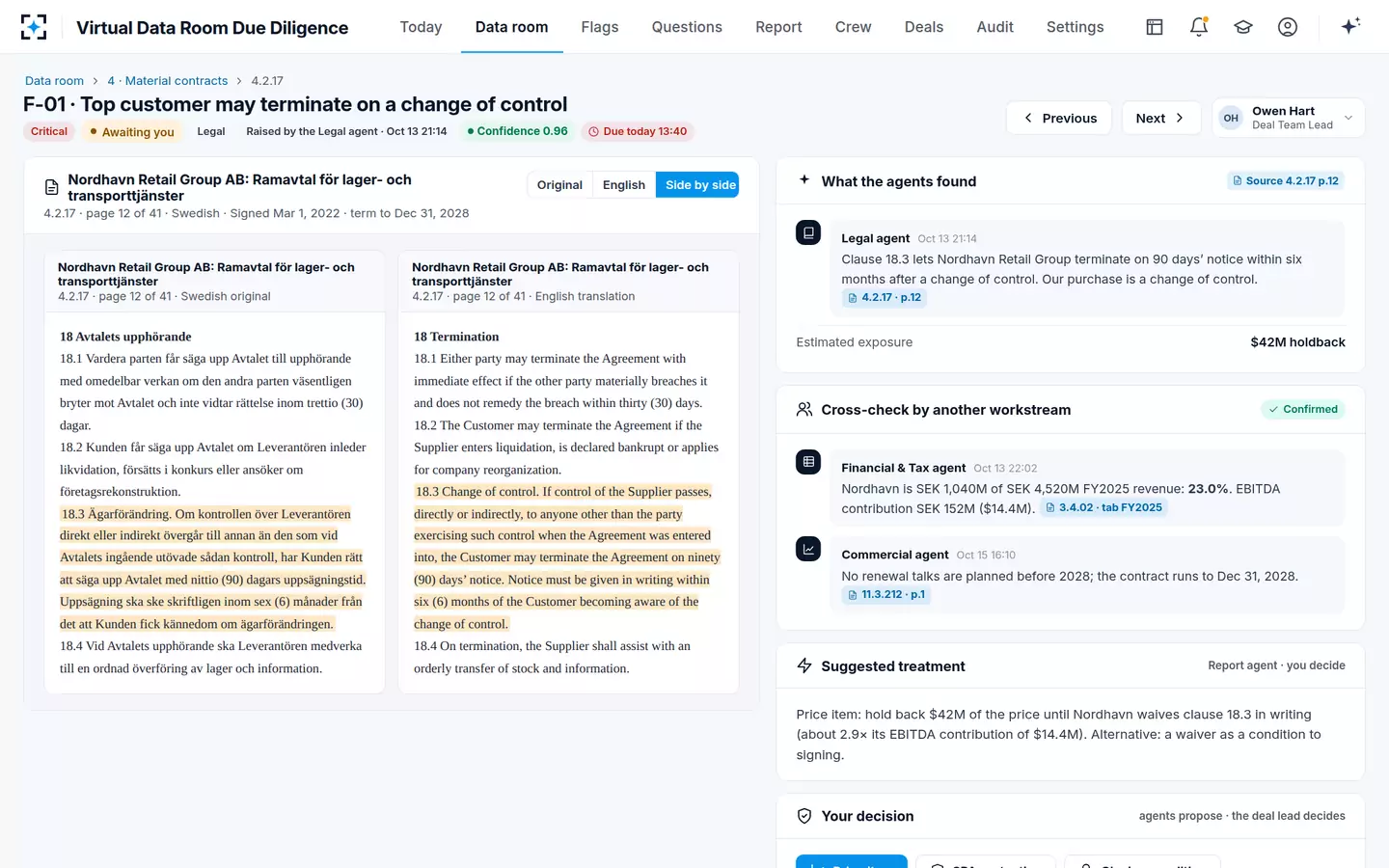
The defence is structural, not a promise of accuracy: every statement an agent makes must point to the page it came from, and the page must open. In the sample, the Legal agent's finding on the largest customer contract reads "Clause 18.3 lets Nordhavn Retail Group terminate on 90 days' notice within six months after a change of control", cited to folder 4.2.17, page 12; one click shows the Swedish original beside the English translation with the clause highlighted. A statement that cannot be traced to a page is not a finding, whoever made it.
A finding is only as good as the page it opens
The limits come first: what none of the eight agents may do
Set the limits before the capabilities: decide what each agent may never do, then let it do everything else quickly. In the sample, each of the eight agents has its limits written next to its job, and the steps that need judgement, deciding a flag, releasing a question and signing the report, belong to named people.
Eight agents and three people: who may do what in Virtual Data Room Due Diligence
Agent
Intake agentConnects to the seller’s room read-only, reads scans, detects language, translates, removes duplicates, watches for new files.
Never: mark a file read that it could not parse, or download outside the room’s rules
Agent
Legal agentReads contracts, corporate, financing, real estate, litigation and data protection files against the firm’s playbook.
Never: close a flag, or advise the seller
Agent
Financial & Tax agentReads the databook, revenue by customer, add-backs, working capital, tax audits and transfer pricing; sizes other workstreams’ flags.
Never: restate accounts; it flags only with a tie-out
Agent
Commercial agentReads customer and supplier contracts, pricing and renewals; recognises competitively sensitive pages.
Never: show customer-level pricing outside the clean team
Agent
ESG agentReads environmental surveys, permits, emissions, safety and human rights material.
Never: score a company without a cited source
Agent
HR agentReads employment contracts, collective agreements, contractors, pensions and key-person terms.
Never: read personal files beyond what the playbook names
A person decides
The deal team lead decides each flagPrice item, purchase agreement protection, closing condition, 100-day plan or reject, always with a reason code; critical flags never in bulk.
Agent
Questions agentDrafts seller questions from flags, merges duplicates, routes each to the adviser in scope, reads the answers.
Never: release a question
A person decides
The deal team lead releases questionsNothing reaches the seller unseen; advisers see only questions in their scope.
Agent
Report agentAssembles the cited red-flag report from decided flags and writes the coverage statement.
Never: include an undecided flag, or sign
A person decides
The deal lead signs; legal counsel co-signsTwo signatures on every version that goes to the investment committee.
Each limit answers a specific failure. An intake step that marks an unreadable scan as read hides a gap; one that refuses to is how the sample room ends up with 56 unread files, each explained. A legal agent that could close its own flags would let a hallucination dispose of a real issue. A questions agent that could release questions would let a draft reach the seller with a competitor's pricing in it. The limits are written in the settings, versioned, and on the audit trail, so they can be shown to a committee or an examiner rather than asserted.
Who is responsible for AI-reviewed contracts?
The firm that uses the AI, and within it the people who make the decisions. ESMA's statement on AI in investment services, written for retail services but stating a general principle, puts it plainly: the firm's management body answers for a decision whether a person or an AI tool took it (ESMA, 30 May 2024). The SEC's examination staff, setting their fiscal 2027 priorities, observe that firms are building what they call "super intelligence (SI)" into their businesses, and say they will check that the duties firms already owe are still met, whatever the technology (SEC Division of Examinations, FY2027 priorities, 23 October 2026; staff priorities, not a rule).
There is a second obligation: describe the tools honestly. When the SEC settled its first cases over false claims about AI, in March 2024, the chair warned advisers not to claim an AI model they were not in fact using (SEC press release 2024-36). A manager that tells investors its diligence is AI-assisted should be able to show what the AI did, and what people decided. In the sample, the audit trail records each agent action, each decision, and each change to an agent, such as an update to the Legal agent's version approved by compliance on 15 October.
Can AI read contracts in other languages?
Yes, and in a cross-border buyout that is often where it saves the most time, as long as a person who reads the original can check what matters. The sample room is 2,941 Swedish documents, 1,688 English, 342 Norwegian, 251 German, 164 Polish and 32 Danish; 3,730 needed translation and 3,712 had been translated a week in. Each finding is shown in the original beside the English translation, so a Swedish-speaking lawyer can check clause 18.3 in Swedish rather than trust a rendering of it.
No independent study publishes the accuracy of machine translation for deal contracts, so measure it yourself: on a past deal, have a lawyer who reads the language compare the translated version of the clauses that became flags with the originals, and record where the meaning shifted. That test takes an afternoon and tells you more than any vendor claim.
What to test before buying legal due diligence AI
Test any legal due diligence AI on a data room your firm has already reviewed, against the report your committee actually received: that is the only benchmark that predicts your next deal. Published benchmarks test research models or legal research tools, not deal-room review products, so they cannot rank the products you are choosing between.
Eight tests for legal due diligence AI, on one of your own past deals
- Does it find every flag your committee saw?
Run it on a closed deal’s room and compare with the report. A missed price item is a failed test; an extra flag is a question for your lawyers.
- Does every statement open its page?
Click ten findings at random. Each should open the passage, not the document, in the original language.
- What does it say about files it could not read?
Scans, passwords and late uploads should be listed by reason, never counted as read.
- Does a second workstream size each finding?
A clause should arrive with the revenue or cost behind it, and both citations.
- What happens when two readings disagree?
A threshold you set, and a person who decides with both readings shown, not an average.
- Who can decide, release and sign?
Ask to see the permission that stops an agent closing a flag, releasing a question or signing.
- Does it respect the clean team and the room’s rules?
Fenced pages stay with named people; nothing is downloaded that the seller’s rules forbid.
- How are changes to agents and models approved?
Versioned, approved by compliance, and on the audit trail with the reason.
The first test is the one most buyers skip, and it needs inputs only the firm has: a past room, its report, and the firm's own red-flag rules. What to assemble before a pilot is set out in what you bring to private equity due diligence software.
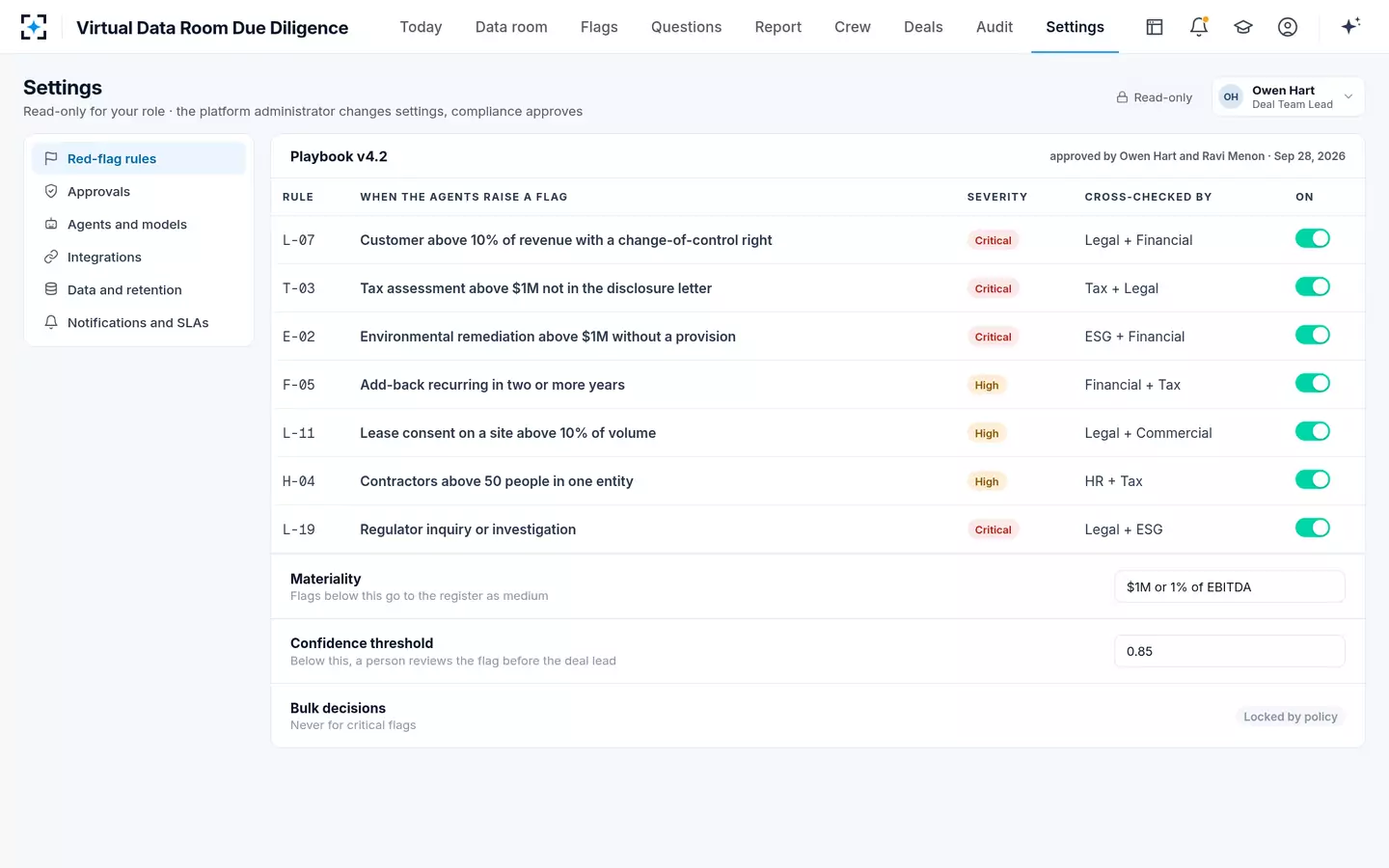
The red-flag rules, confidence threshold and bulk-decision lock, as settings
Where legal due diligence AI fits, and where it does not
It fits where volume, language and cross-referencing defeat people, and it does not fit where judgement, negotiation and responsibility live. The sample shows both sides: in 46 hours the agents had read the room and drafted a cited report; the treatment of the largest flag, a $42 million holdback, was the deal lead's decision, and the waiver it depends on is a negotiation with the seller.
What the agents take, and what stays with counsel and the deal team
The agents: Read every contract in every folder and language for the playbook’s clause types
Counsel and the deal team: Decide which clause types the playbook should contain
The agents: Quote the clause and cite the page, original beside translation
Counsel and the deal team: Interpret it under its governing law, and advise
The agents: Cross-check against the revenue, cost or exposure in another workstream
Counsel and the deal team: Decide whether the size moves price, protection, conditions or the plan
The agents: Draft questions, merge duplicates, read the answers
Counsel and the deal team: Release each question and negotiate the outcome
The agents: Assemble decided flags and write the coverage statement
Counsel and the deal team: Sign it, twice, and present it to the committee
It is also not a data room: it reads the seller's room through a read-only connection and keeps the room's rules. Proving how much of that room was read, folder by folder, is covered in data room due diligence coverage. To see the agents, their limits and the settings on the sample deal, start from Virtual Data Room Due Diligence.
Questions people ask
What is the best AI for legal due diligence?
The one that passes the tests above on a data room your firm has already reviewed. No published study compares deal-room review products; the benchmarks test research models or legal research tools. Ask each vendor to run your past deal and compare its flags with the report your committee received.
Will AI replace lawyers in due diligence?
The research supports replacing the finding, not the judging. The CUAD authors separate "contract analysis", which models can learn, from "counseling", which depends on the client's business and risk tolerance. In the sample, the agents read and cite; lawyers interpret, advise and co-sign the report.
Can ChatGPT do legal due diligence?
A general chatbot can summarise a contract you give it, but it does not connect to a data room, keep the seller's rules, cite every page or record who decided what. In the Magesh study, specialist legal tools hallucinated less than a general-purpose chatbot and still did so 17% to 33% of the time.
How long does AI take to review a data room?
On the fictional sample room of 5,418 documents and 61,240 pages in six languages, the first full read and first cited report were ready 46 hours after access. Translation, scans and late uploads all affect that time, which is why unread files are listed with their reasons rather than hidden.
Is it safe to put a seller's data room into an AI tool?
Only if the confidentiality agreement allows it and the tool keeps the room's rules. In the sample, the connection is read-only, nothing is downloaded outside the seller's rules, text stays in the region the firm chose, and seller material is destroyed within 30 days if the deal ends. Check your NDA's terms on service providers before any pilot.