A red flag report in due diligence is a short report on a target company that lists only the issues the buyer's review found to matter for the deal: those that should change the price, the protections written into the share purchase agreement, the conditions to closing, or the plan for the first 100 days. A full due diligence report describes the business; a red flag report tells the investment committee what to do about it. It is hard to write well because each outside adviser produces its own, findings arrive in different currencies and languages, and the issues that move the price sit between workstreams. Botminds' Virtual Data Room Due Diligence drafts the report from the deal lead's decisions on each flag, with every line cited to its page and a statement of how much of the data room was read.
Take a fictional sample deal through it: Quillfield Private Equity Fund V buying Skarvik Logistik AB, a Swedish contract-logistics company with SEK 4,520 million ($429 million) of revenue and SEK 680 million ($64.6 million) of adjusted EBITDA, at an indicative enterprise value of $708 million. The deal, the people and every figure about them are sample data, not a customer result.
The sample report the morning before it was signed
33
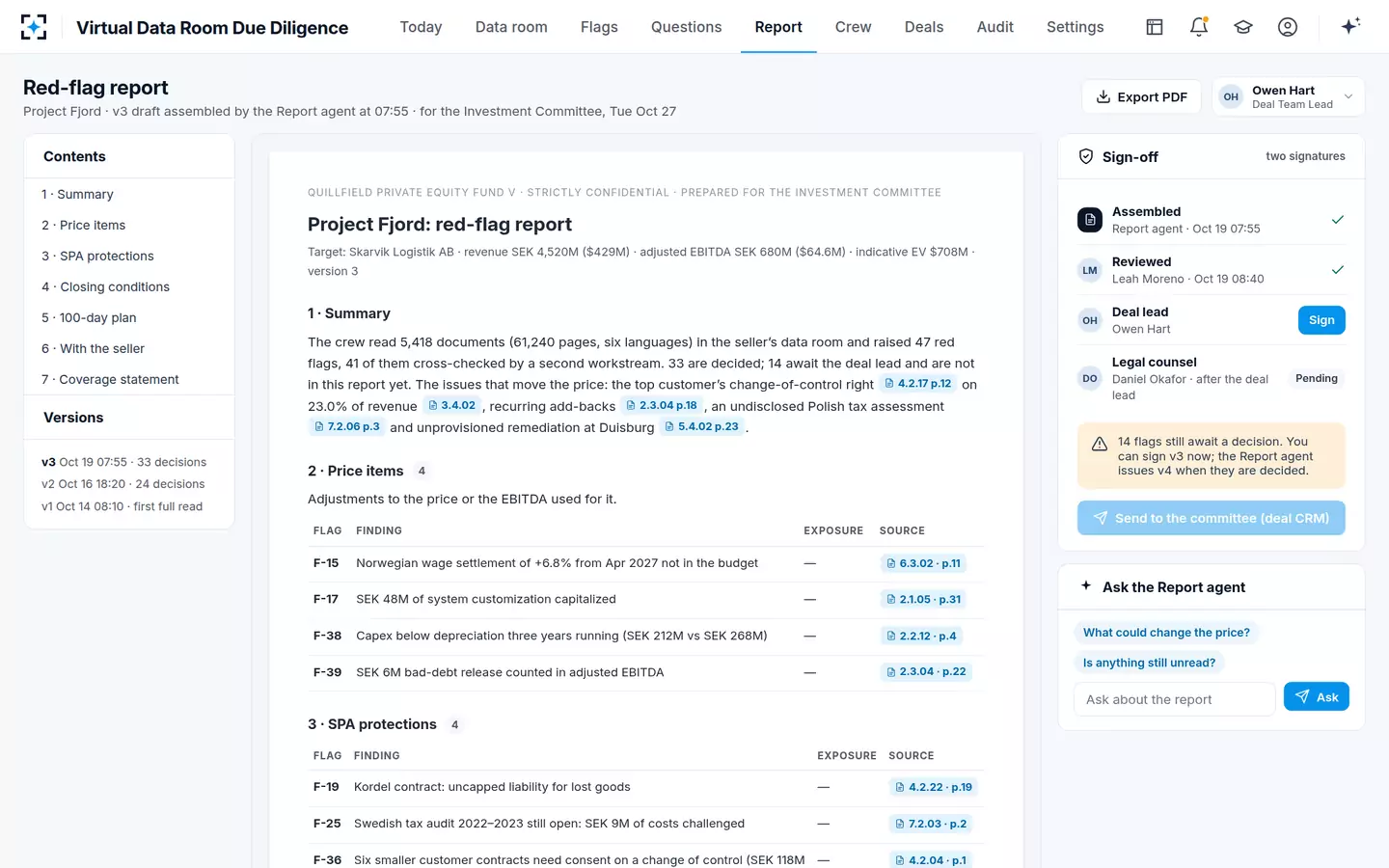
decided flags in version three, each in its section with a reason code
14
flags still awaiting the deal lead, kept out until decided
7
sections, from the summary to the coverage statement
2
signatures: the deal lead, then legal counsel, after the associate’s review
What is a red flag report in due diligence?
A red flag report is the decision document of diligence: a list of findings serious enough to act on, written for the people who approve the deal. The term is practitioners' shorthand rather than a defined legal one, and a Delaware court record shows how it is used in a real acquisition. In Fresenius Kabi's 2017 purchase of Akorn, the buyer's team "kept track of “red flag DD findings”", the trial record included a "Red Flag Tax Due Diligence Report", and after "just over two weeks" in the data room a presentation already identified a "preliminary red flag DD finding" under the heading of sales and marketing: "Risk to achieve forecasts due to stronger competition, especially for Ephedrine, Lidocaine ointment, clobetasol, Fluticasone" (Akorn v. Fresenius Kabi, Del. Ch., 1 October 2018).
Three things in that record are worth copying. The findings were tracked from the second week, not saved for the end. They were split by workstream, with tax producing its own red-flag report. And the preliminary finding named its products, which is what makes a flag testable. What it did not carry, as far as the opinion shows, was a size; the sections below are about adding one.
Red flag report vs full due diligence report: which does the committee need?
The committee needs the red flag report to decide, and the advisers' full reports stand behind it as evidence. A full report describes everything the adviser reviewed, finding or not; a red flag report leaves out what is in order and spends its pages on what is not. Its flags then feed the risks section of the committee's own paper, the part an investment committee memo template ties to its sources.
The red flag report and the full report do different jobs
Full due diligence report: What did the adviser find across the whole business?
Red flag report: What must change in the price, the agreement or the plan?
Full due diligence report: Every area reviewed, including what is in order
Red flag report: Only issues above the firm’s materiality line, each with a treatment
Full due diligence report: The deal team, and lenders or insurers who rely on it
Red flag report: The investment committee, and the negotiators of the purchase agreement
Full due diligence report: Each outside adviser, for its own scope
Red flag report: The deal team, from all workstreams, with advisers’ findings merged
Full due diligence report: At the end of the review
Red flag report: From the first full read, then version by version until signing
Full due diligence report: Usually a scope paragraph
Red flag report: A coverage statement: files read or explained, and what is still open
What goes in a red flag due diligence report?
A red flag due diligence report has seven parts: a summary, price items, purchase agreement protections, closing conditions, 100-day plan items, flags still with the seller, and a coverage statement. The four middle sections are the four things a buyer can do with a finding before signing: pay less, get protected, make it a condition, or fix it after closing. A finding that fits none of them is not a red flag; it is a note.
One section of the sample report, and what each part of a line is for
Project Fjord · red-flag report v3 · 2 Price items
F-01
Top customer may terminate on a change of control: 23.0% of FY2025 revenue
Treatment$42M holdback until a written waiver
Source4.2.17 p.12 · 3.4.02
F-15
Norwegian wage settlement of +6.8% from April 2027 not in the budget
TreatmentAdjust the price or the EBITDA used for it
Source6.3.02 p.11
F-17
SEK 48M of system customisation capitalised
TreatmentAdjust the price or the EBITDA used for it
Source2.1.05 p.31
- 1 · A size, not an adjectiveEvery price item carries the number that moves the price and the second page that sized it, here the revenue file.
- 2 · The decision is on the lineAccepted by the deal lead on 16 October with the reason code “cost increase not in budget”.
- 3 · One page per claimThe citation opens the original page, in the seller’s language, beside its English translation.
The summary is written last and is short: in the sample, one paragraph naming the four issues that move the price, each with its citation. The section on flags still with the seller is the honest part of the report. It lists what the buyer has asked and not been told, so a committee member can see that a clean section 3 does not mean the agreement is clean, only that its open questions are elsewhere.
Does it change the price, the protection or the conditions? The one test for a flag
A finding belongs in the red flag report if it changes what the buyer pays, what the agreement protects, what must happen before closing, or what must be done after it; otherwise it goes to a register. The line needs a number. In the sample firm's playbook, materiality is "$1M or 1% of EBITDA", and flags below it are logged as medium rather than reported. On a target with $64.6 million of adjusted EBITDA, 1% is about $0.65 million (our arithmetic).
The four outcomes are not interchangeable, and the reason is how purchase agreements allocate risk. The Court of Chancery put it directly in Akorn: "The identification of issues in due diligence thus does not simply lead to a binary go/no-go decision on the acquisition; it also affects how the parties use representations in the transaction agreement to allocate responsibility for those issues." A finding sized before signing can be priced or protected; the same finding discovered after signing has to fit a representation that may not have been drafted for it. Research on public acquirers points the same way: Wangerin describes due diligence as the last point at which a buyer can still renegotiate or pull out (Contemporary Accounting Research, 2019).
How to size a flag: from one clause to a number the committee can use
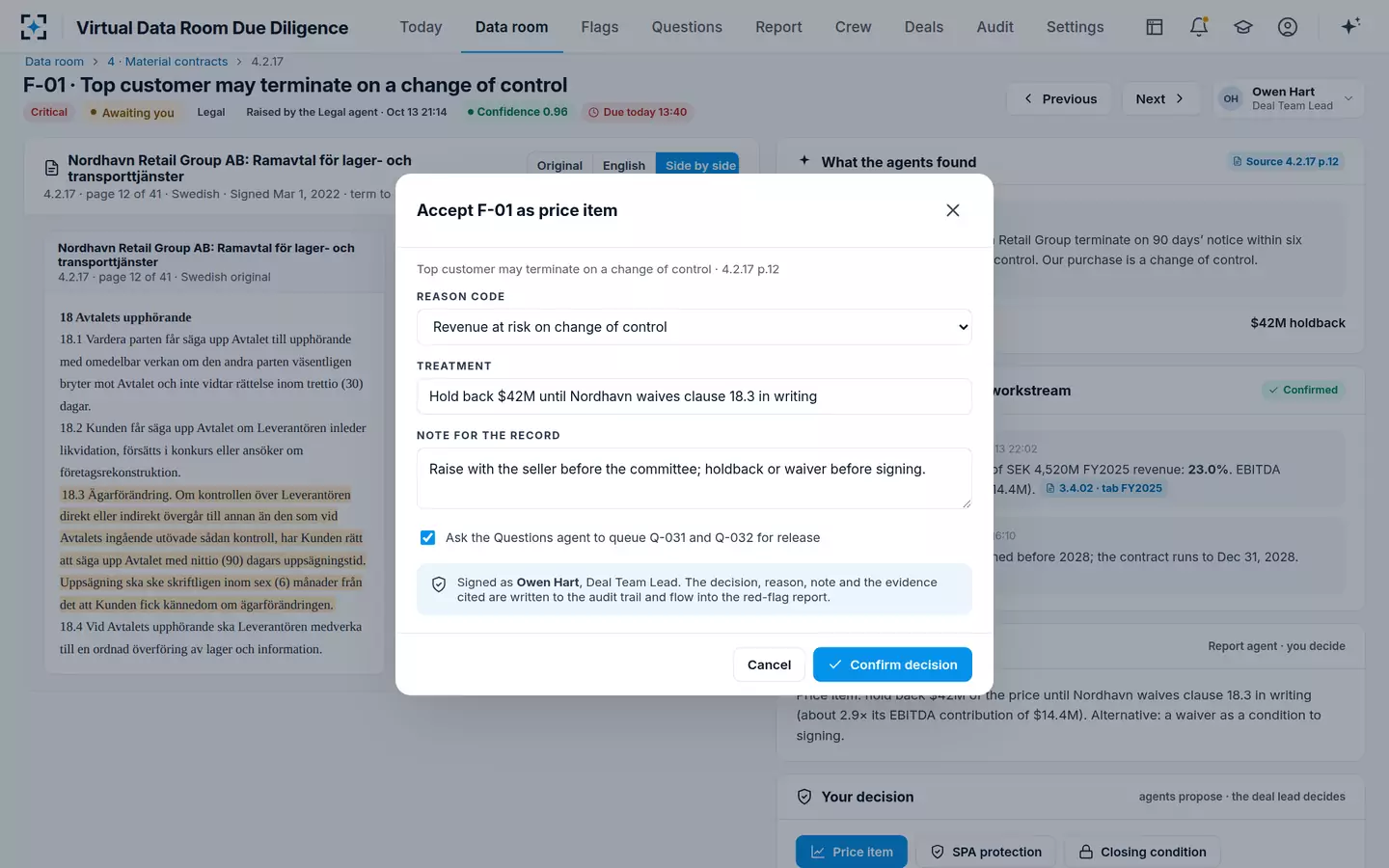
Size a flag by finding the second document that turns the finding into money, then stating the treatment in the same unit the committee prices in. On the sample deal, the legal reading found that clause 18.3 of the Nordhavn Retail Group agreement lets the customer terminate on 90 days' notice within six months of a change of control. The financial reading found that Nordhavn is SEK 1,040 million of SEK 4,520 million FY2025 revenue, 23.0%, with an EBITDA contribution of SEK 152 million ($14.4 million). The suggested treatment, a $42 million holdback until Nordhavn waives the clause in writing, is about 2.9 times that EBITDA contribution, with a waiver as a condition to signing as the alternative.
Six sample flags, from finding to section
| Flag | Finding | Decision | Reason given |
|---|---|---|---|
| F-01 | Top customer may terminate on a change of control (4.2.17, p.12); 23.0% of revenue | Price item: $42M holdback until a written waiver | Revenue at risk on change of control |
| F-15 | Norwegian wage settlement of +6.8% from April 2027 not in the budget (6.3.02, p.11) | Price item | Cost increase not in budget |
| F-28 | A finding the deal team had already priced (3.5.04, p.22) | Rejected | Already in the investment case |
| F-25 | Swedish tax audit for 2022–2023 still open: SEK 9M of costs challenged (7.2.03, p.2) | Purchase agreement protection | Open tax exposure |
| F-36 | Six smaller customer contracts need consent on a change of control: SEK 118M of revenue (4.2.04, p.1) | Purchase agreement protection | Consents outstanding |
| F-11 | SEK 118M of Q4 receivables sold under a non-recourse factoring line, left out of the net-debt bridge (2.4.03, p.9) | Open: the two agents disagree | Confidence 0.78, below the 0.85 threshold, so a person decides |
A rejected flag stays on file with its reason, which is the line that protects the deal lead later. When the committee asks why a known issue did not move the price, "already in the investment case", with the date and the person, is an answer; silence is not. The clause-level mechanics of the largest flag are worked through in the change of control clause and the revenue behind it.
Deciding a flag: the reason code and the treatment go into the report
Who writes the red flag report, and who signs it?
Each adviser writes the red flag findings for its own scope; the deal team writes the report the committee reads, and the deal lead signs it. That division matters because the advisers' reports, merged by hand, are where findings get lost or double-counted: two advisers can flag the same customer contract from different angles, and neither sees the other's number.
In the sample the merge is done from decisions rather than from documents. The agents raise flags; the deal lead decides each one; the Report agent assembles only decided flags into their sections; the associate reviews; the deal lead signs; legal counsel co-signs after him.
How the sample report is assembled and signed
Agent
Workstream agentsRaise each flag with its page, and a second workstream sizes it.
Never: close a flag
A person decides
Owen Hart, deal team leadDecides each flag: price item, protection, closing condition, 100-day plan or reject, with a reason code.
Agent
Report agentAssembles decided flags into their sections and writes the coverage statement.
Never: include an undecided flag, or sign
A person decides
Leah Moreno, deal associateReviews version three line by line against its citations.
A person decides
Owen Hart, then Daniel OkaforThe deal lead signs; legal counsel co-signs after him; the report goes to the committee.
The limits on the agents are the design, not a disclaimer. An agent that could include an undecided flag would let a report reach the committee carrying a judgement nobody made; one that could sign would remove the person the committee holds to account. How those limits are set for each agent, and what the research says about contract-reading accuracy, is the subject of legal due diligence AI and its limits.
What a red flag report must admit: what was not read, and what is still open
A red flag report should state what it does not cover, because a committee reads a short list of flags as a clean bill of health on everything else. The sample report ends with a coverage statement, "5,418 of 5,418 documents read or explained", and lists each unread file with its reason. Its section on flags with the seller lists the questions not yet answered.
The Akorn record shows the cost of a report that is silent on a risk. The court found that the final presentation to Fresenius's supervisory board "did not identify risks related to data integrity", the issue at the centre of the later dispute. Nothing in a report can surface a risk the reviewers could not see; but a report that says where the review stopped tells the committee where to ask. Measuring that, folder by folder, is the subject of proving how much of the data room was read.
The red-flag report with its sections, versions and sign-off
How long is a red flag report, and how often should it be reissued?
A red flag report is as long as its decided flags require; there is no standard length, and padding it with in-order findings defeats its purpose. The sample report has seven sections and 33 decided flags in version three. What matters more than length is cadence. A report issued once, at the end, gives the committee one look; a report reissued as decisions are made lets it see the picture form.
The sample report has three versions in five days: the first on 14 October at 08:10, 46 hours after access, with the first full read; the second on 16 October with 24 decisions; the third on 19 October with 33. Each is kept. The record-keeping rules give the reason. In the EU, a manager investing in illiquid assets after a negotiation must keep records of that diligence work for five years or more (Delegated Regulation 231/2013, Article 19(2)), and a US registered adviser keeps written communications about advice, given or proposed, for at least five years too (17 CFR 275.204-2). The earlier versions show what the committee knew and when.
A checklist before the report goes to the committee
Before the report is signed, the deal lead should be able to answer eight questions about it without opening another document. Each is a test of whether the committee can act on the report as written.
Eight tests a red flag report should pass before it is signed
- Every flag names its treatment
Price, protection, condition, 100-day plan, or rejected with a reason. A flag without one is unfinished.
- Every flag has a size
In the currency the committee prices in, with the page that sized it as well as the page that found it.
- Every line cites its page
Folder, document and page in the seller’s numbering, so the seller’s counsel can find it too.
- Undecided flags are listed, not included
A count of open flags and when the next version follows.
- Cross-workstream flags show both readings
And where readers disagree, who decided and why.
- The coverage statement is current
Files read or explained, as at a stated time, with unread files by reason.
- Questions to the seller are linked
Each open flag points to the question that will close it.
- Two people have signed
The person accountable for the deal and the person accountable for the legal reading.
A report that passes these tests can go to the committee with its open flags visible and its numbers traceable. To see the sample report built from decisions, open Virtual Data Room Due Diligence.
Questions people ask
What should a red flag report due diligence template include?
A summary, then one section for each thing a buyer can do with a finding: price items, purchase agreement protections, closing conditions and 100-day plan items. Add a section for questions still with the seller and a coverage statement. Each line should carry the finding, its size, its treatment, its source page and who decided it.
What is a red flag tax due diligence report?
It is the tax adviser's list of tax exposures serious enough to act on: open audits, assessments not disclosed, transfer-pricing positions and similar. The Akorn trial record cites one by that name. In the sample deal, an undisclosed PLN 14.2 million Polish transfer-pricing assessment and an open Swedish tax audit with SEK 9 million of costs challenged are the kind of items it holds.
What counts as a red flag in due diligence?
An issue above the buyer's materiality line that should change the price, the agreement, the conditions or the post-closing plan. Typical examples are a customer that can terminate on a change of control, add-backs that recur, an undisclosed tax assessment, unprovisioned remediation and a regulator's inquiry. The sample firm sets its line at $1 million or 1% of EBITDA.
Is a sell-side red flag report the same as a buyer's?
No. A seller commissions a vendor red flag report to find and fix issues before buyers see them, and its scope is the seller's choice. A buyer's report is written to price and protect the buyer, and the purchase agreement usually limits what the buyer may rely on to the agreement itself. The difference is set out in buy-side due diligence.
Who reads the red flag report?
The investment committee decides on it, and the people negotiating the purchase agreement use it to draft price adjustments, protections and conditions. Compliance may later need it to show what the firm knew before signing. That is why every line should be traceable to its page and its decision.