An investment committee memo template for a private equity buyout usually runs to about eleven sections: the executive summary and recommendation, the investment thesis, the company, the market, the financial analysis, returns and scenarios, financing, key risks, diligence status, the value creation and 100-day plan, and ESG and regulatory matters. The headings are the easy part. The IC memo is where a deal team turns its model, the confidential information memorandum (CIM) and a dozen diligence reports into a recommendation, and it fails when nobody can say where a number came from. A template earns its keep when each section also names its source and its owner. Botminds' Investment Committee Memo Drafting is built on that idea: its agents draft every section to the committee's own template, each figure tied to a model cell or a page, for the deal team to approve and sign.
The examples come from a fictional sample deal as it runs through the solution: Quillfield Capital Partners VI, a $6.8 billion fund, proposing to buy Selvira Medikal, a Turkish maker of IV sets, catheters and wound-care products, at an enterprise value of $415 million. The research is from regulators and peer-reviewed studies, linked where it is used.
What one final IC memo template has to hold
11
sections in the sample committee’s final memo template; its preliminary memo has 7
186
figures in the first full draft: 118 from model cells, 39 from CIM pages, 29 from diligence pages
67
venture investment analyses from 11 firms read in the classic study of what these memos contain
What should an investment committee memo template include?
It should include what the committee needs to decide and nothing it cannot check: the ask, the case for it, the evidence, the price and returns, what could go wrong, what is still unknown, and what the fund will do after closing. The most cited study of real investment memoranda found the same shape. Steven Kaplan and Per Strömberg read the internal analyses behind 67 venture investments at 11 firms and reported that "VCs consider the attractiveness and risks of the business, management, and deal terms as well as expected post-investment monitoring" (NBER Working Paper 8764, later Journal of Finance, 2004).
That sentence maps cleanly onto a buyout template. The business becomes the thesis, the company and the market. Management sits in the company section and, in a buyout, in the 100-day plan. Deal terms become returns, financing and the conditions. Monitoring becomes value creation. What the study adds is a warning: a later survey by Gompers, Gornall, Kaplan and Strebulaev, revisiting that work, noted that the memoranda "do not rank the importance of the different criteria" (NBER Working Paper 22587). A template that forces the deal team to put its reasons in order, strongest first, gives the committee something to argue with.
In Europe the content is partly a matter of law. A fund manager investing in assets of limited liquidity after a negotiation must, under Delegated Regulation (EU) No 231/2013, keep a business plan for the fund, weigh each transaction's risks together with its legal, tax, financial, people and exit factors, and finish its due diligence before execution (Article 19). Article 18(3) adds that a manager must "implement effective arrangements for ensuring that investment decisions on behalf of the AIFs are carried out in compliance with the objectives, the investment strategy and, where applicable, the risk limits of the AIF". A template with a mandate check and an exit section is one plain way to show both.
The eleven sections, each with its source and its owner
Every section below is written by the associate and approved by the deal lead; what differs is where its figures may come from and who must have cleared it. The point of naming the source is that a reader can tell a model output from a seller's claim from an adviser's finding without asking.
An investment committee memo template that names a source for every section
- 1. Executive summary and recommendation
The ask (equity cheque, enterprise value, entry multiple), base-case returns, conditions. Source: the other sections only; it introduces no new figure. Signed off by the deal partner.
- 2. Investment thesis
Three to five claims, strongest first, each with one figure and the page or cell behind it, and what would prove it wrong.
- 3. Company overview
History, products, plants, people, customers. Source: CIM and management presentation; anything the seller asserts is marked as the seller’s.
- 4. Market and competition
Size, growth, share, competitors. Source: commercial diligence, not the CIM, wherever the two differ.
- 5. Financial analysis
Reported and adjusted EBITDA, margins, capex, cash conversion, working capital. Source: the quality of earnings report and the model; every adjustment the QoE adviser did not accept is listed.
- 6. Returns and scenarios
Gross IRR and multiple for base, upside, downside and every stress case the IC policy requires. Source: named model cells, one row per case.
- 7. Financing and capital structure
Sources and uses, leverage, pricing, covenants and headroom. Source: lender term sheet and the model’s debt tab.
- 8. Key risks and mitigants
Each risk sized, paired with a mitigant and the diligence finding it comes from. Owner: deal lead; legal and tax risks reviewed by counsel.
- 9. Diligence status
Every workstream, final or draft, with what is still outstanding and when. A draft report is a condition, not a finding.
- 10. Value creation and 100-day plan
The initiatives the returns depend on, each with a value, a date and a named owner.
- 11. ESG and regulatory
Permits, product certifications, exclusions in the fund documents. Cleared against the fund’s limits and the conflicts check by compliance.
Two rules make the list work. A figure appears once, in the section that owns it, and other sections refer to it rather than retype it. And the executive summary is written last, from approved sections, so it can never say something the body does not. Who drafts, who approves and who signs each part is the subject of how a private equity deal team divides the IC memo.
What goes in the investment thesis section?
The investment thesis is three to five claims about why this business, at this price, will return the fund's target, each specific enough to be wrong. A thesis that says "market leader in an attractive sector" gives the committee nothing to test. One that names a figure, its source and the event that would disprove it gives every member the same three questions to ask.
Three thesis claims, each with its figure, its source and what would break it
EU-certified capacity at Turkish cost
Figure3 of 4 product families certified; EU export revenue +14.8% a year, 2022–2025
SourceRegulatory diligence; the CIM for the growth rate
What would break itThe fourth family fails its EU device audit, due in the second quarter of 2027
The second-largest producer in a growing market
FigureTurkish hospital consumables $1.9B in 2025, +9.2% a year in dollars; 14% share
SourceCommercial diligence p. 11
What would break itShare falls at the next public-hospital tender round
A plant program the fund can run
Figure$6.3M a year saved by 2028 from moving catheter lines to Manisa; 18 of 20 customers would re-tender
SourceDeal model; commercial diligence p. 52
What would break itNo named owner for the move in the first 100 days
The third claim shows why the last column matters. The saving is a model output, and customers' willingness to stay is a diligence finding. Neither proves the plant move will happen, and in the sample a committee member who has asked about plant programmes on four earlier deals wants an owner's name. A thesis written with its breaking point attached sends the deal team to find that name before the meeting.
How should the returns and scenarios section be built?
Build it the way committees actually judge deals: gross IRR and multiple of money for each case, the entry and exit multiples beside them, and a plain statement of whose forecast the base case uses. Gompers, Kaplan and Mukharlyamov's survey of 79 private equity investors with combined assets over $750 billion found that most rely on gross IRR and money multiples, that more than seven in ten also use comparable-company multiples, and that fewer than one in five use a discounted cash flow (Journal of Financial Economics, 2016).
The same survey found that the 44 investors who answered the question cut management's forecasts by a median of 20% (working paper text). The template should therefore show the management case and the deal team's case side by side, or say which one the returns use. A committee that cannot see the haircut cannot judge it.
Returns and scenarios: one row per case, each tied to its cells
| Case | What it assumes | Gross IRR | Gross multiple | Model cells |
|---|---|---|---|---|
| Base | Exit at 9.0x in 2031, $742M enterprise value | 21.4% | 2.6x | Returns!C12:C13 |
| Upside | EU volume 4% a year higher | 27.6% | 3.2x | Returns!D12:D13 |
| Downside | Tender prices 8% lower, exit at 8.0x | 12.8% | 1.7x | Returns!E12:E13 |
| Currency | Lira 30% weaker against the dollar from January 2027 | 17.9% | 2.2x | FX_Case!F42:F43 |
The last column is what turns a table into evidence. When the model changes, each row can be re-read from its cells, and a reader can see that the currency case lives on its own tab rather than in a hand-edited copy of the base case. The five checks that show every figure in a memo is tied begin with this table.
What goes in the key risks section of an IC memo?
Each key risk should be sized, paired with a mitigant that changes the deal (a price, a structure, a condition or an owner) and traced to the diligence finding it came from. A list of generic risks, such as "macroeconomic conditions" or "key person", tells the committee the deal team has read a textbook, not the data room.
In the sample, three risks show the pattern. Revenue is 59% in Turkish lira, so the mitigant is a hedge on half of lira-denominated EBITDA for 24 months, and the currency case shows what is left. Public hospitals owe TRY 1,248.6 million at 148 days, so the working capital peg is set at 23% of revenue. A former distributor claims TRY 41.6 million in a pending court case, about $0.9 million at the day's rate, so the memo proposes a specific indemnity. Each line names a page in a diligence report; each mitigant is something the committee can approve or refuse.
The risks section is also where the template should catch what the deal team has not put in. In the sample data room, one finding never reached the draft at all: the contract of the director of the plant at the centre of the value-creation plan ends on March 31, 2027. A template that lists every high and medium finding beside the section that uses it makes the gap visible before a member finds it.
How long is an IC memo?
No regulator or independent study sets a length, and committees differ. The sample's final memo runs to 38 pages; its preliminary memo, written to ask for a diligence budget, has seven sections rather than eleven. A better measure of size is the count of figures a reader has to trust: 186 in the sample's first full draft and 190 once a currency case was added. Every one of them is a place where the memo and the model can disagree.
Length grows in predictable places: a financial analysis that reproduces the quality of earnings report instead of citing it, and appendices of model tabs that duplicate the returns table. Cutting those does not lose evidence if each figure that remains opens its source; the financial section can cite the quality of earnings report section by section instead of copying it.
Preliminary vs final IC memo: two templates, not one
The preliminary memo asks for permission to spend money on diligence; the final memo asks for the capital. They need different templates because they answer different questions, and because a committee sees many more of the first. In the Gompers, Kaplan and Mukharlyamov survey, the average firm took 61.8 of every 100 opportunities it considered to a review with the partner group or investment committee, 23.7 to deep diligence and closed 6.1 (Table 19, working paper text). Most of what a committee reads, in other words, is early.
One firm, four memo templates: the sections follow the decision
| Committee and memo | Sections | What it asks the committee to decide |
|---|---|---|
| Private equity, preliminary | 7 | Whether to spend on full diligence and an exclusivity period |
| Private equity, final | 11 | Whether to commit the equity, and on what conditions |
| Credit committee, final | 9 | Whether to lend, at what terms and with which covenants |
| Real assets, final | 10 | Whether to buy the asset, with its operating and capital plan |
Credit memos for a lending committee are a different document with their own conventions; a commercial credit memo, section by section covers that side.
A format or a checklist: what changes when each section names its source
A template that is only a format tells the associate what to write. A template that is a checklist tells the committee what it can rely on. The difference shows on the night the model changes, in the questions the committee sends back, and in what the firm can produce later.
The same investment committee memo template, used as a format and as a checklist
Template as a format: Typed into a table from the model; its cell is in the associate’s head.
Template as a checklist: Tied to a model cell, CIM page or diligence page, and opened with a click.
Template as a format: Someone re-reads the memo and hopes to spot the numbers that moved.
Template as a checklist: A list of each memo figure the new version touched, old value and new.
Template as a format: Summarised, sometimes through a translator’s note.
Template as a checklist: Cited to its page in the original language, or flagged as missing from the memo.
Template as a format: An email saying “looks good”.
Template as a checklist: Each section approved with a reason, by someone other than the person who drafted it.
Template as a format: Final PDF in a shared drive; earlier versions where they fell.
Template as a checklist: Every version, with the model version it was signed against.
How Investment Committee Memo Drafting fills the template
In the solution each committee's template is a setting: the sample firm keeps four, as above. The Drafting agent writes each section to that template from the model, the CIM and the diligence findings, in the house style it learned from past memos, and never writes a figure without a source. The Checker agent re-verifies every figure when a new model version is saved, and blocks approval while any is stale. The Mandate agent tests the deal against the fund's limits and the IC policy's required scenarios, which is how a missing currency case surfaces before the committee asks for it.
The template, filled: every figure coloured by where it came from
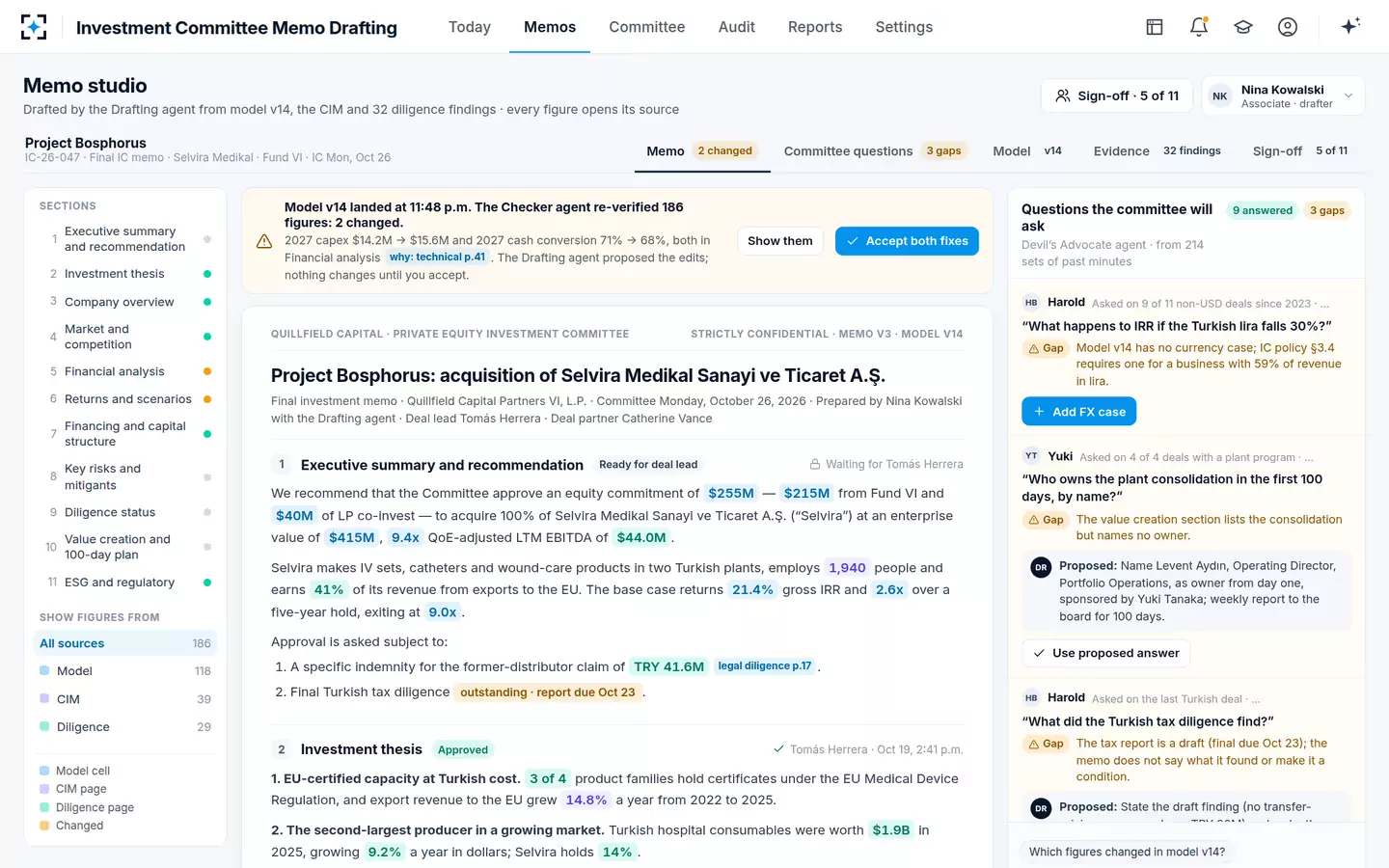
Its limits are part of the design. The solution does not choose the thesis or decide the price; the associate edits, the deal lead approves each section with a reason, and the partner signs. And the template stays the firm's: changing a section or a required scenario is a new version that compliance approves, so a memo signed under last year's rules keeps them. To see an example of a complete summary built this way, read the annotated investment committee memo example.
Questions people ask
What is the format of an investment memo for a committee?
A short executive summary with the recommendation and conditions, then the evidence in a fixed order: thesis, company, market, financials, returns, financing, risks, diligence status and the post-closing plan. Most firms write it as a document with tables rather than slides, because each figure needs a source and each section an approver. The order matters less than keeping it the same on every deal, so members know where to look.
Is there a standard investment committee memo template?
No regulator prescribes one. In the EU, Delegated Regulation 231/2013 sets out what a manager must assess before buying an illiquid asset, including the business plan, the transaction's risks and the exit, but not how the memo is laid out. Each committee keeps its own template, and many firms keep separate ones for preliminary and final memos.
Should the deal model be attached to the IC memo?
Usually an extract is: the returns, sources and uses, and any stress case the policy requires. The whole model is rarely read by members. What matters more is that every memo figure names the cell it came from and the model version the memo was signed against, so the extract and the memo cannot drift apart.
Who fills in the investment committee memo template?
The associate drafts it, the vice president or deal lead reviews and approves each section, and the deal partner signs and presents it. Compliance clears conflicts and the fund's limits before it goes out. With drafting agents, the associate's role moves from typing tables to editing and checking.
How is an IC memo different from an equity research investment memo?
An IC memo asks a committee to commit a fund's capital to one private company and carries the diligence, financing and conditions that decision needs. A research analyst's investment memo argues a view on a listed security for a portfolio manager. The second has its own template and record-keeping concerns, set out in an investment memo template written so “why did we?” has an answer.