You can write a memo with AI, and for ordinary professional writing the evidence is strong: in a preregistered experiment with 453 college-educated professionals, those given ChatGPT finished their writing tasks 40% faster and their output was rated 18% better (Noy and Zhang, Science, 2023). An investment committee memo is a harder case, because the writing is the smaller part of it. Most of the hours go into pulling figures out of the deal model, reading diligence reports, re-checking numbers after each model change and anticipating the committee's questions; the associate builds every table by hand from the model before writing a sentence. Those are the hours worth giving to AI, with checks, and the argument is the part to keep. Botminds' Investment Committee Memo Drafting is designed around that split: agents assemble, cite and check; the deal team writes the judgement and signs.
The hour figures on this page are our estimate for a first full draft of a final buyout memo, using a fictional sample deal in the solution; no regulator or independent study publishes how long an IC memo takes. The research figures are linked where they appear.
What the experiments say about writing with AI
40%
less time on professional writing tasks with ChatGPT, 453 professionals
18%
higher rated quality of the same writing
19%
less likely to reach a correct answer on a task outside the AI’s abilities, 758 knowledge workers
Can I write a memo with AI?
Yes, for the writing; no, for the parts of an investment memo that are not writing, unless the tool works from your sources and something independent checks it. A general assistant will turn notes into a clear business memo in minutes, and the research says the result is usually better than a rushed human draft. An IC memo is a different document: it is 186 figures in the sample, each from a model cell, a CIM page or a diligence page, wrapped in an argument. A tool that writes beautifully but cannot say where a number came from has done the easy part.
So the useful question is not whether AI can write the memo but which of the associate's tasks it should take, and how its work is checked. The rest of this page answers that with hours.
What the experiments found about AI and writing
The best-controlled evidence is clear that AI speeds up and improves routine professional writing. Noy and Zhang assigned occupation-specific writing tasks to professionals and randomly gave half of them ChatGPT. Those with the tool finished their tasks 40% faster on average, and graders rated their output 18% better (Noy and Zhang, Science, 2023).
They also found that "Inequality between workers decreased": the weaker writers gained most. For a deal team that is a double-edged result. It means a junior associate's first draft improves fastest with AI, and it means the fluency of a draft says less than it used to about how much thought went into it. A committee should judge an AI-assisted memo by its sources, because its prose will be uniformly good.
Where AI made skilled people worse
On tasks beyond the tool's abilities, people using it did worse than people without it. In the experiment by Dell'Acqua and colleagues with 758 knowledge workers at a global consulting firm, people using GPT-4 on 18 realistic tasks within its abilities completed 12.2% more tasks, 25.1% more quickly, with better quality; but on a task chosen to fall outside them, "subjects using AI were 19% less likely to produce correct solutions compared with those without AI" (Harvard Business School working paper, published in Organization Science, 2026). The authors call the boundary a jagged frontier, because tasks of similar apparent difficulty fall on different sides of it.
An IC memo straddles that frontier. Assembling a returns table from labelled model cells, citing a page or drafting a company overview from the CIM sits well inside. Judging whether an exit multiple is defensible, or noticing that the director of the plant at the centre of the value-creation plan has a contract ending in March 2027, sits outside or near the edge. The design response is to give the AI the inside tasks with mechanical checks, and to keep people on the outside ones.
How long does it take to write an IC memo?
No regulator or independent study publishes a figure, and anyone quoting one is usually quoting a vendor. Our estimate for a first full draft of a final buyout memo of the sample's size, written by hand, is about 60 associate hours, or seven and a half working days. That excludes the deal lead's and partner's review time, and the preliminary memo written weeks earlier.
Your own figure is easy to get and worth more than ours. Ask one associate to log, for one memo, every hour against six headings: pulling figures into tables, reading diligence, writing sections, re-checking after model changes, anticipating questions, and approvals and the committee papers. Two memos are enough to see the shape.
Where the associate's hours go, task by task
In our estimate, writing takes about a sixth of the hours. The largest blocks are pulling figures out of the model and reading the diligence reports, and the most frustrating is re-checking the memo every time the model changes.
Where an associate's 60 hours on one IC memo go, by hand
Two of the six rows are almost entirely mechanical: pulling figures and re-checking them. Together they are 24 hours, two-fifths of the total, and they are the rows where a copy-paste error enters the memo. Reading diligence is a mix: finding the page that matters is mechanical, deciding what it means is not. Writing and anticipating questions are where the associate's judgement lives, and they are also where a good draft and a good rehearsal save the most rework later.
What part of a memo can AI write?
AI should take the assembly: tables from model cells, citations, first drafts of descriptive sections, findings with their pages, and the re-check after every model change. People should keep the argument: the thesis, the judgement on price and risk, the choice of conditions and the decision to sign. The split below shows what that does to the hours in our estimate.
The same memo, by hand and with agents: where the remaining hours sit
By hand, about 60 hours
- Figures, re-checks and approvals · 46.7%
- Reading diligence · 23.3%
- Writing and the committee’s questions · 30%
With agents, about 11 hours
- Figures, re-checks and approvals · 22.2%
- Reading diligence · 29.6%
- Writing and the committee’s questions · 48.1%
The second bar is the point of the exercise. Of the roughly eleven hours left, almost four-fifths are reading diligence findings, editing the argument and closing the committee's likely gaps, which is the work an associate is hired to learn. In the sample, closing one gap meant adding a currency case to the model, not writing a paragraph. How those roles shift for the vice president and partner too is set out in who drafts, approves and signs the IC memo now.
The associate's morning: what needs her, not what needs typing
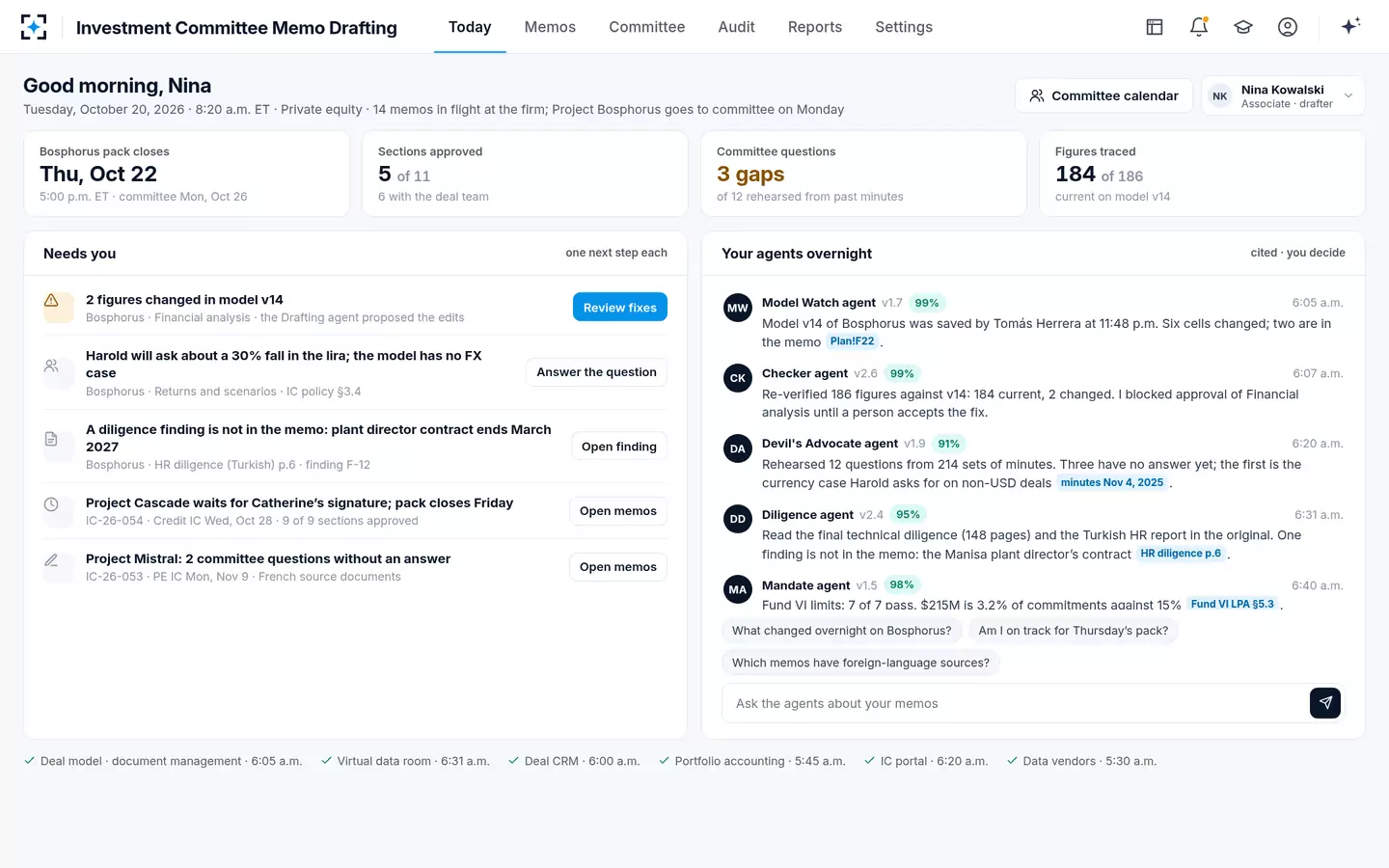
What the hours cost
At public wage data, the mechanical hours in one memo cost a few thousand dollars of associate time, and far more in what they displace. Official statistics have no category for private equity associates; the closest is financial and investment analysts, whose median pay in securities, commodity contracts and other financial investments was $124,370 in May 2025 (BLS Occupational Outlook Handbook). That excludes bonuses and overheads, so it understates the cost to a firm.
Pricing one IC memo's hours from public wage data
| Line | Calculation | Result |
|---|---|---|
| Hourly wage at the median | $124,370 ÷ 2,080 hours | $59.79 |
| First draft by hand | 60 hours × $59.79 | $3,587 |
| First draft with agents | 10.8 hours × $59.79 | $646 |
| Associate time released per memo | $3,587 − $646 | $2,941 |
| Memos a committee reads per closed deal | 61.8 reviewed ÷ 6.1 closed, per 100 opportunities | about 10 |
The wage line is the smallest part of the cost. The larger part is what the hours displace: the associate's Sunday night before a model deadline is not spent thinking about the deal, and the memo that goes back to committee for missing analysis costs the deal team a week. Neither shows up in a wage calculation, and both are why firms look at drafting tools at all.
When a general assistant is enough, and when it is not
A general assistant is enough when the memo is short, the figures are few and you can check each one yourself: a one-page note to a partner on a teaser, a summary of a call, a first outline of a thesis. It stops being enough when three things are true at once, which is the normal state of a final IC memo: the figures run into the hundreds, they come from a model that keeps changing, and the papers will be read by people who vote on a fund's capital.
The tests that separate the two are practical. Can the tool open the deal model in your document management system, and see each saved version? Can it read the data room's reports in their original language and cite the page? Does something other than the drafting model check every figure, and does a stale figure stop the memo from being approved? Can it draft to each of your committees' templates, in your house style? And does it keep a record of which agent drafted what and which person approved it? A general assistant answers no to most of these by design, because it was built to write, not to keep a memo true.
Investment Committee Memo Drafting is built for the second case, and it has limits worth stating. It does not decide the thesis or the price. It works from the firm's own systems (the model, the data room, the deal CRM, portfolio accounting, the committee portal and the compliance system) and is only as complete as what those hold. And its hour savings are our estimate on sample data until a firm measures its own; the honest way to evaluate it is to redraft a closed deal and compare the result with the memo your committee saw, figure by figure.
Is it safe to use ChatGPT for an investment memo?
Not with deal documents, unless your compliance team has approved the tool and the data handling. A CIM and a data room usually arrive under a confidentiality agreement with the seller, and they can contain material nonpublic information about the company or a listed party. Section 204A of the Investment Advisers Act requires every registered adviser to have, and enforce, written policies aimed at stopping that information from being misused (15 U.S.C. 80b-4a). Pasting a CIM into a consumer chat window sits badly with both.
The second risk is quality, not confidentiality: a general assistant has no access to the model and no way to check its own figures. Using one to polish a paragraph of the thesis is a different act from using one to produce the returns section. If a firm allows the first, it should say so in writing and forbid the second. Why a drafting model must not check itself sets out the research behind that line.
How do you check an AI-written memo?
Check it against its sources, not against your sense of whether it reads well. Every figure should open the cell or page it came from; every derived figure should recompute; every figure should be current on the latest model version; every sentence that makes a factual claim should carry a source; and every material diligence finding should have a place in the memo or be flagged as missing. Those five checks are mechanical, so they can run on every version, and they leave the reviewer's time for the argument. Each is defined, with how to report it, in five measures for every figure in an investment committee memo.
Questions people ask
Does AI make writing faster?
For routine professional writing, yes: in Noy and Zhang's experiment, time fell by 40% and rated quality rose by 18%. For tasks beyond the tool's abilities, the same kind of experiment found people using AI were 19% less likely to be correct. The gain depends on which side of that line the task falls.
Which part of an IC memo should never be delegated to AI?
The recommendation and the judgement behind it: whether the price is right, which risks are acceptable, which conditions to require. AI can draft each of those for a person to edit, but the decision and the signature belong to the deal team and the committee.
Can AI write the investment thesis?
It can draft one from the model and the diligence findings, with each claim's figure cited. Whether the claims are the right ones, and in the right order, is the deal team's call. A drafted thesis is useful mostly as something to disagree with quickly.
Which AI is best for writing investment memos?
No independent comparison of tools on investment committee memos has been published. Test candidates on your own closed deals: give each the sources your team had, and measure whether every figure ties, whether derived figures recompute and what each draft left out. The tool that passes those checks matters more than the one that writes best.
How much associate time can AI save on one memo?
In our estimate for a buyout memo like the sample's, a first full draft falls from about 60 associate hours to about 11, most of the saving in pulling figures and re-checking them. That is an estimate, not a measured result; log one memo's hours by task before and after to get your own.