An investment committee memo is the document a private equity deal team writes to ask its investment committee to commit a fund's capital to a deal, and its accuracy is the accuracy of a few hundred figures drawn from the deal model, the confidential information memorandum (CIM) and the diligence reports. Rereading cannot establish it: a reader confirms the figures that look right and misses the one that moved last night. Five measures can, because each counts something specific: figures tied to a source, figures current on the latest model version, derived figures that recompute, factual sentences that carry a source, and material diligence findings that reached the memo. Botminds' Investment Committee Memo Drafting is built to tie every figure to a model cell or a page and to run these checks on every version, so a committee chair can ask for five numbers instead of a reassurance.
The examples come from a fictional sample deal in the solution: Quillfield Capital's Project Bosphorus, a $415 million buyout of a Turkish medical-device maker, whose final memo held 186 figures in its first draft and 190 when it was signed.
One investment committee memo, measured
186
figures in the first full draft, each tied to a model cell, a CIM page or a diligence page
2
stale after one late model save: capital expenditure and cash conversion for 2027
1 of 32
diligence findings with no place in the draft, flagged before anyone approved it
100%
of figures tied and re-checked on every model version: the solution’s design target
What is an investment committee memo, and why is it hard to get right?
It is the written case for an investment, addressed to the committee that can approve it: a recommendation, the thesis, the company and market, the financial analysis, returns and scenarios, financing, key risks, diligence status and the plan after closing. Some firms call it an investment committee memorandum or paper. In the sample firm's private equity template a final memo has eleven sections, and a shorter preliminary memo comes earlier. Each figure in it belongs to one of three sources: the model (118 in the sample's first draft), the CIM (39) or a diligence report (29).
That mix explains why accuracy is hard. The CIM is the seller's document, the diligence reports arrive as drafts and finals, and the model changes until the papers go out; the sample's went through four versions in eleven days. The memo has to be right against all three at the moment it is signed. An annotated example of the memo's executive summary shows what that looks like figure by figure.
Why "is the memo right?" is the wrong question
Because it has no answer anyone can check. A deal lead who says yes has reread the memo and found nothing wrong, which is evidence about the deal lead's evening, not about the memo. Reading is especially poor at finding the errors that matter in a memo: a figure that was right yesterday, a ratio whose inputs changed, a finding that was never included. None of those looks wrong on the page.
Drafting with AI raises the stakes. Fluent text is now cheap, and ESMA has warned investment firms that with generative tools invented content can turn into misleading advice, with risks nobody expected or chances missed (ESMA public statement, May 30, 2024; written for retail investment services). The answer is not to read harder. It is to replace the question with counts that a machine can produce and a person can judge.
Five measures of investment committee memo accuracy, each with its formula
1Tied
figures tied to a model cell, CIM page or diligence page ÷ all figures
Sample 186 of 186 on the first draft
Catches A number typed into a table with no source behind it
2Current
figures whose source still holds the memo’s value on the latest model version ÷ all figures
Sample 184 of 186 on version 14; 190 of 190 on version 15
Catches A figure the last model save moved, still in the memo
3Recomputed
derived figures that match their inputs at display rounding ÷ derived figures
Sample Every multiple, margin and share recomputed on each version
Catches A ratio that no longer follows from its own inputs
4Sourced
factual sentences carrying no source
Sample Target zero
Catches A claim about the market or the company that nobody can check
5Complete
material diligence findings with no place in the memo
Sample 1 of 32 findings, flagged on the morning it was read
Catches A risk the data room holds and the committee never sees
Measure one: is every figure tied to a cell or a page?
Count the figures in the memo that open their source, and divide by all the figures. A figure is tied when a reader can go from the number to the model cell, the CIM page or the diligence page it came from in one step, and see the same value there. Everything else on this page depends on this measure, because a figure with no source cannot be re-checked, recomputed or reported.
In the sample all 186 figures in the first draft were tied: the Drafting agent never writes a figure without a source. The breakdown matters as much as the total. A memo with many CIM figures is leaning on the seller's own account; in the sample, the growth rate behind the first thesis claim, EU export revenue up 14.8% a year, came from the CIM rather than diligence, which a reader could see by its colour. A tied figure is not necessarily a verified one. It is one that can be.
What is a stale figure?
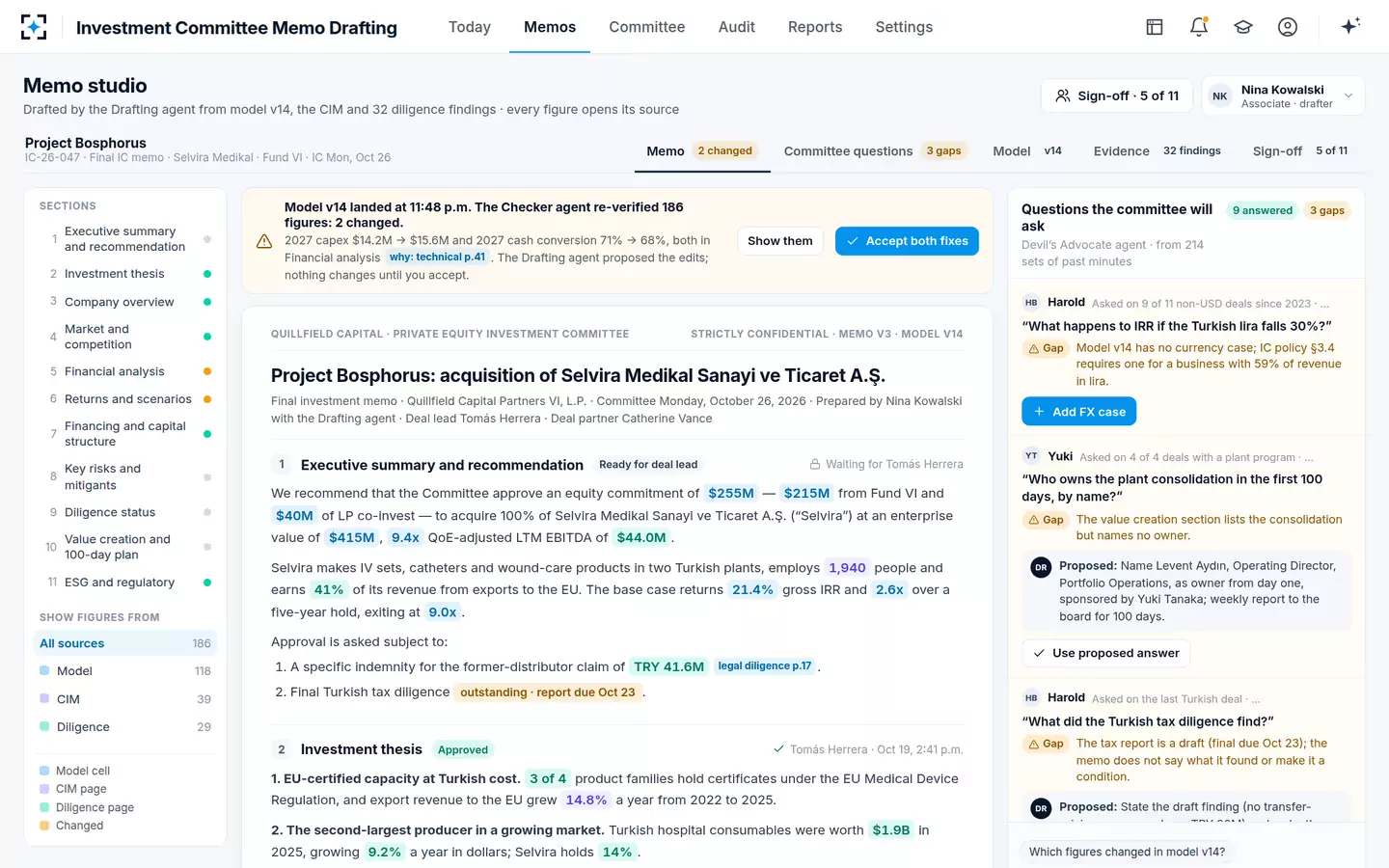
A stale figure is one whose source has changed since the memo was written: the model cell now holds a different value, or a draft report has been replaced by a final one with a different number. Measure two counts figures that are current on the latest version of every source, and the count that matters is the stale ones. In the sample, a model version saved at 11:48 p.m. left 2 of 186 figures stale; the Checker agent re-verified all 186 by 6:07 a.m. and blocked approval of the affected section until a person accepted the fixes.
The rule that makes this measure useful is a block, not a warning. In the sample firm's settings, a stale figure blocks approval and signature until a person accepts the fix, and the partner signs against a named model version: memo version 5 against model version 15. Without the block, a stale count is a report someone reads after the papers have gone out. The night it happened is told in the private equity investment memo the night the model changed.
Measure three: do derived figures recompute?
Every multiple, margin, percentage and sum in the memo should follow from its inputs, and measure three checks that they still do. Derived figures are where copy-paste memos fail quietly: the deal team updates capital expenditure and the cash conversion two rows down keeps its old value. They are also where language models are weakest; the FinQA benchmark found pre-trained models far behind financial experts on multi-step numerical reasoning over company reports (Chen and co-authors, EMNLP 2021). The fix is to compute, not to read.
Six derived figures from the sample memo, recomputed from their inputs
| Figure in the memo | Inputs | Recomputed | Matches at display rounding |
|---|---|---|---|
| Entry multiple 9.4x | $415M enterprise value ÷ $44.0M QoE-adjusted EBITDA | 9.43x | Yes |
| Equity $255M | $215M from Fund VI + $40M co-investment | $255M | Yes |
| Unitranche leverage 3.6x | $160M ÷ $44.0M | 3.64x | Yes |
| 2027 cash conversion 68% (model version 14) | ($48.9M EBITDA − $15.6M capex) ÷ $48.9M | 68.1% | Yes |
| 2027 cash conversion 71% (model version 13) | ($48.9M − $14.2M) ÷ $48.9M | 71.0% | Stale once capex moved |
| Single-company concentration 3.2% | $215M ÷ $6.8B fund | 3.16% | Yes |
The fifth row is the stale figure from the second measure, seen from the other side. Nobody edited the cash conversion; capital expenditure moved and the ratio moved with it. A check that only compared typed figures with typed cells might have found it; a check that recomputes every derived figure finds it every time, which is why the two measures are separate.
Measure four: which factual sentences carry no source?
Count the sentences that state a fact about the company, the market or the deal and cite nothing. The right number is zero, and the useful output is the list. Opinions and recommendations are exempt; "the market grew 9.2% a year" is not. In the sample the Drafting agent never writes a figure without a source, but people edit drafts, and an edit can add an unsourced claim, which is why the count should be re-run on every version.
Sentences matter because a memo misleads most easily in words. SEC examiners reviewing private fund advisers in 2022 found track records built on "inaccurate underlying data" (SEC Division of Examinations risk alert, January 27, 2022; staff observations about performance shown to investors, not committee memos). The memo version of that failure is a sentence that sounds like a finding and is really an assumption. A source requirement for every factual sentence makes the difference visible.
Measure five: which diligence findings never reached the memo?
List the material findings in the diligence reports, and count those with no place in the memo. This is the measure rereading can never produce, because the reader only sees what the memo contains. In the sample, the Diligence agent drafted 32 findings from the data room, each with its page and the memo section that uses it. One had none: the HR report, in Turkish, noted that the contract of the director of the plant at the centre of the value-creation plan ends on March 31, 2027. It was flagged as "Not in memo" the morning it was read, before the deal lead approved anything.
Thirty-two findings, each with its page and its place in the memo
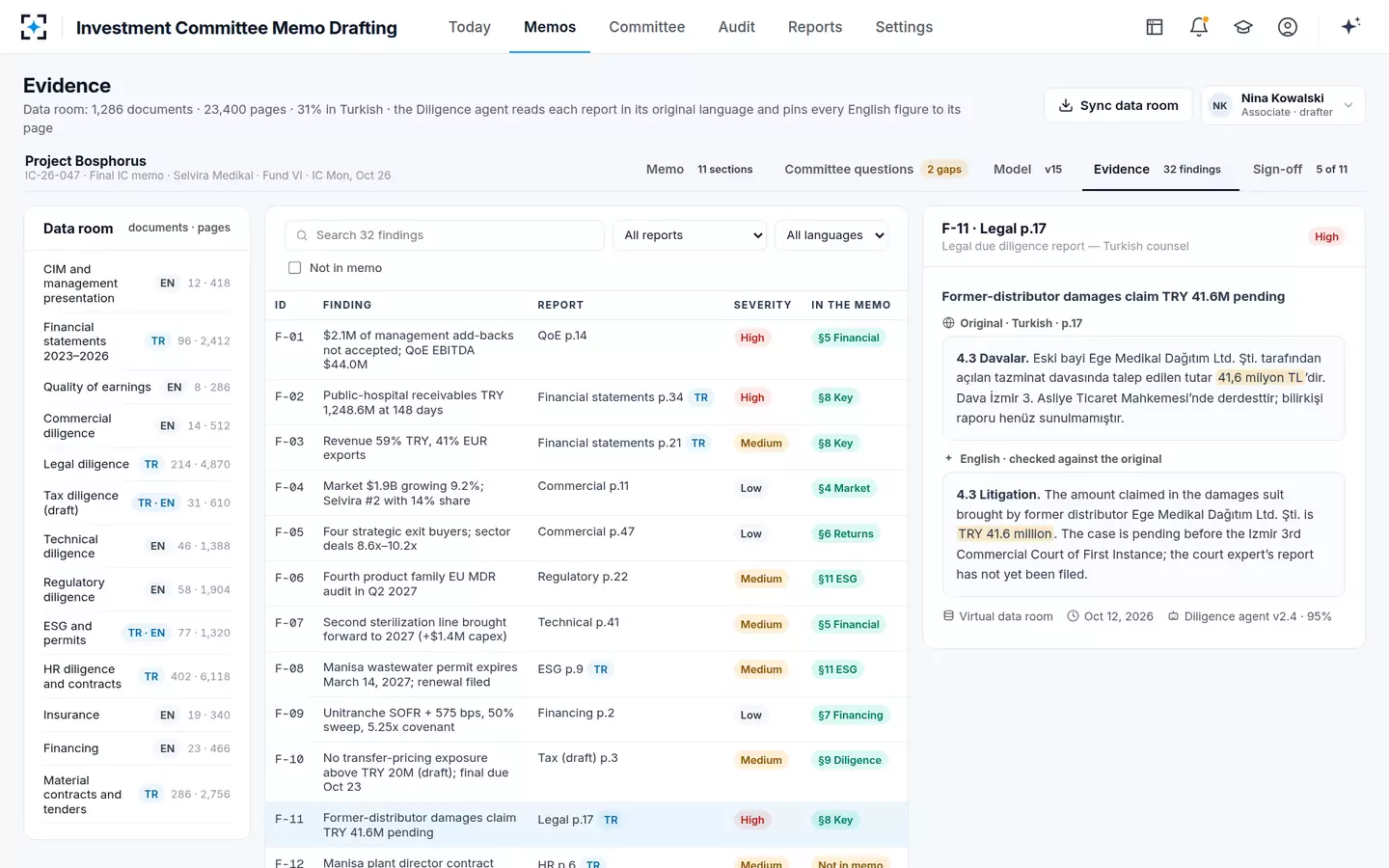
The measure has a policy choice inside it: which findings are material. In the sample, findings carry a severity from the report, and any finding without a section in the memo is listed as not in it. A firm should set its own line and write it down, because "we didn't think it was material" is a defensible answer only if it was decided before the committee asked.
How do you verify a memo against the model?
Tie each figure to its cell, keep every saved version of the model, and on each save compare the memo's figures with their cells and recompute every derived figure; then block approval of anything that differs until a person accepts the change. Done by hand, that is a day of an associate's time per memo in our estimate, and it is usually done once, the night before the papers go out. Done by the system, it runs on every save. In the sample, the agent that watches the model diffed version 14 within minutes of the morning run, found six changed cells, and identified the two that sat in the memo.
Verification also needs a fixed point. The signature should name the memo version and the model version, so that anyone can later re-run the five measures against exactly what the committee saw. Rule 204-2 expects an adviser keeping records electronically to be able to hand examiners a true and complete copy on request (Rule 204-2(g)); a memo that names its model version is what makes such a copy of the memo meaningful, because the figures can be re-checked against the right model.
The memo with every figure coloured by source and the stale ones marked
What does an IC chair look for in a memo?
A chair looks for the decision's weak points: the price, the earnings it rests on, the exit, the downside and what has not been checked yet. The five measures do not replace that reading; they make it possible, by assuring the chair that the numbers on the page are the numbers in the model. The EU rulebook for fund managers asks for the same foundation in its own words: a manager "shall ensure that they have adequate knowledge and understanding of the assets in which the AIF is invested" (Delegated Regulation (EU) No 231/2013, Article 18(2)).
Five numbers an IC chair can ask for before reading a memo
- How many figures, and how many tied?
The answer should be the same number twice. Ask how many come from the CIM.
- How many stale on the latest model version?
Zero, with the model version named next to the partner’s signature.
- Do the derived figures recompute?
Every multiple, margin and share, at display rounding. Ask to see one that failed during drafting.
- How many factual sentences have no source?
Zero, or a list. Opinions are fine; unsourced facts are not.
- Which material findings are not in the memo?
Zero, or a list with a reason for each, decided before the meeting.
A memo that scores well on all five has earned a chair's attention for the questions that matter. Those questions are often predictable from past minutes, which is the subject of rehearsing the investment committee meeting.
Questions people ask
How do you check figures in an IC memo quickly?
Do not reread the memo; compare each figure with its source and recompute the derived ones. If figures are tied to cells and pages, that comparison is mechanical and can run on every model version; if they are not, start by tying the returns table and the executive summary, which carry the figures members read most.
What is an investment committee memorandum?
The same document as an investment committee memo or IC paper: the deal team's written request to its committee for approval of an investment, with the evidence and conditions.
What figure tolerance should a memo check use?
Exact at display rounding is the strictest workable rule: if the memo shows one decimal, the source must round to the same value. The sample firm uses that tolerance, and any other difference blocks the section until a person resolves it. Looser tolerances hide exactly the small changes a late model save produces.
Can these accuracy measures be run on a memo written by hand?
Partly. Measures four and five can be done by a careful reviewer with the data room open. Measures one to three need every figure tied to its source, which hand-built memos rarely are; the first step for any deal team is to start tying the figures in new memos, section by section.
Who should own memo accuracy?
The deal team owns the memo, and the deal lead approves each section; the measures belong to whoever approves, because they are what an approval should rest on. Compliance owns the rules: the tolerance, the materiality line and the requirement to sign against a named model version.