An AI investment memo generator is software that drafts an investment committee memo from a deal's own documents: the model, the confidential information memorandum (CIM), the diligence reports and the committee's template. The best of them cite every figure; the weakest produce fluent prose with numbers nobody can trace. The question a buyer should ask first is not how well it writes but who checks what it wrote, because research on large language models shows they are poor judges of their own output. Botminds' Investment Committee Memo Drafting is built around that finding: a Drafting agent writes each section with every figure tied to a model cell or a page, a separate Checker agent verifies each figure against the current model and recomputes the derived ones, and people approve each section and sign. The generator never marks its own homework.
The examples come from a fictional sample deal in the solution: Quillfield Capital's Project Bosphorus, a $415 million buyout of a Turkish medical-device maker, with a final memo of 186 figures in its first draft.
An AI investment memo generator that checks itself, and one with an independent checker
The drafter checks its own draft: Read back by the same model that wrote it, which tends to find it plausible.
A separate checker, then people: Compared with the model cell or page by an agent that did not write it; a mismatch blocks the section.
The drafter checks its own draft: Re-read as text; a ratio that no longer follows from its inputs survives.
A separate checker, then people: Recomputed from its inputs and compared at display rounding.
The drafter checks its own draft: Invisible, unless someone regenerates the memo and rereads it.
A separate checker, then people: Diffed on save; the memo figures it touched are listed, old and new.
The drafter checks its own draft: Absent, because the draft only contains what the drafter chose.
A separate checker, then people: Flagged by the agent that reads the data room: a finding with no place in the memo.
The drafter checks its own draft: Often a single “approve memo” click after the model says it is fine.
A separate checker, then people: Each section approved by a person who did not draft it; the partner signs a named version.
Can AI write an investment memo?
Yes, a first draft, if it works from the deal's own sources and cites them, and no, not one a committee should rely on without an independent check. Drafting is the part of the work language models do best: turning a model's outputs and a stack of reports into sections in a house style. The parts they do worst are the ones a committee cares about most: exact figures, multi-step arithmetic and knowing what is missing.
The arithmetic weakness is well documented. FinQA, a benchmark of questions written by financial experts over company reports, found large pre-trained models well behind financial experts, both in finance knowledge and in multi-step numerical reasoning over that knowledge (Chen and co-authors, EMNLP 2021). Models have improved since, but an IC memo's derived figures, such as an entry multiple, cash conversion or covenant headroom, are exactly multi-step calculations. A generator should compute them from model cells, not write them.
What is an AI investment memo generator?
Three different things are sold under the name. A general chat assistant with documents uploaded can produce a memo-shaped draft. A template filler maps fields from a model or a data room into a fixed document. An agent system drafts against the committee's template, ties each figure to its source, checks the draft independently and routes each section to a person. The three differ less in how the prose reads than in what happens when a figure is wrong.
Investment Committee Memo Drafting is the third kind. It has seven agents with written limits: the Drafting agent never writes a figure without a source; the Checker agent never changes a figure itself; the agent that rehearses committee questions never shows a member's vote or notes; the Diligence agent never summarises a page it could not read; the Model Watch agent never edits the model; the Mandate agent never clears a breach of the fund's limits; and the Committee Record agent never records a decision without the IC secretary and the chair.
Can an AI check its own work?
Not reliably, and the research gives two reasons. The first is that self-correction without outside information tends to fail. Testing that idea on reasoning tasks, Huang and colleagues found that models rarely fix their own answers without feedback from outside, and sometimes do worse after trying (ICLR 2024). A model asked "are you sure?" about its own draft has nothing new to go on.
The second is bias. Panickssery, Bowman and Feng describe self-preference, a model grading its own output above others' that human readers judge no better, and find that models can recognise their own text (arXiv 2404.13076, not peer reviewed). A memo generator that grades its own draft is grading a document it is inclined to like.
The remedy follows from the first finding. The check needs external feedback that the drafter did not produce: the model cell, the page in the report, the recomputed ratio. That is what the Checker agent in the solution uses. It does not reread the draft for plausibility; it compares each of the memo's figures with its source on the current model version, and its only power is to block approval until a person accepts a fix.
What the research says about trusting a model's own reading
81%
of questions over company filings answered wrongly or refused by a 2023 model with retrieval
2
places in a long input where models find facts best: the beginning and the end
0.90
confidence below which nothing enters the sample memo without a person confirming it
How accurate are AI memo generators?
No regulator or independent study has measured AI generators on investment committee memos, so the honest answer is that accuracy depends on the design and must be measured on your own deals. The nearest public evidence is not encouraging for simple designs. On FinanceBench, built from questions about public company filings, "GPT-4-Turbo used with a retrieval system incorrectly answered or refused to answer 81% of questions" (Islam and co-authors, 2023, not peer reviewed). Long inputs add another weakness: models find facts best at the start or end of a long input and noticeably worse when the fact sits in the middle (Liu and co-authors, TACL 2024). A legal diligence file like the sample's, 4,870 pages across 214 documents, has a lot of middle.
The European Securities and Markets Authority put the risk in plain terms for investment firms: text-generating AI tools are known to "hallucinate", producing wrong facts that still read as plausible and precise (ESMA public statement, May 30, 2024; written for retail investment services, but the point travels). For a memo generator the useful measures are concrete: the share of figures tied to a source, the share still current after a model change, derived figures that recompute, sentences with no source, and diligence findings missing from the memo. Those five are defined in five measures for every figure in an IC memo; running them on closed deals is how a six-week go-live from past memos validates a generator before it touches a live deal.
Maker-checker for an IC memo, agent by agent
Maker-checker means the work is done by one party and verified by another before it counts, with a person deciding wherever judgement is involved. Applied to an AI investment memo generator, it means at least three separations: the drafting agent never checks its own draft; no agent approves or signs; and the person who drafts a section is not the one who approves it.
Maker-checker in Investment Committee Memo Drafting: who drafts, who checks, who decides
Agent
Model Watch agentDiffs every saved model version and tells the checker which memo figures it touched.
Never: edits the model
Agent
Diligence agentReads each data-room report in its original language and drafts findings with page citations, flagging any not in the memo.
Never: summarises a page it could not read
Agent
Drafting agentWrites each section to the committee’s template, every figure bound to a cell or page; proposes edits when a source changes.
Never: writes a figure without a source
Agent
Checker agentVerifies every figure against the current model, the CIM and the diligence pages; recomputes derived figures.
Never: changes a figure; it blocks approval while any is stale
A person decides
AssociateAccepts or rejects each proposed edit; adds the analysis the committee will ask for.
A person decides
Deal leadApproves each section with a reason; cannot approve a section he drafted, cannot sign.
A person decides
Deal partnerSigns a named memo version against a named model version.
In the sample, the design showed its value on one night. A new model version was saved at 11:48 p.m.; by 6:07 a.m. the Checker agent had re-verified all 186 figures, found 184 current and 2 changed, and blocked approval of the financial analysis until the associate accepted the fixes. The full case is told in the night the model changed.
Who approves an AI-drafted IC memo?
The same people who approve a memo written by hand, with the approvals made more specific. The deal lead approves each section with a reason, the deal partner signs, and the committee decides; no agent approves, signs or records a decision. ESMA has said that firms' decisions stay the responsibility of their management bodies whether a person or an AI tool takes them. A memo drafted by agents is still the deal team's memo.
Specific approvals also make a generator safer to use. When a section must be approved with a reason, "Figures and sources checked" is a claim a person makes about specific figures, and the approval is blocked while any figure in that section is stale. A single "approve" for a whole memo invites the reviewer to trust the machine.
What does the SEC say about AI tools?
The SEC's examination staff call these tools "super intelligence", or SI, and their fiscal 2027 priorities say firms are using it across research, drafting and investment analysis, that existing obligations still apply, and that examiners will look at firms' policies for monitoring it (SEC Division of Examinations, announced October 23, 2026; staff priorities, not a rule). The same document describes the Division's own plan: bring SI into examinations and risk assessment to add staff capacity and oversight, without displacing examiners' judgment. That is the right model for a deal team too: the tool adds capacity, and the judgement stays with the people who sign.
The Commission has also shown it will act on claims about AI. In March 2024 it settled charges against two advisers, with $400,000 in total penalties, for telling clients and the public that they used AI in ways they did not (SEC press release 2024-36). For a memo generator the implication is practical: a firm should be able to show, from its own records, which agent drafted which section, which checks ran and which person approved, and should describe its process to investors only as it actually runs.
Can AI read diligence reports in other languages?
Yes, if the generator reads the original and pins each English figure to its page, rather than working from a translation. In the sample data room, 1,286 documents and 23,400 pages, 31% are in Turkish, including the legal, tax and HR reports. The Diligence agent reads each in its original language; a click on an English figure in the memo opens the original passage beside the English, marked as checked against the original.
Diligence findings by report and language, each with its page and place in the memo
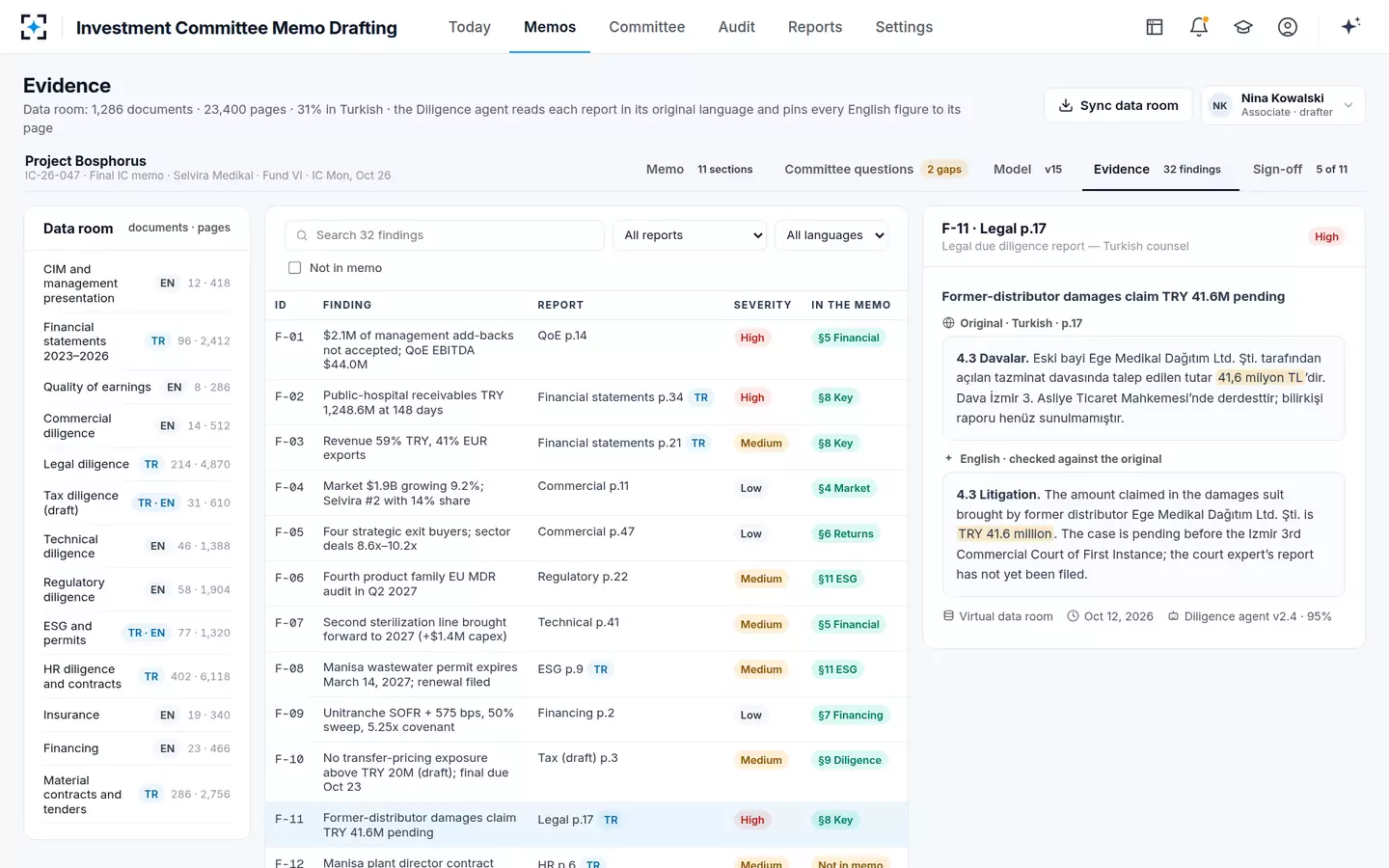
Two limits matter. A scan below the read-quality threshold is flagged rather than summarised, and a finding is never marked resolved by an agent. Both are cases where a fluent summary would be worse than an honest gap.
What to ask before you buy an AI investment memo generator
Ask how it is checked, not how it writes. Any generator's demo memo reads well; the differences appear when a figure is wrong, a model changes or a report is in another language. Put these questions to any vendor, Botminds included.
Ten questions for any AI investment memo generator
- Does every figure open its source?
A model cell, a CIM page or a diligence page, in one click. If not, the committee is reading claims.
- Who checks the draft, and with what?
An independent check against the source, not the drafting model rereading its own text.
- Are derived figures recomputed?
Multiples, margins, conversion and headroom computed from their inputs, at display rounding.
- What happens when the model changes?
Each saved version diffed; the memo figures it touched listed; approval blocked until a person accepts the fix.
- Does it use our committee’s template?
Each committee’s own sections, preliminary and final, kept as settings that compliance approves.
- Can it read reports in their original language?
With the English pinned to the original page, and poor scans flagged rather than guessed.
- Does it show what the memo is missing?
Diligence findings with no place in the memo, and the committee’s likely questions with no answer.
- Who can approve and sign, and what is blocked?
The drafter cannot approve, the approver cannot sign; signature closed while any figure is stale.
- What stays confidential?
Committee minutes, votes and members’ notes kept from the deal team; deal documents kept inside the firm’s controls.
- What does the record show afterwards?
Every memo and model version, each agent step with its model version and confidence, every approval with its reason.
The limits matter as much. The solution does not choose a deal's thesis or set its price; it does not replace the model, the data room or the committee portal, it reads and writes to them; and its value depends on the firm's templates, IC policy and past minutes being available to it. A firm that wants a one-page teaser from a CIM in a chat window needs something simpler.
Questions people ask
Is there a free AI investment memo generator?
General chat assistants will produce a memo-shaped draft from uploaded documents at little or no cost. The costs come later: confidential deal documents leaving the firm's controls, figures with no source, and no record of who checked what. For a teaser or a first outline that may be acceptable; for papers a committee votes on it usually is not.
Can ChatGPT write an IC memo?
It can write prose in the shape of one. Without the deal's model and reports, and without an independent check of every figure, the result should not go to a committee. Material nonpublic information in deal documents also raises a compliance question before any upload, under the firm's policies on inside information.
Does an AI memo generator decide whether to invest?
It should not, and in a well-designed system it cannot. In the solution the agents draft, check, rehearse and propose; the associate edits, the deal lead approves sections, the partner signs and the committee votes. The Mandate agent tests the fund's limits but sends any breach to compliance rather than clearing it.
What happens when an agent is not sure?
In the sample firm's settings, anything below 0.90 confidence needs a person to confirm it before it enters the memo, and committee questions below 90% confidence stay in the agent's notes rather than on the list. Every threshold is a setting, versioned and approved by compliance.
Can an AI generator write in our house style?
Yes, if it learns from your past memos. The Drafting agent in the solution writes in the house style it learned from the firm's closed memos, to each committee's own template. Style is the easy part; the checks above are what make the draft usable.