A private equity investment memo is the document a deal team puts to its investment committee to ask for a fund's capital: the recommendation, thesis, financial analysis, returns and scenarios, financing, risks, diligence status and the plan after closing, with every figure drawn from the deal model, the confidential information memorandum or a diligence report. Its weakest point is time. The model keeps changing until the papers go out, and a memo built by copying numbers out of it cannot say which of its figures a new version touched. This case follows one memo through one night in Botminds' Investment Committee Memo Drafting, where every figure is tied to a model cell or a page, so a late model save becomes a short list of old and new values rather than a reread.
The memo, the model and the people are fictional sample data in the solution: Quillfield Capital's Project Bosphorus, a $415 million buyout of a Turkish medical-device maker, due at the Private Equity Investment Committee on Monday, October 26, 2026. The night in question is Monday, October 19.
The night in four numbers
11:48 p.m.
model version 14 saved, with capital expenditure re-phased after the technical diligence
186
figures in the memo that had to be re-checked against it
2
that had actually changed; four other changed cells were not in the memo
8:40 a.m.
partner signs memo version 5 against model version 15
What is a private equity investment memo?
It is the written case for one deal, addressed to the people who can commit the fund: the investment committee. In the sample firm a final memo has eleven sections, from the executive summary to ESG and regulatory matters, and the draft for this deal ran to 186 figures. Each figure belongs to one of three sources. In this memo 118 came from the deal model, 39 from the CIM and 29 from diligence reports.
Those sources move at different speeds. The CIM is fixed once the sale process starts. Diligence reports arrive in drafts and finals over weeks. The model moves fastest, because it is where the deal team absorbs everything else: lender terms one week, quality of earnings adjustments the next, capital expenditure after the technical report. A memo has to be right against the model at the moment it is signed, and nothing in a document built by copy and paste records which cell each number came from. The sections of the memo and the source each should name are set out in the template guide.
Four model versions in eleven days, each moving figures the memo quotes
| Version | Saved | What changed | Cells |
|---|---|---|---|
| v12 | Fri, Oct 9, 6:14 p.m., associate | Lender terms from the unitranche term sheet | 1,840 |
| v13 | Thu, Oct 15, 9:02 p.m., associate | Quality of earnings adjustments: EBITDA $46.1M → $44.0M | 1,852 |
| v14 | Mon, Oct 19, 11:48 p.m., deal lead | Capital expenditure re-phased after the technical diligence | 1,852 |
| v15 | Tue, Oct 20, morning, associate | Currency case: lira −30% against the dollar from January 2027, on a new tab | 1,911 |
11:48 p.m.: model version 14 is saved
The deal lead, a vice president, saved model version 14 a little before midnight. The final technical diligence had brought a second sterilisation line forward by a year, adding $1.4 million of capital expenditure in 2027. That was the right change to make, and it was made the right way, in the model and under his name. The problem it created is the one every deal team knows: the memo was due in front of the deal lead for approval the next morning, the papers had to go out by Thursday at 5:00 p.m., and nobody could say which of the memo's 186 figures the new version had moved.
By hand, the answer comes from the associate. In the sample her words describe the usual cure: "I spend Sunday night re-pasting numbers from model version 14." Re-pasting is both slow and unreliable. Research on spreadsheet errors summarises the problem in two lines: any one cell is rarely wrong, but a large workbook almost certainly carries at least one wrong bottom-line figure, and "errors are extremely difficult to detect and correct" (Panko, EuSpRIG conference, 2015; arXiv 1602.02601, not peer reviewed). A memo that copies values out of a model inherits those odds, then adds its own.
From the model save to the partner's signature, in minutes
- Overnight, no one working11:48–6:05
- Agents35 min
- Waiting, then people decide6:40–8:43
Re-checking a memo after a model change: a day by hand, minutes with agents
How many figures are in an IC memo?
In this one, 186 in the first full draft and 190 in the final version. The number matters because it is the size of the re-check after every model change. In the sample, the first message the associate saw on Tuesday morning was the count, from the agent that verifies figures: "Re-verified 186 figures against v14: 184 current, 2 changed. I blocked approval of Financial analysis until a person accepts the fix." It was sent at 6:07 a.m.
Two minutes earlier, the agent that watches the model had already diffed the new version: six cells had changed, and two of them were in the memo. That is the arithmetic a person cannot do quickly by eye. Four changed cells did not touch the memo at all, and the internal rate of return was unchanged after rounding; reading the whole memo again would have confirmed 184 numbers to find two.
Tuesday, 8:20 a.m.: the associate starts with what needs her
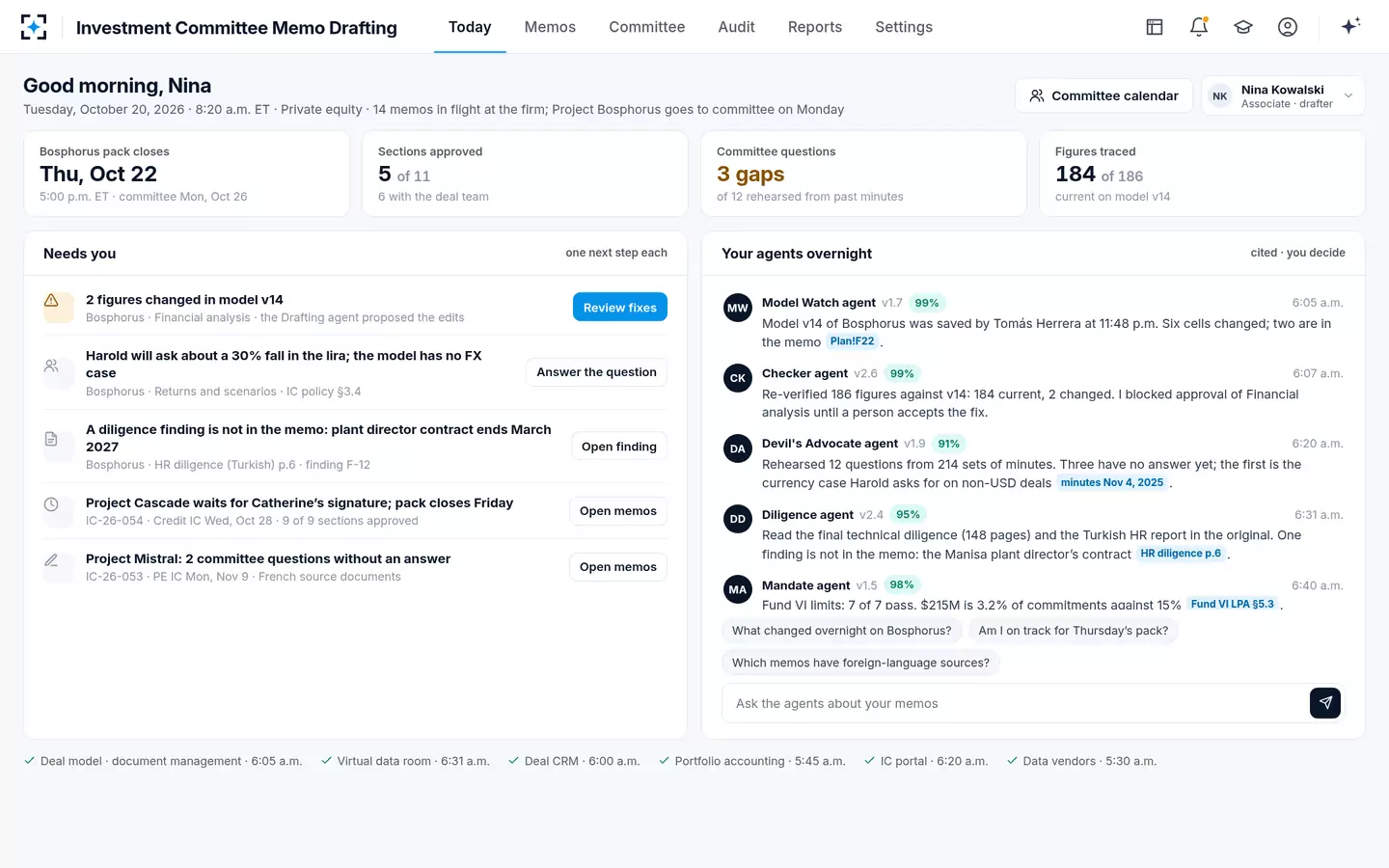
Which figures moved, and which did not
Two figures moved, both in the financial analysis: 2027 capital expenditure from $14.2 million to $15.6 million, and 2027 cash conversion, EBITDA less capital expenditure as a share of EBITDA, from 71% to 68%. The Drafting agent proposed the edits and the Checker agent blocked approval of that section until someone accepted them. The associate accepted both at the start of her day and the memo moved to version 4.
The second figure is the more instructive. Cash conversion is derived: it moved because capital expenditure moved, and a person re-pasting the capital expenditure line could easily miss that a ratio two rows down had moved with it. Derived figures are also where language models are weakest. The FinQA benchmark, built from questions written by financial experts over company reports, found large pre-trained models clearly behind financial experts at multi-step numerical reasoning over company reports (Chen and co-authors, EMNLP 2021). In the solution a derived figure is therefore recomputed from its inputs, not re-read, and compared at display rounding.
What happens if the model changes before IC?
Before the papers go out, the memo is updated and re-approved; after they go out, the change should reach the committee as a named amendment, never as a quiet edit. The sample handles both. Before distribution, a changed figure blocks approval and signature until a person accepts the fix, and the partner signs against a named model version. After distribution, the deal lead can lock the model for the committee, so that any later edit needs a reason and is kept on the audit trail.
The rule is simple to state and hard to keep by hand: the signature on a memo should name the model version it was checked against. In the sample it reads "memo v5 · model v15". If the model moves after that, everyone can see that the memo and model no longer match, which is the point.
The committee question that became a model case
The same morning brought a second kind of change, and this one started in the memo rather than the model. At 6:20 a.m. the agent that rehearses committee questions from past minutes reported three gaps; the first was the chair's habit of asking what happens to returns if a non-dollar currency falls 30%, which he had asked on nine of eleven such deals since 2023. The firm's IC policy requires a ±30% currency case where more than a quarter of revenue is outside dollars, and 59% of this company's revenue is in lira. Model version 14 had no such case.
Adding the currency case: a new model version, not a new sentence
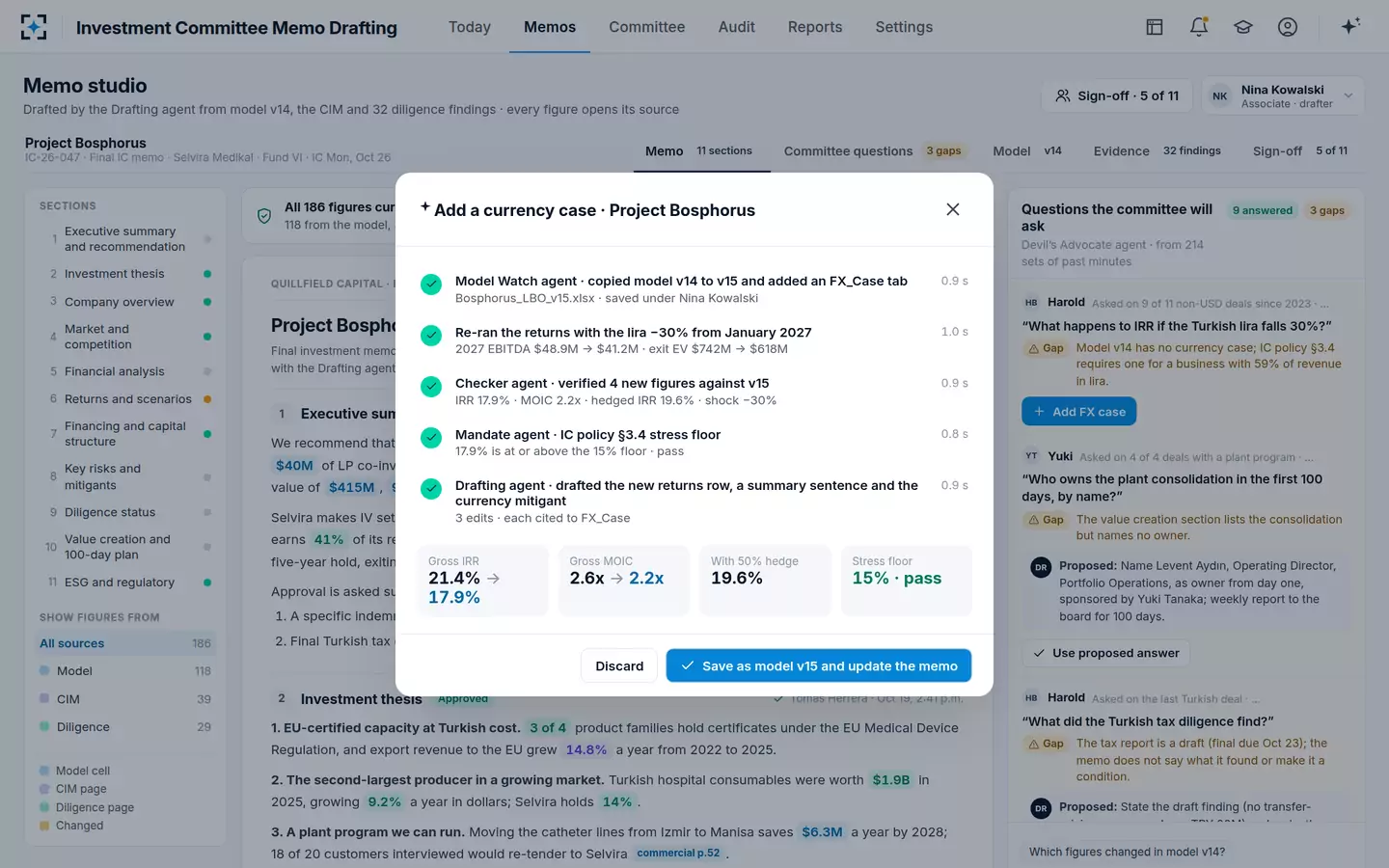
The associate closed the gap the way a committee would want: with analysis in the model. A copy of version 14 became version 15 with a new currency tab, saved under her name; the returns were re-run with the lira 30% weaker from January 2027, which took 2027 EBITDA from $48.9 million to $41.2 million in dollars and the exit value from $742 million to $618 million. The four new figures were checked, the case was tested against the policy's 15% stress floor (17.9% passed), and the memo gained a returns row, a summary sentence and a hedge condition, each cited to the new tab. The memo moved to version 5, with 190 figures, all current on version 15. How the rehearsal found the question is its own guide.
Who checks the numbers in an IC memo?
Three people check them, in order, and each checks something different. The associate checks that each figure is the right one; the deal lead checks that the section makes the right argument with them; the partner checks that the whole is ready to sign. None of them should have to check that a figure matches its cell. That check is mechanical, it has to be repeated on every model version, and it is the one people do worst late at night.
In the sample, the deal lead approved six sections between 8:28 and 8:38 a.m., each with a reason; five more had been approved the day before. At 8:40 the partner signed memo version 5 against model version 15, and at 8:43 the IC secretary distributed the papers to five members and two observers. Everything people did to the memo that morning happened between 8:20 and 8:43, and every step of it was a decision.
The model versions, the cells that moved and where each sits in the memo
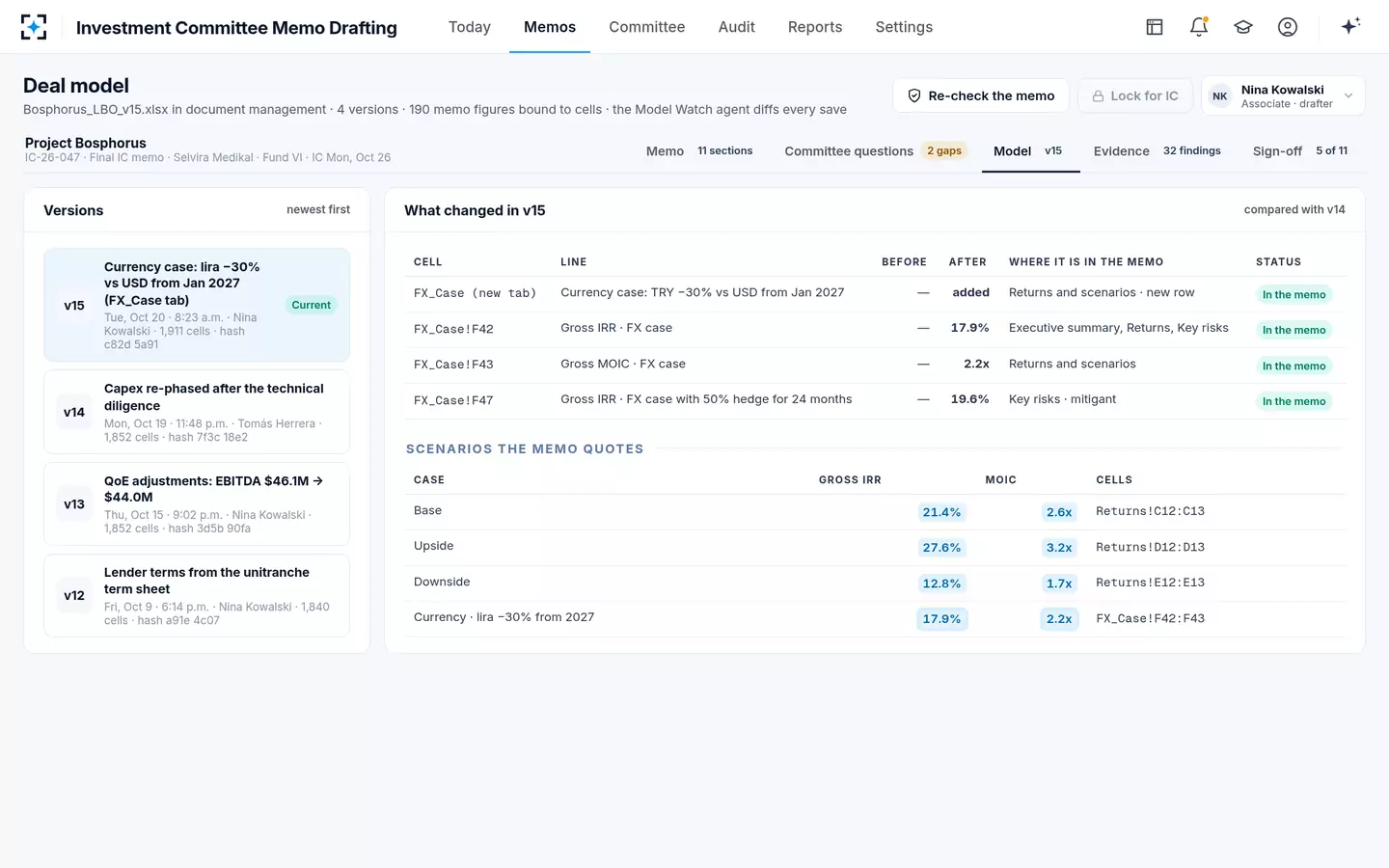
How do you keep an IC memo consistent with the model?
Tie every figure to the cell or page it came from, keep every saved version of the model, and compare each new version with the last before anyone approves. Those three steps turn "is the memo still right?" into "which of these listed figures do we accept?". The comparison below is the same memo, kept two ways.
A private equity investment memo kept by copy and paste, and kept with every figure tied
Figures copied from the model: Someone notices, or does not. The memo has no record of which cells it used.
Figures tied to cells and pages: The new version is diffed on save; the memo figures it touched are listed, old value and new.
Figures copied from the model: Re-typed with their inputs, if the person remembers they are derived.
Figures tied to cells and pages: Recomputed from their inputs on every version and compared at display rounding.
Figures copied from the model: Given on a memo that may already be stale.
Figures tied to cells and pages: Blocked while any figure is stale, until a person accepts the fix.
Figures copied from the model: On a document, against whatever the model was that day.
Figures tied to cells and pages: On a named memo version against a named model version.
Figures copied from the model: An associate re-reads the memo and re-pastes tables.
Figures tied to cells and pages: People review a short list in the morning; the re-check ran overnight.
The measures that show a memo is in this state, and how to report them to a committee chair, are set out in five measures for every figure in an investment committee memo.
Questions people ask
What is the difference between a private equity investment memo and a CIM?
The CIM, or confidential information memorandum, is written by the seller's adviser to market the company to bidders. The investment memo is written by the buyer's deal team to its own committee, and uses the CIM as one source among several, with diligence figures replacing the seller's wherever they differ.
Should the IC memo be updated after the papers are distributed?
Only as a visible amendment. If the model changes after distribution, the committee should receive a note of what changed and why, against named versions, rather than a silently replaced file. Locking the model for the committee makes that the default.
How often does the deal model change before IC?
As often as new information arrives. In the sample, four versions were saved in eleven days: lender terms, quality of earnings adjustments, capital expenditure after the technical report, and a currency case. Each moved figures the memo quotes, and each would have needed a full re-check by hand.
Can a spreadsheet tool alone keep an IC memo in sync?
Linking a document to cells helps, but links break when rows move or a tab is copied, and they do not cover the CIM or diligence pages. A dependable approach diffs each saved model version, recomputes derived figures, and blocks approval of anything stale until a person accepts the change.
Is a private equity investment memo the same as an IC memo?
Yes, in practice. Deal teams call it the investment memo, the IC memo, the investment committee paper or the final memo; firms that use a two-stage process also write a shorter preliminary memo before full diligence.