Investment committee minutes are the written account of what a committee decided and how it decided it: who attended and voted, which conflicts were cleared, which version of the memo and model the members considered, the questions they asked and the answers they got, the vote, and the conditions attached, each with an owner. Minutes matter after the meeting, when an examiner, an investor's due diligence team or the firm's own auditors try to follow a decision, and they often fall short because they are written from scrawled notes by a secretary chasing sign-offs by email. Regulators have reviewed committees whose minutes could not show how decisions were made. Botminds' Investment Committee Memo Drafting drafts the decision from the vote and the conditions, for the IC secretary to record and the committee chair to co-sign, and keeps it beside every memo and model version it rests on.
The examples follow a fictional sample committee in the solution: Quillfield Capital's Private Equity Investment Committee deciding Project Bosphorus, a $255 million equity commitment to a Turkish medical-device maker.
Investment committee minutes for one decision: seven parts an examiner can follow
- 1Meeting
- Private Equity Investment Committee, Monday, October 26, 2026, 9:00 a.m. ET. Quorum 4 of 5; five voting members present; two observers.
- 2Conflicts
- Cleared for all five voting members by the deputy chief compliance officer, October 19. The deal partner presents and does not vote on her own deal.
- 3Papers considered
- Final memo version 5 (38 pages) signed against model version 15; model extract; committee questions appendix; diligence findings index; fund-limit check and conflicts clearance.
- 4Discussion
- Each question asked, by member, with the answer given and its memo section; any question not answered in the room, with who owes the answer.
- 5Decision and vote
- Approved 5–0 with conditions. Abstentions and recusals named; a dissent recorded with its reason.
- 6Conditions
- Each with an owner and a date: a specific indemnity for the TRY 41.6M distributor claim; the final Turkish tax report; a hedge of 50% of lira EBITDA for 24 months; a named owner for the plant move.
- 7Signatures
- Recorded by the IC secretary; co-signed by the committee chair. Conditions written to the deal team’s tracking system after the co-signature.
What should investment committee minutes include?
Seven things: the meeting and its quorum, the conflicts cleared, the papers considered by version, the discussion, the decision and the vote, the conditions with owners and dates, and the signatures. The first three let a reader check that the right people decided on the right papers. The next three are the decision itself. The last makes the record final.
Two of those are where most minutes are thin. The papers are usually listed as "the IC memo", without a version, so nobody can later tell whether the committee saw the memo before or after the model changed. In the sample that matters: the memo went through five versions and the model through four, and the decision rests on memo version 5 signed against model version 15. The discussion is usually reduced to "the committee discussed the risks". A reader learns nothing from that sentence; a list of questions asked, by member, with the answer and its memo section, shows that the committee did its job.
Minutes that show how the decision was reached
Regulators judge committees by what their records can show, and they have said so plainly. The FCA's review of valuation practice at private market firms found that over 90% of the valuation processes it surveyed had a valuation committee, but that some committees' minutes did not show how their decisions were reached, and that where the records were thin the regulator could not take comfort that oversight had worked (FCA, Private market valuation practices, March 2025). Those were valuation committees rather than investment committees, but the standard the FCA applied is the one any committee will meet; valuation committee terms of reference show how a committee writes it into its own rules.
“There were high-quality minutes taken of committee and forum meetings where decisions were taken, and the documentation showed how the firm complied with relevant requirements and standards in policy and procedures documents.”
FCA multi-firm review, Conflicts of interest and fair customer treatment in private markets, October 2026
That is how the FCA described the firms with stronger conflicts arrangements in its October 2026 review, and the valuation review drew the same contrast: the better committees kept a record of the discussion of each asset, not only the outcome. The test, in both, is whether someone absent from the meeting could follow the reasoning from the page.
Do investment committee minutes record votes?
They should record the result and how each member voted, including abstentions, recusals and any dissent with its reason. A bare "approved" hides the difference between a unanimous decision and a 3–2 vote with the chair dissenting on price, which is exactly what a later reader wants to know. In the sample the committee approved 5–0 with conditions; the deal partner presented and, under the firm's rules, did not vote on her own deal, and the minutes say so.
Recording a vote is not the same as publishing it. Votes and members' pre-read notes in the sample are visible only to committee members and the secretary; the deal team sees the decision and the conditions, not who doubted what. Lending committees face the same question with a sharper regulatory edge, worked through in how to record dissent in committee minutes on a 5–1 vote.
Who takes the minutes at an investment committee?
The committee secretary takes them and the chair approves them; the deal team should not write the record of its own deal. In the sample, the IC secretary distributes the papers once the partner signs, the Committee Record agent drafts the decision from the vote and the conditions, the secretary records it, and the chair co-signs. The secretary never edits the memo's content, and no agent records a decision without the secretary and the chair.
Separating the roles is what gives the minutes weight. A record drafted by the people whose deal it was invites the question every examiner asks of self-reporting. A record drafted from the vote and the conditions, recorded by a secretary who did not write the memo and co-signed by the chair, answers it.
Conditions: the part of the minutes that works after the meeting
Most of what investment committee minutes record is history; conditions are instructions. "Approved subject to" creates work that someone must finish before closing, and the minutes are the only place that work is defined. Each condition therefore needs an owner, a due date and a test of when it is met. In the sample, the conditions are written to the deal team's tracking system as soon as the chair co-signs, and the $215 million commitment goes to portfolio accounting as approved, pending close.
From conflicts cleared to a co-signed decision: the sample committee's week
- ClearedOct 19
- Partner signs; papers out Oct 20; members read6 d
- VoteOct 26
- Indemnity and tax report: deal teamdeal team
- Hedge and 100-day owner: named in the tracking systemnamed owners
How long should IC minutes be kept?
At least five years, and longer if the firm's policy or a legal hold says so. No rule names investment committee minutes as such, so the answer comes from the rules that cover what the minutes contain and from the firm's own retention schedule. The table sets out the main ones.
How long investment committee minutes should be kept, rule by rule
| Rule or policy | What it covers | How long |
|---|---|---|
| SEC Rule 204-2(e)(1), US registered advisers | Required books and records, including written communications relating to a recommendation made or proposed | Five years from the end of the fiscal year of the last entry, the first two in an appropriate office |
| Delegated Regulation (EU) 231/2013, Article 19(2) | The records of an EU fund manager’s plan, assessment and due diligence before buying an illiquid asset | At least five years |
| Firm policy, fictional sample firm | Every memo and model version, approvals, the rehearsal, the decision and the audit trail | Seven years from the committee decision |
| Legal hold | Anything relevant to a dispute or investigation | Until released, overriding the schedule |
Retention is only half of it. Rule 204-2 also governs how electronic records are kept: the adviser must index electronic records so each one can be located and produced, and keep them "so as to reasonably safeguard them from loss, alteration, or destruction" (Rule 204-2(g)). Minutes held as unindexed attachments in a secretary's mailbox fail the first test even when they survive the second.
What do examiners ask for from an investment committee?
They ask for the records of the decision, promptly, and then test whether the process described in the firm's policies is the one that happened. Rule 204-2 obliges an adviser to give examiners, promptly on request, a complete and legible copy of any record in the format in which it is kept. For private fund advisers, the SEC's examination priorities for fiscal 2027 say reviews will test whether compliance controls are built to catch risks at the level of each investment as well as the fund (SEC Division of Examinations, fiscal year 2027 priorities; staff priorities, not a rule).
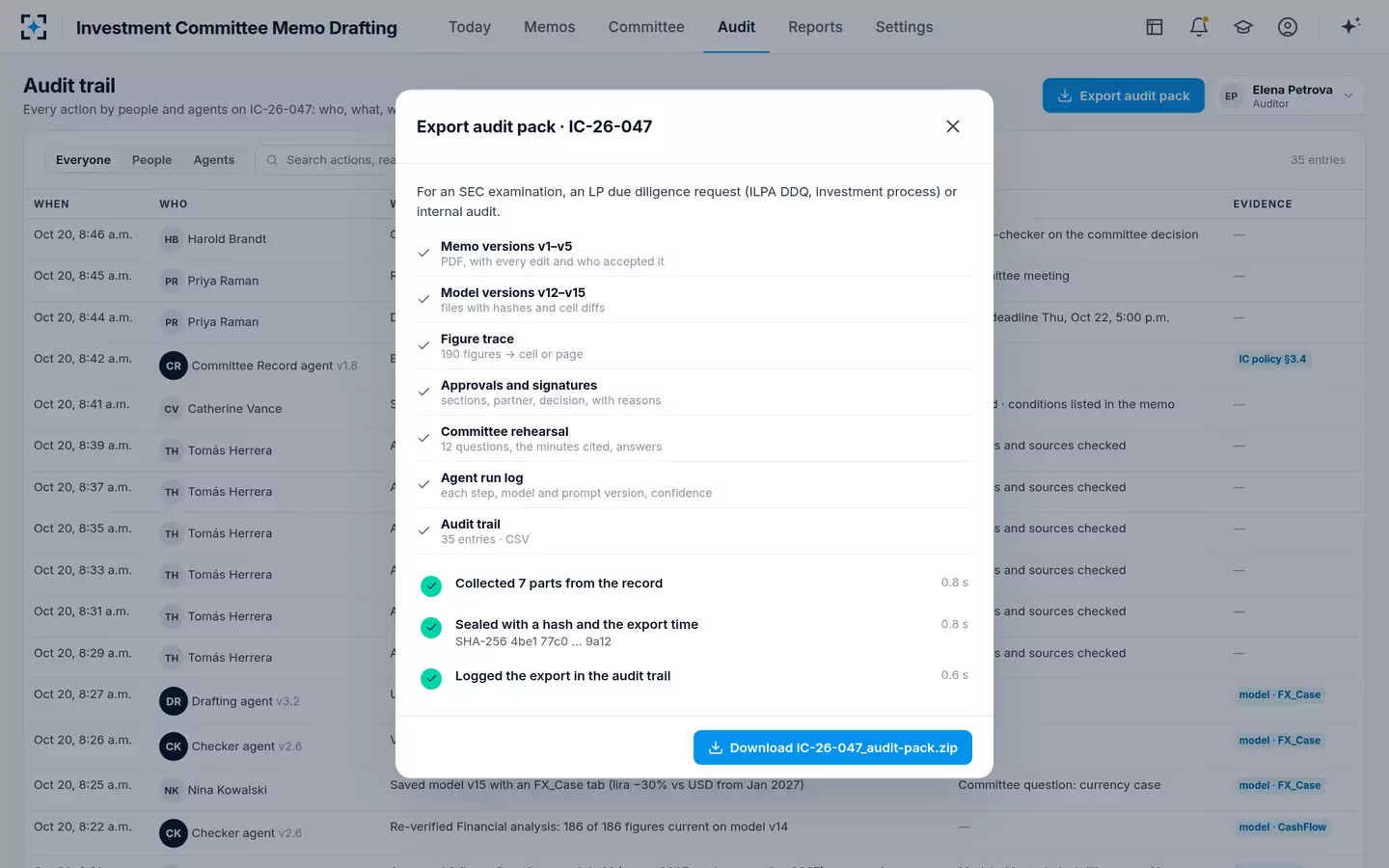
An investment committee's minutes are where investment-level controls either show up or do not: the conflicts clearance, the fund-limit check, the stress cases the committee's policy requires and the conditions attached. Rule 206(4)-7 adds the annual test, requiring the adviser to review the adequacy and effectiveness of its policies at least once a year (17 CFR 275.206(4)-7); a year of minutes, each with its papers, is the evidence that review needs. In the sample, one export holds every memo and model version, the figure trace, the approvals and signatures with reasons, the committee rehearsal and the agent run log, sealed with a hash.
One export of the decision and everything it rests on
Committee-only: who may read the minutes and the notes
Members, the secretary and the control functions that need them, and nobody else, because minutes and pre-read notes hold members' doubts about live deals. Rule 204-2(g)(3) expects an adviser keeping electronic records to have procedures "To limit access to the records to properly authorized personnel and the Commission". A committee needs its own version of that line: the deal team can see the decision and conditions, not the votes or the notes.
The sample draws the line in the system rather than in a policy memo. Past minutes, votes and members' pre-read notes are committee-only. The rehearsal agent learns from past minutes so that it can list the questions members are likely to ask, but it never shows a member's vote or notes to the deal team. How those past minutes become a rehearsal for the next meeting is the other use of a well-kept record.
An investment committee minutes template, field by field
- Committee, date, time, location and quorum
Who was present, by video or in person, and the observers.
- Conflicts cleared
By whom and when, for every voting member; any recusal named.
- Papers, by version
Memo version, the model version it was signed against, and every appendix.
- Questions and answers
By member, with the memo section that answered each, and any answer still owed.
- Decision and vote
Approved, declined or approved with conditions; the count; dissent with its reason.
- Conditions
Each with an owner, a due date and how the committee will know it is met.
- Signatures
Recorded by the secretary, co-signed by the chair, with the date of each.
- Access and retention
Who may read it, how long it is kept, and whether a legal hold applies.
The minutes are only as good as the memo they cite. If the papers list "memo version 5, model version 15", the memo has to have been checked against that model; five measures that show every figure in the memo is tied describe how.
Questions people ask
Should dissent be recorded in investment committee minutes?
Yes, with the member's reason. A dissent that is not recorded cannot later show that the committee weighed the risk, and a reason that is recorded often becomes a condition. The FCA's reviews of private market firms judged committees by whether their records showed how decisions were reached, which a vote count alone does not.
Can AI take investment committee minutes?
An agent can draft the decision from the vote, the conditions and the questions logged against the memo, which removes the transcription. It should not be the author of record. In the solution the Committee Record agent drafts, the IC secretary records and the chair co-signs, and no decision is recorded without both people.
Are investment committee minutes shared with investors?
Not routinely; they are internal and often confidential. Investors may ask, in due diligence on a manager, how the investment process works and how decisions are documented. The safer design is to keep minutes that could be shown, and decide case by case whether to show them.
What is the difference between minutes and the decision record?
The minutes cover the whole meeting; the decision record is the part that binds: the decision, the vote and the conditions, signed. Many firms keep both. In the sample the co-signed decision is what sends conditions to the deal team's tracking system and the commitment to portfolio accounting.
How soon after the meeting should minutes be signed?
No rule sets a deadline, but conditions start running at the vote, so the decision should be recorded the same day. The fuller minutes can follow within days. In the sample, conditions are not released to the deal team until the chair co-signs, which gives the record a reason to be prompt.