An investment committee meeting is the session at which a fund's voting members hear a deal team present its memo, question it and vote to approve, decline or approve with conditions. The deal partner presents, members ask about the risks the memo underplays, and the secretary records the decision. The hard part is not the vote; it is that a memo goes back for more work whenever a member asks something the deal team never thought to cover. Yet members are consistent people, and the questions they asked on similar deals are written in the committee's own minutes. Botminds' Investment Committee Memo Drafting reads those minutes under committee-only access, lists the questions each member is likely to ask on the next deal, and shows whether the memo already answers each one, so the gaps are closed before the meeting rather than in it.
The examples are a fictional sample committee in the solution: Quillfield Capital's five-member Private Equity Investment Committee, meeting on Monday, October 26, 2026, to decide a $255 million equity commitment to a Turkish medical-device maker.
Members ask the same questions on similar deals
What happens in an investment committee meeting?
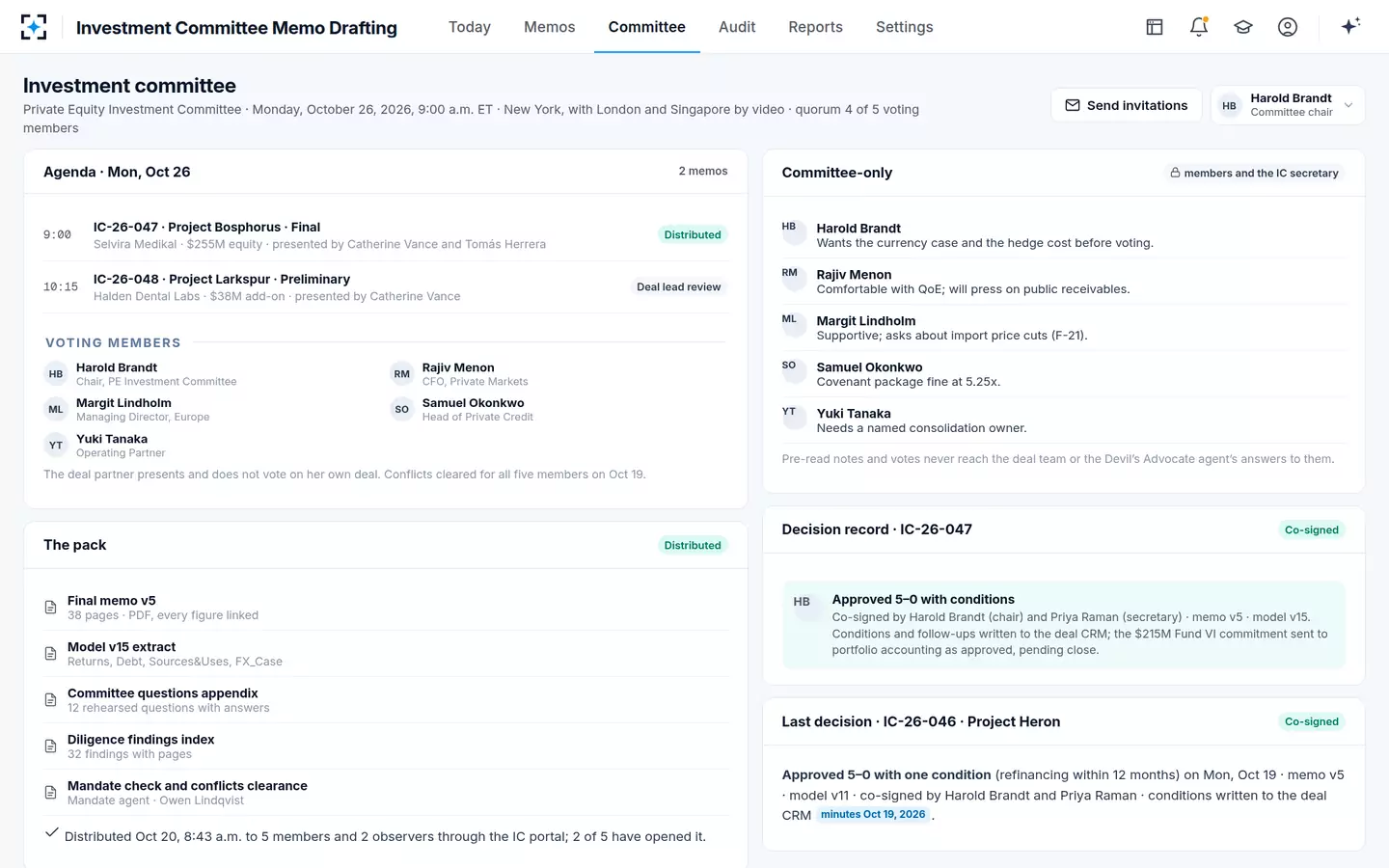
The deal team presents a memo the members have already read, the members question it, and the committee decides; the papers, not the presentation, carry the argument. In the sample, the agenda gives the final memo for one deal a slot at 9:00 a.m. and a preliminary memo for a smaller add-on at 10:15, so a final decision on a $415 million buyout has about an hour and a quarter. Some members join from London and Singapore by video.
The sequence is predictable. The partner restates the ask and the conditions in a few minutes. Members take turns on their own concerns, which is where the meeting is won or lost. The deal team answers from the memo or promises follow-up. Members vote, and the secretary writes down the result, the conditions and any follow-up owed. If the answer to a question is "we will come back to you", the deal usually comes back to the next meeting, and the timetable with the seller slips.
Who attends an investment committee?
Voting members, the presenting deal team, the committee secretary, and sometimes non-voting observers. The sample committee has five voting members: the chair; the chief financial officer for private markets; the managing director for Europe; the head of private credit; and an operating partner. A quorum is four of five. Two observers receive the papers. The deal partner presents with the vice president who led the deal, and under the firm's rules she does not vote on her own deal.
The mix is deliberate. Each member brings a lens: the CFO reads the quality of earnings, the credit head reads the debt package, the operating partner reads the 100-day plan. That is also why the questions are predictable. The operating partner in the sample has asked who owns a plant programme on every deal that had one.
How does an investment committee vote?
By the rule written into the firm's governance, and those rules vary more than most associates expect. The best evidence comes from venture capital. In the survey by Gompers, Gornall, Kaplan and Strebulaev, "roughly half the funds—particularly smaller funds, healthcare funds and non-California funds—require a unanimous vote of the partners" for an initial investment (NBER Working Paper 22587, published in the Journal of Financial Economics, 2020).
How investment committees decide: the voting rules venture firms reported
| Decision rule | Share of funds |
|---|---|
| Unanimous vote of the partners | 49% |
| Unanimous less one | 7% |
| Consensus, with some partners holding a veto | 20% |
| Majority of partners | 15% |
| Scoring | 2% |
A second study looked at why rules differ. Malenko, Nanda, Rhodes-Kropf and Sundaresan report that at major venture firms, for early-stage deals, "one partner ‘championing’ an early-stage investment is sufficient to invest", while "the same VCs use a more conventional ‘majority’ rule for later-stage investments" (accepted by the Journal of Finance, 2024). Their explanation is that early-stage outcomes are so skewed that one enthusiast should be able to carry a deal. On their argument, where outcomes are less heavy-tailed "a greater degree of consensus is optimal", and a buyout priced on today's earnings is that case: one member's unanswered question can reasonably hold a deal.
What questions does an investment committee ask?
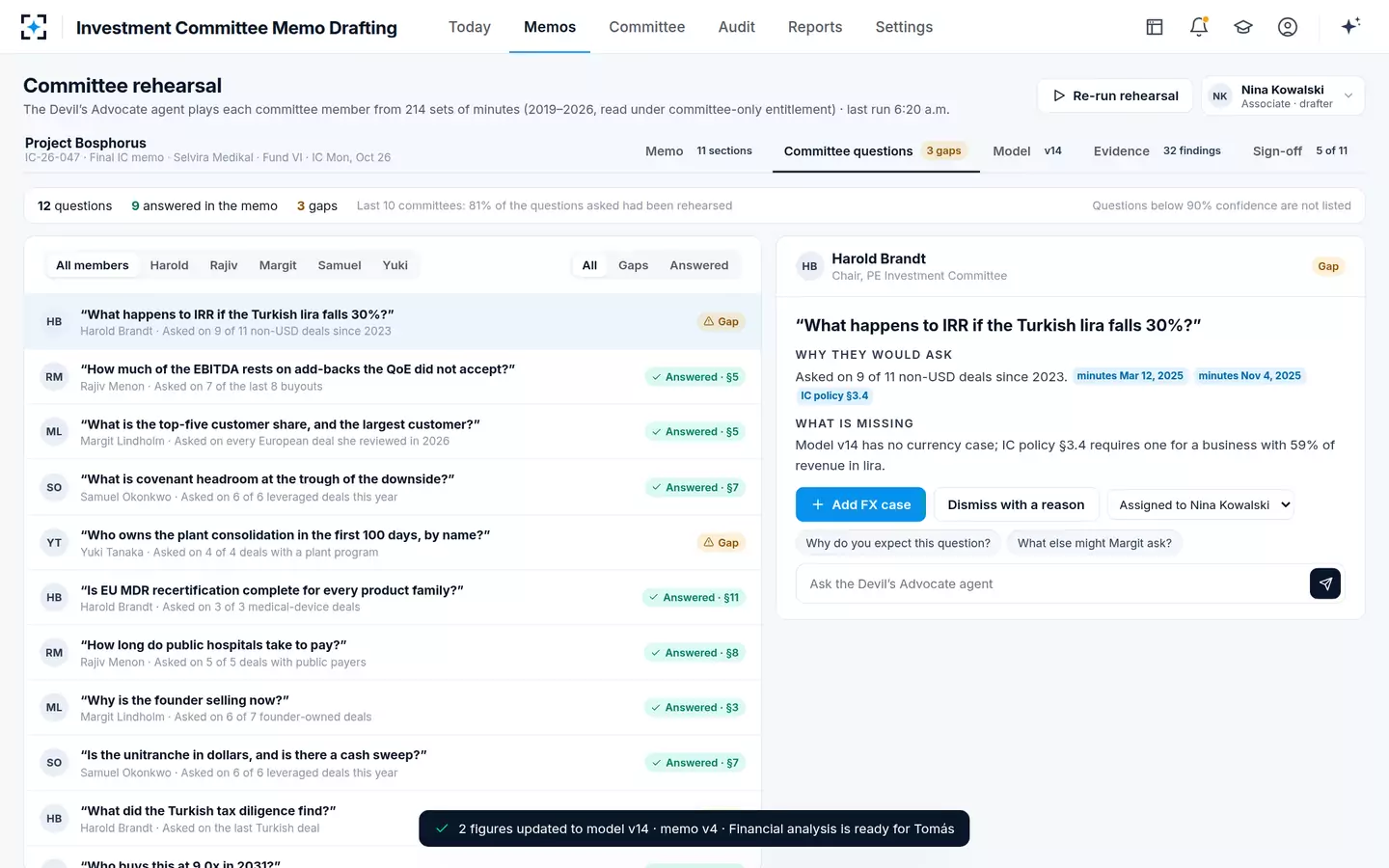
Members ask about what would make the returns wrong: the earnings the price rests on, the exit, the leverage, the plan and who runs it, and the risks specific to the deal, such as a currency or a regulator. In the sample, the twelve questions the solution rehearsed were about exactly those things, and each was tied to a member and to the deals on which that member had asked it before.
The chair asks what happens to returns if the lira falls 30%, and has done so on nine of eleven non-dollar deals since 2023. The CFO asks how much EBITDA rests on add-backs the quality of earnings provider did not accept. The managing director asks about the top five customers and why the founder is selling. The credit head asks about covenant headroom at the bottom of the downside case and whether the debt is in dollars. The operating partner wants a name against the plant move. Nine of the twelve were already answered in the memo, each pointing to its section. Three were not.
Twelve likely questions, by member, answered or a gap
Why committees spend the meeting on what everyone already knew
Groups talk about what they share, not about what only one member knows, and a memo is how a deal team makes sure the important facts are shared before anyone sits down. This is one of the most replicated findings in the study of group decisions. A meta-analysis of 65 studies, covering 3,189 groups, found that groups "mentioned two standard deviations more pieces of common information than unique information", and that groups whose members each held different parts of the picture "were eight times less likely to find the solution than were groups having full information" (Lu, Yuan and McLeod, Personality and Social Psychology Review, 2012).
What decades of group-decision research say a committee meeting will do
65
studies of how groups pool what their members know, 3,189 groups in all
2 SD
more discussion of information everyone held than of information only one member held
8×
less likely to reach the right answer when the information was split among members
For an IC memo the lesson is concrete. A diligence finding that only the associate has read, such as a plant director's contract expiring months after closing, will not surface in the meeting by itself. It has to be in the papers. In the sample, the Diligence agent flagged that finding as missing from the memo the morning it was read, which is the cheapest moment to fix it.
Rehearse from past minutes, not from memory
The best predictor of what a member will ask is what that member asked on comparable deals, and the committee's minutes record it. Deal teams already do this informally: a vice president warns an associate that the chair always asks about currency. The trouble with memory is that it is selective, and research on private equity decisions shows the cost of selective analogies.
Lovallo, Clarke and Camerer studied private equity investment decisions and found that an "outside view", built from a whole reference class of comparable cases, "performs better than a few analogies familiar to the decision maker" (Strategic Management Journal, 2012). Read every set of minutes for deals that share the current deal's features, rather than the two the VP remembers, and the rehearsal becomes a reference class too.
One rehearsed question, from the minutes it was learned from to the memo row that answers it
The question
“What happens to IRR if the Turkish lira falls 30%?”
The chair, Private Equity Investment Committee
Why he will ask
Asked on 9 of 11 non-dollar deals since 2023
Cites the minutes of March 12 and November 4, 2025, and IC policy §3.4
What the memo lacked
No currency case in model version 14
The policy requires one where more than a quarter of revenue is outside dollars; here 59% is in lira
How it was closed
Model version 15: 17.9% gross IRR, 2.2x; 19.6% with half of lira EBITDA hedged
A new returns row, a summary sentence and a hedge condition, each cited to the new tab
The gap was closed with analysis, not prose. The associate added a currency case to the model, the agents re-ran and checked the four new figures, and the memo gained a row, a sentence and a condition. In the sample, across the last ten committees, 81% of the questions members actually asked had been on the rehearsal list beforehand; that is a figure from the sample data, not a measured result, but it is the measure a real committee should track.
Why an assigned devil's advocate is not enough
Because role-played dissent is weaker than the real thing. In a study comparing the two, Nemeth, Brown and Rogers found that "the authentic minority was superior to all three forms of ‘devil's advocate,’" (European Journal of Social Psychology, 2001); a colleague told to argue the other side tends to bolster the view the group already holds. A language model asked to play the sceptic adds a second problem. Researchers testing five AI assistants found that they "consistently exhibit sycophancy across four varied free-form text-generation tasks", tilting answers toward the user's view (Sharma and co-authors, arXiv 2310.13548, not peer reviewed).
That is why the rehearsal in the solution, though its agent is called the Devil's Advocate, is built from authentic dissent: the questions real members actually asked, in minutes the deal team could not edit, matched to the features of the current deal. It does not invent objections or argue with the associate. Each question carries the minutes behind it, and anything below the 90% confidence setting stays in the agent's notes rather than on the list.
It also never leaks what members think. Past minutes, votes and members' pre-read notes are visible only to committee members and the secretary. In the sample, the chair's pre-read note says he wants the currency case and the hedge cost before voting; the deal team sees the question, never the note. How those minutes should be written and protected is the other half of the same system.
How do you prepare for an IC meeting?
Prepare the papers, not the speech: make sure every figure is current, every likely question is answered in the memo or written as a condition, and every unfinished piece of diligence is named. The checklist below is the order we would work in during the last week.
How to prepare for an investment committee meeting in the final week
- List each member’s likely questions from past minutes
Match on deal features: currency, leverage, plant programmes, public payers, founder sellers. Mark each answered, with its section, or a gap.
- Close gaps with analysis, not adjectives
A currency question is answered by a currency case in the model, not by a paragraph about currency risk.
- Re-check every figure against the latest model version
After the last model save, not before it. A changed figure the deal lead has not seen is the most common late surprise.
- Turn open items into conditions
A draft tax report or an unnamed 100-day owner is a condition on approval, written in the memo, not an apology in the room.
- Clear conflicts and the fund’s limits before the papers go out
Compliance clears every voting member; the fund-limit check is attached to the papers.
- Meet the papers deadline
In the sample, 5:00 p.m. two business days before the meeting. Papers that arrive late are read late, or not at all.
The committee's agenda, members, papers and committee-only notes
Questions people ask
How long is an investment committee meeting?
There is no standard; it depends on how many deals are on the agenda and how complete the papers are. In the sample, a final buyout memo has a slot of about an hour and a quarter before a preliminary memo for an add-on. Meetings run long when members discover gaps in the room, which is the cost rehearsal aims to remove.
What questions should I ask at an investment committee meeting as a member?
Ask what would make the returns wrong: which earnings the price rests on, whose forecast the base case uses and how much it was cut, what the exit multiple is compared with, how much headroom the debt has in the downside, and who runs the plan after closing. Ask for a named owner and a date for each condition.
Can an investment committee approve a deal with conditions?
Yes. In the sample the committee approved 5–0 with conditions, and the memo's conditions included an indemnity for a known legal claim and a currency hedge; the conditions were written to the deal team's tracking system so that someone owns each one until closing.
What is the difference between an investment committee and a board?
A board governs a company; an investment committee decides how a fund's capital is invested, under the fund's documents and the manager's own policies. At a private equity firm, the committee approves new investments and exits, while each portfolio company has its own board on which the firm's people sit.
Is it a conflict for a committee member to sit on a bidder's board?
It can be, and it is the kind of interest compliance should clear before the papers are distributed. In the sample, the deputy chief compliance officer cleared conflicts for all five voting members a week before the meeting, and the clearance went out with the committee papers.