Implementing an investment memo generator well takes about six weeks in our plan: one to connect the systems and collect your committee templates, IC policy, fund agreements and closed memos; one to set the templates and rules; two to redraft closed deals and measure the drafts against the memos your committee saw; one in the shadow of a live deal; and one to put a first memo in front of the committee. The weeks are targets, not a measured result, and the order matters more than the count. An investment committee memo is the document a private equity deal team writes to ask its committee for capital, and a generator earns trust only by proving on old deals that its figures tie to the model and its drafts miss nothing the committee needed. Botminds' Investment Committee Memo Drafting is set up this way, from the firm's own documents, and the plan below uses its settings and a fictional sample firm, Quillfield Capital, as the example.
Six weeks from past memos to a live investment committee
- Connect and collectweek 1
- Templates and rulesweek 2
- Redraft closed deals; measureweeks 3–4
- Shadow a live dealweek 5
- First live memoweek 6
How long does it take to implement an investment memo generator?
Plan on about six weeks to a first live memo, most of it spent proving the drafts on deals you have already closed. The software can be connected in days. What takes time is everything that makes the drafts yours: each committee's template, the IC policy's required scenarios and thresholds, the fund's limits, the house style in past memos, and the questions your members actually ask, which live in your minutes.
No regulator or independent study publishes implementation times for these tools, and vendors' claims are not evidence. The measure that counts is whether the generator passes its checks on your closed deals. If it does not by the end of week four, extend the redrafting phase rather than the timetable to the live committee.
What documents are needed to set up a memo generator?
Five sets, all of which a deal team already has: your committee templates, IC policy, fund LPAs, and past memos and minutes. The templates give the sections; the IC policy gives the required scenarios and thresholds; the fund agreements and side letters give the limits a deal is tested against; past memos give the house style and the closed deals to redraft; past minutes give the questions members ask.
What to bring in week one
- Each committee’s memo templates
Preliminary and final, for every committee that will use it. The sample firm has four: private equity final (11 sections) and preliminary (7), credit (9) and real assets (10).
- The IC policy, current version
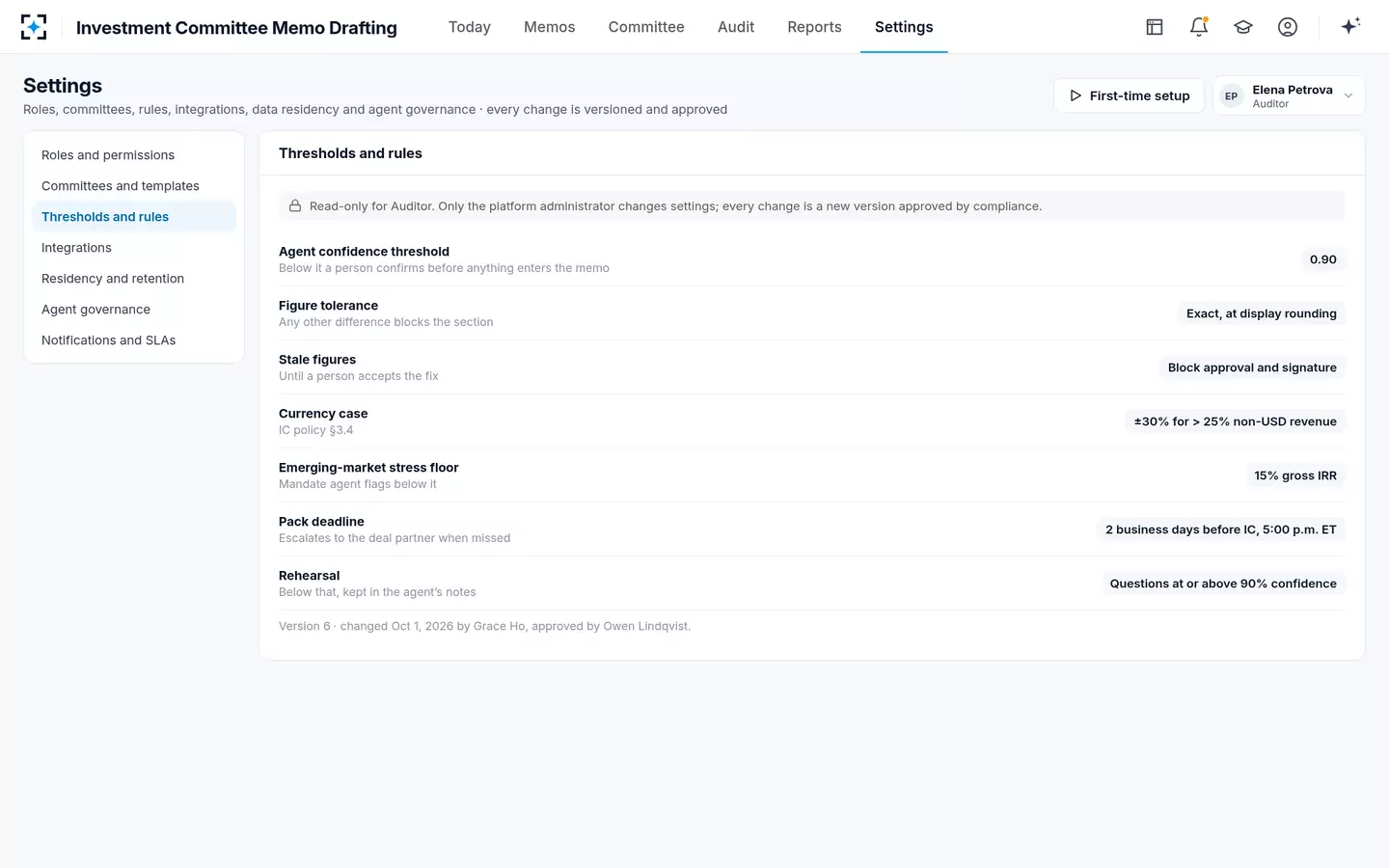
Required scenarios, stress floors, papers deadlines, who may vote. In the sample, a ±30% currency case for any business with more than a quarter of revenue outside dollars, and a 15% gross IRR stress floor.
- Fund agreements and side letters
The concentration and geography limits, excluded sectors and any investor-specific exclusions.
- Closed memos with their final models
Enough recent deals to redraft and measure; each memo paired with the model version it was signed against and the diligence reports it cited.
- Committee minutes
Several years, so the rehearsal has a reference class. In the sample, 214 sets since 2019, read under committee-only access.
- Read access to the systems
Document management for the model, the virtual data room, the deal CRM, portfolio accounting, the committee portal and the compliance system.
Can an investment memo generator use our IC template?
It should, and if it cannot, it is the wrong tool: a committee that reads a memo in a new order reads it less well. In the solution each committee's template is a setting, with its own sections in its own order, and the Drafting agent writes to it in the house style it learned from your closed memos. Changing a template, like any setting, creates a new version that takes effect when compliance approves it, and memos already signed keep the template they were signed under.
The template is also where most firms find work to do before going live. Writing down, section by section, what sources each part may draw on often exposes habits nobody chose, such as growth rates taken from the CIM. The investment committee memo template, section by section is a starting point for that exercise.
The rules every memo is checked against, as versioned settings
The six weeks of an investment memo generator go-live, week by week
Each week has an owner and a check that can fail. The checks are what make the plan worth following; a week whose check fails is repeated, not skipped.
Week 1, connect and collect. Read-only connections to the six systems; the documents above gathered; a list of closed deals chosen for redrafting, mixing currencies, sectors and at least one deal the committee sent back. Check: every chosen deal has its signed memo, its final model version and its diligence reports in one place.
Week 2, templates and rules. Each committee's template set up; the IC policy's thresholds entered; roles and separations configured (the drafter cannot approve, the approver cannot sign, the secretary cannot edit content); retention set. Check: compliance approves version 1 of the settings.
Weeks 3 and 4, redraft closed deals and measure. The generator drafts each closed deal's memo from the sources the deal team had, and the draft is compared with the memo the committee saw, figure by figure. A planted model change tests the stale-figure block. The rehearsal is run on each closed deal using only minutes from before it, and its list is compared with the questions members actually asked. Check: the measures in the table below.
Week 5, shadow a live deal. One live deal runs through the generator while the deal team still writes its memo by hand. The deal team reports every place the draft was wrong, thin or missing something. Check: nothing in the shadow draft would have misled the committee.
Week 6, first live memo. The deal team uses the drafted memo for one committee, with every rule live: section approvals with reasons, signature only when every figure is current and the fund-limit and conflicts checks are clean. Check: a review with the committee chair afterwards.
How do you validate an AI memo tool before a live deal?
Redraft closed deals and measure the drafts against the memos your committee actually saw, with pass marks set before you start. The measures should be ones a draft can fail. "Reads well" is not a measure; "every figure ties to its source" is.
Validation on closed deals: the measures and the pass marks to set in advance
| Measure | How it is tested | Pass mark (our recommendation) |
|---|---|---|
| Figures tied to a source | Every figure in each draft opens a model cell, CIM page or diligence page | All of them; the solution’s design target is 100% |
| Stale figures blocked | A planted model change on a closed deal; does approval block until a person accepts? | Blocked every time |
| Derived figures recomputed | Multiples, margins, conversion and headroom recomputed from inputs, compared at display rounding | No difference at display rounding |
| Findings missing from the memo | High- and medium-severity diligence findings with no place in the draft | Every one either placed or flagged |
| Questions rehearsed | Share of the questions members actually asked that the rehearsal listed in advance | Set your own bar from the closed deals; track it |
| Separation of duties | Try to approve a section as its drafter; try to sign as the deal lead | Refused both times |
The fourth row catches the failure that matters most and is easiest to miss: a draft that is accurate about everything it contains and silent about a finding that should have been in it. The fifth tells you whether the rehearsal is worth reading; in the sample firm, across the last ten committees, 81% of the questions members asked had been on the list, a sample figure that shows the kind of measure to keep, not a result to expect. How each measure is defined is set out in five measures for every figure in an investment committee memo.
Who owns the rollout?
A chief operating officer or head of the private equity business sponsors it; the IC secretary and compliance own the rules; a deal partner owns the choice of pilot deals; and the associates who use it own the verdict. A generator rolled out by technology alone tends to be judged on how its prose reads, which is the least important thing about it.
Who does what in an investment memo generator rollout
Today
Hears that memos take too long and committees send them back.
With agents
Sponsors the six weeks, sets the pass marks with compliance, decides on go-live.
Still theirs: the decision to go live
Today
Keeps templates in shared drives and minutes in email.
With agents
Sets up each committee’s templates, the papers deadline and the decision process.
Still theirs: the templates and the decision record
Today
Reviews the memo process once a year from policy documents.
With agents
Approves every settings version, the separations and the access to minutes.
Still theirs: approval of every rule
Today
Presents memos built by hand.
With agents
Chooses the closed deals to redraft and the live deal to shadow; signs the first live memo.
Still theirs: the signature
Today
Builds the memo by hand.
With agents
Marks every wrong or thin passage in the shadow draft; uses the live one.
Still theirs: the verdict on usefulness
What compliance should approve before go-live
Compliance should approve the rules, the separations, who can read committee minutes, what the record keeps and for how long, and how the tool's use will be described to investors. Advisers already review their compliance policies at least once a year under Rule 206(4)-7 (17 CFR 275.206(4)-7); the go-live is the point at which the memo process enters that review with evidence rather than description. European supervisors have set out the expectation in similar terms. ESMA's 2024 statement says "senior management should foster a culture of risk ownership, transparency and accountability", and that "clear documentation and reporting mechanisms should be established to ensure transparency and accountability in AI-related risk management practices" (ESMA public statement, May 30, 2024; written for retail investment services).
Before the first live memo: what compliance signs off
- The settings, as version 1
Confidence threshold, figure tolerance, stale-figure block, required scenarios, stress floor, papers deadline, rehearsal threshold.
- The separations
Drafter cannot approve; approver cannot sign; secretary cannot edit content; no agent approves, signs or records a decision.
- Access to minutes and notes
Committee-only for votes and members’ notes; the rehearsal learns from minutes but never shows a vote or a note to the deal team.
- Handling of inside information
How deal documents and committee papers fit the firm’s information barriers and restricted list.
- The record and its retention
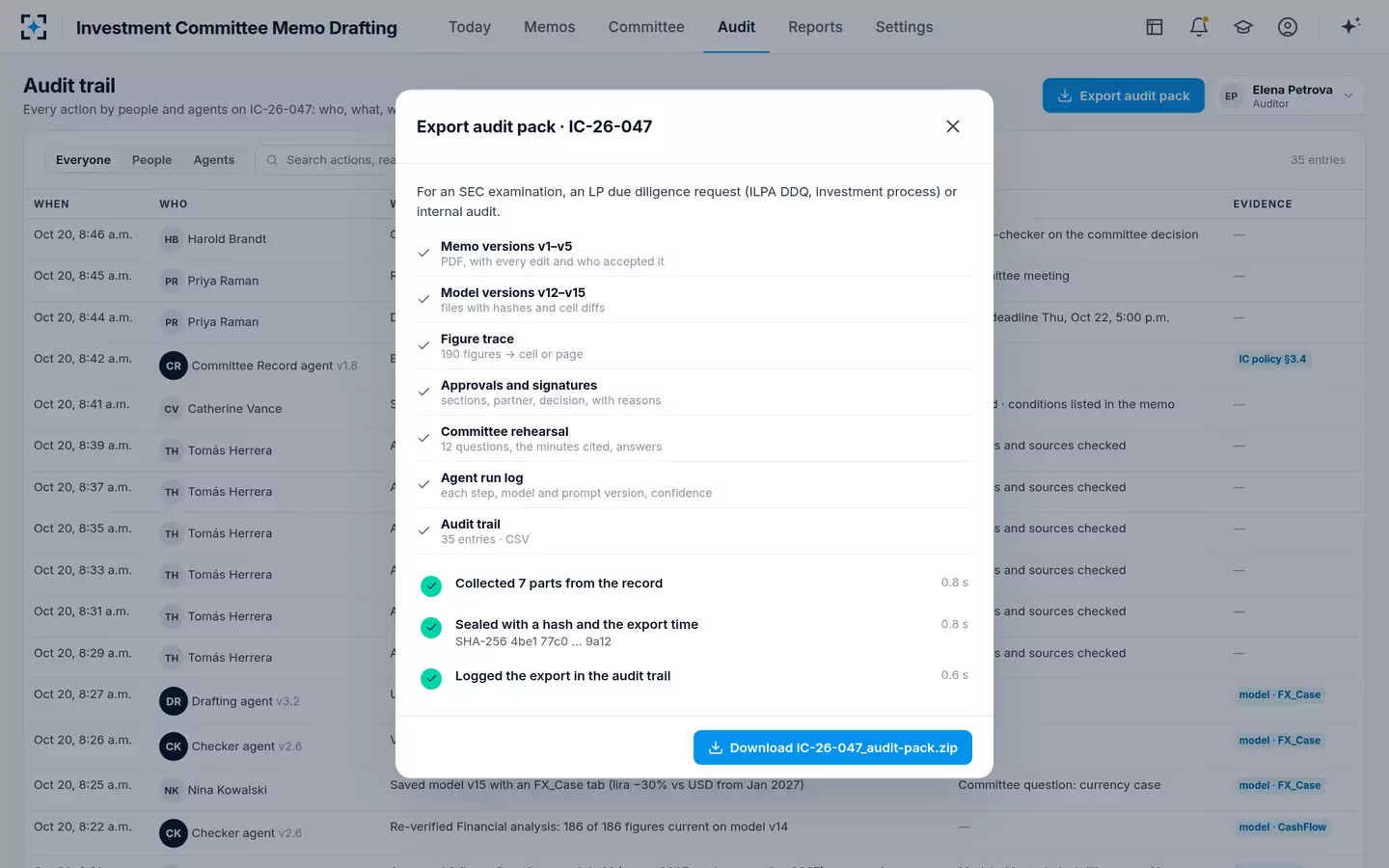
Every memo and model version, approvals with reasons, the agent run log; kept at least as long as Rule 204-2 requires, and indexed for retrieval.
- What investors will be told
A description of the process as it actually runs, with nothing claimed for the tool that it does not do.
What the record holds once a memo has been decided
What the Bank of England and FCA found about AI in financial firms
Most firms already use AI, few let it decide alone, and many do not fully understand the models they buy. The Bank of England and FCA's third survey of AI in UK financial services, published in November 2024, is the best regulator-run picture of how firms are adopting it, and three of its findings bear directly on a memo generator.
AI in UK financial services, as firms reported it to their regulators
75%
of firms already using AI, with a further 10% planning to within three years
1 in 3
AI use cases are third-party implementations
46%
of firms report only partial understanding of the AI technologies they use
2%
of use cases have fully autonomous decision-making
The third finding is the one to plan for. The survey attributes partial understanding "largely" to third-party models, which is what a memo generator will be for most firms. The remedy is the redrafting phase: a firm that has watched a generator draft its own closed deals, and measured where it was wrong, understands the tool it is buying in the way that matters. The fourth finding sets the design: in a memo process the agents draft and check, and every decision stays with a named person.
After go-live: what to measure in the first quarter
Keep the validation measures running on every live memo, and add two that only live use can produce: how many times the committee sent a memo back, and how associates' hours moved. The first is the committee's own verdict; the second tells you whether the hours went to judgement or simply disappeared from the timesheet. Where an IC memo's hours go sets out how to log them. Review the settings at the end of the quarter with compliance, and record every change as a new version.
Questions people ask
Can we pilot an investment memo generator on a live deal first?
We would not. A live deal has no answer key, so a pilot on one shows how the draft reads, not whether it is right. Closed deals let you compare every figure with the memo your committee saw and every rehearsed question with the questions members asked. Shadow a live deal only after the closed-deal checks pass.
How many closed deals should we redraft?
Enough to cover the variety your committee sees: different currencies, sectors, a carve-out if you do them, and at least one memo the committee sent back. For a firm with one committee that is often a handful of recent deals; the point is coverage of the kinds of deal, not a large count.
Does the generator need access to our committee minutes?
Only for the rehearsal of likely questions, and only under committee-only access. In the solution the rehearsal agent learns from past minutes but never shows a member's vote or notes to the deal team. A firm that does not want minutes read can still use drafting and checking without the rehearsal.
Who can change the generator's rules after go-live?
In the sample firm, only the platform administrator changes settings, and each change is a new version that takes effect when compliance approves it. Memos already signed keep the rules they were signed under, so a later change never rewrites history.
What if the generator fails a check during the six weeks?
Repeat the phase, find out why, and do not move to a live deal until it passes. A failure on a closed deal is cheap and informative; the same failure in front of the committee costs a week and some trust.