An IC memo in private equity is the document a deal team writes to ask its firm's investment committee to commit a fund's capital to a company: the recommendation, the thesis, the financials, returns and scenarios, risks, diligence status and the plan after closing, written to the committee's template. The associate usually drafts it, the vice president who leads the deal reviews it, and the deal partner signs and presents it; the committee then votes. The work is hard because the memo has to agree, figure by figure, with a model and a dozen diligence reports that keep changing until the day the papers go out. Botminds' Investment Committee Memo Drafting gives that first draft to agents and keeps the people where the judgement is: the associate edits and checks, the deal lead approves each section with a reason, and the partner signs a memo whose figures are all current.
The roles below are illustrated with a fictional sample deal team in the solution, at Quillfield Capital: an associate, a vice president leading the deal, a deal partner, an IC secretary and a five-member Private Equity Investment Committee.
The scale behind the IC memo in private equity
27,682
private equity funds reported to the SEC on Form PF, fourth quarter of 2025
2,047
SEC-registered advisers that advise private equity funds
61.8
of every 100 opportunities a firm considers reach a partner-group or committee review, on average
$124,370
median pay of financial and investment analysts in securities and investment firms, May 2025
What is an IC memo in private equity?
It is the written case for a deal, addressed to the people who can commit the fund's money, and it usually comes in two forms. A preliminary memo asks for permission to spend on full diligence and exclusivity; a final memo asks for the capital and lists the conditions. In the survey of private equity investors by Gompers, Kaplan and Mukharlyamov, the average firm took 61.8 of every 100 opportunities it considered to a partner-group or committee review, and closed 6.1 (Table 19, working paper text). On those averages, a committee reads about ten memos for every deal it closes. That arithmetic is ours, but it explains why memo quality is a capacity question for the whole firm, not a style question for one associate.
In the sample firm each committee keeps its own template: eleven sections for a private equity final memo, seven for a preliminary one, nine for a credit committee and ten for real assets. What each of the eleven sections holds, and where its figures come from, is set out section by section elsewhere in this series.
Who writes the IC memo?
The associate writes it, almost always. The associate builds the tables from the deal model, reads the diligence reports as they arrive, drafts each section to the template and keeps the memo in step with the model as the deal team changes it. In the sample, the associate describes her Sundays spent re-pasting numbers from the latest model version into the memo, the night the private equity investment memo case follows hour by hour.
The seat has no official occupation of its own. The Bureau of Labor Statistics counts private equity associates among financial and investment analysts, whose median pay was $102,740 in May 2025 across all industries and $124,370 in securities, commodity contracts and other financial investments (BLS Occupational Outlook Handbook). Those figures cover far more than private equity and say nothing about bonuses, but they put a floor under what an hour of memo-typing costs a firm.
When agents draft the first version, the associate's work changes shape rather than disappearing. The associate starts from a drafted memo in which every figure opens its source, reads the diligence findings the agents flagged as missing, accepts or rejects each proposed edit, and closes the gaps the committee is likely to probe. In the sample that meant adding a currency case to the model itself rather than writing a sentence about currency risk.
What does the VP do on an IC memo?
The vice president, or whoever leads the deal day to day, is the memo's first critical reader and its approver. The VP decides what the memo argues, challenges the associate's numbers, and in most firms reads the whole memo again each time the model changes, because nothing else shows what moved. The sample VP puts it plainly: "I need to know which figures changed since I last read it."
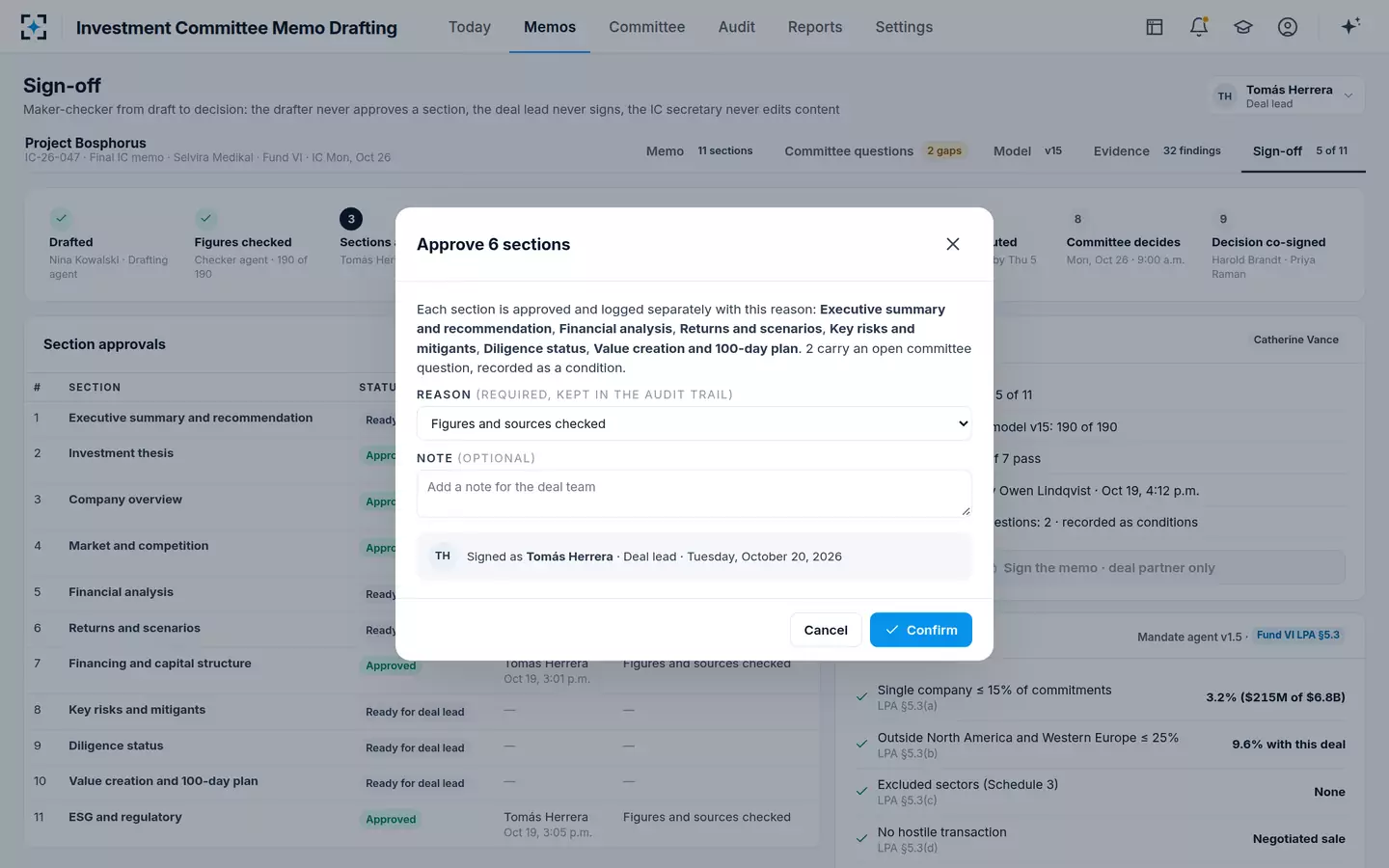
In the solution that rereading becomes a list. Every saved model version shows which cells changed and where each sits in the memo, so the deal lead reviews the two figures that moved rather than the 186 that did not. The approval itself becomes more specific: the deal lead approves each section separately, with a required reason such as "Figures and sources checked", "Approved with edit" or "Approved · open question recorded as a condition", and the reason stays on the audit trail.
The deal lead approves six sections, each with a reason, and cannot sign
Who signs the investment committee memo?
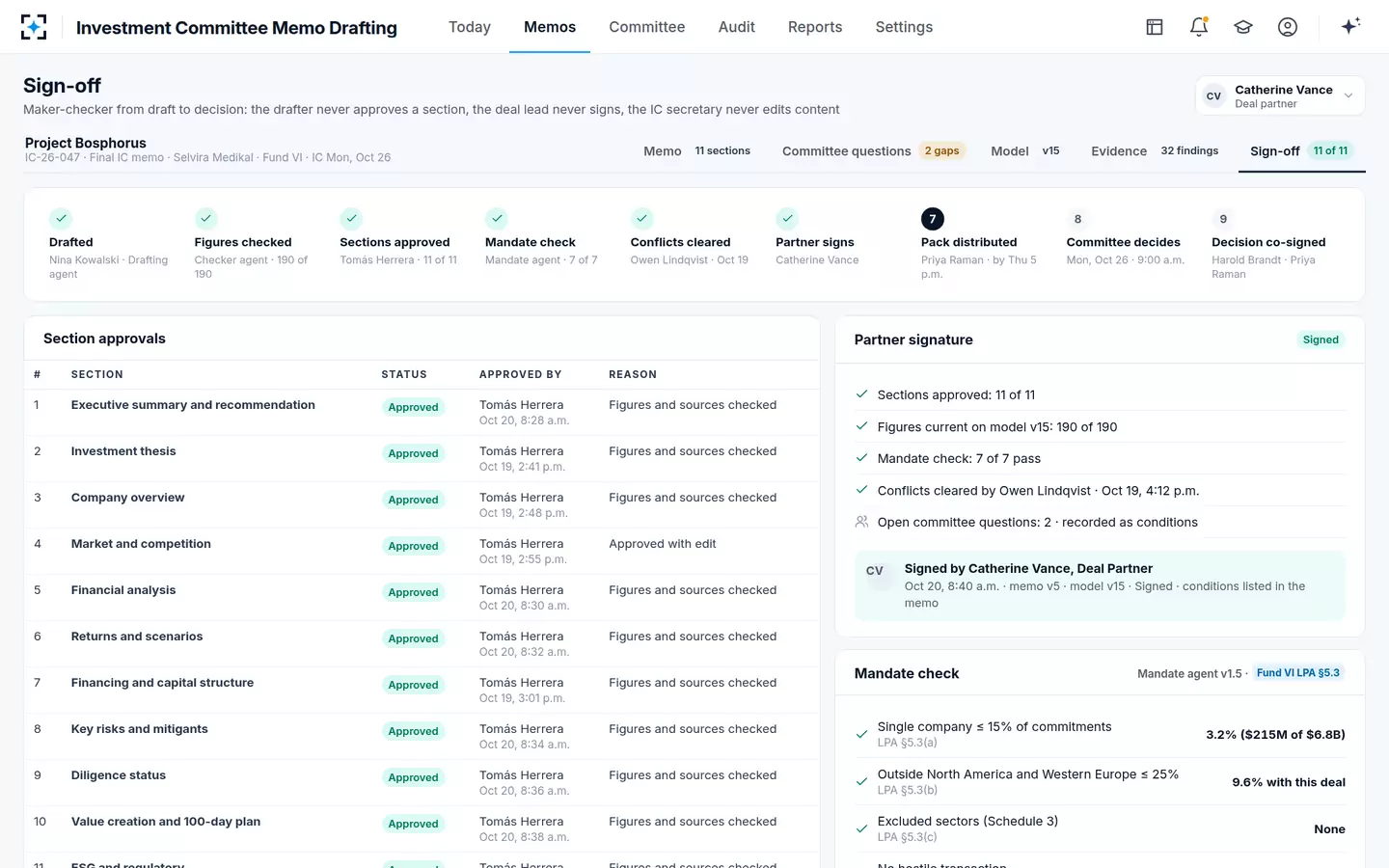
The deal partner signs it and presents it; the committee decides. Signing means the partner stands behind the recommendation and its figures, which is why in the sample the signature only opens when every section is approved, every figure is current on the latest model version, the fund's limits are checked and conflicts are cleared. Catherine Vance, the sample's deal partner, signed memo version 5 against model version 15, with two open committee questions listed as conditions.
The partner then presents to a committee on which she does not vote for her own deal. That is the sample firm's rule, not a legal requirement, and committees differ: in a survey of venture capital firms by Gompers, Gornall, Kaplan and Strebulaev, roughly half required a unanimous vote of the partners for an initial investment (NBER Working Paper 22587, Table 32). After the vote, the IC secretary records the decision and the committee chair co-signs it, and the conditions go to the deal team's tracking system. What those minutes should hold for an examiner or an investor is its own subject.
The deal team before and after drafting moves to agents
The change is a shift of each person's hours from assembly to judgement, with the order of authority unchanged. The comparison below follows the sample team.
An IC memo in private equity: the deal team before and after the first draft is drafted for it
Memo built by hand: Types every table from the model, re-pastes after each new version, reads each report, writes each section.
Memo drafted by agents, decided by people: Edits a drafted memo, accepts or rejects each proposed fix, closes the committee’s likely gaps in the model.
Memo built by hand: Re-reads the whole memo after every model save; approves by email.
Memo drafted by agents, decided by people: Reviews only the figures a new version moved; approves section by section with a reason; cannot sign.
Memo built by hand: Finds out what the memo is missing in the meeting.
Memo drafted by agents, decided by people: Signs a memo whose sections are approved, figures current and limits checked; open questions become conditions.
Memo built by hand: Chases sign-offs, assembles committee papers, keeps the decision trail in email.
Memo drafted by agents, decided by people: Distributes once the partner signs; records the decision for the chair to co-sign.
Memo built by hand: Clears conflicts from a list; checks fund limits from a spreadsheet.
Memo drafted by agents, decided by people: Clears conflicts as one step of the sign-off chain; the fund-limit check is drafted clause by clause and any breach comes to compliance.
Who keeps which decision in Investment Committee Memo Drafting
Today
Builds the memo by hand from the model, the CIM and the diligence reports.
With agents
Starts from a cited draft, accepts fixes, adds the analysis the committee will ask for.
Still theirs: what the memo argues, and every edit
Today
Re-reads after each model change and approves by email.
With agents
Reads the changed figures, approves each section with a reason.
Still theirs: section approval; never the signature
Today
Presents a memo checked as far as time allowed.
With agents
Signs against a named model version, with conditions listed.
Still theirs: the signature and the presentation
Today
Chases sign-offs and assembles committee papers.
With agents
Distributes the signed memo and records the decision.
Still theirs: the decision record, co-signed by the chair
The research on knowledge work with AI tools gives a reason to keep it that way. In a preregistered experiment with 758 knowledge workers at a global consulting firm, people using GPT-4 on tasks inside the tool's capabilities completed 12.2% more tasks and finished 25.1% more quickly, but on a task chosen to be outside them they were 19% less likely to reach a correct answer than people working without it (Dell'Acqua and co-authors, Harvard Business School working paper, published in Organization Science, 2026). An IC memo contains both kinds of work. Tables, figure checks and citations sit inside; the judgement about price and risk sits outside. The deal team's roles should follow that line.
Why the person who drafts a section may not approve it
Because a check by the author is not a check. A second reader catches what the first could not see, and separation makes the approval mean something to the committee and, later, to anyone reviewing how the decision was made. The sample firm writes it as three rules: the drafter never approves, the deal lead never signs, and the IC secretary never edits content.
Regulators have pointed at overlapping roles as a weakness in private markets governance. Reviewing how firms handle transactions between their own funds, the FCA reported in October 2026 that "We also observed examples where the same individuals remained involved on both sides of transactions and where committee memberships overlapped" (FCA multi-firm review, conflicts of interest and fair customer treatment in private markets). That finding is about conflicted transactions rather than memo approvals, but the remedy is the same idea: decide in advance who may do what, and make the system enforce it.
From draft to decision: who acts at each step of the IC memo
Agent
Drafting agentWrites each section to the committee’s template, every figure tied to a model cell or a page.
Never: writes a figure without a source
Agent
Checker agentRe-verifies every figure on each model version and recomputes derived figures.
Never: changes a figure itself; it blocks approval while one is stale
A person decides
AssociateAccepts or rejects each proposed edit and closes the committee’s gaps.
A person decides
Deal leadApproves each section with a reason; cannot approve a section he drafted.
A person decides
ComplianceClears conflicts; receives any breach of the fund’s limits.
A person decides
Deal partnerSigns against a named model version, conditions listed.
A person decides
IC secretary and chairDistribute the papers, record the vote and co-sign the decision.
What compliance owns before the memo reaches committee
Compliance owns three things a deal team cannot clear for itself: conflicts, the handling of inside information, and the fund's own limits. Under Section 204A of the Investment Advisers Act, every registered adviser must have and enforce written policies to stop material nonpublic information being misused (15 U.S.C. 80b-4a), and a committee member who sits on a portfolio company board, or a deal partner who knows a listed bidder's plans, is exactly where those policies bite. Under Rule 206(4)-7 the adviser names a chief compliance officer to administer its policies and reviews them at least once a year (17 CFR 275.206(4)-7).
In the sample, conflicts for all five committee members were cleared by the deputy chief compliance officer on October 19, the day before the partner signed. The fund-limit check ran against Fund VI's partnership agreement clause by clause: the $215 million commitment is 3.2% of the $6.8 billion fund against a 15% single-company limit; with this deal, investments outside North America and Western Europe reach 9.6% against a 25% cap; no excluded sector; no hostile transaction. A breach would not have been cleared by the agent that found it; it would have gone to compliance.
The partner's signature, the sign-off chain and the fund-limit check
What a head of private equity should change first
Start with the rules, not the software: who may approve, what a signature certifies, and what a figure must be tied to. Tools enforce rules; they do not invent good ones. The checklist below is where we would begin.
Five changes to the IC memo operating model, in the order we would make them
- Write down the three separations
The drafter never approves, the approver never signs, the secretary never edits content. Then check last year’s memos against them.
- Approve sections, not documents
One approval per section, with a short list of reasons, makes it visible which parts were read closely and which were waved through.
- Make the signature mean something specific
The partner signs a named memo version against a named model version, with open questions written as conditions.
- Lock the model for committee
After the papers go out, a model change needs a reason and reaches the committee as an amendment, not a quiet edit.
- Measure the hours you get back, and spend them on the questions
Track where associate time goes for one quarter before and after; the aim is more time on the committee’s likely questions, not fewer associates.
The last point is the operating model in one line: capacity moves to judgement, not out of the team. How many hours there are to move, and where they sit today, is worked through in where an IC memo's hours actually go. Whether a drafting agent can be trusted to check its own figures is answered, with the research, in why the drafter must not check itself.
Questions people ask
How long does an IC memo take to write?
Nobody outside the firms collects this, and it varies with the deal. Our estimate for a first full draft of a final buyout memo written by hand is about 60 associate hours, most of it building tables, reading diligence and re-checking figures after model changes. The way to know your own number is to log one memo's hours by task.
What does a private equity associate do on a deal?
The associate builds and maintains the model, reads the data room and the advisers' reports, drafts the IC memo, and coordinates diligence requests. On the IC memo specifically, the associate is the author of record for every section and the person who keeps the memo in step with the model.
Does the deal partner vote at the investment committee?
It depends on the firm's rules. In the sample firm the deal partner presents and does not vote on her own deal; other firms count the sponsoring partner's vote. In a survey of venture capital firms, about half required a unanimous vote of the partners for an initial investment, which makes the sponsor's vote less decisive than it looks.
Can an associate approve a section of the IC memo?
Not one they drafted, if the firm separates making from checking. In the solution the drafter of a section cannot approve it, the deal lead approves each section with a reason, and only the deal partner can sign. The rule matters most when deadlines are tight, which is when it is most often waived.
Who presents the IC memo to the committee?
Usually the deal partner, often with the deal lead. In the sample, the final memo for Project Bosphorus was presented by the deal partner and the vice president; a preliminary memo on the same agenda was presented by the deal partner alone.