An investment committee memo example is most useful when you can see where each number came from, not only what the memo says. Below is the executive summary of a final IC memo for a $415 million buyout, with every figure annotated: the model cell, the confidential information memorandum (CIM) page or the diligence page behind it, and what a committee member would do to check it. The IC memo is the document a private equity deal team writes to ask its investment committee for capital; it is hard to write well because its figures come from three kinds of source that change at different speeds. Botminds' Investment Committee Memo Drafting drafts the memo from those sources and ties each figure to its origin, so the annotations below are what the solution shows on screen.
The deal is a fictional sample in the solution: Quillfield Capital Partners VI, a $6.8 billion fund, buying Selvira Medikal, an Izmir maker of IV sets, catheters and wound-care products, for its Private Equity Investment Committee on Monday, October 26, 2026.
An investment committee memo example: the executive summary, every figure annotated
1 · Executive summary and recommendation
We recommend that the Committee approve an equity commitment of $255M1, $215M from Fund VI and $40M of LP co-invest, to acquire 100% of Selvira Medikal Sanayi ve Ticaret A.Ş. at an enterprise value of $415M2, 9.4x3 QoE-adjusted LTM EBITDA of $44.0M4.
Selvira makes IV sets, catheters and wound-care products in two Turkish plants, employs 1,9405 people and earns 41%6 of its revenue from exports to the EU. The base case returns 21.4% and 2.6x7 over a five-year hold, exiting at 9.0x8.
Approval is asked subject to a specific indemnity for the former-distributor claim of TRY 41.6M9, and to the final Turkish tax diligence, whose report is due October 23.
- 1
$255M equity · Model, sources and uses
Open the cell. $215M from Fund VI plus $40M of co-investment adds up in your head.
- 2
$415M enterprise value · Model, sources and uses
Open the cell; compare with the price in the letter of intent.
- 3
9.4x · Model, derived
Recompute: 415 ÷ 44.0 = 9.43. A ratio that does not recompute is the first thing to query.
- 4
$44.0M QoE-adjusted EBITDA · Quality of earnings report, p. 14
Management’s figure was higher; $2.1M of its add-backs were not accepted. Read the page, not the summary.
- 5
1,940 people · CIM
The seller’s number. Fine for scale; check against the HR diligence before relying on it.
- 6
41% exports to the EU · Financial statements in the data room, p. 21
Read with its twin: 59% of revenue is in lira, which is what the currency question is about.
- 7
21.4% and 2.6x · Model, returns tab
Open the cells. Gross, before fees and carry; the memo should say so.
- 8
9.0x exit · Model assumption
An input, not a result. Compare it with the entry multiple and with recent sector deals.
- 9
TRY 41.6M claim · Legal diligence, p. 17, in Turkish
Open the page in the original. Sized at about $0.9M; the condition is an indemnity.
What does an investment committee memo look like?
A final investment committee memo looks like a long, numbered document, not a slide deck: in the sample, 38 pages and eleven sections, opening with a summary that fits on one screen and states the ask, the price, the returns and the conditions. Everything after it is evidence for those four things. The summary above holds twelve figures in three short paragraphs, and every one of them is repeated, explained or derived somewhere in the body.
The order of the body is the committee's choice, and the sample's is typical: investment thesis, company, market and competition, financial analysis, returns and scenarios, financing, key risks and mitigants, diligence status, value creation and the 100-day plan, and ESG and regulatory. The investment committee memo template, section by section sets out what each holds and where its numbers may come from. This page shows what that looks like on one deal.
The executive summary, annotated figure by figure
Read the annotations as a member would, with a minute to spare. Eight of the twelve figures come from model cells and open with one click, and one of those, the 9.4x entry multiple, can also be recomputed in your head: $415 million divided by $44.0 million is 9.43. Three need a page in a diligence report. One, the headcount, is the seller's own number from the CIM, and the memo says so by its colour.
What a member can check in the twelve figures of one summary
8
from model cells, opened with one click
3
from diligence pages: the QoE EBITDA, the export share and the legal claim
1
from the CIM: the seller’s headcount, not yet confirmed by diligence
1
that recomputes in your head: 415 ÷ 44.0 = 9.4x
The figure that repays the most attention is the smallest-looking one: $44.0 million of EBITDA. It is green, not blue, because it comes from the quality of earnings report rather than from the deal team's own model. Management's adjusted figure was higher; the QoE provider did not accept $2.1 million of its add-backs, and the deal team's model version 13 moved from $46.1 million to $44.0 million to match. Every multiple and return in the memo rests on that one page, which is why the summary cites it.
Where the 186 figures in this example come from
Across the whole memo, not just the summary, the first full draft held 186 figures. The split by source tells a committee how much of the memo is the deal team's own analysis and how much it is borrowing.
Most of the memo is the deal team’s model; a fifth is the seller’s document
The 39 figures from the CIM deserve a second look in any memo. A CIM is written to sell the company. Some of its figures, such as founding dates and plant locations, are harmless; others, such as growth rates and market positions, should be replaced by a diligence figure wherever one exists, or flagged as the seller's where none does. A memo that colours its figures by source makes that review a scan rather than a reading.
The investment thesis, annotated: whose number is it?
The thesis in the sample has three claims, and the colours show something the words do not. In the first, "3 of 4 product families hold certificates under the EU Medical Device Regulation" is green, from the regulatory diligence; "export revenue to the EU grew 14.8% a year from 2022 to 2025" is violet, from the CIM. The growth rate behind the first reason to buy the company is the seller's.
That does not make it wrong. It makes it a question: does the financial diligence confirm 14.8%, and is it in dollars or euros? The second claim, a $1.9 billion Turkish hospital-consumables market growing 9.2% a year in dollars with a 14% share, is all from commercial diligence. The third, a $6.3 million annual saving from moving catheter lines between plants by 2028, is a model output, and its support, that 18 of 20 customers interviewed would re-tender to the company, is cited to page 52 of the commercial report.
The distinction between actual and projected figures matters for the same reason. Reviewing private fund advisers in 2022, SEC examiners found track records built on "inaccurate underlying data", including cases of "projected rather than actual performance used in performance calculations" (SEC Division of Examinations risk alert, January 27, 2022; staff observations, not a rule). That finding concerned performance shown to investors, not committee memos, but the discipline transfers: a memo should never let a projection sit in a sentence that reads like history.
How are returns shown in an IC memo?
Returns are shown as gross IRR and money multiple for each case, with the entry and exit multiples beside them, because that is how most private equity investors say they judge deals (Gompers, Kaplan and Mukharlyamov, Journal of Financial Economics, 2016). The sample's section 6 is one table and two sentences.
The example’s returns section: four cases, one exit multiple to argue about
| Case | Key assumption | Gross IRR | Multiple |
|---|---|---|---|
| Base | Exit at 9.0x in 2031, $742M enterprise value | 21.4% | 2.6x |
| Upside | EU volume 4% a year higher | 27.6% | 3.2x |
| Downside | Tender prices 8% lower, exit at 8.0x | 12.8% | 1.7x |
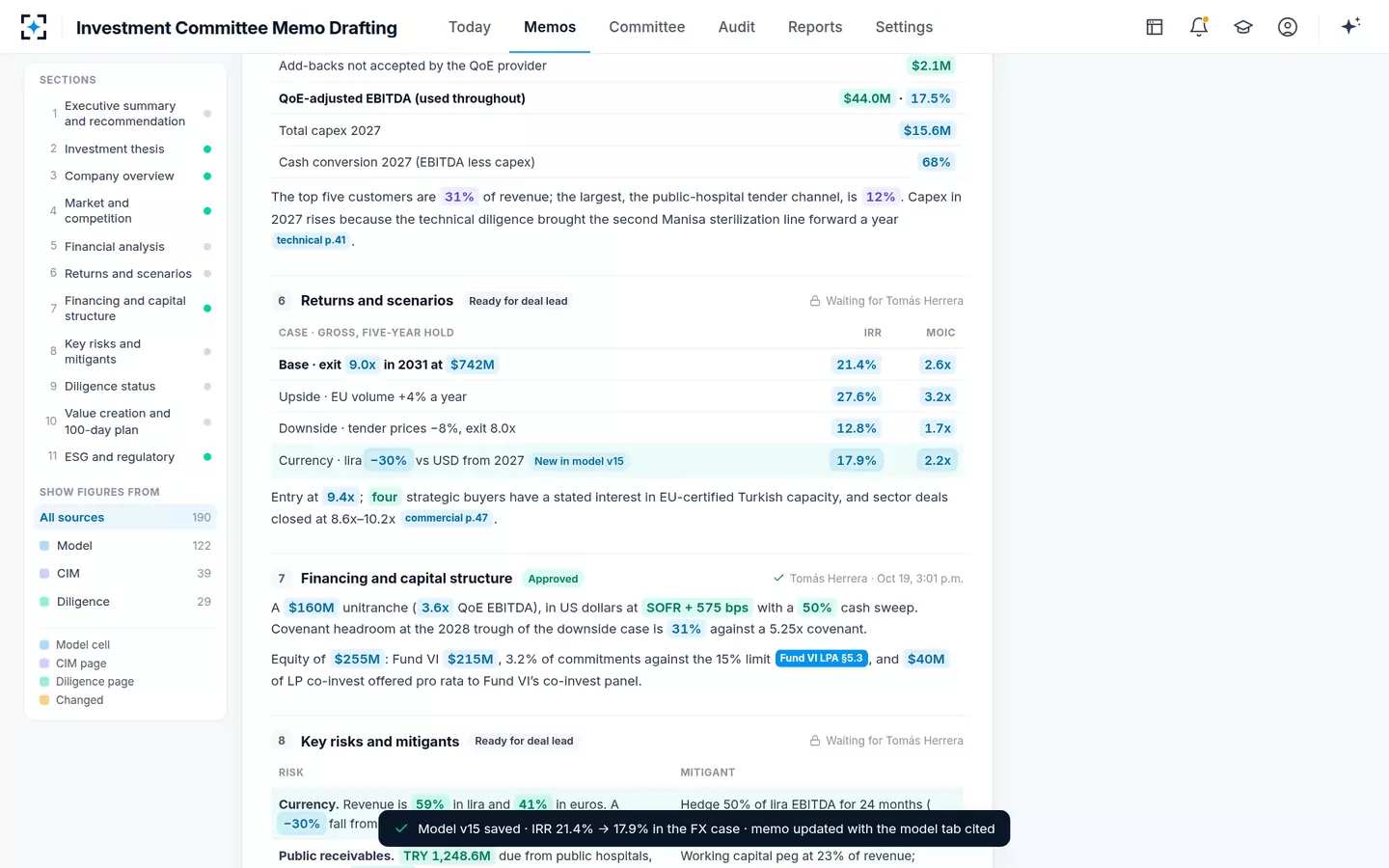
| Currency, new in model version 15 | Lira 30% weaker against the dollar from 2027 | 17.9% | 2.2x |
The exit multiple is where a committee should push, because it is an assumption that moves every row. The sample answers the push in the right way: it cites a range of comparable deals, 8.6x to 10.2x, and names buyers, rather than defending 9.0x by itself. Research on private equity decisions supports that habit: Lovallo, Clarke and Camerer found that judging a deal against a whole class of comparable cases beats leaning on the few the decision maker happens to know (Strategic Management Journal, 2012), a finding the questions a committee asks puts to work.
A reference class in the returns section, the full set of comparable exits rather than the one the deal team remembers, is that finding put to work. A memo can show it in a sentence and a page citation, as the sample does.
What is the investment recommendation section?
The recommendation is the first paragraph of the executive summary: the amount, the price and the conditions on which approval is asked. Conditions are the part members read most closely, because they are what the committee is actually voting to require. In the draft above there are two: an indemnity for a known claim, and a diligence report that is not yet final.
Conditions also grow. In the sample, a rehearsal of the questions the committee was likely to ask showed that the chair asks about currency on nine of eleven non-dollar deals since 2023, and the model had no currency case. Once the case was added, the final memo carried a further condition: a hedge of 50% of lira-denominated EBITDA for 24 months, with the hedged case at 19.6% gross IRR. How that question was found before the meeting is the subject of rehearsing the investment committee meeting from past minutes.
The returns section after the currency case was added
What a member can verify in a minute, and what it takes on trust
A member reading forty pages before a meeting cannot verify everything, and should not try. An annotated memo helps by sorting the figures into what can be checked quickly, what needs a page, and what rests on judgement. The last group is the one worth the meeting.
Reading this investment committee memo example: quick checks, page checks and judgement
Can be checked in a minute: Equity, enterprise value and the split between fund and co-investment open their model cells; the multiple recomputes.
Has to be taken on trust, or argued: Whether 9.4x is a fair price for this business, against the range of sector deals.
Can be checked in a minute: The QoE figure and the add-backs not accepted are on one cited page.
Has to be taken on trust, or argued: Whether the remaining adjustments will recur, which the QoE adviser judged and the memo inherits.
Can be checked in a minute: The market size and share are cited to commercial diligence.
Has to be taken on trust, or argued: The 14.8% export growth, which comes from the seller’s CIM until diligence confirms it.
Can be checked in a minute: Each case opens its cells; the currency case is labelled new.
Has to be taken on trust, or argued: The exit multiple and year, which move every case at once.
Can be checked in a minute: The legal claim opens in Turkish beside the English.
Has to be taken on trust, or argued: The court’s outcome, and whether an indemnity is worth the seller’s covenant.
The right-hand column is short on purpose. If a committee spends its meeting confirming that the left-hand column is right, the memo has failed at its job. If the memo shows the left-hand column is right, the committee can spend its time on the right.
A Turkish finding read at its source, not through a summary
The ninth annotation is the one most memos get wrong. The former distributor's claim sits on page 17 of the legal diligence report from Turkish counsel, written in Turkish. In many deal teams it reaches the memo through a translator's summary, and the committee sees a figure with no page behind it.
The legal claim, in the original beside the English, one click from the memo
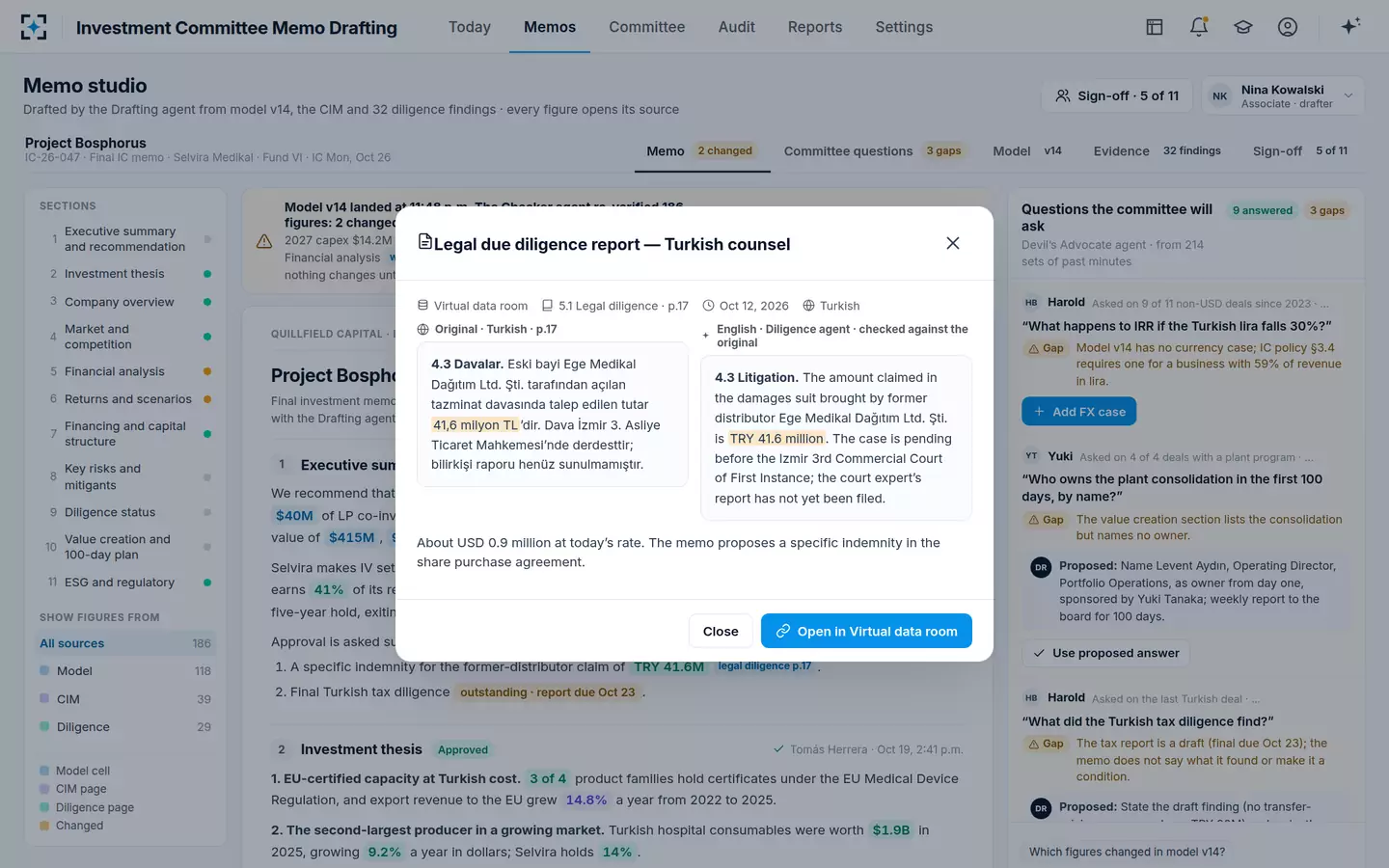
The same check applies to any figure from a foreign-language report: the English sentence in the memo should open the original passage. Whether the memo then stays right when the model changes the night before is the subject of the night the model changed.
Questions people ask
Where can I find a private equity investment memo example?
Real IC memos are confidential and rarely published, so most examples online are templates or teaching cases. The example on this page is a fictional deal built to show how a final memo cites its sources. If you use any example, check that its returns are gross or net as stated and that every figure has a source, because examples are often copied without either.
How detailed is an IC memo?
Detailed enough that each figure can be traced and each risk has a mitigant, and no more. The sample final memo runs to 38 pages with 186 figures in its first draft; a preliminary memo, asking only for a diligence budget, is much shorter. Detail belongs in cited reports, with the memo carrying the conclusion and the page.
What does the executive summary of an IC memo say?
It states what the committee is asked to approve (the equity amount and its split), the price as an enterprise value and multiple, the base-case returns and the conditions. In the sample that is three short paragraphs and twelve figures. It should introduce no figure that is not in the body.
Are IC memo returns gross or net?
Deal-level returns in IC memos are usually gross, before management fees and carried interest, because the committee is judging the investment rather than the fund. The memo should say so in the table heading, as the sample does with "gross, five-year hold". Net figures belong in fund-level reporting to investors.
What should an IC memo example never include?
Figures without a source, projections presented as history, and generic risks with no mitigant. It should also never carry a figure from a draft diligence report as if it were final; the sample lists its unfinished Turkish tax report as a condition instead.