A clean team agreement is a confidentiality agreement, signed alongside the main non-disclosure agreement, that restricts a seller's most competitively sensitive information, such as customer-level prices, margins, tenders and strategic plans, to a small group of named people on the buyer's side who do not set prices or strategy, and lets them pass on only aggregated or blinded conclusions. It matters when the buyer competes with the target, or owns a company that does, because until the deal closes the two are still competitors and an exchange of pricing can break antitrust law whether or not the deal is cleared. Botminds' Virtual Data Room Due Diligence recognises those pages in the seller's data room, fences them to the clean team that compliance approved, gives everyone else aggregated, cited summaries and logs every view.
The examples come from a fictional sample deal run through the solution: Quillfield Private Equity Fund V is buying Skarvik Logistik AB, a Swedish contract-logistics company, while the same sponsor's Fund IV owns Veltra Logistics, which competes with Skarvik in Poland. The deal team lead sits on Veltra's board. The firms, people and figures in the sample are fictional; the enforcement cases are real and linked.
What jumping the gun has cost, and the clock it jumps
$5.6M
record US civil penalty for gun jumping, agreed in January 2025
€124.5M
EU fine on Altice in 2018 for acting on a target before clearance
30days
US waiting period after both parties file under the HSR Act, unless ended early or extended
4people
on the sample deal’s clean team; the deal lead is not one of them
What is a clean team agreement, and when does a deal need one?
A clean team agreement is the second confidentiality agreement in a deal between competitors: the first covers diligence generally, the second covers the information that could let the buyer coordinate with the target before closing. A Delaware court record shows the pair in a real acquisition. Before Fresenius Kabi agreed to buy its competitor Akorn, the two "entered into two confidentiality agreements, one covering due diligence generally and the second permitting a “clean team” to review competitively sensitive information that might have antitrust implications" (Akorn v. Fresenius Kabi, Del. Ch., 1 October 2018).
A deal needs one when the buyer's side includes anyone who competes with the target. For a private equity sponsor that is wider than it looks: the buyer may be one fund, but the competitor may be a portfolio company of another fund under the same manager, and the people who sit on that company's board may be the same people running the deal. The US competition staff's advice to the buyer's side is direct: "Establish clean teams and employ third-party consultants for competitively sensitive information that must be exchanged" (FTC Bureau of Competition, 20 March 2018).
Clean team agreement vs NDA: what is different?
A non-disclosure agreement protects the seller's information from the outside world; a clean team agreement protects competition from the buyer's own business. The NDA asks the buyer to keep the room confidential. The clean team agreement goes further and limits who inside the buyer may see particular information at all.
The NDA keeps the room confidential; the clean team agreement keeps it away from competitors
Non-disclosure agreement: The seller’s information from disclosure to third parties
Clean team agreement: Competition between buyer and target until closing
Non-disclosure agreement: The buyer, its advisers and financing sources with a need to know
Clean team agreement: Named individuals only, vetted and approved, who do not set prices or strategy
Non-disclosure agreement: Everything in the data room
Clean team agreement: Competitively sensitive items: customer-level prices, margins, tenders, plans
Non-disclosure agreement: Use for evaluating the deal
Clean team agreement: Aggregated or blinded conclusions, reviewed by counsel before they go to the business
Non-disclosure agreement: Return or destroy the seller’s documents
Clean team agreement: Destroy the documents and any analysis built on them
Who can be on a clean team?
Anyone who does not take part in competitive decisions for the buyer's competing business, and who has been vetted for the role. The FTC staff's test is the one to apply first: "Clean teams should not include any personnel responsible for competitive planning, pricing, or strategy", and "Outside counsel should vet clean team members for the role." Outside consultants and counsel are the usual members; deal professionals can join if they have no role at the competing business.
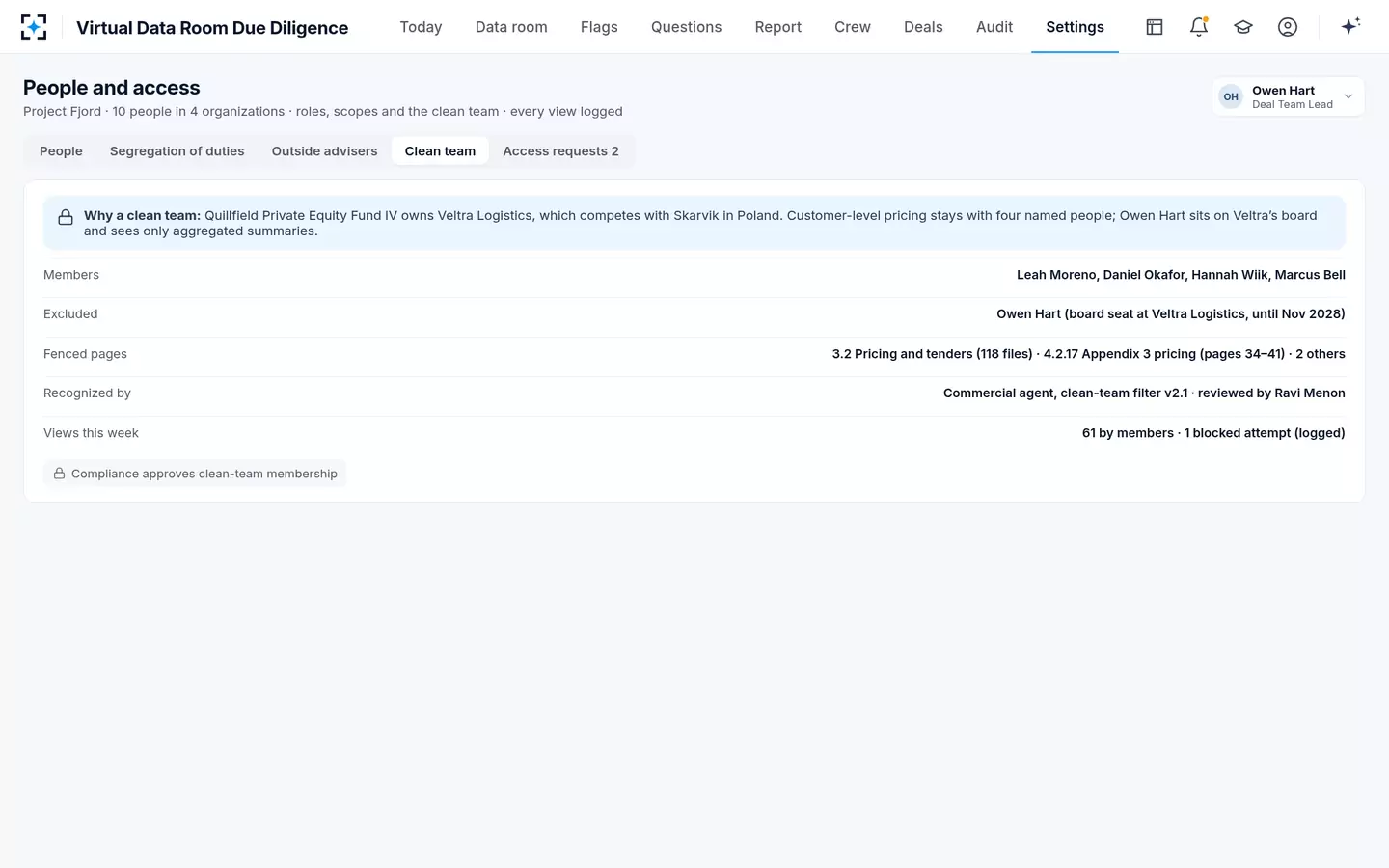
In the sample, four people are on the clean team: the deal associate, the firm's legal counsel and two others, all approved by compliance; one membership was approved on 16 October with the reason "need to know". The deal team lead is excluded because he sits on the board of Veltra Logistics, the Fund IV company that competes with the target in Poland, until November 2028. He leads the deal and decides every red flag, but on the fenced pages he sees only aggregated summaries.
Who sees what in the sample room
Customer-level prices and tenders (folder 3.2, 118 files)
Clean team (4 named)Sees it
Deal lead on a competitor’s boardAggregated summary only
Other deal teamAggregated summary only
Outside advisersOnly what is in its scope
Pricing appendix of the top customer contract (4.2.17, pages 34–41)
Clean team (4 named)Sees it
Deal lead on a competitor’s boardAggregated summary only
Other deal teamAggregated summary only
Outside advisersOnly what is in its scope
Revenue by customer, aggregated and cited
Clean team (4 named)Sees it
Deal lead on a competitor’s boardSees it
Other deal teamSees it
Outside advisersOnly what is in its scope
The contract’s other terms, such as change of control (4.2.17, page 12)
Clean team (4 named)Sees it
Deal lead on a competitor’s boardSees it
Other deal teamSees it
Outside advisersOnly what is in its scope
The grid shows the point of a clean team in a private equity deal. The deal lead still sees the customer's share of revenue, the change of control clause and every other finding he needs to price the deal; what he does not see is the individual prices a competitor's board member should not hold. The red flag and the clean team coexist on the same contract, at page 12 and pages 34 to 41.
What is gun jumping in M&A?
Gun jumping is acting as if a deal has closed before the law allows it: taking control of the target, coordinating its prices or customers, or receiving information that lets the buyer do either, before the waiting period ends or clearance is granted. In the United States, the HSR Act bars completing a reportable deal until the waiting period expires, which ends "on the thirtieth day after the date of such receipt" of both filings, or the fifteenth for a cash tender offer, unless extended (15 U.S.C. 18a(b)(1)). The FTC describes the purpose simply: the period exists "so that the federal agencies can investigate the deals before they close", and it is "generally illegal to finalize an acquisition during this investigatory period".
The record US penalty shows what enforcers count as control. In January 2025, three oil companies agreed to "a record $5.6 million civil penalty" after the buyers were alleged to have ordered "a stoppage to EP's planned well-drilling and development activities" and coordinated "on prices for EP's customers in the Eagle Ford region of Texas" before the waiting period ended (FTC, 7 January 2025). In the EU, the Commission fined Altice €124.5 million in 2018, finding among other things that it had been "seeking and receiving detailed commercially sensitive information about PT Portugal outside the framework of any confidentiality agreement" (European Commission, 24 April 2018).
Information alone can be enough. The FTC staff warned that pre-merger sharing can breach the HSR Act when it hands the buyer, in effect, beneficial ownership of the seller before the deal closes. A clean team agreement is the buyer's evidence that the sensitive part of diligence never reached the people who could act on it.
What information can be shared before closing?
Share what the buyer needs to value the business and plan the integration, in the least sensitive form that does the job. The FTC staff's 2018 guidance gives sellers and buyers a practical list, and every item on it can be written into the data room's permissions.
The FTC staff's safeguards, written as data room settings
- “Share the least amount of information needed for effective due diligence.”
Fence folders, or single pages, rather than whole agreements.
- “Mask customer identities and aggregate all competitive information.”
Give the deal team revenue by customer tier and the clean team the detail.
- Prohibit data room users “from downloading or e-mailing confidential information”
View-only access for fenced pages, and no copy of their text outside the clean team’s view.
- Reports “should contain blinded, aggregated versions” of the sensitive data
Clean team reports go to the business only after counsel has reviewed them.
- Examine materials “including schedules later added to data rooms”
New uploads are checked for sensitive pages on arrival, not only the first index.
- “Requiring bidders to destroy any independent internal analysis based on the confidential data.”
Destruction of documents and derived work if the deal ends, with a certificate.
Download restrictions and late uploads are coverage questions as much as antitrust ones; how a data room review accounts for every file, including fenced ones, is set out in proving how much of the data room was read.
Enforcing a clean team in the data room, page by page
An agreement on paper protects nothing if the room lets anyone open any page. Enforcement has three parts: recognising sensitive pages as they arrive, limiting them to named people, and proving afterwards who saw what. In the sample, the Commercial agent recognises competitively sensitive pages, compliance approves who is on the team, and every view is logged.
From a sensitive page to a logged view
Agent
Commercial agentRecognises competitively sensitive pages as each file arrives, using a clean-team filter that compliance reviewed.
Never: show customer-level pricing outside the clean team
A person decides
Ravi Menon, complianceApproves each clean team member and records the reason.
Agent
Questions agentRoutes any seller question about fenced data to the clean team only, such as a request for the top customer’s volumes and prices.
Never: release a question
A person decides
Clean team memberReads the fenced pages and writes the aggregated conclusion the deal team may see.
A person decides
Owen Hart, deal team leadWorks from aggregated, cited summaries; a blocked attempt to open a fenced page is logged, not hidden.
The clean team settings: why it exists, who is in, who is out
What happens to clean team materials if the deal fails?
They are destroyed, and so is the analysis built on them. The FTC staff list "Requiring bidders to destroy any independent internal analysis based on the confidential data" among the safeguards, because a losing bidder that keeps a competitor's prices has gained exactly what the agreement was meant to prevent. In the sample firm's settings, seller material is destroyed within 30 days of a deal ending and a destruction certificate is issued; if the deal closes, retention follows the firm's policy of seven or ten years, and a legal hold suspends deletion.
Closing does not end every restriction at once. Until the deal is consummated, the FTC staff note, "the merger parties are still independent businesses", so integration planning that needs customer-level detail stays inside the clean team until the day of closing. The timetable that governs those weeks, from the waiting period to closing, is covered in how long due diligence takes on a buyout.
The rules around clean teams are moving: what changed in 2024–26
Clean team practice now rests on the statutes, the cases and staff guidance, because the agencies' main guidance on collaborations between competitors was withdrawn in December 2024 and its replacement is still being consulted on. The HSR filing form changed and then changed back. A deal team should check each item below on the day it relies on it.
Dated changes that bear on clean teams and pre-closing conduct
| Date | What happened | Where it stands |
|---|---|---|
| 11 Dec 2024 | FTC and DOJ withdrew the 2000 Antitrust Guidelines for Collaborations Among Competitors, which they said “no longer provide reliable guidance” | Withdrawn; no replacement issued |
| 7 Jan 2025 | Record US gun-jumping penalty: $5.6 million (XCL Resources, Verdun Oil, EP Energy) | Settled |
| 10 Feb 2025 | New HSR premerger notification form took effect | Vacated, see below |
| 12 Feb 2026 | A federal district court vacated the new HSR form | Filers use the form in place before 10 February 2025 |
| 23 Feb 2026 | FTC and DOJ opened a public inquiry on guidance for business collaborations, listing “information and data sharing” among the topics | Comments closed 24 April 2026; guidance not yet issued |
| 19 Mar 2026 | The court of appeals denied the FTC’s motion for a stay pending appeal | Appeal pending; FTC page updated 23 March 2026 |
Why does a private equity firm need a clean team when the buyer is a new fund?
Because competition law looks at the sponsor's group, and the people, not only at the fund doing the deal. A sponsor that owns a competitor through an earlier fund, or whose partners sit on a competitor's board, has a route by which a target's prices could reach a competing business. The sample deal is the common case: a new fund buying a company that competes in one country with a company owned by the previous fund, run by a partner who sits on that company's board.
The clean team list is therefore one of the inputs a sponsor brings to any diligence tool on day one, alongside its red flag rules and the people on the deal, as set out in what you bring to private equity due diligence software. To see the fence, the logged views and the routed questions on the sample deal, start from Virtual Data Room Due Diligence.
Questions people ask
What does a clean team agreement template usually cover?
The categories of information that count as clean team material, the named members and how members are added, what members may pass on and in what form, review of outputs by counsel, how the material is stored and viewed, and return or destruction if the deal ends. FTC staff also suggest restricting downloads and emailing from the data room for such material.
Is a clean team the same as an information barrier?
No. A clean team keeps a competitor's commercially sensitive information away from people who compete with the target; an information barrier keeps material non-public information away from people who trade securities. A private equity firm may need both on one deal, with different lists of people behind each.
Can the deal lead see clean team reports?
Yes, if they are aggregated or blinded and counsel has reviewed them. The FTC staff say clean team reports "should contain blinded, aggregated versions of the competitively sensitive information." In the sample, the deal lead sees revenue by customer and every red flag, but not individual customer prices.
Do outside consultants on a clean team sign the agreement?
They are usually bound by it, through their engagement or by signing an acknowledgement, because the FTC staff recommend using third-party consultants for competitively sensitive information. What matters is that each person seeing fenced material is named, vetted for the role and on the log.
Is a clean team needed if the buyer does not compete with the target?
Usually not for antitrust reasons, though a seller may still restrict its most sensitive pages. Check the whole group first: other funds' portfolio companies, board seats held by the deal team, and co-investors who operate in the same market. In the sample deal, the overlap came from a company owned by a different fund of the same sponsor.