Buy-side due diligence is the investigation a buyer carries out on a target company before signing a purchase agreement: its own review of the seller's documents, financial results, contracts, tax, environmental position and people, done to decide what to pay, what protections to demand and what conditions to set. It differs from sell-side work in whose interests it serves and what the buyer may later rely on. It is hard because the evidence arrives in the seller's data room under the seller's index, an order built to show what has been disclosed, while the findings that move the price are scattered across folders and workstreams. Botminds' Virtual Data Room Due Diligence reads the whole room and organises what it finds by the buyer's own red-flag rules and questions, each finding cited to the seller's folder and page.
The examples come from a fictional sample deal run through the solution: Quillfield Private Equity Fund V buying Skarvik Logistik AB, a Swedish contract-logistics company with SEK 4,520 million ($429 million) of revenue, from a seller's room of 5,418 documents in eleven numbered folders and six languages. Everything about the deal is sample data, not a customer result.
The same room, organised two ways
11folders
in the seller’s index, numbered by document type and entity
8questions
in the buyer’s map below, each answered from several folders
47flags
raised against the buyer’s rules in the first week
64questions
drafted for the seller, with 12 duplicates across workstreams merged
What is buy-side due diligence?
Buy-side due diligence is the buyer's own check that the business is what the seller says it is, carried out before the buyer is bound. Its value lies in its timing. Wangerin, studying public acquirers, describes due diligence as giving the buyer "a more informed assessment of the expected costs, benefits, and risks of an acquisition" and "one last opportunity to renegotiate or terminate an M&A transaction" (Contemporary Accounting Research, 2019). For an EU fund manager it is also an obligation with a deadline: for an illiquid asset bought after a negotiation, the manager must do its diligence on the transaction before arranging to execute it (Delegated Regulation 231/2013, Article 19(1)(d)).
In a buyout it usually runs as six workstreams, legal, financial, tax, commercial, ESG and HR, most of them with outside advisers, and ends in a red-flag report to the investment committee. How those workstreams divide the reading, and who answers for the whole, is set out in the six workstreams of private equity diligence.
Buy side vs sell side due diligence: what changes with the side you are on
Sell-side due diligence is commissioned by the seller to prepare the business for sale and to give bidders a common starting point; buy-side due diligence is commissioned by a buyer to price and protect its own deal. The documents can overlap almost entirely. The purpose, the scope and above all the reliance do not.
Buy-side and sell-side diligence answer different questions about the same room
Sell-side (vendor) due diligence: The seller, before or during the sale
Buy-side due diligence: Each buyer, for itself
Sell-side (vendor) due diligence: Find and fix issues early, and give every bidder the same picture
Buy-side due diligence: Decide price, protections, conditions and the post-closing plan
Sell-side (vendor) due diligence: The seller and its advisers
Buy-side due diligence: The buyer’s own red-flag rules and investment case
Sell-side (vendor) due diligence: Whatever the seller chooses to say
Buy-side due diligence: Often only the representations in the purchase agreement
Sell-side (vendor) due diligence: Vendor reports placed in the data room
Buy-side due diligence: A red-flag report to the buyer’s investment committee, and seller questions
What is a vendor due diligence report, and can a buyer rely on it?
A vendor due diligence report is a report the seller commissions from an adviser and places in the data room for bidders to read. Whether a buyer can rely on it is a question of contract, not of quality, and purchase agreements often say the buyer may not rely on anything outside the agreement itself. Delaware's Court of Chancery enforced such a clause in a sale between two private equity firms: the agreement "stated the Buyer’s promise that it was not relying upon representations and warranties not contained within the Agreement’s four corners and that no such extra-contractual representations had been made" (ABRY Partners V v. F&W Acquisition, Del. Ch., 14 February 2006).
The court held that "Delaware law permits sophisticated commercial parties to craft contracts that insulate a seller from a rescission claim for a contractual false statement of fact that was not intentionally made", while a lie written into the contract itself stays actionable. The consequence for the buyer is practical. The vendor report, the management presentation and the data room are evidence to test, not promises to hold the seller to. Anything the buyer finds there that matters has to be turned, before signing, into price, a representation, an indemnity or a condition.
Why the seller's index is built to disclose, not to price
A seller's index is organised by document type and legal entity because its job is to prove what was disclosed; a buyer's reading has to be organised by the questions that change the price, because that is what the buyer will decide. The two structures cut across each other. In the sample room, the question of whether the largest customer can leave is answered by a contract in folder 4.2, a revenue file in folder 2, and the seller's answers in its Q&A log.
The seller's index and the buyer's question map are built for different jobs
The seller’s index: Document type and legal entity: corporate, financial, contracts, real estate, tax
The buyer’s question map: Questions that move price, protection or conditions
The seller’s index: The seller’s counsel, before the buyer arrives
The buyer’s question map: The buyer’s deal team, from its red-flag rules and investment case
The seller’s index: A folder and a document
The buyer’s question map: A finding, its size and the pages behind it
The seller’s index: No: it shows what was filed
The buyer’s question map: Yes: an unanswered question is itself a finding
The seller’s index: Added to the end of a folder
The buyer’s question map: Matched to the open question they answer
Keeping both is the trick. The seller's numbering is the right address system, because every adviser and the seller's own counsel can open "4.2.17, page 12". The buyer's questions are the right reading plan, because they decide where the hours go. Accounting for every file in the seller's index, read or explained, is a separate discipline, covered in data room due diligence coverage.
The buyer's question map: eight questions that move price
Most of what moves a buyout's price can be framed as eight questions, each answered from several folders and checked by two workstreams. The table applies them to the sample room; a firm's own red-flag rules turn each one into tests.
Eight buyer questions, the folders that answer them, and what the sample room showed
| Buyer’s question | Where the answers sit | Checked by | In the sample room |
|---|---|---|---|
| Who could leave on a change of control? | 4.2 Customer contracts; 2 Financial information; the seller’s Q&A log | Legal + Financial | F-01: the top customer, 23.0% of revenue, may terminate (4.2.17, p.12) |
| Are the adjusted earnings real? | 2 Financial information: the databook and add-backs | Financial + Tax | F-02: SEK 31M of “one-off” add-backs recur every year (2.3.04, p.18) |
| What tax exposure is not disclosed? | 7 Tax, against the disclosure letter | Tax + Legal | F-03: a PLN 14.2M Polish transfer-pricing assessment (7.2.06, p.3) |
| What is the net debt, really? | 2.4 Working capital; 4.4 Financing | Financial + Legal | F-11: SEK 118M of factored receivables outside the bridge; disputed |
| What will the sites cost to clean up? | 5 Real estate and environment | ESG + Financial | F-04: Duisburg groundwater, EUR 2.1M to remediate, unprovisioned (5.4.02, p.23) |
| Which regulators are asking questions? | 8 Litigation, compliance and data protection | Legal + ESG | F-09: a privacy authority inquiry into a breach affecting about 38,000 people (8.2.04, p.1) |
| Who works here, and on what terms? | 6 Human resources | HR + Tax | F-08: 214 drivers in Poland engaged as contractors (6.4.03, p.2) |
| What will the largest customers demand next? | 4.2 Customer contracts; 3 Commercial and customers | Commercial + ESG | F-05: the top customer requires 40% fossil-free transport by 2028; the target is at 14% (4.2.17, p.15) |
Two things stand out in the right-hand column. Half the findings sit in a folder other than the one a reader would open first: the net-debt question is answered partly in the financing folder, and the customer's environmental demand sits in a commercial contract, not in the environment folder. And the largest customer contract answers two questions at once, on pages 12 and 15. Read by index, those are one document; read by question, they are two findings for two workstreams. The first of them, and how it was sized, is the subject of the change of control clause guide.
The seller's index on screen, with the buyer's flags pinned where they sit
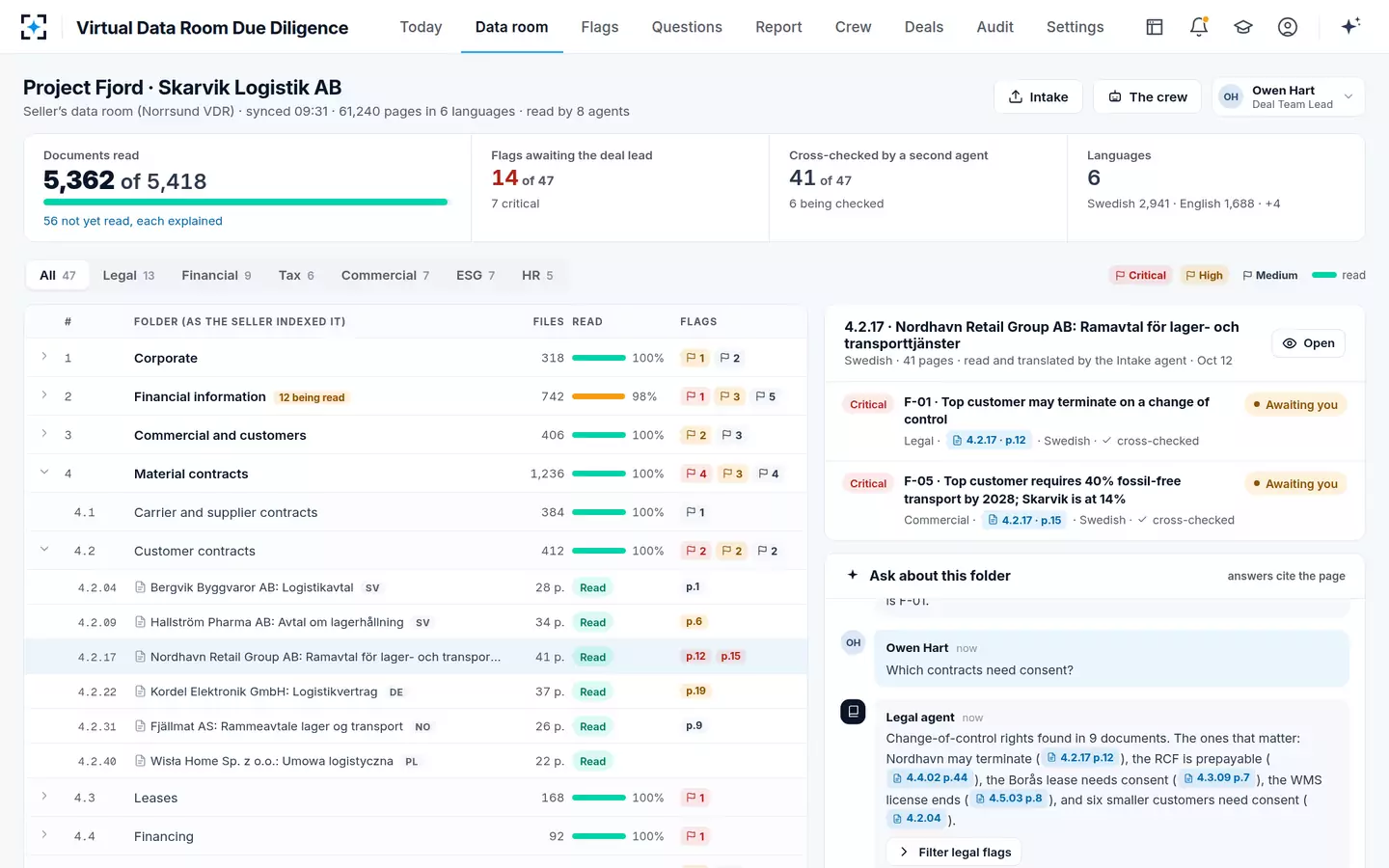
What does a buyer look for in due diligence?
A buyer looks for anything that should change four things: the price, the protections in the purchase agreement, the conditions to closing, and the plan for the first months of ownership. Everything else is background. A Delaware opinion explains why the second category exists at all, quoting Chief Justice Strine: "Due diligence is expensive and parties to contracts in the mergers and acquisitions arena often negotiate for contractual representations that minimize a buyer’s need to verify every minute aspect of a seller’s business" (Akorn v. Fresenius Kabi, Del. Ch. 2018).
Representations also cover what diligence cannot reach. When one competitor buys another, some areas are off limits before closing; in the Akorn case the buyer's parent conceded that some areas were closed to it, as proving data room coverage recounts, and that the answer was to ask the seller "for assurances, representations [and] warranties". A buyer's question map therefore has two outputs: findings to price, and gaps to cover with representations. How each finding is written up for the committee is in the red flag report guide.
What is confirmatory due diligence?
Confirmatory due diligence is the later stage of buy-side work, after a bid has been accepted in principle, in which the buyer checks the facts its price assumed and closes the questions it left open. It is narrower and deeper than the first pass. The Akorn record shows the shift: the buyer's offer letter said it "had largely completed its due diligence and was prepared to begin negotiating a merger agreement, but that senior management wanted to conduct site visits" and needed further information.
The stage has a tax marker in the United States. Diligence costs become costs of the acquisition, to be capitalised, from the earlier of signing a letter of intent or exclusivity agreement and the board's approval of the material terms (26 CFR 1.263(a)-5(e)(1)). A buyer that dates its confirmatory work from that point has its timesheets in the right order for its tax return as well.
From a finding to a clause in the purchase agreement
Buy-side diligence ends in the purchase agreement, and every finding should travel there by a known route: found and sized, decided, asked of the seller, answered, decided again, then written into price, representations, indemnities or conditions. In the sample, agents do the finding, sizing, drafting and assembling; people decide and release.
How one finding reaches the purchase agreement on the sample deal
Agent
Workstream agentsFind the clause or number against the buyer’s rules, cite the page, and have a second workstream size it.
Never: close a flag
A person decides
Owen Hart, deal team leadDecides the treatment: price item, protection, closing condition, 100-day plan or reject, with a reason code.
Agent
Questions agentDrafts the seller question from the flag, merges duplicates from other workstreams, routes it to the adviser in scope.
Never: release a question
A person decides
Owen Hart releases the questionQuestions for the seller go out through the seller’s data room; nothing reaches the seller unseen.
Agent
Questions agent reads the answerReads the seller’s reply and any new files, and proposes to close the flag or escalate it.
A person decides
Owen Hart, then the negotiatorsConfirms or changes the treatment; the signed red-flag report goes to the committee and the agreement is drafted from it.
The seller Q&A is the buyer's instrument, not the seller's
The question list is where buy-side diligence becomes a negotiation, and a buyer that sends the seller six advisers' overlapping lists gives away time and leverage. In the sample, the agents and the team drafted 64 questions and merged 12 duplicates across workstreams; each remaining question is tied to its flag and routed to the adviser whose scope it is, financial and tax, legal and HR, or ESG, and questions for the seller itself go out through the seller's room. Only the deal lead releases them.
One list for the seller, each question tied to its flag
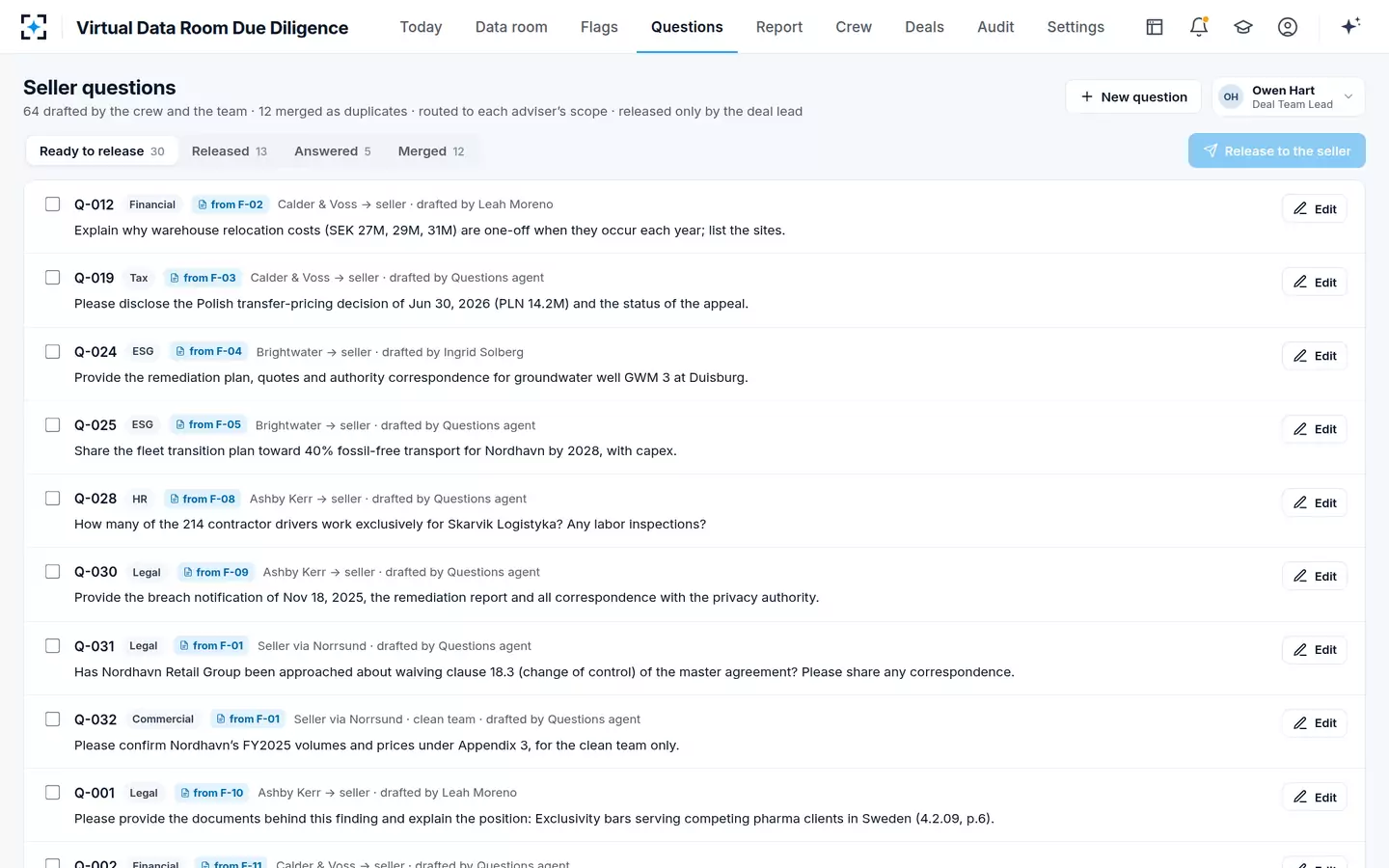
The list also shows the buyer's map at work. The question about warehouse relocation costs, SEK 27 million, 29 million and 31 million in successive years, is the add-back question asked in the seller's own terms: why is a cost that occurs every year called one-off? A seller can answer a question; it cannot argue with three of its own numbers in a row. To see a room read by the buyer's questions, start from Virtual Data Room Due Diligence.
Questions people ask
What is on a buy-side due diligence checklist?
The documents to request for each workstream, legal, financial, tax, commercial, ESG and HR, and the questions that move price: customers who can leave, earnings quality, undisclosed tax, net debt, remediation, regulators, people and customer demands. A checklist says what should be there; the buyer still needs to show what was read and what was missing.
What is a buy-side due diligence report?
It is the buyer's report to its investment committee on what the review found that should change the price, the purchase agreement, the closing conditions or the plan, with each finding sized and cited. Advisers produce reports for their own scope; the deal team's red-flag report brings them together.
Who performs buy-side due diligence?
The buyer's deal team leads it and outside advisers do much of the specialist reading: counsel for legal, an accounting firm for financial and tax, and specialists for commercial, ESG and HR work. The deal team stays accountable for the whole and signs the report to the committee.
What is buy-side financial due diligence?
It tests the earnings and the net debt the price is based on: adjusted EBITDA and its add-backs, normal working capital, and debt-like items. In the sample, it found SEK 31 million of add-backs that recur every year and disputed SEK 118 million of factored receivables. The quality-of-earnings work itself is covered by Quality of Earnings Analysis.
How long does buy-side due diligence take?
No regulator sets a period and no independent study publishes one for buyouts. In one acquisition documented by a Delaware court, the buyer had largely finished diligence 32 days after entering the data room and signed 70 days after. The evidence and where the weeks go are set out in how long due diligence takes.