Private equity due diligence software covers three different tools: the seller's virtual data room, which hosts and controls the documents; trackers and checklists, which manage requests and status; and reading tools, which read the documents, flag issues and draft the deal team's questions and report. A buying firm usually chooses only the third, since the seller chooses the room. What decides how fast and how well a reading tool works is less the software than the inputs the firm brings on day one: written red-flag rules with a materiality line, a past deal's room and the report the committee received, the deal team and its advisers, the clean-team list, and the firm's rules on data. Botminds' Virtual Data Room Due Diligence is a reading tool of that kind, built from exactly those inputs, and the guide says plainly where it fits and where it does not.
The examples come from a fictional sample firm and deal run through the solution: Quillfield Private Equity Fund V buying Skarvik Logistik AB, a Swedish contract-logistics company, from a data room of 5,418 documents in six languages. The firm, its settings and every figure are sample data, not a customer's result.
The sample firm's inputs, as the solution holds them
v4.2
of the red-flag playbook, approved by the deal lead and compliance on 28 September 2026
$1Mor 1%
of EBITDA: the materiality line below which flags go to a register, not the report
0.85
confidence threshold; below it, a person reviews a flag before the deal lead
30days
to destroy seller material if a deal ends, with a destruction certificate
What is due diligence software, and what does each kind do for a private equity deal team?
Due diligence software is any tool that helps a buyer collect, read, track or report on a target's documents, and the three kinds do different jobs for different owners. Comparing them on one feature list is how buyers end up with a second data room instead of a way to read the first.
Three kinds of due diligence software, and who chooses each
| Kind | Who chooses it | What it does | What it does not do |
|---|---|---|---|
| Virtual data room | The seller and its adviser | Hosts documents under the seller’s index, sets permissions, runs the Q&A channel, logs views | Read the documents, or tell the buyer what it has not read |
| Tracker or checklist tool | Each buyer, often each adviser | Lists requests and their status, assigns reviewers, tracks open items | Read the documents, or join findings across advisers |
| Reading tool | The buyer | Reads every file, flags issues against the buyer’s rules, cites pages, drafts questions and the report | Host the room, give legal advice, or decide for the deal team |
Is a virtual data room the same as due diligence software?
No: a virtual data room is the seller's system for disclosing, and a buyer's due diligence software is the buyer's system for reading. The room controls who may see what, which is why a reading tool must respect its rules rather than copy its contents. The FTC's competition staff, for example, suggested that sellers consider barring anyone with data room access from downloading or emailing its confidential contents where competitively sensitive data is involved (FTC Bureau of Competition, 2018).
In the sample, the solution connects to the seller's room read-only, re-reads it every 15 minutes, and keeps the room's download rules: the Intake agent's written limit is that it never downloads outside them. The extracted text is kept in the region the buying firm chose. The buyer gets a reading of the whole room without a second copy of it on someone's laptop.
What do you need to implement due diligence software?
You need seven things, all of which your firm already has in some form: rules, a past deal, people, a clean-team list, data rules, connections, and an approval route. The faster these are assembled, the faster the software is useful; none of them can be supplied by a vendor.
What a private equity firm brings on day one
- A written red-flag playbook
Each rule with its trigger, threshold, severity and the two workstreams that must check it, plus the materiality line. Where it lives in memos and habits, writing it down is the work.
- A past deal’s data room and its committee report
The room as it stood at signing and the red-flag report the committee received: the answer key for testing.
- The deal team, advisers and their scopes
Who decides, who reviews, who signs; which adviser handles legal, financial and tax, commercial, ESG and HR questions.
- The clean-team list and its reason
Which portfolio companies compete with likely targets, who sits on their boards, who may join a clean team and who approves it.
- Data rules
Where text may be stored, how long after closing it is kept, how fast it is destroyed if a deal ends, and when a legal hold applies.
- Connections
Single sign-on for the team and advisers, the deal CRM for committee approvals, and the repository where reports are filed.
- An approval route
Who approves changes to the playbook, to people’s access and to the agents themselves. In the sample, compliance approves all three.
What is a red flag playbook, and why does it come first?
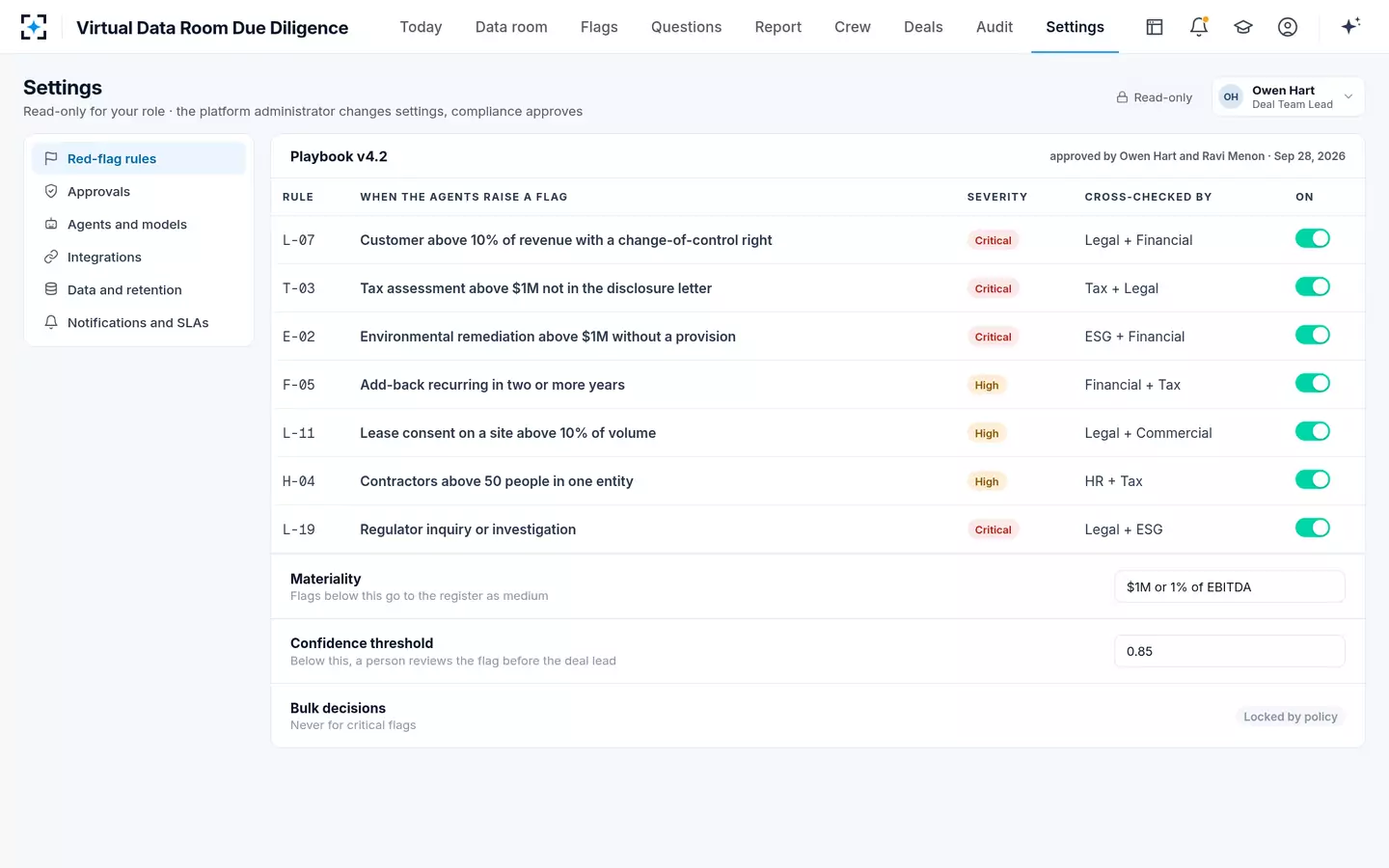
A red flag playbook is the firm's written list of what counts as a red flag: each rule's trigger, threshold and severity, which workstreams must check it, and the materiality line below which a finding is logged rather than reported. It comes first because it is the firm's diligence policy made specific enough to apply. In the EU, a manager must "establish, implement and apply written policies and procedures on due diligence", and they "shall be regularly reviewed and updated" (Delegated Regulation 231/2013, Article 18(3) and (4)). The SEC's staff, in 2022, found advisers whose fund documents promised a diligence process their own policies did not support (SEC Risk Alert, 27 January 2022). A playbook that a tool applies on every deal is a tailored policy with evidence that it was followed.
The sample firm's rules, as settings: each with a value and the options it could take
| Setting | Value at the sample firm | Options or effect |
|---|---|---|
| Red-flag playbook | Version 4.2, approved by the deal lead and compliance | Each rule on or off, with its severity and cross-checking workstreams |
| Customer with a change of control right | Above 10% of revenue: critical | Cross-checked by legal and financial |
| Tax assessment not in the disclosure letter | Above $1M: critical | Cross-checked by tax and legal |
| Materiality | $1M or 1% of EBITDA | Flags below it go to the register as medium |
| Confidence threshold | 0.85 | Below it, a person reviews the flag before the deal lead |
| Bulk decisions | Never for critical flags | Locked by policy |
| Data residency | EU (Stockholm region) | EU, United States (Virginia) or Singapore |
| If the deal ends | Destroy seller material within 30 days, with a certificate | After closing: keep 7 or 10 years; a legal hold suspends deletion |
Testing on the data room of a past deal before go-live
Test the software on a deal your firm has closed, against the report your committee actually received, before it touches a live deal. That report is an answer key that cost your firm weeks to produce, and it is specific to your rules and your kind of target. Building such keys is expensive: the researchers behind the MAUD merger-agreement benchmark put in "over 10,000 hours by law students and experienced lawyers" to label 152 agreements (Wang et al., EMNLP 2023). Your firm already has one per closed deal.
Score three things. Every flag in the committee's report should be found, with its page; a miss is a failed test. Extra flags should be reviewed by the lawyers who wrote the original report: some will be noise, some will be findings the original review missed. And every unread file should come with a reason. The wider test plan for contract-reading AI, including who may decide and sign, is in legal due diligence AI and its limits.
Can due diligence software connect to our data room?
It should connect to whichever room the seller chooses, read-only, and keep that room's rules; the buyer rarely chooses the room. In the sample the connection is read-only, synced every 15 minutes so late uploads are read the same morning, with exact copies collapsed and versions linked. Before connecting, check two documents: the confidentiality agreement, for what it allows the buyer's service providers to do with the seller's information, and your data processing terms. Under the GDPR, a controller "shall use only processors providing sufficient guarantees to implement appropriate technical and organisational measures" (GDPR, Article 28(1)), and data rooms carry personal data in employment and customer files.
Connections on the buyer's side matter as much: single sign-on, so outside advisers get scoped access and any screen outside their scope says so and is logged; the deal CRM, where the signed report is filed with the committee's approval; and the firm's document repository. How much of the room the connection let the agents read, file by file, is the subject of proving data room coverage.
Records, retention and destruction: settings to decide before the first deal
Decide before the first deal how long diligence work is kept, where, and how it is destroyed if the deal dies, because the rules point in two directions. A US registered adviser must keep written communications relating to advice given or proposed for "not less than five years" (17 CFR 275.204-2), and an EU manager must "retain records of the activities carried out" on a negotiated illiquid investment "for at least five years" (Delegated Regulation 231/2013, Article 19(2)). A seller's confidentiality agreement, by contrast, usually requires destruction of its material if the deal fails, and the FTC's staff list destroying analysis built on a competitor's data among the safeguards.
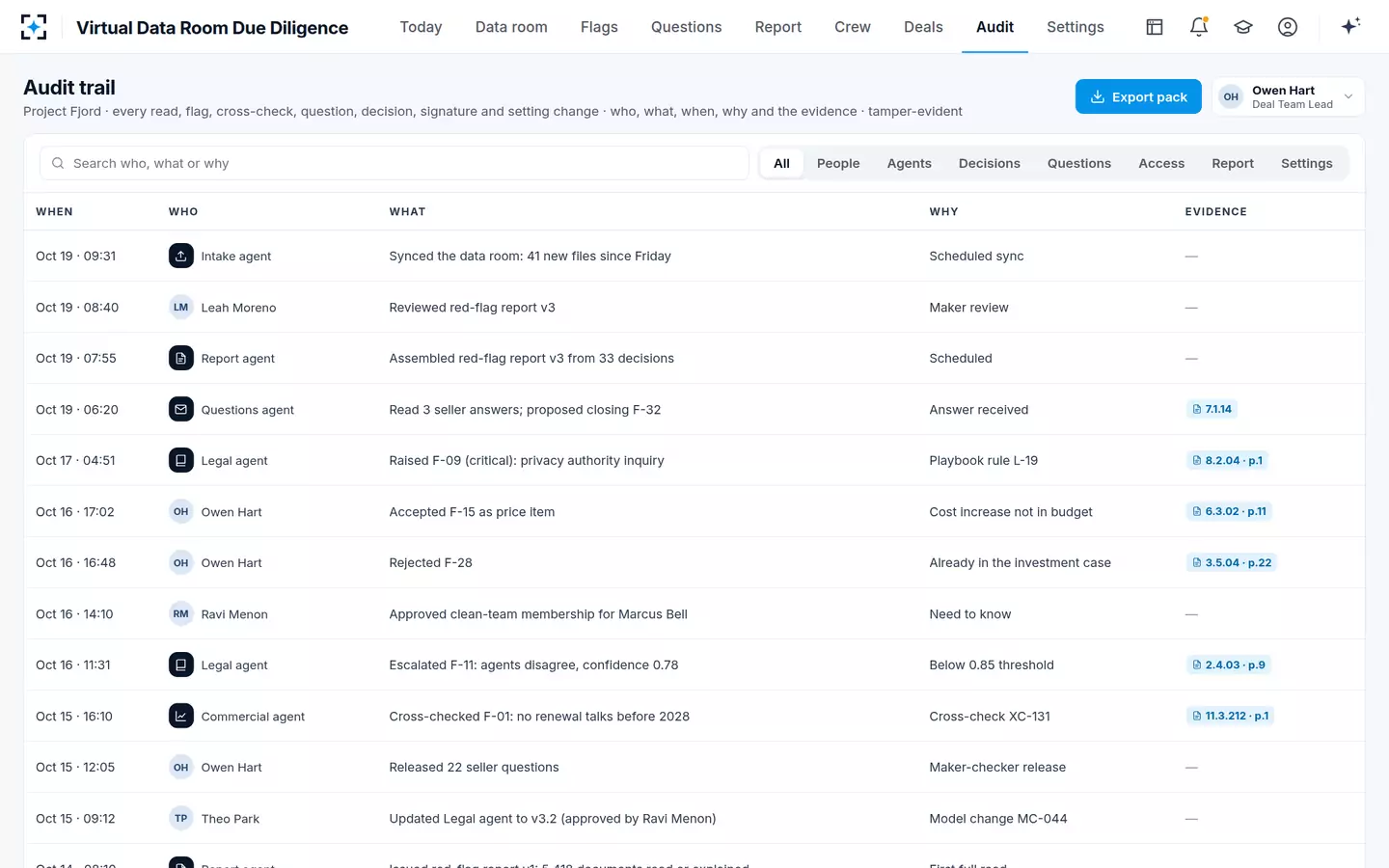
The sample firm's answer is two settings: destruction within 30 days with a certificate if a deal ends, and retention of seven or ten years after closing, suspended by a legal hold. The audit trail underneath is what makes either one provable: every read, flag, cross-check, question, decision, signature and setting change, with who, what, when, why and the evidence.
The audit trail: who did what, when, why, and on which page
How long does it take to set up due diligence software?
No independent study publishes set-up times, and the honest answer is that it depends on how ready the firm's inputs are: a firm with a written playbook and a recent closed deal can test quickly; a firm whose red-flag rules live in partners' heads spends its first weeks writing them down. The sequence below is the one we suggest, with the input each step needs and how to know it is done.
A go-live sequence, and how to know each step is done
| Step | Input it needs | Done when |
|---|---|---|
| 1. Write the playbook | Past red-flag reports, partners’ rules of thumb, the materiality line | Every rule has a trigger, threshold, severity and two checking workstreams, approved by compliance |
| 2. Set people and access | Deal team, advisers and scopes, the clean-team list and its reason | Each person’s scope is set and every clean-team member approved |
| 3. Set data rules | Residency, retention, destruction, legal hold | Settings approved and recorded with the date |
| 4. Replay a closed deal | Its data room at signing and its committee report | Every committee flag found with its page; extras reviewed by counsel |
| 5. Tune and re-run | The differences from step 4 | Misses explained and fixed, and the playbook version raised |
| 6. Run a live deal beside the team | A new room and the usual advisers | The deal lead decides from the report, and the trail shows each decision |
The red-flag rules a firm brings, with their severity and cross-checks
Where Virtual Data Room Due Diligence fits, and where it does not
It fits as the buyer's reading layer over the seller's room, for deals where volume, languages and the joins between workstreams are what slow the team down. It does not fit as a data room, a project tracker for the whole deal, or a source of legal, tax or valuation opinions.
What the solution does on a private equity deal, and what stays elsewhere
Virtual Data Room Due Diligence: Reads every file in the seller’s room, read-only, in its original language, with translations
Stays with other systems and people: Hosting, indexing and permissions stay with the seller’s data room
Virtual Data Room Due Diligence: Flags against the firm’s playbook, each cited and sized by a second workstream
Stays with other systems and people: Interpretation and advice stay with counsel and the advisers
Virtual Data Room Due Diligence: Drafts, merges and routes seller questions; reads the answers
Stays with other systems and people: Release stays with the deal lead; the Q&A channel stays in the room
Virtual Data Room Due Diligence: Sizes flags against the databook and revenue files
Stays with other systems and people: Quality of earnings and valuation have their own work and their own solutions
Virtual Data Room Due Diligence: Assembles the cited report from decided flags
Stays with other systems and people: Decisions and both signatures stay with the deal lead and legal counsel
Two more inputs complete the picture: the cost model that tells a firm whether the reading hours are worth changing, set out in due diligence costs, and the clean-team rules that decide who may see what, in the clean team agreement guide. The solution itself is at Virtual Data Room Due Diligence, where a demo runs on the data room of one of your past deals.
Questions people ask
What are the requirements for private equity due diligence software?
At minimum: read-only connection to any seller's room; reading of every file in its own language, with unread files listed by reason; flags against your own written rules, each cited to its page; a second workstream sizing each flag; permissions that keep decisions, releases and signatures with named people; clean-team fencing; and an audit trail and retention settings that meet the five-year record rules.
What do private equity due diligence software companies offer?
Broadly the three kinds described above: data rooms for sellers, trackers for managing requests, and reading tools for buyers. Compare products within a kind, on your own past deal, rather than across kinds on a feature list; a data room and a reading tool solve different problems.
Can the software use our existing red-flag checklist?
It should, but a checklist of topics is not yet a playbook. Each item needs a trigger the software can test, a threshold, a severity and the workstreams that check it. Converting the checklist is the first piece of work, and it improves the firm's diligence whether or not software applies it.
Does due diligence software replace outside advisers?
No. A reading tool takes the finding, translating and joining; advisers keep interpretation, opinions and negotiation. In the sample, outside advisers work inside the same room, each seeing only the questions in their own scope.
Who approves changes to the software's rules and agents?
Someone independent of the deal team. In the sample, the platform administrator proposes changes to the playbook, people's access and the agents, compliance approves them, and each change is versioned on the audit trail, such as an update to the Legal agent approved on 15 October.