Broken deal expenses in private equity are the legal, diligence, travel and other costs a manager runs up on a transaction that is never completed. Most LPAs make the fund bear them, and the question that fills SEC orders is the next one: if co-investment vehicles, employee funds or the manager itself would have invested beside the fund, who pays their share of a deal that died? The SEC's answer, across three settled cases, is that a vehicle that shared in the deal flow shares in its cost unless the documents and disclosures say otherwise. Botminds' Fund Expense Allocation applies that rule to every dead-deal invoice: it reads the bill, finds the vehicles that committed, splits the cost by commitment and cites the clause on every slice.
The work is hard because a dead deal leaves no portfolio company to bill and no closing memo listing who invested. The examples below follow a broken-deal legal bill at a fictional sample manager, Quillfield Capital, as it runs through the solution.
The largest broken-deal case, in the SEC's own figures
$338M
of broken-deal expenses incurred by one manager, 2006–2011
$17.4M
misallocated to flagship funds instead of co-investors
$18.7M
disgorgement and interest paid to the funds
$10M
civil penalty
What are broken deal expenses?
Broken deal expenses are the costs of pursuing an investment that is not made: lawyers' and accountants' diligence, financing commitment fees, consultants, data rooms, travel and the like. The fund documents define them, and the definitions in SEC orders are broad. KKR's 2006 fund agreement made the fund pay "all" broken deal expenses "incurred by or on behalf of" the fund "in developing, negotiating and structuring prospective or potential [i]nvestments that are not ultimately made"; the order added that they "include research costs, travel costs and professional fees, and other expenses incurred in deal sourcing activities related to specific “dead deals” that never materialize" (SEC IA-4131).
The KKR definition went further, to costs "incurred by KKR to evaluate particular industries or geographic regions for buyout opportunities as opposed to specific potential investments". That matters for allocation. A cost tied to one named target has an identifiable set of would-be investors. A cost of surveying a sector has none, and needs a basis written down in advance.
On a live deal the question rarely arises, because the portfolio company or the deal vehicle usually reimburses the costs at closing. In KKR's words, the firm was "reimbursed directly from portfolio companies for the expenses incurred in connection with successful transactions". Broken deals are the residue: costs with no company to pay them, landing on whoever the manager decides.
Who pays broken deal expenses in private equity?
The fund pays, in most LPAs, and so should every other vehicle that would have taken part in the deal, unless its documents excuse it and the fund's investors are told. The manager pays only what the documents put on it: in KKR's funds, the fee-sharing terms, which credited the fund with 80% of its share of portfolio-company fees after deducting broken-deal costs, meant the firm "economically bore 20% of broken deal expenses" and the fund 80%.
The examination staff described the general pattern in its June 2020 risk alert, which listed broken-deal costs first among the shared expenses it found allocated across "private fund clients, employee funds, and coinvestment vehicles" inconsistently with disclosures (SEC OCIE, June 23, 2020). The three orders below show the mechanics: in each, the vehicles that escaped the cost were co-investors or employees, and in each the fund's investors paid their share.
Years of misallocation, then the order: three broken-deal cases
- Co-investors bear no broken-deal costs2006–11
- Policy, exam, order2011–15
- Funds pay co-investors’ share of dead deals2004–15
- Order2016–17
- Flagship funds bear employee funds’ and co-investors’ share2000–16
- Repaid, order2017–18
KKR: $338 million of dead-deal costs and no co-investor share
From 2006 to 2011 KKR's flagship funds invested $30.2 billion in 95 transactions and its co-investment vehicles $4.6 billion, including $750 million from vehicles for its own executives. Over the same years the firm incurred about $338 million of broken deal expenses and allocated them by the region of the potential deal, so North American dead deals went to the 2006 fund. Co-investors were left out: "KKR did not allocate broken deal expenses to KKR co-investors from 2006 to 2011 except for a partial allocation to certain co-investors in 2011" (SEC IA-4131).
The firm found the gap itself. In June 2011 an internal review recognised it "lacked a written policy governing its broken deal expense allocations"; a policy drafted that autumn allocated $333,500 to several committed co-investment vehicles for 2011. From January 2012 a new methodology also charged its executives' vehicles and other co-investors, weighing "the amount of committed capital, the amount of invested capital, and the percentage of transactions in which KKR Co-Investors were eligible to participate". An SEC examination in 2013 followed, and the firm refunded $3.26 million to its funds in the first quarter of 2014.
The order applied the new method backwards. The $17.4 million misallocated is $22.5 million of broken-deal expenses attributable to co-investors under the post-2012 methodology, less the 20% KKR bore through fee sharing. KKR paid $18,677,409 to the funds and a $10 million penalty, and the order found violations of the antifraud provision and of the compliance rule because the firm had no written policy until 2011.
Platinum Equity: the co-investors who paid for live deals only
Platinum Equity's case shows how a co-investment document can look complete and still leave the fund paying. The firm's officers, directors and employees co-invested a pre-determined share of every completed deal through a separate vehicle for each deal: generally 50% for investments of $10 million or less and 5% to 20% above that. Each vehicle's agreement made it pay "a pro rata share of expenses for the transactions in which the co-investment vehicle participated (i.e., successful deals, not broken deals)" (SEC IA-4772).
Dead deals had no co-investment vehicle, so the funds paid all of them. The LPAs said the funds would bear partnership expenses including broken deals, but "did not disclose that the Private Equity Funds would also pay the broken deal expenses for the portion of each investment that would have been allocated to the Platinum Co-Investors". From the second quarter of 2012 the firm was reimbursed about $42.6 million of broken deal expenses; applying each year's co-investment percentages, $1,811,501 of it was the co-investors' share. Platinum paid $1,902,132 in disgorgement and interest and a $1.5 million penalty, and had no written policy on broken-deal allocation from its 2012 registration through 2015.
Lightyear: employee funds, co-investors and a promise to recover costs
Lightyear's order widens the lesson from broken deals to every shared deal cost, and adds a second failure. From 2000 through 2016 the firm allocated "broken deal, legal, consulting, insurance and other expenses solely to the Flagship Funds", though its employee funds invested beside them on a proportional basis. Without disclosure or advisory committee approval, the flagship funds paid about $167,000 more than their share on the employee funds' account and about $221,000 more on the co-investors' account for certain post-closing expenses (SEC IA-5096).
The second failure was a promise in the LPA. Each flagship fund's agreement said Lightyear would "seek to have prospective portfolio companies bear the cost of the Partnership Broken Deal Expenses"; the order found the firm "did not, in fact, seek to recoup broken deal expenses from prospective portfolio companies" and had no procedure to do so. Lightyear made full reimbursements with interest before the order and paid a $400,000 penalty.
What each broken-deal case put back into the funds, before the penalty
Do co-investors pay broken deal costs?
Co-investors pay broken deal costs when their documents say so, and when they do not, the fund's investors are entitled to know that the fund is paying instead. Many co-investors negotiate out. In the 2023 release adopting private fund rules that a court later vacated, the SEC described co-investment rights with "materially different fee and expense terms from those of the main fund (e.g., no fees or no obligation to bear broken deal expenses)", and recorded commenters' warning that "potential co- investors would wait until a transaction is certain before committing to the transaction to avoid broken deal expenses" (88 FR 63206, September 14, 2023).
That gives a manager three honest options. It can make co-investors bear their share in their agreement. It can bear the co-investors' share itself. Or it can let the fund bear it and say so plainly in the fund's documents, before investors commit. The orders punish only the fourth option: the fund pays and nobody is told.
How to allocate a broken deal expense: the method the orders point to
The method the orders point to is deal by deal, by intended commitment, fixed on the day the cost was incurred. KKR's post-2012 method looked at committed capital, invested capital and how often co-investors were eligible; Platinum's remedy applied "a methodology based on the co-investment percentages established each year". Both start from the same fact: who would have owned how much of the deal.
The sample bill shows the arithmetic. Project Heron was Quillfield's Fund III's proposed acquisition of a French company, with a co-investment vehicle formed for the deal, and it broke when exclusivity lapsed on September 18, 2026. The Paris law firm's bill came to €184,500 in five lines. Four lines, €172,500, were broken-deal costs; the fifth, €12,000 of talks with prospective investors in the next fund, was fundraising and went to the manager. The broken-deal costs were split by commitments to the deal: Fund III's family $310.0 million and Heron Co-Invest $190.0 million of $500.0 million, so €106,950.00 and €65,550.00. Fund III's share then ran across its Delaware, Cayman and Luxembourg vehicles by their commitments.
One broken-deal bill in Fund Expense Allocation: 62% Fund III, 38% the co-investors, €12,000 to the manager
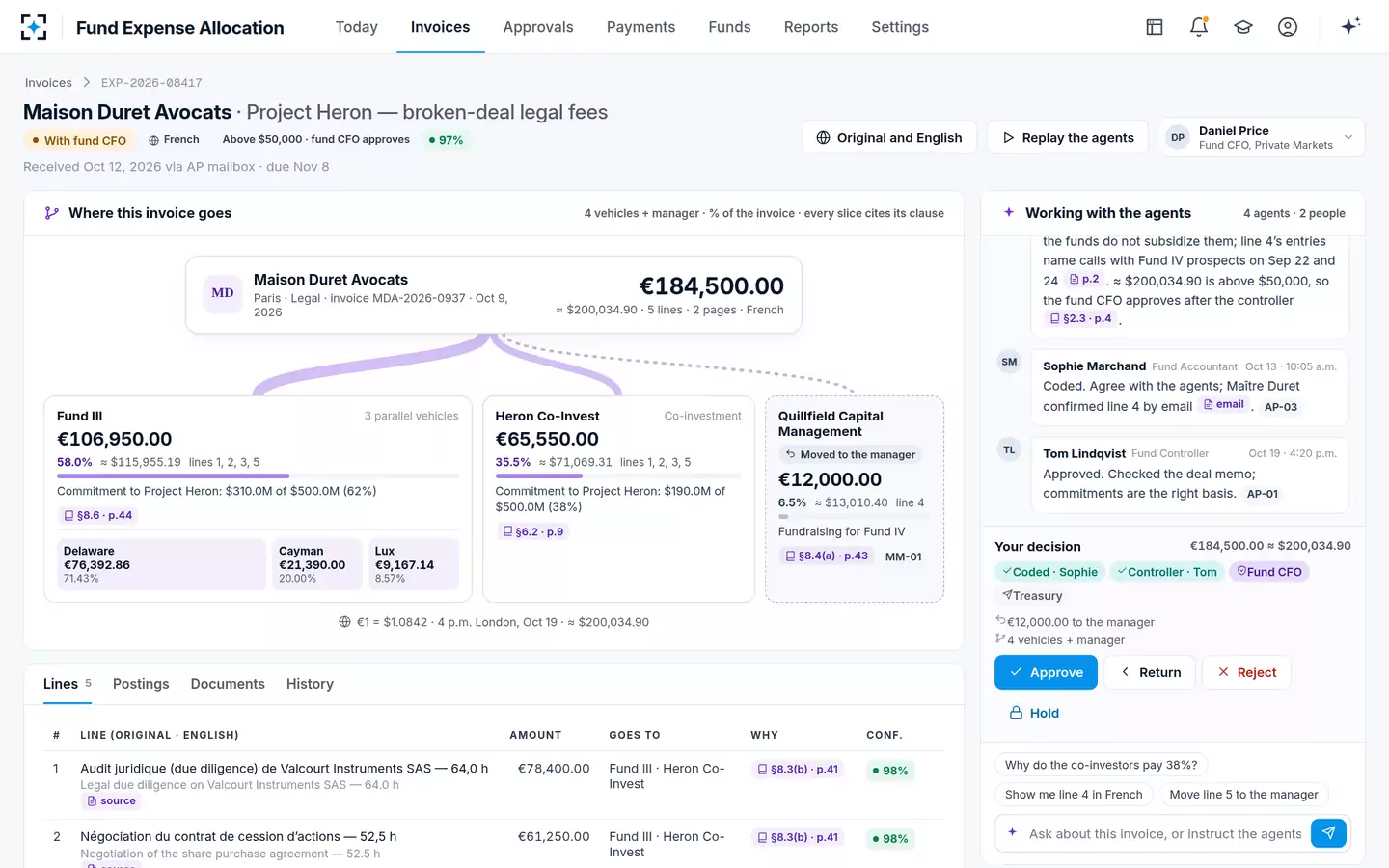
Two inputs make the split defensible. The first is the date: the vehicles and amounts on the deal allocation memo when the cost was incurred, not the fund family as it stands at quarter end. The second is the excluded line. A deal bill often carries time that belongs to the manager, and the €12,000 here would have been a fund expense if the split had been run on the invoice total.
Five failures in the broken-deal orders, and the control for each
What went wrongBroken-deal costs pooled by region or strategy and charged to the flagship fund alone
WhereKKR, 2006–2011
The controlFor every dead deal, the list of vehicles that would have invested, with their intended amounts, fixed on the date the cost was incurred.
What went wrongCo-investment documents that cover expenses of completed deals but are silent on deals that die
WherePlatinum Equity, 2004–2015
The controlA broken-deal clause in every co-investment agreement, or written disclosure to the fund’s investors that the fund bears the co-investors’ share.
What went wrongEmployee funds and co-investors excused without disclosure or advisory committee approval
WhereLightyear, 2000–2016
The controlA rule that any vehicle excused from a cost is named to the fund’s investors or its advisory committee before the fund pays.
What went wrongAn LPA promise to seek recovery from the target, never acted on
WhereLightyear
The controlA step in the dead-deal close-out: ask the counterparty for any reimbursement or break fee the documents allow, and record the answer.
What went wrongNo written policy until an internal review or an examination
WhereKKR, Platinum Equity
The controlA written broken-deal section of the expense allocation policy, versioned, applied, reviewed every year.
What the broken-deal cases cost, beyond the penalty
The penalties are the visible cost. The less visible one is the look-back: each order rebuilt years of allocations under a method the firm had to defend, and repaid the funds with interest. KKR's misallocation ran six years and its payment to the funds covered all of them; Platinum's covered the period from the second quarter of 2012 because of the limitations period; Lightyear reimbursed back to 2001. A firm that cannot show, for each dead deal, which vehicles were in line to invest, has to reconstruct it from deal memos and emails when the question comes.
There is also the tax and reporting tail. A reallocation changes each vehicle's expenses for years already closed, and with them the partners' capital accounts and the K-1s already issued. Replaying last year's invoices under a written method is the cheapest time to find such a difference: before an examiner does.
Broken deal costs in Fund Expense Allocation
In Fund Expense Allocation, each step of the method belongs to a named agent, and people decide. The Chargeability agent classifies each line as a broken-deal cost, a live-deal cost, a fund expense or the manager's, citing the investment committee memo for the date the deal broke and the LPA clause; on the sample bill it found the line of fundraising time and moved it to the manager. The Allocation agent splits the rest by the deal allocation memo. The Checker agent re-does the split from scratch and argues the manager's side, looking for exactly the kind of co-investor share the orders found missing.
Asking why the co-investors pay 38%, and getting the memo and the clause
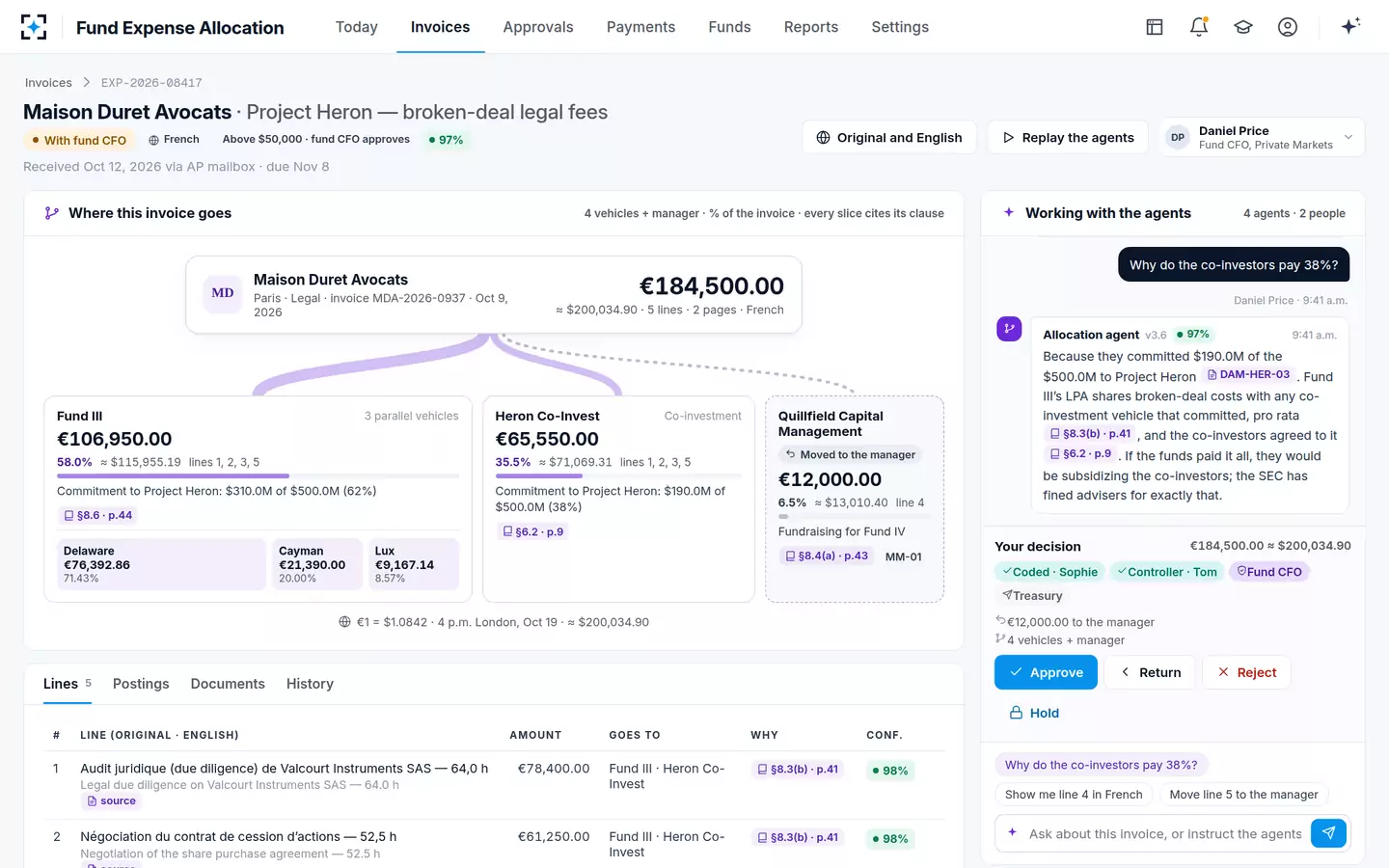
The people stay where the orders put responsibility. The fund accountant codes the invoice, the controller approves it, and above $50,000 the fund CFO approves too; the agents can neither approve nor post an unapproved entry. For an examiner's request, the Evidence agent assembles the broken-deal allocations with their deal memos for the Chief Compliance Officer to review before anything leaves the firm. The expense allocation policy behind these decisions sets out the three questions every invoice must answer.
Seven controls for broken deal expenses
- Keep a would-be investor list for every live pursuit
Vehicles and intended amounts, updated when the structure changes, so a dead deal has its basis on the day it dies.
- Give every co-investment agreement a broken-deal clause
Or disclose to the fund’s investors that the fund bears the co-investors’ share.
- Separate deal costs from sector studies
Costs not tied to a named target need their own basis in the policy.
- Close out each dead deal formally
Date it broke, final bills, any break fee or reimbursement sought from the counterparty, and the split.
- Strip manager time out of deal bills
Fundraising, investor meetings and the manager’s own advice do not become fund costs by appearing on a deal invoice.
- Re-perform the split independently
A second person, or a second agent, recomputes it from the memo before approval.
- Keep the evidence with the allocation
Investment committee memo, deal allocation memo, clause and approver, for every dead deal.
Questions people ask
What counts as a broken deal expense?
Whatever the fund documents define, usually every out-of-pocket cost of developing, negotiating and structuring an investment that is not made. Platinum Equity's LPAs, for example, defined them as "[a]ll out-of-pocket fees, costs, and expenses, if any, incurred in developing, negotiating, and structuring prospective [p]ortfolio [i]nvestments that are not ultimately made." Legal diligence, financing commitment fees, consultants and travel are typical.
What did KKR pay for broken deal expenses?
Under the SEC's June 2015 order, KKR paid $18,677,409 in disgorgement and prejudgment interest to its flagship funds and a $10 million civil penalty. It had already refunded $3.26 million to the funds during the 2013 examination; that refund was deducted from the disgorgement.
Can a co-investor refuse to pay broken deal costs?
Yes, if its agreement says so, and many negotiate exactly that. The fund may then bear the share only if its own documents and disclosures allow it; otherwise the manager bears it. In Energy Capital Partners (2022), co-investors who refused a share of bridge-loan fees left a fund paying about $3.3 million more than its share, and the SEC fined the manager $1 million.
Are broken deal expenses reimbursed by the target?
Sometimes. A merger agreement may give the buyer a break fee or expense reimbursement if the seller walks away, and some LPAs require the manager to seek it. Lightyear's LPAs promised to seek to have prospective portfolio companies bear broken-deal costs; the SEC found it never tried and had no procedure for it.
Should employee co-investment funds share broken deal costs?
Unless the fund's investors are told otherwise, yes. Employee and executive vehicles that invest beside the fund benefit from the same deal flow. In Lightyear the flagship funds paid about $167,000 of the employee funds' share without disclosure or advisory committee approval, and KKR's executive vehicles bore none until 2012.