Expense allocation methods are the rules that decide how a shared cost is divided between the vehicles that benefited from it. For private funds the common bases are commitments, invested capital, NAV, commitments to a specific deal, time spent, and attendance, and the choice matters: the same $100,000 bill can cost one fund $30,000 under one method and $15,000 under another. No method is right for every cost, so the useful test is not which method sounds fairest but whether a written method, applied consistently, reproduces what should have been booked. The way to prove that is to replay a closed year of invoices through the method, or through a tool such as Botminds' Fund Expense Allocation, compare the result with what was booked, and explain every difference.
The worked figures below are illustrative arithmetic unless they are labelled as sample data from the solution, which runs on a fictional manager, Quillfield Capital.
Six expense allocation methods for funds: where each fits and where it breaks
Fits: Fund-wide costs during the investment period: audit, administration, insurance, the annual meeting.
Breaks when: Late in a fund’s life, when commitments say little about which fund still holds assets.
Fits: Costs that follow deployed money, such as portfolio monitoring.
Breaks when: Early in a fund’s life, or for dead deals, where nothing is invested yet.
Fits: Open-end and evergreen vehicles, where investors come and go.
Breaks when: Closed-end funds with stale or contested valuations; a mark moves the split.
Fits: Deal costs, live or broken, shared between a fund and its co-investors.
Breaks when: The structure changes after the cost is incurred and nobody fixed the date of measurement.
Fits: Shared staff or service groups working for funds and the manager.
Breaks when: Time is not recorded, or recorded only for the funds’ side.
Fits: Investor meetings and events.
Breaks when: Guests include prospective investors in the next fund, which is the manager’s cost.
What are the main expense allocation methods for funds?
There are two families: direct assignment, where a cost incurred for one vehicle goes to that vehicle, and proportional allocation, where a shared cost is divided on a base that measures benefit. Most fund disputes are about the second. The base can be economic (commitments, invested capital, NAV), transactional (commitments to a specific deal) or activity-based (hours, attendees, headcount).
The sample firm's policy uses five: commitments, deal commitments, NAV for open-end funds, LP attendees, and a fee schedule for services priced per vehicle, with foreign-currency invoices converted at the prior business day's 4 p.m. London rate. A sixth, time, sits behind the shared-staff clause. Each base is assigned to a cost type in the written policy, which is what turns a method into a rule two accountants will apply the same way.
What the federal cost principles say about allocation
Federal contracting rules offer the clearest public statement of the principle, and they map well onto fund expenses. A cost "is allocable if it is assignable or chargeable to one or more cost objectives on the basis of relative benefits received or other equitable relationship"; it is allocable to a contract if it "benefits both the contract and other work, and can be distributed to them in reasonable proportion to the benefits received" (48 CFR 31.201-4).
The federal grant rules add the fallback every fund policy needs. If a cost benefits two or more projects in proportions that can be determined "without undue effort or cost", it must be allocated "based on the proportional benefit"; when the proportions cannot be determined, costs "may be allocated or transferred to benefitted projects on any reasonable documented basis" (2 CFR 200.405(d)). Read "vehicle" for "project" and the rule for a fund is the same: measure benefit where you can, and where you cannot, write down a reasonable basis before you use it.
The SEC has said something similar about pro rata. In the 2023 release adopting private fund rules, later vacated, it observed that "advisers implement pro rata allocations based on ownership percentages", agreed "there may be multiple methods to determine pro rata allocations", and declined to define the term (88 FR 63206, September 14, 2023). No single formula is required; consistency with the documents and disclosures is.
Which allocation base is fair: commitments or invested capital?
Both are fair for the costs they measure, and either is unfair for the others. Commitments measure each fund's claim on the deal flow and suit costs of being in business during the investment period. Invested capital measures money at work and suits costs that follow the portfolio. The two diverge most where it matters: a young fund with large commitments and little invested, beside an older fund with the reverse.
One $100,000 shared cost, Fund B's share under four methods
The bars show why a policy must assign one base per cost type rather than let the desk choose. A fund's share can halve with the base, and an accountant choosing case by case will, without meaning to, favour whichever vehicle is under pressure that quarter. Energy Capital Partners' fund documents promised allocation "based on the relative investments and/or benefits derived among the ECP III Funds" and/or "in any manner determined equitable, in the good faith judgment" of the adviser; when a one-off arrangement left the fund bearing about 39% of a deal's bridge-loan fees on about 27% of the equity, the SEC found the fund paid about $3.3 million more than its share by ownership (SEC IA-6049, 2022).
Pro rata allocation formula, and where it breaks
The pro rata allocation formula is simple: a vehicle's share equals its base divided by the sum of the bases of all vehicles that benefited, times the cost. Fund III's share of the sample Project Heron broken-deal costs is $310.0 million ÷ $500.0 million × €172,500 = €106,950.00. The formula breaks in three places, none of them arithmetic.
It breaks on the denominator, when a vehicle that benefited is left out: that is the KKR and Platinum Equity pattern, where co-investors were missing from the sum. It breaks on the date, when the base is measured at quarter end instead of the day the cost was incurred, and a vehicle that joined later absorbs a share. And it breaks on the cost, when the amount being divided includes lines that belong to the manager. The sample bill's €12,000 of fundraising hours had to come out before the formula ran.
Time-based allocation has its own failure: the time that is not recorded. NB Alternatives' funds bore the full cost of a business services group whose members also spent time raising capital and sourcing deals; about $2 million, 7% of the $28.7 million charged, was for unrelated work, and the order noted that "for certain employees and years, the percentage was lower or zero; for others, it was considerably higher" (SEC IA-5079). An average hides exactly the people the test should find.
How do you prove an allocation was right? Replay a closed year
You prove it by reproducing it. Take a closed period, a quarter or a year of invoices that has already been booked, audited and reported, and run each invoice through the written method, or through the tool you are evaluating, without looking at what was booked. Then compare, line by line and vehicle by vehicle, and explain every difference. A method or tool that reproduces the booked allocations, except where the booked allocation was itself wrong, has earned trust on your own files, which is the only accuracy measure an allocation can have.
A replay beats a sample review for one reason: allocation errors are not random. They cluster around particular vendors, deal types, vehicles and quarters, such as a co-investment vehicle missing from every dead deal or a cap clause misread for one fund family. A random sample of 30 invoices can miss a pattern that a full replay surfaces in the first hour.
Replaying a closed year through Fund Expense Allocation
A person decides
Controller and complianceChoose the period, freeze the policy version and fund terms that were in force, and set aside the booked allocations as the answer key.
Agent
Reader agentReads every invoice in the period from the originals, in their own languages.
Agent
Chargeability and Allocation agentsClassify and split each line under the frozen policy, citing clause and basis, without seeing the booked answer.
Agent
Checker agentRe-performs each split independently; disagreements are flagged, not resolved.
Agent
Evidence agentLines up the replay against the booked allocations, vehicle by vehicle, and lists every difference with its evidence.
A person decides
ControllerReads every difference and classifies it: the tool’s error, last year’s error, a policy gap or a timing difference.
A person decides
Chief Compliance OfficerDecides what changes: the policy, the fund terms, the agents, or a correction to the books.
Reading the differences: tool error, last year's error, or policy gap
Every difference falls into one of five classes, and only one of them is the tool's fault. Expect the replay to find some of last year's errors: that is a finding about the past, not a failure of the replay, and it is cheaper to find it now than in an examination. Rialto's case shows the cost of a method nobody re-tested: the cost allocation methodology it used from 2012 through 2017 "increased the Overhead Factor from 11% to 25%" without full disclosure to the funds' advisory committees, and the funds were charged about $3 million more than their pro rata share (SEC IA-5558, 2020).
Five kinds of difference a replay finds, and what each calls for
| Difference | What it looks like | What to do |
|---|---|---|
| The tool’s error | A misread amount, a clause applied to the wrong line, a wrong basis input. | Correct the agent or its fund terms; re-run the replay before go-live. |
| Last year’s error | The booked split left out a vehicle, charged the manager’s cost to a fund, or broke a cap. | A correction to the books, reviewed by compliance; possibly a repayment with interest. |
| A policy gap | Two reasonable readings: the tool and the desk each followed one. | Write the rule down; the Chief Compliance Officer approves the new policy version. |
| A timing difference | The base measured on a different date, such as quarter end instead of the date incurred. | Fix the measurement date in the policy; decide whether past differences are material. |
| Rounding and currency | Cents, or a different FX rate or rate time. | Set the rule (rate source and time, rounding to the cent with a residual line) and move on. |
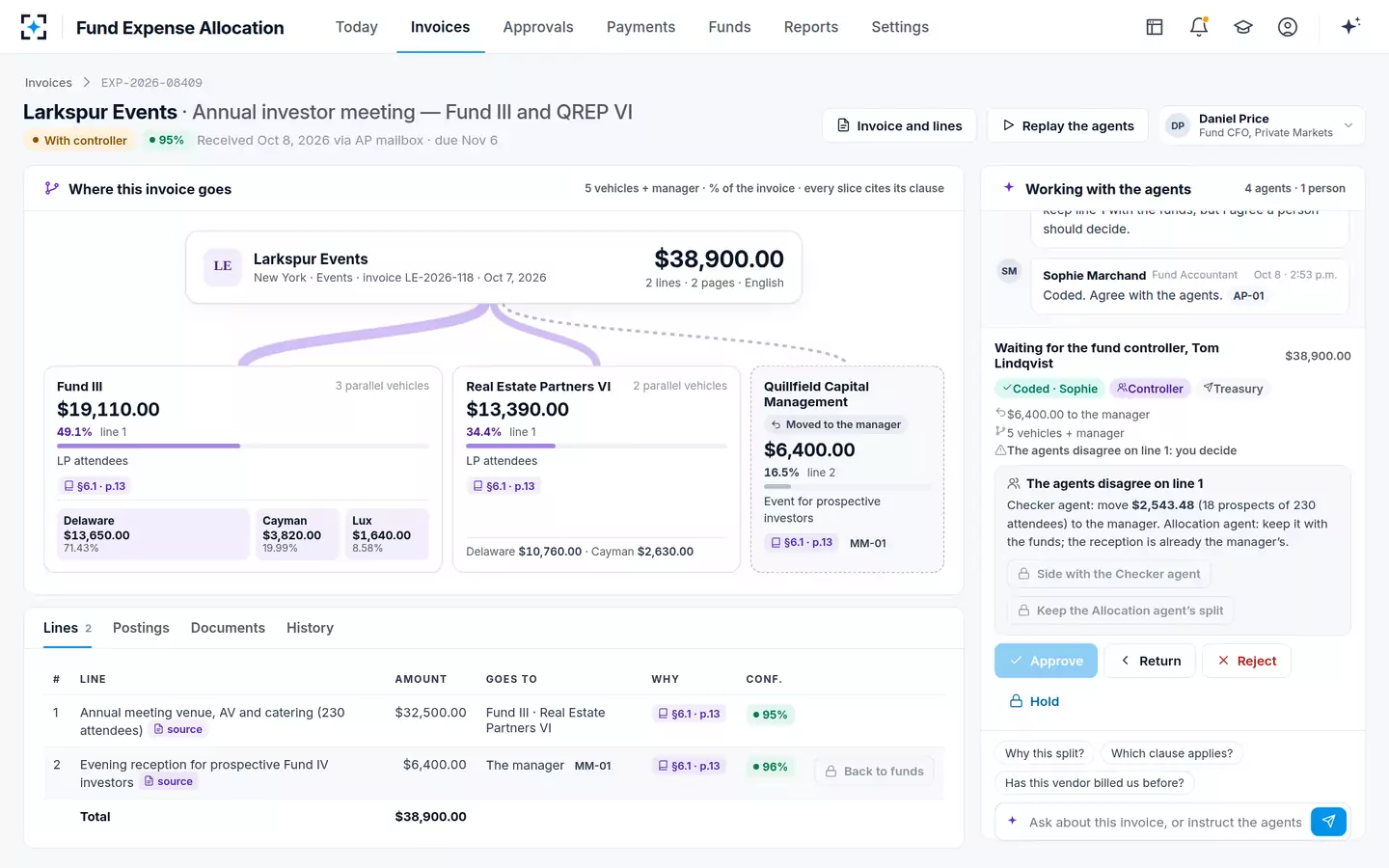
The policy gaps are the most valuable finding. The sample firm's annual meeting bill is one: the policy said investor attendees, but did not say whether prospective investors in the next fund count, so two agents read it two ways and the controller had to decide. A replay of a year surfaces every such case at once, so compliance can close them in one policy revision instead of one dispute at a time. The expense allocation policy is where each answer ends up.
When two agents read the policy two ways, Fund Expense Allocation blocks approval
How large should the replay be?
Large enough to include every kind of cost the method must handle, which usually means a full quarter at least and a full year if the fund family changed. A quarter without a dead deal says nothing about broken-deal allocation; a year without a new close says nothing about how the method treats a vehicle that joins mid-period. The test is coverage of cases, not invoice count.
Replay the whole population of the chosen period rather than a sample. The cost of a replay is mostly reading and splitting invoices, which is the work the tool is meant to do anyway, while the cost of a missed pattern is a look-back over years. The sample firm's examiner request covered 21 months and 1,906 invoices for one fund, its parallels and its co-investment vehicles; a replay that covers the same ground answers that kind of request before it arrives.
Choose the answer key with care. Booked allocations are not truth; they are last year's decisions, some of which were wrong. That is why every difference needs a person to classify it, and why a tool that matched the books perfectly on a year that contained errors would be a warning sign, not a success.
Running the replay on Fund Expense Allocation
In the solution the replay is the step before go-live: the agents replay the last quarter under the policy and fund terms the firm approved, and every difference is explained before any live invoice is allocated. The same test runs again whenever an agent changes: a new version is used only after it has been re-run on a fixed set of past invoices and approved by the controller and the Chief Compliance Officer. Every override a person makes in live use, with its reason code, joins the next evaluation.
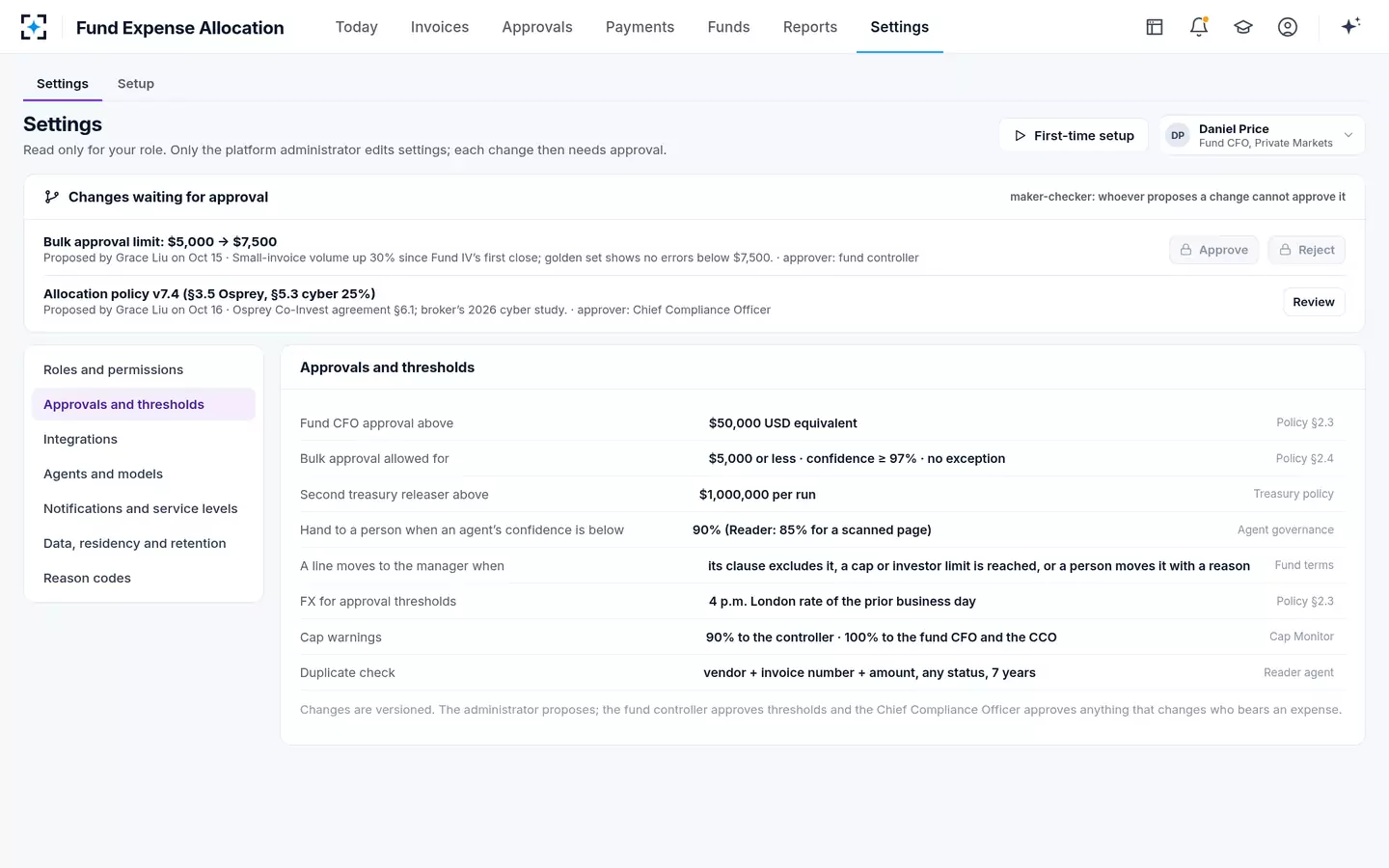
Settings carry the policy, and a change to who bears an expense is itself an approval. On the sample firm's settings screen, a proposed policy version 7.4, which touches a co-investment vehicle's clause and the share of cyber cover, waits for the Chief Compliance Officer with the agreement and a broker's study attached; a proposal to raise the bulk-approval limit from $5,000 to $7,500 waits for the controller, with the replay evidence attached.
Allocation rules as settings, each change waiting for its approver
A replay plan for an allocation method or tool
- Choose a closed, audited period
A full quarter at least; a year if the fund family changed during it.
- Freeze the rules that were in force
The policy version and fund terms of the period, not today’s.
- Hide the answer
The method or tool must not see the booked allocations until it has finished.
- Compare vehicle by vehicle, line by line
Totals can match while two vehicles are each wrong by the same amount.
- Classify every difference
Tool error, last year’s error, policy gap, timing, rounding and currency.
- Send policy gaps to compliance
Each becomes a rule in the next policy version.
- Decide on corrections to the books
Some of last year’s errors may need repaying with interest.
- Repeat when anything changes
A new fund, a new co-investment structure, a new version of the tool.
A replay also prices the decision. Knowing how many invoices a method gets wrong, and how much money those errors moved, is the input to the cost of one allocated invoice. To see the replay on sample data, start from Fund Expense Allocation.
Questions people ask
What are cost allocation methods examples for funds?
Commitments for fund-wide costs, commitments to the deal for live and broken deal costs, invested capital for portfolio costs, NAV for open-end vehicles, hours for shared staff and attendees for investor events. In KKR's 2015 case the SEC described a broken-deal method that weighed committed capital, invested capital and how often co-investors were eligible to take part.
What is a reasonable allocation basis?
One that measures benefit, is written down before it is used, and is applied the same way every time. The federal grant rules allow "any reasonable documented basis" when benefit cannot be measured directly; for a fund, reasonable also means consistent with the LPA and what investors were told.
Can a fund change its allocation method?
Yes, prospectively and in writing, within what the fund documents allow, and with disclosure where investors could be affected. Rialto's change raised the overhead factor in its cost calculation from 11% to 25% without full disclosure to the funds' advisory committees, and the SEC treated that as part of its case.
How often should allocations be tested?
No rule sets a frequency. A full replay is worth running before relying on a new tool or policy, after any change to the fund family, and at the annual policy review the compliance rule already requires. Between replays, an independent re-performance of each allocation before approval catches most single errors.
Is pro rata always by ownership?
Usually, but not necessarily. The SEC noted in 2023 that advisers generally implement pro rata allocations based on ownership percentages, and declined to define the term because there are multiple methods. What matters is that the basis matches the documents, the disclosures and the cost being shared.