An expense allocation policy in private equity decides who pays each invoice: the fund, its parallel and co-investment vehicles, or the manager. It works as three questions asked in order. First, do the LPA and side letters allow the fund to bear this kind of cost at all? Second, which vehicles benefited from it? Third, on what written basis is it split between them? Most of the SEC's expense cases are a firm skipping one of the three. Botminds' Fund Expense Allocation is an agentic solution that asks all three on every line of every vendor invoice, cites the clause each answer rests on, and leaves the approval to the fund accountant, controller and CFO.
The work is hard because the answer is rarely on the invoice. A law firm's bill for a deal that died says nothing about the co-investors who would have joined it; a consultant's bill says nothing about whether the consultant is really the manager's own staff. The examples below come from a fictional sample manager, Quillfield Capital, as it runs through the solution.
What three SEC orders found when the policy was missing or not followed
$17.4M
of broken-deal costs misallocated between flagship funds and co-investors at one manager, 2006–2011
$2M
of staff pay, about 7% of one group’s cost, charged to three funds for work they did not owe
$455,698
of an adviser’s registration, exam and investigation costs charged to its funds
What an expense allocation policy in private equity must answer
A fund expense allocation policy has one job: to turn the LPA's expense clauses into decisions a fund accountant can repeat on a Tuesday afternoon without asking the general counsel. The LPA says what the fund may bear. The policy says how the firm applies it: which costs are shared, between which vehicles, on which basis, who decides the close calls and what evidence is kept.
The SEC's examination staff described the failures it found in plain terms in its June 2020 risk alert on private fund advisers. Advisers "allocated shared expenses, such as broken-deal, due diligence, annual meeting, consultants, and insurance costs, among the adviser and its clients, including private fund clients, employee funds, and coinvestment vehicles, in a manner that was inconsistent with disclosures to investors or policies and procedures, thereby causing certain investors to overpay expenses" (SEC OCIE risk alert, June 23, 2020). The list in that sentence is a working inventory of the costs a policy must name.
The order of the questions matters. A firm that starts with the split, asking only how to divide a $200,000 legal bill between three vehicles, can produce a perfect pro rata allocation of a cost the funds should never have borne. A firm that starts with the LPA but forgets the co-investment vehicle has the right cost on the wrong vehicles. The tree below puts the questions in the order an examiner reads them.
The three questions of an expense allocation policy, with an SEC order at each fork
Question 1
May the fund bear this expense at all?
Read the expense clause of the LPA, then every side letter that limits it. A cost the documents do not give the fund belongs to the manager, however useful it was to the fund.
YesGo to question two, carrying the clause that allows it.
NoThe manager pays. Record the clause that excludes it.
When it was skippedCherokee (2015): $455,698 of the advisers’ registration, exam and investigation costs charged to funds whose LPAs did not disclose it.
Question 2
Which vehicles benefited from it?
List every vehicle that would have shared in the deal, the service or the event: parallel funds, feeder and alternative vehicles, co-investment vehicles, employee funds and the manager itself.
YesOne vehicle only: it bears the whole cost.
NoSeveral: go to question three with the list.
When it was skippedKKR (2015): $17.4 million of broken-deal costs left on flagship funds while co-investors that shared in the deals bore none.
Question 3
On what basis is it split?
Use the basis the documents and the written policy name for that kind of cost: commitments, deal commitments, invested capital, NAV, headcount or time. Apply it the same way every time.
YesA named basis applied: allocate, and keep the inputs.
NoNo basis written down: stop, and settle it with compliance before anyone pays.
When it was skippedEnergy Capital Partners (2022): a fund holding about 27% of a deal bore about 39% of its bridge-loan fees.
Question one: may the fund bear this expense at all?
The first question is contractual, and the answer is in the LPA's expense clause read together with the side letters. Most LPAs list the costs the partnership bears (legal, audit, tax, administration, insurance, the annual meeting, broken deals) and then list what the manager bears out of its management fee (its own people, rent, general technology, fundraising). A policy that restates both lists in the firm's own words, with each item mapped to its clause, removes most of the judgment from the desk.
The SEC reads the clause narrowly when the manager is on both sides. In Cherokee, the LPAs said the funds would pay expenses that "in the good faith judgment of the general partner arose out of the operation and activities of the Funds, including the legal and consulting expenses of the Funds". The advisers charged the funds $455,698 of consulting, legal and compliance costs of their own, incurred preparing to register, answering an SEC examination and responding to an enforcement investigation. The order found "there was no disclosure that the Funds would be charged for the advisers' legal and compliance expenses" (SEC IA-4258). A general clause did not stretch to cover the manager's own regulatory life.
Two practical rules follow. When the clause is general, the policy should say which of the manager's own costs it never covers. And when a line could go either way, the person deciding should write down the clause relied on before the fund pays, not after the auditor asks.
Which expenses does the manager pay, not the fund?
Unless the fund documents say otherwise, the manager pays the costs of being a manager: its people, its offices, its compliance programme, its regulatory filings and its fundraising. The 2020 risk alert lists the pattern examiners found when firms got this wrong: advisers "charged private fund clients for expenses that were not permitted by the relevant fund operating agreements, such as adviser-related expenses like salaries of adviser personnel, compliance, regulatory filings, and office expenses" (SEC, 2020).
The hard cases are people who look like vendors. NB Alternatives' funds could bear the cost of a business services group up to a cap of 50 basis points of commitments, while the manager paid all "compensation costs of [their] investment professionals" outside that group. Some of the group's staff also helped raise capital and find new investments. Of the $28.7 million the funds paid for the group from 2012 to 2016, "approximately $2 million, or 7%, was paid for time spent on tasks not related to" it; the firm paid a $375,000 penalty (SEC IA-5079). The cap was hit in only one year, so a cap test alone would not have caught it. A time test would.
Description is the third trap. In the 2023 release adopting the private fund adviser rules, which a federal court later vacated, the SEC gave a pointed example of a cost hidden by its label: an adviser that "charges a fund for fees and expenses associated with the preparation and filing of the adviser's Form ADV but only identifies such charges broadly as" legal expenses (88 FR 63206, 2023). A policy should name the manager's recurring costs by what they are, so that a law firm's bill for the Form ADV cannot pass as fund legal work.
Costs that end up with the manager, and the clause that sends them there
| Cost | Usually borne by | What the policy should test |
|---|---|---|
| Manager staff salaries and bonuses | Manager | Whether any “consultant”, “operating partner” or service group is in substance the manager’s own staff, and how its time is split. |
| Compliance, registration, exams, regulatory filings | Manager | Whether a general “legal and consulting” clause is being stretched to cover the adviser’s own obligations. |
| Fundraising for a successor fund | Manager | Hours on a deal bill that are really time with prospective investors in the next fund. |
| Placement agent fees | Manager, or fund with an offset | Whether the LPA lets the fund pay first and requires the management fee to be reduced. |
| Insurance (D&O, E&O, GPL) | Shared | The manager’s share of a policy that covers it as well as the funds. |
| Organizational expenses above the cap | Manager | A running total against the cap, with the LPA’s own definition of what counts. |
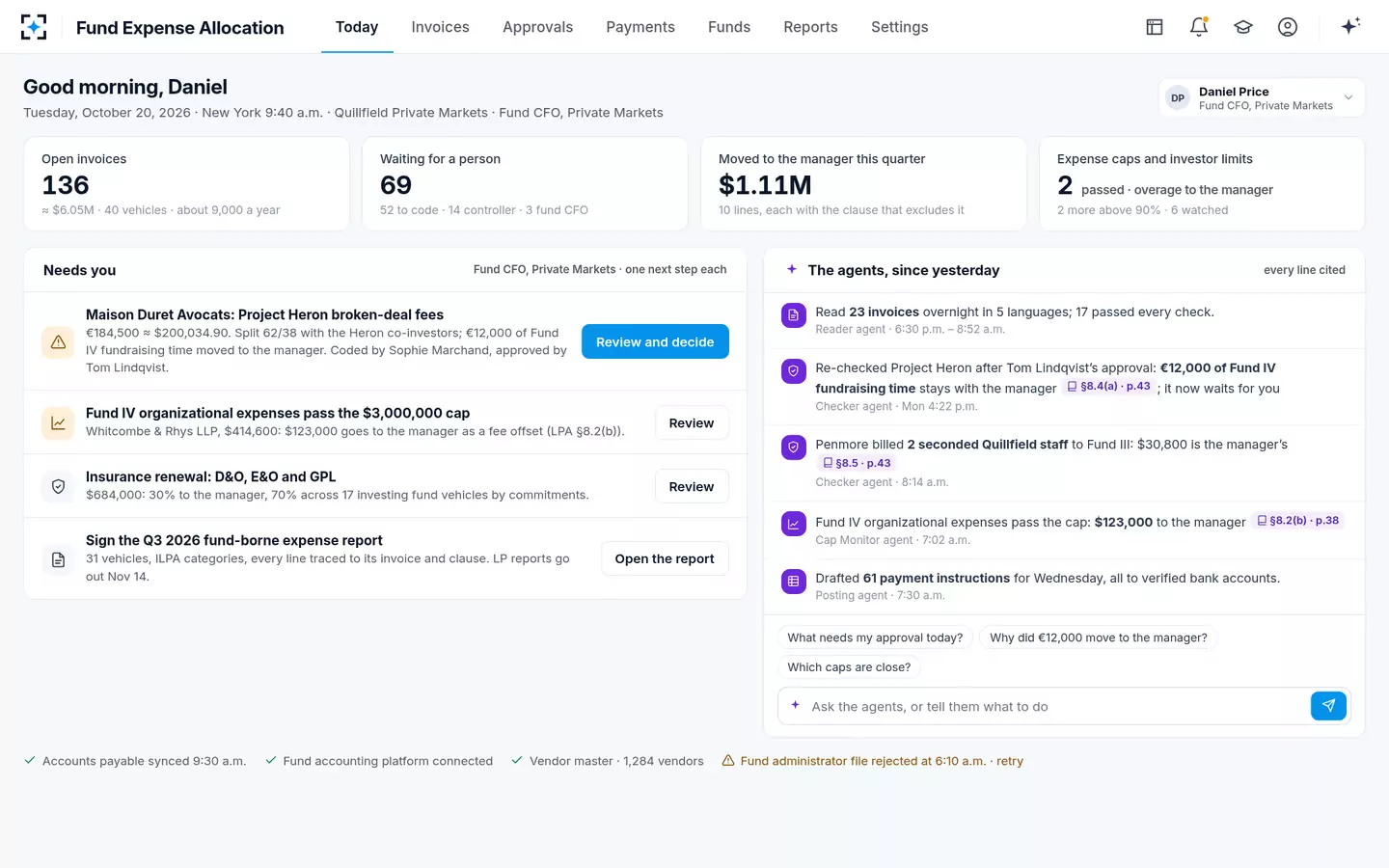
The sample manager's home screen shows what the third column looks like in practice. One morning the Checker agent found that a consultant, Penmore, had billed two seconded Quillfield staff to Fund III, and moved $30,800 to the manager under the LPA clause on manager personnel. The same morning an insurance renewal of $684,000 waited for review, split 30% to the manager and 70% across 17 investing vehicles by commitments.
Fund Expense Allocation's home: what the agents moved to the manager, and why
Question two: which vehicles benefited?
Once a cost is chargeable, the question becomes who shared in the benefit. A modern fund family is rarely one partnership. Fund III might be a Delaware partnership, a Cayman parallel and a Luxembourg vehicle, investing beside an employee fund, a committed co-investment vehicle and deal-by-deal co-investors. Each is a separate client with its own investors, and the manager owes each one the same duty.
The SEC's view, stated across several orders, is that a vehicle that shared in the deal flow should share in its cost unless the documents say otherwise. In KKR the co-investors "participated in and benefited from KKR's sourcing of private equity transactions", yet bore no broken-deal costs from 2006 to 2011; the order found "KKR misallocated $17.4 million in broken deal expenses" and that it "did not adopt and implement a written compliance policy or procedure governing its fund expense allocation practices until 2011" (SEC IA-4131). The same reasoning reached the portfolio-company level in Lincolnshire, where two companies owned by different funds were run as one and shared a written cost-sharing policy that "was not followed in certain instances" (SEC IA-3927).
Do co-investors share fund expenses?
Co-investors share the expenses their documents give them, and the fund should not quietly absorb the rest. That usually means deal expenses of consummated deals pro rata to what each invested, and broken-deal expenses only where the co-investment agreement says so. Where a co-investor negotiates out of a cost, the fund's own investors need to be told before the fund picks it up; who pays broken deal expenses, case by case, follows the orders that turned on exactly this.
The practical test is a list. For every deal, keep the list of vehicles that committed or would have committed, with their amounts, at the date the cost was incurred. Without it, nobody can show later that a co-investor's share was charged, and the fund's investors pay by default.
Question three: on what basis is it split?
The basis must be written down before the invoice arrives, and it must match the kind of cost. Commitments suit fund-wide costs during the investment period; commitments to the specific deal suit deal costs; NAV suits open-end vehicles; attendees suit an annual meeting; time records suit shared staff. The policy should name one basis per cost type, the date its inputs are measured, and what happens when a vehicle closes mid-period. Expense allocation methods, tested on last year's invoices compares the bases on the same bills.
A policy that only promises fairness does not answer the question. Energy Capital Partners' written policy stated that the firm would allocate expenses on a fair and equitable basis. When pre-deal co-investors refused to pay bridge-loan commitment fees of about $27 million, the fund that held about 27% of the deal was allocated about 39% of the fees, about $3.3 million more than its share by ownership. The firm repaid the fund's limited partners and paid a $1,000,000 penalty (SEC IA-6049).
“… will allocate expenses charged to its private funds on a fair and equitable basis in accordance with the relevant fund partnership agreements.”
Energy Capital Partners' written expense policy, as quoted in SEC order IA-6049 (June 2022)
The sentence is not wrong; it is empty. It names no basis, no measurement date, no exception route and no approver, so it could not stop a one-off deal with co-investors from moving cost onto the fund. The order treated the gap as a compliance failure in its own right.
What examiners look for in a fund expense allocation policy
Examiners look for three things: a written policy, evidence that it is applied, and an annual review. The written-policy duty comes from the Advisers Act compliance rule, which requires a registered adviser to put in place, and actually apply, written policies and procedures designed to prevent breaches of the Act, and to review them at least once a year (17 CFR 275.206(4)-7). KKR, Platinum Equity, Rialto, Energy Capital Partners and NB Alternatives were each charged under that rule as well as for the misallocation itself.
The SEC's Division of Examinations keeps the subject on its list. For fiscal year 2027 it says reviews of private fund advisers will assess whether compliance controls cover risks at both the fund and the deal level, including "the accuracy of fee and expense calculations at both the fund and investment levels" (SEC Division of Examinations, Examination Priorities FY2027, October 23, 2026). The private fund adviser rules that would have prescribed quarterly expense statements were vacated by the Fifth Circuit in June 2024, so the obligation rests where it always did: on fiduciary duty, the disclosures and the compliance rule.
In practice an examiner asks for every expense allocated to a fund and its related vehicles over a period, with the basis. The firm that can answer from a register of allocations, each with its clause, basis inputs and approver, spends a day. The firm that rebuilds spreadsheets spends weeks, and finds its own exceptions while the examiner waits.
How Fund Expense Allocation applies the policy line by line
Botminds' Fund Expense Allocation turns the three questions into the work of named agents, each limited to one step, with people deciding at the end. The Reader agent reads the invoice in its own language and cites every value to its page. The Chargeability agent tests each line against the LPA, side letters and co-investment agreements and classifies it as an allowed fund expense, a broken-deal cost, a live-deal cost, an organizational expense or the manager's, citing a clause or handing the line to a person. The Allocation agent applies the written basis. The Checker agent re-does the split independently and argues the manager's side.
The fund terms the agents work from, each clause with its page
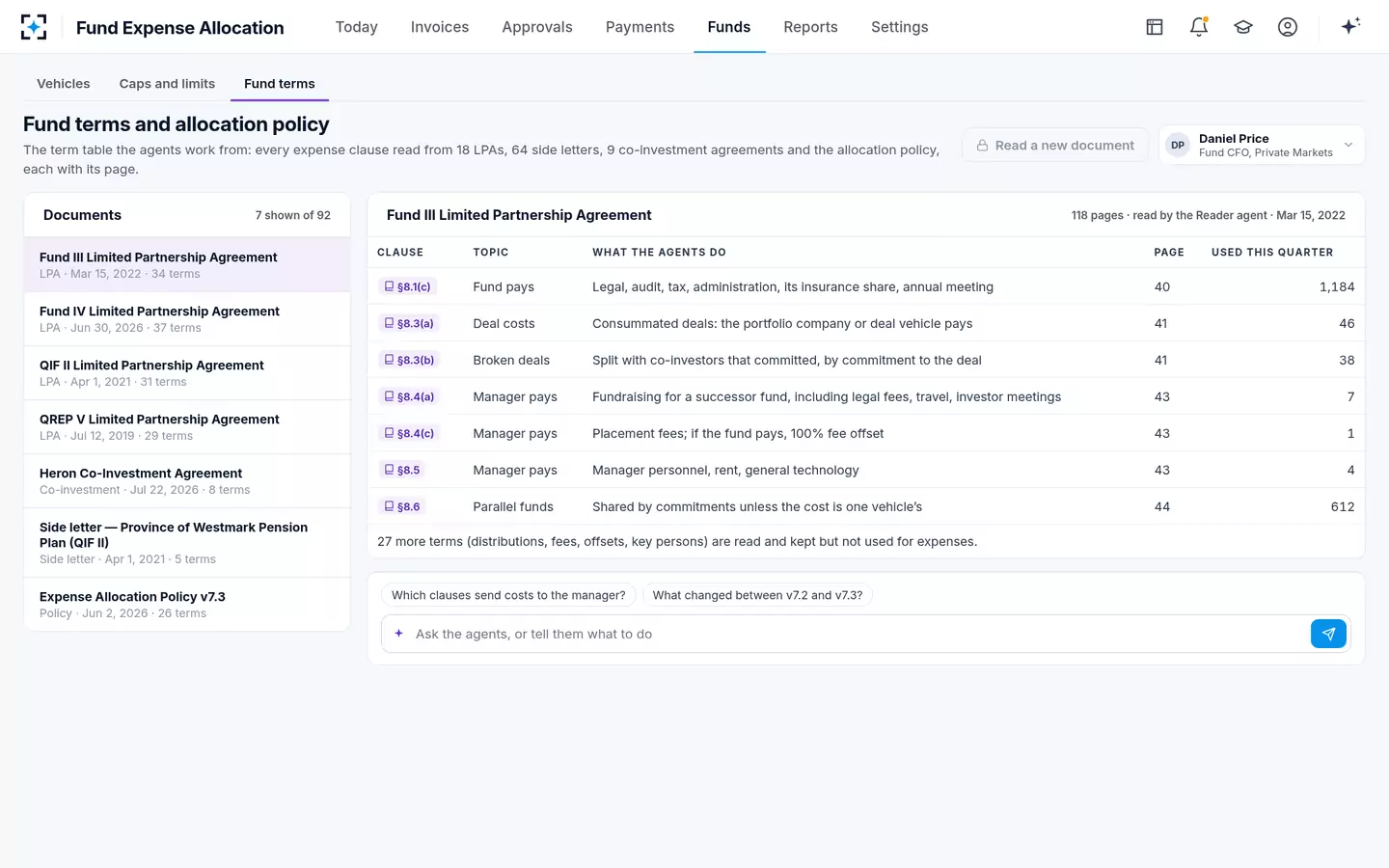
Three settings carry the policy's judgment calls. A line moves to the manager when its clause excludes it, when a cap or investor limit is reached, or when a person moves it with a reason code. The policy and every fund term are approved by the Chief Compliance Officer before an agent may use them. And when two agents disagree, approval is blocked until a person decides. The sample firm's annual investor meeting bill shows why: one agent wanted to move a share of the venue cost to the manager because 18 of 230 guests were prospective investors in the next fund; the other kept it with the funds under the policy's attendee basis. The policy did not say, so the controller decided, and his reason code stays with the allocation for the next examiner and the next annual review.
The clauses a written allocation policy needs
A policy that survives an examination is specific enough that two accountants, given the same invoice, reach the same split. The clauses below are the ones the SEC orders show were missing, each with the reason it matters.
Ten clauses for a private equity expense allocation policy
- Scope: every vehicle the manager advises
Flagship funds, parallels, feeders, alternative vehicles, co-investment and employee vehicles, separate accounts and the manager itself.
- The manager’s costs, named
Salaries, compliance, registration and exam costs, regulatory filings, office and fundraising: the 2020 risk alert’s list, in your words.
- A basis for each shared cost type
Commitments, deal commitments, invested capital, NAV, attendees or time, with the date the inputs are measured.
- Broken deals and co-investors
Which co-investors bear broken-deal costs, from what date, on what amount. The KKR and Platinum Equity orders turned on this.
- Shared staff and operating partners
How time is recorded and split when people work for both the funds and the manager.
- Caps and investor limits
Each cap and side-letter limit, what counts toward it, and who is told at 90% and at 100%.
- Vendor terms
Discounts and rate cards negotiated for the manager and the funds together must reach the funds on the same terms.
- Exceptions and approvers
Who may approve a departure from the basis, with what evidence, and when the investors or the advisory committee must hear first.
- Evidence kept
Clause, basis inputs, approver and policy version for each allocation, kept with the invoice.
- Annual review
What changed in the fund documents, the overrides of the year and what they teach, signed by the Chief Compliance Officer.
The checklist is the paper half. The other half is applying it to every invoice, which is where a cap passes unseen or a successor fund's fundraising hides inside a deal bill. What counts toward an organizational expense cap takes the cap clause further. To see the policy applied line by line on sample invoices, start from Fund Expense Allocation.
Questions people ask
Who pays fund expenses in private equity?
The fund pays the expenses its LPA assigns to it, usually legal, audit, tax, administration, insurance, the annual meeting and the costs of deals, and its investors bear them in proportion to their interests. The manager pays its own overhead out of the management fee. Anything the documents do not give the fund stays with the manager.
Is an expense allocation policy required by the SEC?
No rule names it, but a registered adviser must adopt written policies and procedures reasonably designed to prevent violations of the Advisers Act, and review them at least annually. In KKR, Platinum Equity, Rialto and Energy Capital Partners the SEC treated the absence or emptiness of an expense allocation policy as a breach of that rule in its own right.
What are partnership expenses?
Partnership expenses are the costs the LPA says the partnership itself bears, as opposed to the general partner's or manager's expenses. In Platinum Equity's LPAs, for example, each fund would "bear and be charged with all expenses of the [p]artnership other than [g]eneral [p]artner [e]xpenses", including broken-deal expenses. The definition is contractual, so it differs from fund to fund.
Are insurance premiums a fund expense?
Often in part. A policy covering both the funds and the manager, such as D&O or E&O cover, is a shared cost, and the 2020 risk alert lists insurance among the shared expenses examiners found misallocated. The policy should state the manager's share and the basis for splitting the rest, and the split should be revisited when the cover changes.
Does the policy reach portfolio company costs?
It should, wherever the manager decides how a cost is shared between companies owned by different funds. In Lincolnshire, two portfolio companies held by separate funds shared management and a written cost-sharing policy, and the SEC found the policy was not followed in certain instances, so one company, and its fund's investors, paid more than its share.
How often should an expense allocation policy change?
At least at the annual review the compliance rule requires, and whenever a new fund, side letter or co-investment structure adds a vehicle or a limit. Each change should carry a version number and an approver, so that every past allocation can be read against the policy that was in force when it was made.