An invoice approval workflow at a private fund is the chain of people who must agree before a vendor is paid: a fund accountant codes the invoice to the right vehicles, a controller approves the coding, a CFO approves above a threshold, compliance is told when a cap or conflict is involved, and treasury releases the payment to a verified bank account. The examples below show that the slow part is rarely the approving. It is the waiting: for the engagement letter, for the deal team to say what a line of hours was for, for the clause that decides whether a fund may bear the cost. Botminds' Fund Expense Allocation is an agentic solution that answers those questions before the invoice reaches the first person, so each approver starts from a split with its basis and clause already attached.
The examples follow invoices at a fictional sample manager, Quillfield Capital, with 40 vehicles and about 9,000 invoices a year, as they run through the solution.
Who waits on whom in a fund's invoice approval workflow
Fund accountantThe vendor and the deal team
ForAn engagement letter, a deal memo, or what a line of hours was really for.
ExampleCoding the Heron bill waited for the law firm to confirm by email what line 4 covered.
Fund accountantThe fund documents
ForWhich clause applies, and whether a side letter limits an investor’s share.
ExampleThe LPA, 64 side letters and 9 co-investment agreements live in a document system, not in the payables queue.
Fund controllerThe fund accountant’s evidence
ForThe basis inputs behind a split: commitments, deal commitments, attendees.
ExampleAn approval with no basis attached comes back as a question.
Fund CFOThe controller
ForAbove $50,000 the CFO approves only after the controller.
ExampleThe €184,500 Heron bill reached the CFO four business days after it was coded.
Compliance and the advisory committeeThe finance team
ForA cap passed, a conflict, a cost the LPA needs consent for.
ExampleA cap overage needs a note to the advisory committee before the quarter’s report.
TreasuryEveryone above, and the vendor master
ForOnly approved invoices to call-back-verified bank accounts.
ExampleA vendor that emails new bank details is held until someone calls the number already on file.
What does an invoice approval workflow look like at a private fund?
It looks like an ordinary payables workflow with one extra question at every step: which vehicle pays? A corporate invoice is approved against a purchase order and a budget. A fund invoice is approved against fund documents, because the same law firm may bill work for three parallel funds, a co-investment vehicle and the manager on one invoice, and each of those is a separate client with separate investors.
That extra question changes who must be involved. The fund accountant needs the LPA and side letters, not just the vendor master. The controller needs the basis behind the split, not just the total. Compliance needs to see anything that crosses a cap or touches a conflict. And the evidence has to survive: an investment adviser must keep "All bills or statements (or copies thereof), paid or unpaid, relating to the business of the investment adviser as such", generally for at least five years, the first two in an appropriate office (17 CFR 275.204-2). The sample firm keeps every invoice, decision and approval for seven.
Before the solution, the sample firm worked by hand: a fund accountant read the invoice, decided from memory which clause applied, built the split in a spreadsheet and keyed it into two systems, and approvals happened by email with the evidence in shared drives. Each of those hand-offs is a place to wait.
Who approves a fund invoice?
At least two people, and the person who codes it is never the person who approves it. In the sample firm's settings the fund accountant codes every invoice, the fund controller approves every coded invoice, and the fund CFO also approves anything above $50,000 in US dollar terms. Treasury releases payments, and above $1,000,000 a second releaser must release too. Two rules are locked: whoever codes cannot approve, and nobody who codes or approves can release the payment.
A sample approval matrix for fund invoices
| Step | Who | When | Service level in the sample firm |
|---|---|---|---|
| Code the invoice | Fund accountant | Every invoice | 2 business days |
| Approve the coding | Fund controller | Every coded invoice | 3 business days |
| Second approval | Fund CFO | Above $50,000 USD equivalent, after the controller | 2 business days |
| Policy, fund terms, caps at 100% | Chief Compliance Officer | Before any rule is used; when a cap is reached | Not set |
| Release payment | Treasury | Approved invoices to verified accounts; two releasers above $1,000,000 per run | Weekly run |
| Escalation | Controller, then fund CFO, then COO | When a service level is missed | — |
The approval matrix is also a compliance document. The Advisers Act compliance rule (17 CFR 275.206(4)-7) expects a registered adviser's written procedures to work in practice and to be reviewed every year. Who may approve which expense, and on what evidence, is one of the places an examiner looks for them.
Five people who carry a fund invoice, before and after the agents
Today
Codes 30 to 40 invoices a day, keys splits into two systems and chases engagement letters.
With agents
Starts from the original invoice beside the English, each line already tested and split; confirms it or edits it with a reason code.
Still theirs: Coding: no invoice is coded by an agent.
Today
Approves every coded invoice from an email thread and a spreadsheet.
With agents
Sees what a person changed after the agents, and why; decides when two agents disagree, with both views in front of him.
Still theirs: Every approval, and every disagreement.
Today
Approves every invoice above $50,000 and signs the quarterly expense report.
With agents
Sees each slice, its basis and clause, and who coded and approved it, on one screen; signs with a reason code.
Still theirs: The second approval and the quarterly sign-off.
Today
Owns the allocation policy and answers examiners.
With agents
Approves the policy and every fund term before an agent uses them, and releases anything sent to an examiner.
Still theirs: The rules, and what leaves the firm.
Today
Releases payment runs and calls back on bank changes.
With agents
Releases only approved invoices to call-back-verified accounts; a second releaser above $1,000,000.
Still theirs: Every release.
Example one: a single-fund audit bill
The simplest fund invoice has one vehicle and one clause. An audit firm bills Fund III's Delaware partnership for its annual audit. The LPA puts audit costs on the fund, there is no co-investor and no cap, and the amount is below the CFO threshold. The fund accountant codes it to one vehicle, the controller approves, and treasury pays in the next weekly run. Nobody waits on anybody but the queue.
Even here two checks matter. Is it a duplicate of an invoice already paid, perhaps re-sent with a new number? And is the bank account on the invoice the one in the vendor master? The sample firm checks duplicates by vendor, invoice number and amount across seven years, in any status, and pays only to accounts verified by call-back.
Example two: a broken-deal legal bill across four vehicles
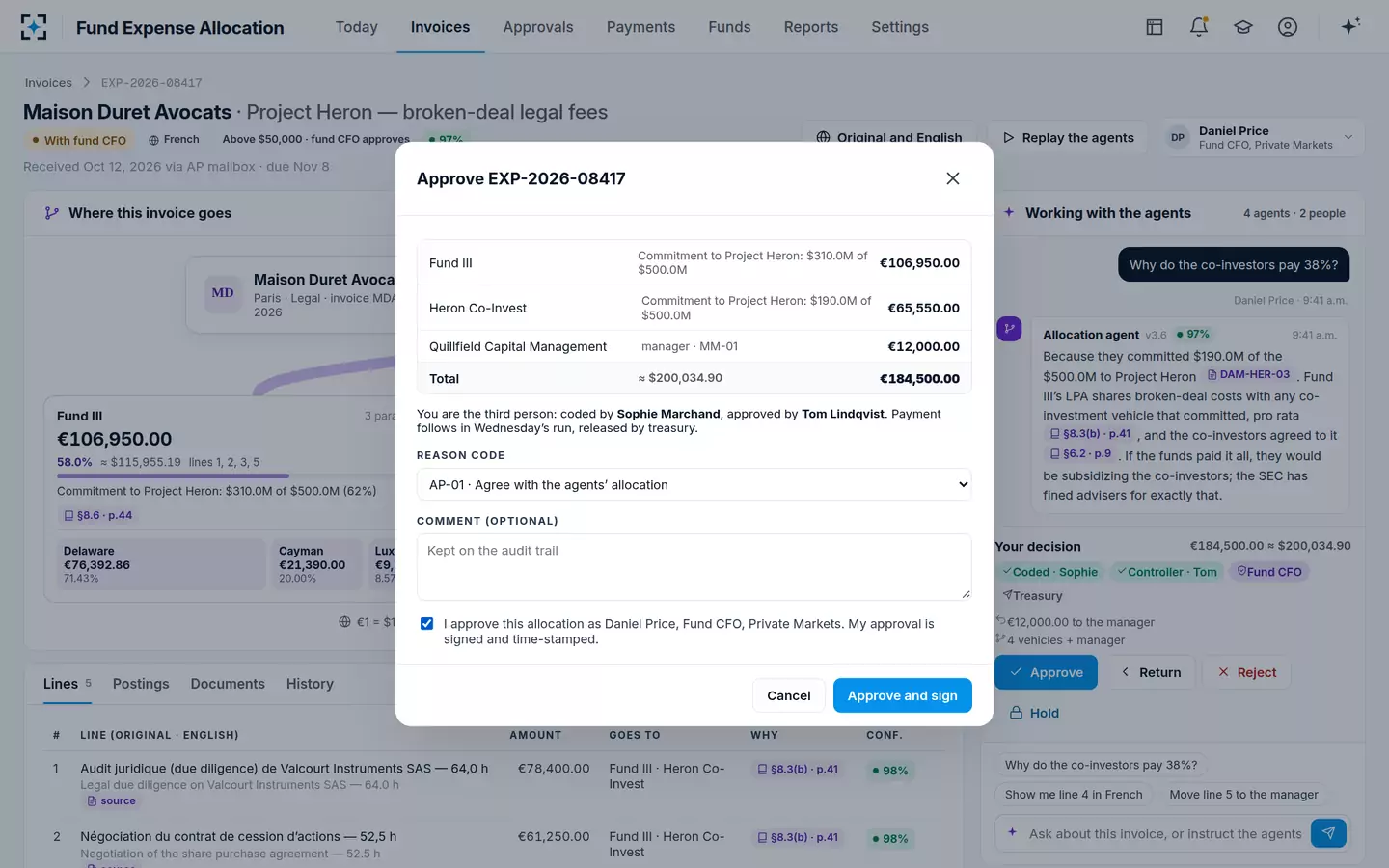
The sample firm's Paris law firm billed €184,500, about $200,035, in French, for Project Heron, a deal that died when exclusivity lapsed. Five lines; four were broken-deal costs to be shared between Fund III's three parallel vehicles and a co-investment vehicle by their commitments to the deal, and one, €12,000 of talks with prospective investors in the next fund, was the manager's. Why the co-investors pay their share of a dead deal is a story of its own.
Here is who waited on whom. The bill arrived on October 12; the agents had read, tested, split and re-checked it by 8:49 that morning. The fund accountant coded it on October 13 after the law firm confirmed by email what line 4 covered. The controller approved on October 19 after checking the deal memo. Above $50,000, it went to the fund CFO, who signed on October 20, and it was queued for the Wednesday payment run. Every wait was a person checking evidence, not a person looking for it.
The fund CFO's approval in Fund Expense Allocation: third person, every slice, a reason code
Example three: a bill that crosses a cap
A cap adds two people to the chain. The sample firm's formation counsel billed $414,600 for Fund IV's formation and second-close side letters when the fund had already charged $2,708,400 of its $3,000,000 organizational cap. The Cap Monitor agent moved $123,000 to the manager under the LPA and drafted a note to the advisory committee; at 100% of a cap, the fund CFO and the Chief Compliance Officer are told as well as the controller. What counts toward an organizational expense cap covers the arithmetic.
The advisory committee is the slowest link in any fund's chain, because it meets on a calendar, not a queue. The SEC's cases show what happens when it is skipped or under-informed. Rialto's LPAs made each fund's advisory committee responsible for approving costs charged for in-house services; the firm sent it an annual memo and was reimbursed after consent, but the memos did not disclose that an overhead factor had risen from 11% to 25% (SEC IA-5558, 2020). Energy Capital Partners did not tell its fund's advisory committee that the fund would bear more than its share of a deal's bridge-loan fees (SEC IA-6049, 2022).
Example four: a bill the agents disagree on
A disagreement adds a decision, and in the sample firm it belongs to the controller. Larkspur Events billed $38,900 for the annual investor meeting. The evening reception for prospective investors in the next fund, $6,400, was already the manager's. On the $32,500 venue line, the Checker agent counted 18 prospective investors among 230 guests and proposed moving $2,543.48 to the manager; the Allocation agent kept the line with the funds under the policy's basis of investor attendees. Approval was blocked until the controller chose a side, with a reason code.
The wait here is useful. A spreadsheet would have applied one basis silently; the disagreement surfaces a gap in the policy that the Chief Compliance Officer can close at the next review.
Why do fund invoices take weeks to pay?
Fund invoices take weeks because each one needs facts that live outside the payables team: the clause, the deal's investor list, the side letter limit, the vendor's explanation of a line. In Botminds' estimate for one multi-fund invoice at a 40-vehicle manager, done by hand, deciding what each line is under the fund documents takes a day and a half of business days, building the split across vehicles another day, and approvals by email, with the evidence gathered, a further day.
Where one multi-fund invoice's business days go, by hand and with Fund Expense Allocation
- Logging and keying0.75
- Reading a foreign-language bill0.5
- Deciding what each line is under the fund documents1.5
- Building the split1
- Caps and investor limits0.5
- Approvals by email, evidence gathered1
- Agents read, test, split, check0.45
- People approve0.5
Most of the reduction comes from the first two people no longer looking for facts. The approval step barely shrinks, and should not: it is where the judgment is. The sample firm's targets are coding within one day of receipt, inside a two-business-day service level, with every line tested against the fund documents before a fund bears it.
The payment step: why bank changes need a call-back
The last wait is deliberate. Funds pay large invoices to law firms and service providers by wire, which makes them a target for payment fraud. The FBI's Internet Crime Complaint Center describes business email compromise as a scam aimed at firms that pay suppliers by wire, run by taking over email accounts and other channels the payer trusts (FBI IC3, 2024 Internet Crime Report).
Business email compromise, as reported to the FBI in 2024
21,442
complaints of business email compromise in 2024
$2.77B
in reported losses, 2024
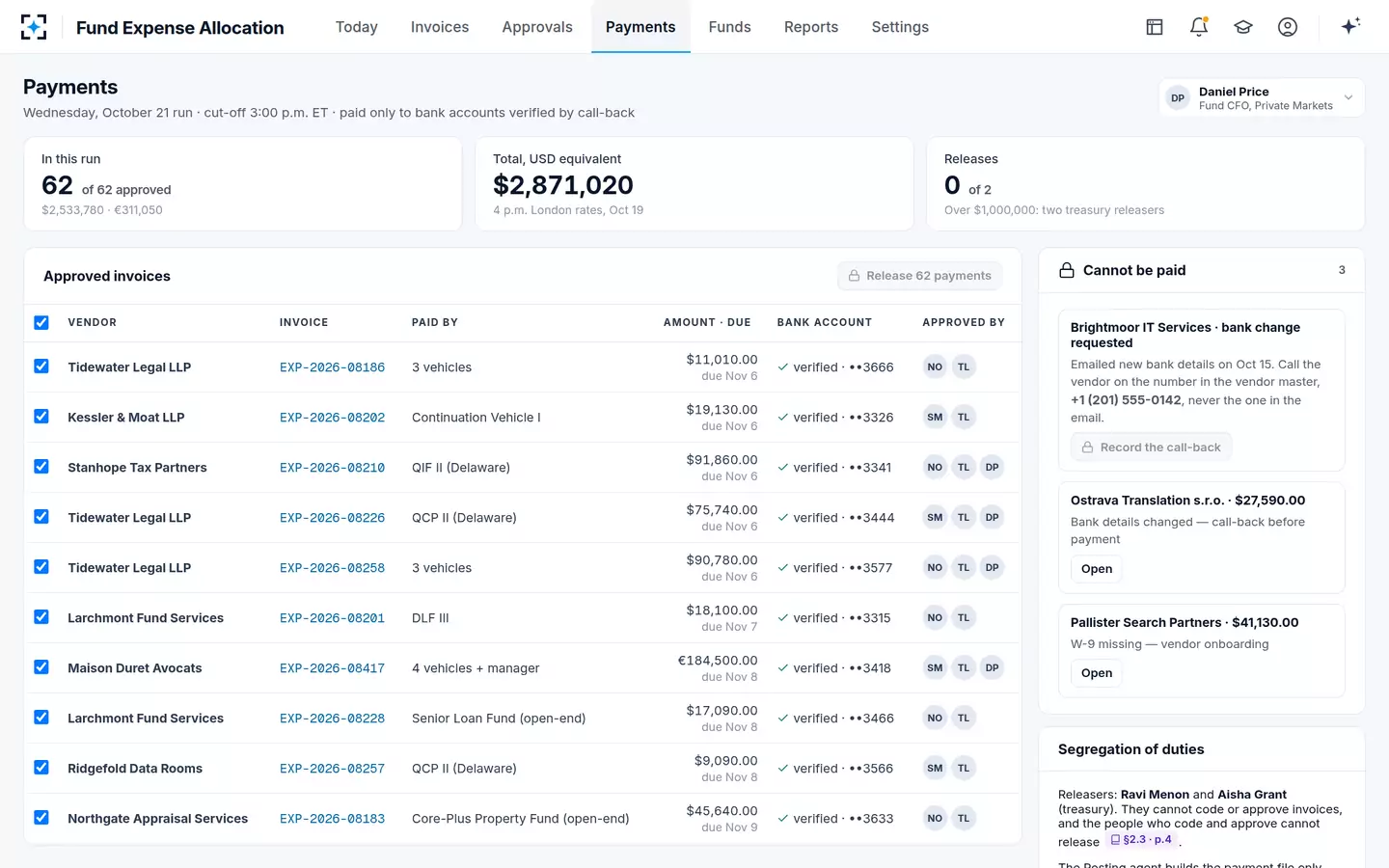
The control is old and it works: never take bank details from an email, and call the vendor back on the number already in the vendor master before any change takes effect. In the sample firm's Wednesday run, one vendor had emailed new bank details; its invoice was set aside with the instruction to call the number on file, "never the one in the email".
A payment run in Fund Expense Allocation: approved invoices only, verified accounts only
Invoice approval workflow best practices for funds
The practices that shorten a fund's workflow are the ones that move facts to the start of it. Attach the fund documents to the vendor, not to the person: every engagement letter, LPA clause and side-letter limit should be findable from the invoice. Fix the basis before the bill: the deal's investor list and commitments on the date costs are incurred. Separate the questions: what the line is, who benefited, how it splits, and who approves are four decisions that can be made by four different people or agents in parallel.
And keep the evidence with the decision. When an examiner asks for every expense allocated to a fund and its co-investment vehicles over two years, with the basis, a firm whose approvals happened by email rebuilds the answer from inboxes. A firm whose every approval carries its clause, basis inputs, approver and reason code exports it. Choosing and rolling out invoice approval workflow software takes the next step: how a team learns to trust a proposed split.
There is a staffing argument too. The US Bureau of Labor Statistics put the median annual wage of accountants and auditors in finance and insurance at $93,290 in May 2025, before benefits and overhead (BLS, Occupational Outlook Handbook). Hours spent looking for an engagement letter are expensive hours.
Questions people ask
What is an approval workflow?
An approval workflow is the fixed sequence of people who must agree before something happens, here before a vendor is paid. For a fund it typically runs from coding, to a controller's approval, to a CFO's approval above a threshold, to treasury's release, with the rule that no one approves their own work.
How long should invoice records be kept?
An SEC-registered adviser must keep all bills or statements relating to its business, paid or unpaid, for at least five years from the end of the fiscal year of the last entry, the first two years in an appropriate office. Fund documents, auditors and tax rules may require longer; the sample firm keeps seven years.
How should vendor bank changes be verified?
By calling the vendor on a number already held in the vendor master, never one supplied in the email or letter requesting the change, and by holding payment until the call is recorded. Business email compromise drew 21,442 complaints and $2.77 billion of reported losses to the FBI's complaint center in 2024.
Should the deal team approve deal invoices?
The deal team should confirm what the work was for, such as whether hours relate to a live deal, a dead deal or fundraising, but the allocation approval belongs to finance. Keeping the two separate stops a deal partner from deciding which vehicle bears a cost his own deal ran up.
What makes a good CFO approval threshold?
No regulator sets one for fund invoices; it is a matter of the firm's own policy. Pick a figure that sends the CFO the invoices large enough to matter to a fund's results, review it at the annual policy review, and treat any change as a policy change with its own approval, as the sample firm does.