Invoice approval workflow software routes each vendor invoice to the people who must code, approve and pay it, and keeps the evidence of who did what. For a private fund that is only half the job: the hard part of a fund invoice is deciding which vehicles bear it, and newer tools, including Botminds' Fund Expense Allocation, propose that split with its clause and basis before anyone approves. A proposal is worth nothing until the controller trusts it, and trust cannot be switched on at go-live. The way to earn it is a ladder of four rungs, each climbed only when the team's own numbers say so: shadow the desk, start from the proposal, bulk-approve small clean invoices, then review by exception. The ladder also works backwards; a bad quarter sends the team down a rung.
The examples come from a fictional sample manager, Quillfield Capital, as it runs Fund Expense Allocation.
Four rungs from approving to reviewing, and what earns each one
Rung 1
Shadow
How work flowsPeople allocate as before. The software proposes, unseen, and the two are compared each week.
Earned byEvery difference on a replayed quarter explained, and the live weeks agreeing on the clause and the split.
Rung 2
Start from the proposal
How work flowsThe fund accountant starts from the proposed split and clause, confirms or edits it, and every edit carries a reason code.
Earned byEdits falling quarter on quarter, with no edit reason that points to a wrong clause or a missing vehicle.
Rung 3
Bulk approval for small, clean invoices
How work flowsInvoices under a set amount, above a confidence level and with no exception are approved in batches; everything else as before.
Earned byA replay showing no errors below the threshold, and a controller who signs off the threshold as a policy change.
Rung 4
Review by exception
How work flowsPeople spend their time on caps, disagreements, side-letter limits and large bills, and sign the rest with the evidence in front of them.
Earned bySustained agreement, overrides reviewed at each annual policy review, and compliance satisfied with the evidence file.
What should invoice approval workflow software do for a fund?
It should do what any approval workflow does, route, enforce who may approve what, and keep the trail, plus three things specific to funds. It should know the fund documents well enough to say which vehicle bears each line and why. It should separate the people who code, approve and pay, so no one approves their own work or releases a payment they approved. And it should produce, on request, every allocation for a fund and its related vehicles over a period, with its basis, clause, policy version and approvers, because that is what an examiner asks for.
The control environment is not optional. An adviser's yearly compliance review has to ask both whether its procedures are adequate and whether they work as implemented (17 CFR 275.206(4)-7). Software that changes how expenses are allocated changes the implementation, so its adoption belongs inside that review, not beside it.
How do you get a team to trust proposed allocations?
By letting the team measure the proposals on its own invoices before relying on them, and by making every disagreement visible. A controller trusts a proposal for the same reasons she trusts a new accountant: it has been right on cases she has checked, it says why, it asks when unsure, and its mistakes are the kind she can catch. Each of those can be designed in, and each can be measured.
Regulators expect the measuring. ESMA's 2024 statement on AI in investment services says firms "should implement rigorous quality assurance processes for their AI tools", including "thorough testing of algorithms and their outcomes for accuracy, fairness, and reliability in various market scenarios" (ESMA public statement, May 30, 2024). The SEC describes its own approach to the tools it calls super intelligence in similar terms: it is adopting them "supplementing, but not replacing, staff judgment" (SEC, Examination Priorities FY2027, October 23, 2026). A fund adopting allocation software can hold itself to the same standard.
What each approver needs to see before trusting a proposed split
Today
Builds every split by hand and is blamed for every error found later.
With agents
Starts from a proposed split with the clause and basis; edits it with a reason code when it is wrong.
Still theirs: The coding decision, and the right to say no.
Today
Approves splits whose basis lives in a spreadsheet he did not build.
With agents
Sees what a person changed after the agents and why; decides every disagreement between agents.
Still theirs: Every approval, and the thresholds for bulk approval.
Today
Signs the quarter’s expense report on trust.
With agents
Sees agreement and override figures for the quarter beside the report; approves every invoice above $50,000.
Still theirs: The quarter’s sign-off.
Today
Learns of allocation problems when an examiner or auditor finds them.
With agents
Approves the policy, the fund terms and each new version of the agents before use.
Still theirs: The rules, and what is sent outside the firm.
Rung one: shadow the desk on last quarter
Start with a replay, not live invoices. Run a closed quarter through the software under the policy and fund terms that were in force, compare its splits with what was booked, and explain every difference before a single live invoice is touched. In Fund Expense Allocation the agents replay the last quarter before go-live and every difference is explained. Then shadow live work for a few weeks: people allocate as before, the software proposes in parallel, and someone compares the two.
What the team learns on this rung is less the overall agreement rate than the shape of the disagreements. A tool that misses on rounding is harmless; one that misses a co-investment vehicle on dead deals is not. The replay method sorts each difference into the tool's error, last year's error, a policy gap or a timing difference, and only the first counts against the tool.
Rung two: start from the proposal, record every change
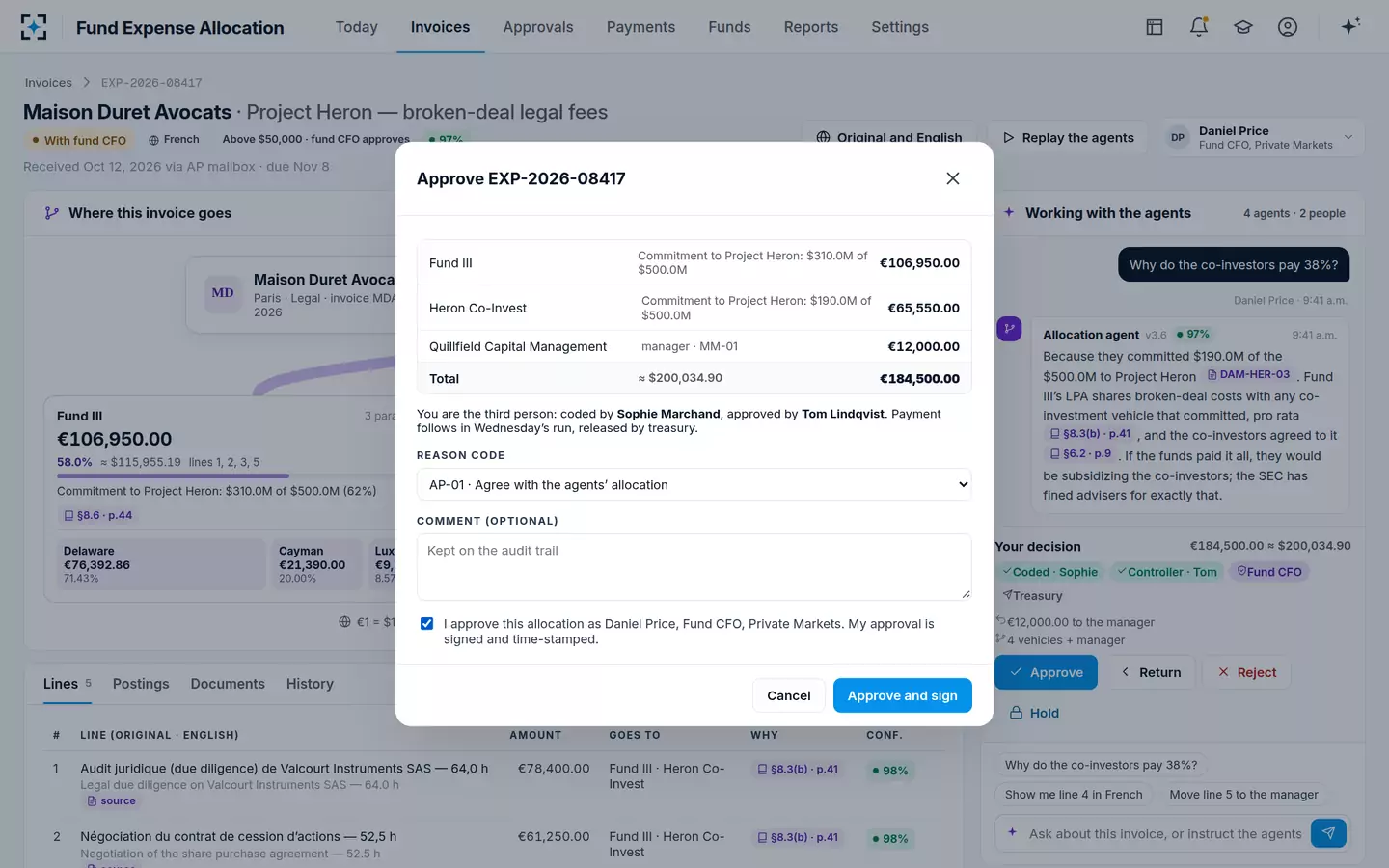
On the second rung the accountant starts from the proposed split and confirms or edits it, and every edit carries a reason code. The approver sees what changed after the agents and why. The reason codes are the measurement: if most edits are "vendor clarified a line", the tool is fine and the vendor's bills are vague; if edits say "wrong vehicle" or "clause misread", the team has found a defect to fix before climbing.
Overrides are not a failure; they are how the system learns the firm's policy. In the sample firm's quarter, 9 of 2,214 allocations, about 0.4%, carried a human override with a reason (our arithmetic on the sample report). One, on the audit trail, moved a partner's time from the manager back to a fund because it was portfolio-company work: a person deciding that time sent to the manager belonged with a fund. Every override joins the next evaluation of the agents.
The approval in Fund Expense Allocation: what the approver sees before signing
Rung three: bulk approval for small, clean invoices
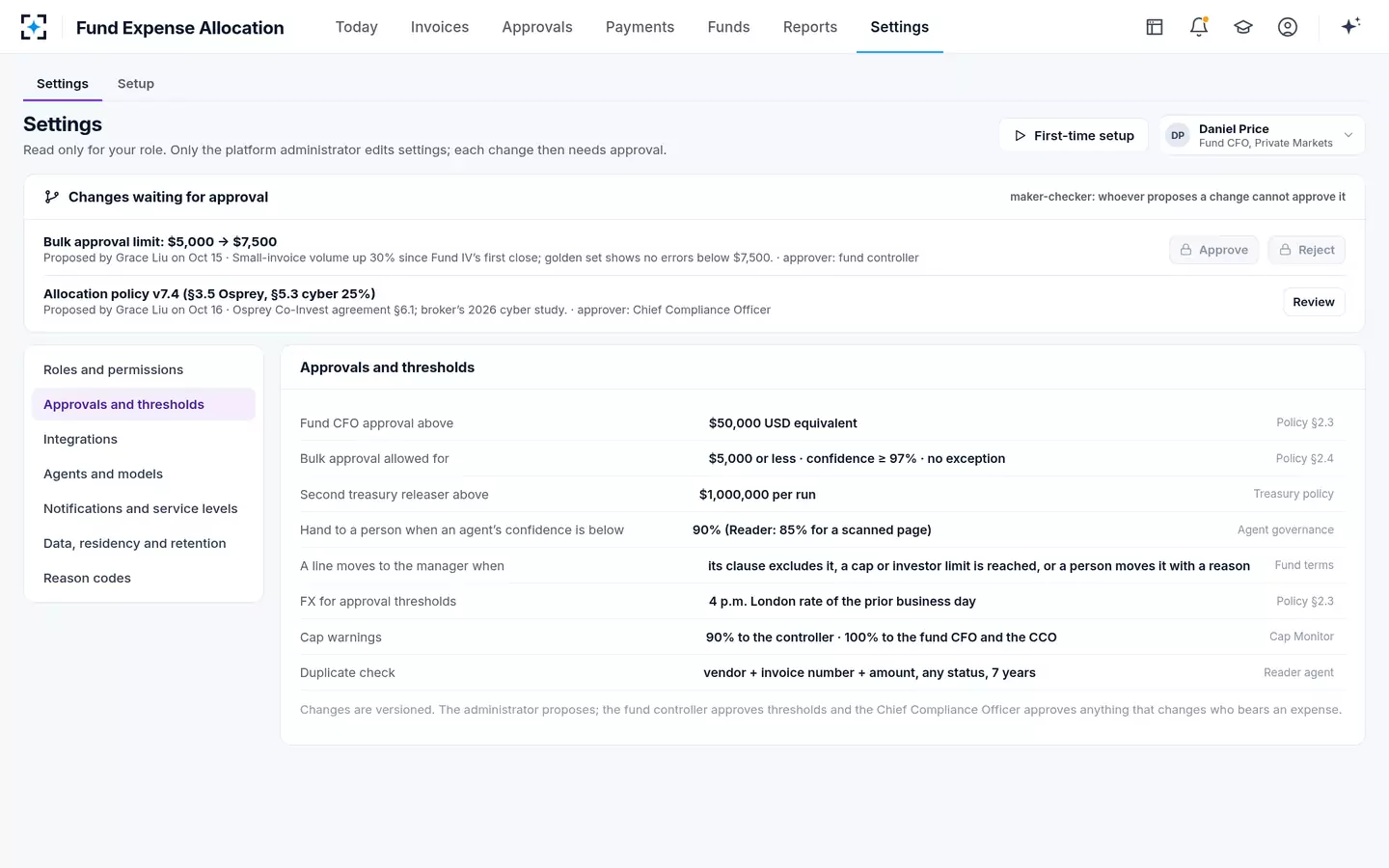
Bulk approval is earned, not configured on day one. On the third rung, invoices below a set amount, above a set confidence and with no exception are approved in batches by the controller, while everything else follows the full path. The sample firm's setting is $5,000 or less, confidence of 97% or more, and no exception. A proposal to raise the limit to $7,500 waits for the controller, with its evidence attached: small-invoice volume up 30% since a new fund's first close, and a test set of past invoices showing no errors below $7,500.
That is the pattern for every threshold: a change is proposed by one person with evidence, approved by another, versioned, and visible on the audit trail. Whoever proposes a change cannot approve it. A threshold raised because the queue is long, rather than because the replay supports it, is the most common way an adoption goes wrong, and it is the easiest to prevent in the settings.
Fund Expense Allocation's settings: thresholds as approvals, not preferences
Rung four: people review exceptions and sign the rest
On the top rung people spend their time where judgment is needed: caps and side-letter limits, disagreements between agents, large bills and new vendors. The rest are signed with the evidence on one screen. Two hand-offs stay in force at every rung: below 90% confidence (85% on a scanned page) work goes to a person, and when two agents disagree approval is blocked until a person decides with a reason code. The top rung never removes the controller from any invoice; it changes what the controller looks at first.
An illustrative climb: four quarters from shadow to review by exception
- Replay and shadowQ1
- Start from the proposalQ2
- Bulk approval for small, clean invoicesQ3
- Review by exceptionQ4
Where people's review time goes, rung by rung
Rung 1 · shadow
- Building splits · 70%
- Comparing · 20%
- Approving · 10%
Rung 2 · proposal
- Checking proposals · 60%
- Approving · 40%
Rung 4 · exceptions
- Exceptions · 55%
- Approving with evidence · 45%
What moves a team down a rung
A rung is lost the same way it is earned: by the numbers. Step down when the edit reasons start pointing at wrong clauses or missing vehicles, when a new fund, co-investment structure or side-letter regime arrives that the replay never covered, when an agent version changes, or when an auditor or examiner finds an error the process passed. The sample firm requires any new version of an agent to be re-run on a fixed test set of past invoices and approved by the controller and the Chief Compliance Officer before use.
The cost of not stepping down is visible in the SEC's cases. Cherokee's advisers allocated their own registration, exam and investigation costs to their funds for nearly four years, and the order also found they "failed to adequately review, no less frequently than annually, the adequacy of their policies and procedures" (SEC IA-4258, 2015). A process that is never re-tested drifts, whether a person or software runs it.
Six numbers to watch at every rung
- Agreement on the replay
Share of lines where the proposed clause, vehicles and amounts match the booked answer, after excluding last year’s own errors.
- Edit rate and edit reasons
How often people change a proposal, and why; the reasons matter more than the rate.
- Disagreements between agents
How often two agents read the policy differently: each one is a policy question for compliance.
- Hand-offs below the confidence threshold
A rising share means harder invoices or a weaker model; find out which.
- Time from receipt to coding
The sample firm’s target is one day, inside a two-business-day service level.
- Errors found after approval
By auditors, investors, the advisory committee or the team itself. One of these outweighs a quarter of good agreement figures.
Who signs off each climb
Every move up the ladder is a change to how expenses are allocated, so it needs an owner, evidence and a date on the audit trail. A sensible split mirrors the sample firm's settings: the fund controller signs off operational thresholds, such as the bulk-approval limit and the confidence level for hand-offs, because he approves the invoices they affect; the Chief Compliance Officer signs off anything that changes who bears an expense, such as a new basis or a new fund term; and the fund CFO sees the quarter's agreement and override figures beside the expense report she signs.
Write the decision down the way an examiner would want to read it: the rung, the measures that justified it, the period they covered, who proposed it and who approved it. The compliance rule already requires an annual review of how policies are implemented; a ladder with dated decisions is that review, done continuously. And keep the old settings: if a later replay or an auditor finds a problem, the firm needs to show which invoices were approved under which thresholds.
The hardest discipline is saying no to a date. Rollout plans like to promise that bulk approval starts in a given month. The ladder works only if the month is an expectation and the numbers are the condition; a team that climbs on schedule while its edit reasons still point to wrong vehicles has adopted the software's errors along with its speed.
What to look for in invoice approval workflow software demos and reviews
Look for evidence on your own invoices, not polish on someone else's. A demo on the vendor's sample data shows the screens; a replay of your closed quarter shows whether to buy. Reviews from other users tell you about support and uptime, but rarely about allocation accuracy, because few teams measure it. Ask for the six numbers above from a pilot on your files, and ask what the software does when it is unsure.
Price belongs in the same conversation. The cost of one allocated invoice gives a way to compare quotes that come in different units, and who waits on whom in the current workflow shows where the time goes before any software is chosen. Fund Expense Allocation is built for managers with parallel funds, co-investment vehicles and caps; a single-fund manager with simple bills may need only a standard approval workflow. To see the ladder's settings on sample data, start from Fund Expense Allocation.
Questions people ask
When can approvals be done in bulk?
When a replay of your own invoices shows the software makes no errors in the band you want to bulk-approve, and a controller approves that threshold as a policy change. The sample firm allows bulk approval only at $5,000 or less, 97% confidence or more and no exception, and a proposal to raise it to $7,500 waits for the controller with its evidence.
How long does it take to roll out invoice approval software?
Routing and approvals can be live quickly; trust in proposed allocations takes longer, because each rung should be earned on the team's own numbers. Plan on replaying at least one closed quarter before go-live and moving up a rung no faster than the measures allow.
Should approvers see the software's confidence score?
Yes, alongside the evidence, but a score is not a reason. A proposal at 98% with the wrong vehicle list is still wrong. In the sample firm, scores below 90% send the work to a person, while every proposal, whatever its score, carries the clause and basis an approver can check.
What happens when a person disagrees with the software?
The person wins, and records why. In Fund Expense Allocation a person can move any line between fund and manager or change a basis with a reason code; the approver sees the change and must approve with the override code, and every override joins the next evaluation of the agents.
Does invoice approval software replace the controller?
No. It changes what the controller spends time on, from checking arithmetic to deciding exceptions, but the approval, the thresholds and every disagreement between agents stay with a person. The agents in Fund Expense Allocation never code, approve, post an unapproved entry or release a payment.