Placement agent fees in private equity are the fees a manager pays a broker-dealer or other agent for introducing investors to its fund, on terms set in the agent's engagement letter. Because the agent is raising money for the manager's product, the economic cost is normally the manager's. Some fund documents, like those in the SEC's Wave Equity case, let the fund pay the invoice and then require the management fee to be reduced by the same amount, so the fee should come back to the fund, quarter by quarter, in full. Botminds' Fund Expense Allocation reads each placement agent invoice, tests it against the LPA's placement-fee clause, and keeps the fee visible until the manager has borne it.
The trouble is rarely the first invoice. It is the advance that sits on the fund's books while the offset is forgotten, the placement fee folded into organizational expenses, or the agent paid to approach a public pension without being registered. The examples below use a fictional sample manager, Quillfield Capital.
One placement agent invoice in Fund Expense Allocation, from receipt to the manager bearing it
Agent
Reader agentReads the agent’s invoice and the engagement letter, cites the fee, the investors and the commitment it relates to, and checks for a duplicate.
Never: uses bank details from an email
Agent
Chargeability agentClassifies the line as a placement fee and cites the LPA clause: in the sample fund, placement fees are the manager’s, and if the fund pays, the management fee is reduced 100%.
Never: changes the fund terms
A person decides
Fund controllerApproves who pays the vendor: the manager directly, or the fund as an advance to be offset. Above $50,000 the fund CFO approves too.
Agent
Posting agentDrafts the entries for the vehicle that paid and for the manager, and the payment to the verified bank account.
Never: posts unapproved or releases a payment
Agent
Evidence agentShows the fee in the quarter’s report as a cost borne by the manager instead of the funds, traced to its invoice and clause.
A person decides
Fund CFOSigns the quarter’s fund-borne expense report, with the placement fees the manager bore listed on their own line.
What are placement agent fees in private equity?
A placement agent fee is compensation paid to a third party for soliciting investors in a private fund. The agent is often a registered broker-dealer, and where public pensions are approached it must be a regulated person under the SEC's pay-to-play rule. The fee, what it is measured on and when it is paid are set in the engagement letter. The investors themselves do not pay it directly. The question for the fund accountant is who pays the invoice and who ends up bearing the cost.
For tax purposes the answer to "what is it" is settled. The Treasury regulations list placement agent costs among syndication expenses, the costs of issuing and marketing interests in the partnership, with brokerage and registration fees and the securities-law advice of the placement agent and the issuer among the examples (26 CFR 1.709-2(b); the organizational expense cap guide quotes the regulation in full). A placement fee is therefore not an organizational expense for tax, whatever the LPA calls it.
Are placement fees a fund expense?
Only if the LPA makes them one, and neither set of fund documents in the two SEC cases below did. Corinthian Capital's LPA left placement fees out of the organizational expenses the fund could bear; when the firm charged them to the fund anyway, the SEC counted them in the overcharge (SEC IA-5229, 2019). Wave Equity's fund documents let the fund pay placement agent fees but required "prompt repayment of the loan through an offset of the quarterly management fees" (SEC IA-6146, 2022). In both, the fund was not meant to end up bearing the cost.
The examination staff has named placement agent fees, with legal fees, among the contractual expense limits that advisers broke, causing investors to overpay (SEC OCIE risk alert, June 23, 2020). The safe reading of any LPA is to treat a placement fee as the manager's unless the agreement plainly gives it to the fund and the investors were told.
Three ways an LPA can treat placement agent fees, and what each needs on the books
What the LPA says: Placement fees are the manager’s expense; the fund never pays the agent.
What the expense desk must show: Nothing on the fund’s books. Check that no agent invoice reaches the fund, including one disguised inside an organizational or legal bill.
What the LPA says: The fund may pay the agent; the management fee is reduced by 100% of what it paid.
What the expense desk must show: The advance, the quarter it was paid, and each quarter’s offset until the balance is nil. An open balance is a debt from the manager.
What the LPA says: The fund bears placement fees up to a limit, or as part of an organizational cap.
What the expense desk must show: A running total against the limit, the definition of what counts, and the excess borne by the manager.
How is a placement fee offset against the management fee?
The fund pays the agent, and the manager's next management fee is reduced by the same amount, so the cash comes back to the fund within a quarter or two and the manager ends up bearing the whole fee. If the fee is larger than one quarter's management fee, the balance carries forward to the next quarter until it is used up. In the SEC's description, management fee offsets "reduce the fees and expenses the fund pays to the adviser and its affiliates, typically on a dollar-for-dollar basis" (88 FR 63206, September 14, 2023, a release whose rules were later vacated).
A placement fee advanced and offset: the arithmetic, and the case where it never happened
Q1
Paid by the fund$400,000 placement fee advanced by the fund
Management fee$2,500,000 management fee due
Offset− $400,000 offset
Result$2,100,000 paid to the manager
Q2
Paid by the fundNo new placement fee
Management fee$2,500,000 management fee due
OffsetNothing left to offset
Result$2,500,000 paid to the manager
Wave Equity
Paid by the fund$1,096,443 advanced over 2018–2020
Management feeQuarterly management fees collected
OffsetNo offset for 11 quarters
ResultRepaid in 2021 with 12.5% interest: $1,410,185.49
Two details decide whether the offset is right. The first is the base: an offset of 100% of what the fund paid, not 100% of the fee attributable to fee-paying investors, unless the LPA says so. The second is timing: "prompt" in Wave Equity's documents meant the next quarterly fee, not when the manager had cash to spare. The fee arithmetic itself is the management fee team's work, set out in a management fee offset example; the expense desk's job is to make sure the advance is recorded as the manager's and that someone can see it until it is gone.
Wave Equity: eleven quarters without the offset
Wave Equity's order is the plainest placement-fee case the SEC has brought. From May 2018 to October 2020 the adviser "caused Fund II to pay certain organizational expenses specified in Fund II's governing documents, including placement agent fees to a third-party vendor"; the amounts totalled $1,096,443. The documents required them to be repaid promptly by offset. The adviser "did not offset any of the money borrowed from Fund II against the receipt of management fees for 11 consecutive quarters" and "used the management fees it charged and collected for its own operating expenses" (SEC IA-6146).
Investors were not told. From July 2018 to October 2021 the adviser "never informed investors and potential investors in Fund II that it had failed to repay Fund II timely". It repaid the full amount between January and October 2021 "with 12.5% annualized interest, for repayment totaling $1,410,185.49", hired a new Chief Compliance Officer and paid a $325,000 penalty. The 2023 release adopting private fund rules, later vacated, cited the case as an adviser that "borrowed money from a private equity fund that it managed in order to pay placement agent fees to a third-party vendor" (88 FR 63206).
Wave Equity's placement-fee offset, in the SEC's figures
$1.10M
of placement agent fees paid by the fund, May 2018 to October 2020
11
consecutive quarters with no offset
12.5%
annualized interest on the repayment, $1,410,185.49 in total
$325K
civil penalty
Placement fees in private equity accounting and tax
On the fund's books an advanced placement fee is not an expense the fund keeps; it is either a receivable from the manager or a cost recovered through the next management fee, depending on the LPA's wording and the auditor's view. What matters for the expense desk is that the fund's statements and its investor reports can show the gross fee, the offset and any balance outstanding, and that the fee never appears as an ordinary fund expense with no recovery behind it.
The tax treatment is harsher than for formation costs. Syndication expenses "are not subject to the election under section 709(b) and must be capitalized" (26 CFR 1.709-2(b)): the partnership cannot deduct them in the first year or amortize them, and on liquidation "there is no partnership deduction with respect to its capitalized syndication expenses" (26 CFR 1.709-1(b)(3)(i)). A placement fee misclassified as an organizational expense is therefore wrong twice: against the LPA's cap and in the partnership's return. What counts toward the organizational expense cap sets out the difference line by line.
Placement agents and public pension money: the pay-to-play rule
When the investors are public pensions, a placement agent must be a regulated person. The SEC's pay-to-play rule makes it unlawful for an adviser "to provide or agree to provide, directly or indirectly, payment to any person to solicit a government entity for investment advisory services on behalf of such investment adviser unless such person is" a regulated person or the adviser's own executive or employee (17 CFR 275.206(4)-5(a)(2)(i)). The rule reaches private funds: an adviser to a covered investment pool in which a government entity invests "shall be treated as though that investment adviser were providing or seeking to provide investment advisory services directly to the government entity".
A regulated person is, broadly, a registered investment adviser, a registered broker-dealer that is a member of a securities association with its own pay-to-play rules, or a registered municipal advisor, in each case meeting the conditions in the rule. For the expense desk the practical point is simple: before a placement fee is paid, the engagement letter, the agent's registration and the investors it introduced should be on file. A fee to an unregistered finder for a pension commitment is a compliance question before it is an accounting one.
Tracing each placement fee from invoice to offset
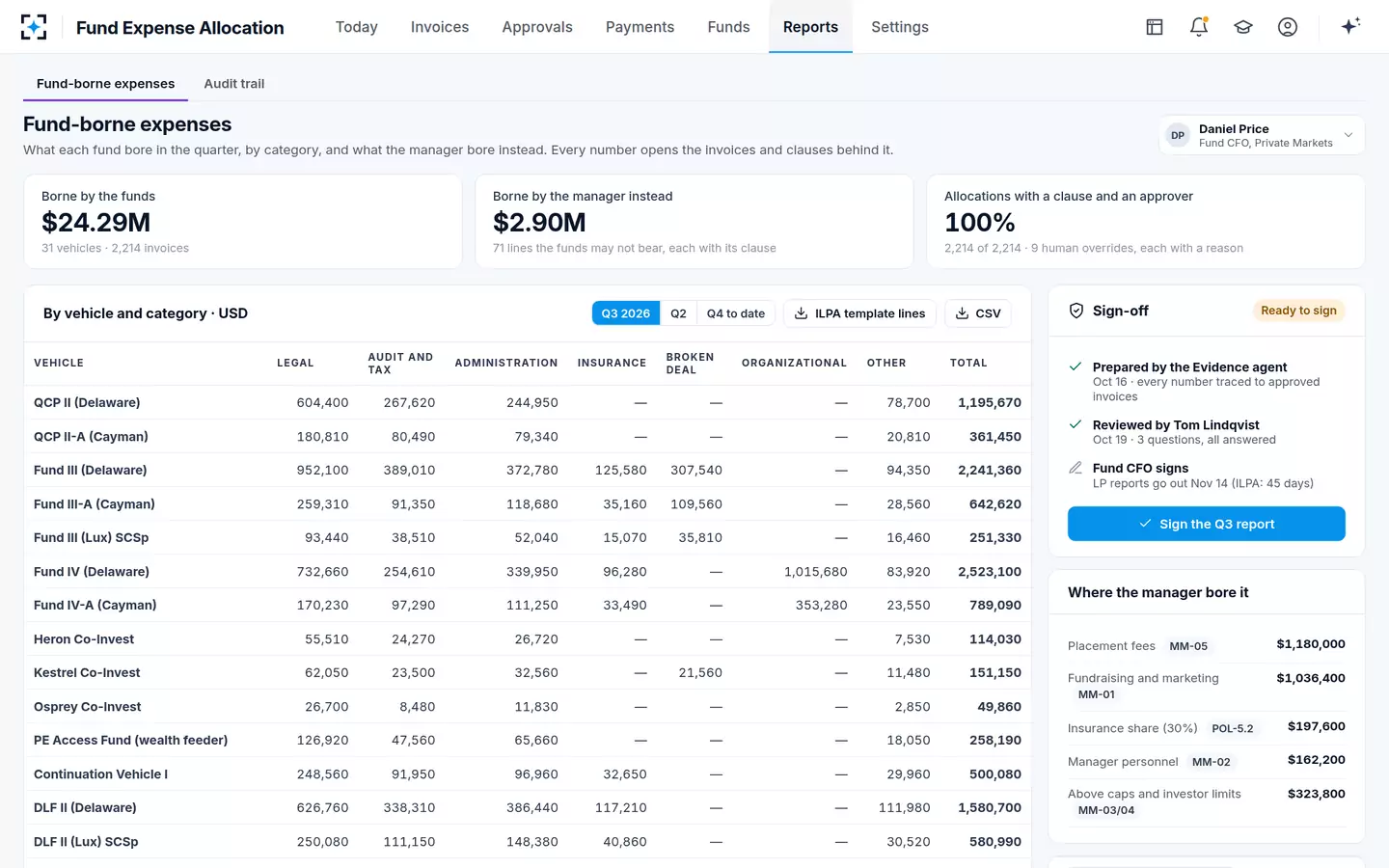
A placement fee needs a trail with four points: the engagement letter that set the fee, the investor commitments it relates to, the payment, and the offset or the manager's direct payment that bore it. Without the second point nobody can check the fee; without the fourth, the Wave Equity pattern can run for years. The sample firm's quarter shows the result when the trail is kept: $1,180,000 of placement fees borne by the manager, each on its own reason code, listed in the fund CFO's sign-off beside fundraising costs, the manager's insurance share and overages above caps.
The quarter's report in Fund Expense Allocation: placement fees on the manager's side
Placement fees in Fund Expense Allocation
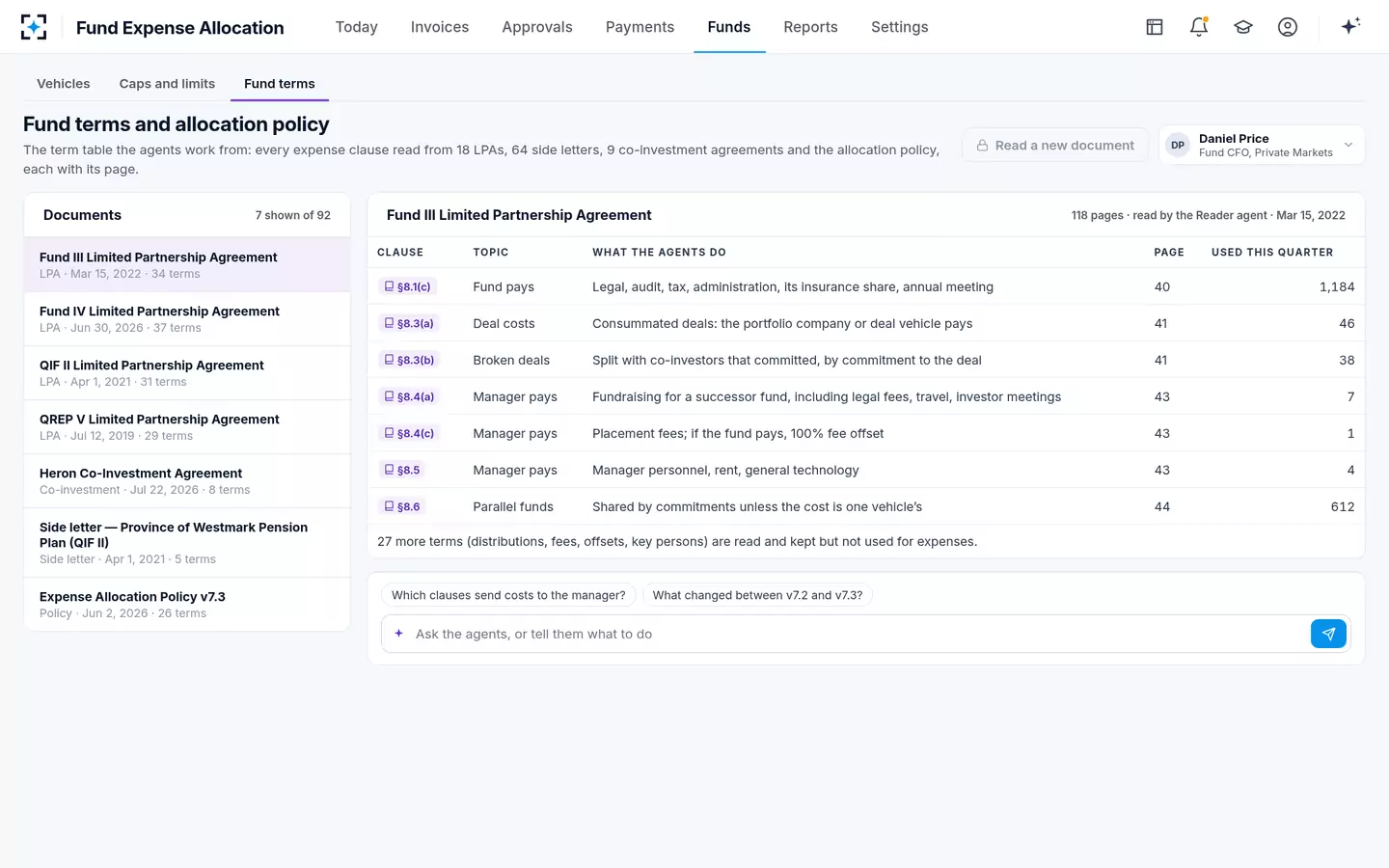
Fund Expense Allocation treats a placement fee as a line to be classified, not a vendor to be paid. The Chargeability agent tests it against the LPA's placement-fee clause; in the sample Fund III LPA, that clause sends placement fees to the manager and requires a 100% fee offset if the fund pays. The Cap Monitor agent counts any placement-related cost that the LPA puts inside an organizational cap. The fund accountant codes, the controller approves, the fund CFO approves above $50,000, and the agents cannot approve or release a payment.
The clause the agents cite for a placement fee, with its page
Placement agent fee checklist for the fund controller
- Read the placement-fee clause before the first invoice
Manager pays, fund pays and offsets, or fund bears up to a limit: three different sets of books.
- Keep the engagement letter and the agent’s registration on file
And, for public pension investors, check the agent is a regulated person under the pay-to-play rule.
- Tie each invoice to the commitments it relates to
A fee with no named investors behind it cannot be checked.
- Never fold a placement fee into organizational expenses
Unless the LPA says so; for tax it is a syndication cost either way.
- Track every advance as a balance owed by the manager
Until the offset or repayment brings it to nil.
- Report the gross fee and the offset
Investors should be able to see the fee, the amount recovered and anything outstanding.
- Escalate an offset that is late
Wave Equity’s documents said prompt; eleven quarters later the SEC was involved.
Where the solution stops is as important. It does not negotiate placement agreements or decide whether an agent may approach a pension; it reads, classifies, tracks and reports, and people decide. To see a placement fee move through the sample firm's books, start from Fund Expense Allocation, or read the expense allocation policy that sends it to the manager in the first place.
Questions people ask
What is a placement agent fee?
It is the fee a fund manager pays a third party, often a registered broker-dealer, for introducing investors to its fund, on terms set in the agent's engagement letter. Investors do not pay it directly; the fund documents decide whether the fund or the manager pays the invoice and who bears the cost.
Who pays the placement agent in private equity?
The manager bears the cost in the fund documents described in the SEC's cases, either by paying the agent directly or by reducing its management fee by whatever the fund paid. A fund bears placement fees only if its LPA plainly says so; Corinthian's LPA excluded them, and charging them anyway formed part of an SEC order.
Are placement fees deductible for a partnership?
No. Under the Treasury regulations they are syndication expenses, which must be capitalized and are not covered by the election to deduct and amortize organizational expenses. Even when the partnership is liquidated, there is no deduction for capitalized syndication expenses.
Can a placement agent solicit a public pension?
Only if it is a regulated person under the SEC's pay-to-play rule: broadly, a registered adviser, a registered broker-dealer subject to an association's pay-to-play rules, or a registered municipal advisor meeting the rule's conditions. The rule applies to private fund advisers because a fund with a government investor is treated as advising the government entity directly.
What happens if the offset is never taken?
The fund is owed the money, and investors who were told the fee would be offset have been misled. In Wave Equity the adviser repaid $1,410,185.49, including 12.5% annualized interest, after eleven quarters without an offset, and paid a $325,000 civil penalty.