A management fee offset example starts with what the manager received from a portfolio company, takes the fund's share of it, applies the percentage the LPA sets, and deducts the result from the fund's gross management fee: if a fund owning 60% of a company sits behind $2.62 million of fees and its LPA offsets 100%, its investors' fee falls by $1,572,000. The percentage is the easy part. The SEC's orders show offsets going wrong at the edges: interest earned on fees whose payment was deferred, fees paid to affiliates and operating partners, fees from a company several funds own, and percentages changed by an amendment. Botminds' Management Fee Calculation reads each fund's offset clause and amendments, applies the percentage in force to every fee the manager and its affiliates received, and shows investor by investor where the administrator's offset differs.
The worked example below is illustrative arithmetic on an invented portfolio company owned by two funds of one manager, Fund A and Fund B. The sample screens come from Quillfield Capital, a fictional manager whose funds and investors run through the solution.
What are management fee offsets?
Management fee offsets are credits that reduce the management fee by some or all of the transaction, monitoring, directors' and similar fees the manager or its affiliates receive from the fund's portfolio companies. They exist because those fees are paid by companies the investors own, for work the manager is already paid to do. The LPA sets the percentage, which fees count, which affiliates' receipts count, and what happens to an offset larger than the fee. Placement agent fees a fund advances for the manager are often recovered through the same mechanism, as who bears placement agent fees explains.
The terms differ widely between funds of the same manager. Global Infrastructure Partners' Fund I documents credited 80% of advisory, directors', transaction, topping, break-up and other fees received in the preceding fee period against the current period's fee; its Fund III documents credited directors' fees at 100% (SEC Advisers Act Release 5930, December 20, 2021). TZP's LPAs offset 100% of "Transaction Fees", defined to include "all transaction fees, advisory fees, monitoring fees or other similar fees" received by the manager, the general partner, their affiliates or any of their officers, directors, employees, managers, members, partners or shareholders, subject to listed exclusions (SEC Advisers Act Release 6908, August 15, 2025).
A management fee offset example, line by line
Take one invented company. Fund A owns 60% of it on a fully diluted basis, Fund B owns 25% and co-investors hold the rest. In one quarter the manager receives a $2,000,000 transaction fee that the company deferred a year ago at 8% interest, a $400,000 monitoring fee, and $60,000 of directors' fees paid to an operating partner who sits on the board. Fund A's LPA offsets 100% of all such fees received by the manager and its affiliates.
One quarter's offset for Fund A, from the fees received to the net fee
Received
Fees the manager and its affiliates received from the company this quarter
$2,000,000 transaction fee + $400,000 monitoring fee + $60,000 directors’ fees paid to an operating partner + $160,000 interest on a transaction fee deferred for a year at 8%
$2,620,000
Fund A’s share
Fund A’s fully diluted ownership of the company
$2,620,000 × 60%
$1,572,000
Offset rate
The percentage Fund A’s LPA credits against its fee
$1,572,000 × 100%
$1,572,000
Gross fee
Fund A’s gross management fee for the quarter
From the basis, rate and days
$3,000,000
Net fee
What Fund A’s fee-paying investors are charged
$3,000,000 − $1,572,000
$1,428,000
Then the net fee is shared among Fund A's investors. Each fee-paying investor bears its share of the gross fee and receives its share of the offset, in proportion to its share of the fee basis unless the LPA says otherwise. Investors who pay no fee, such as the general partner's own commitment or an employee feeder whose terms waive it, should neither bear the fee nor dilute the offset. The SEC's staff found advisers that "incorrectly allocated portfolio company fees across fund clients, including private fund clients that paid no management fees" (OCIE risk alert, June 23, 2020): every dollar of offset sent to a vehicle that pays no fee is a dollar the fee-paying investors did not receive.
In the sample fund the same last step is one row of each investor's fee replay. Calder Bay Public Employees' Retirement System's offset is 100% of $1,005,000 of transaction, monitoring and directors' fees times its 8.4746% share of net invested capital, or $85,169.49, deducted from a gross fee of $280,313.10. Where the offset sits in the whole management fee calculation is set out in the guide to the formula.
Splitting one company's fees between funds: the duplicated reduction
When several funds own one company, each fund's offset should start from all the fees received and be reduced once for the other owners. TZP's LPAs said exactly that: each fund's offset was based on all Transaction Fees, reduced "to account for other Funds' and co-investors' fully diluted equity ownership". For at least one company, the SEC found, TZP first gave each fund a share of the fees based on its share of the capital the funds had invested, then reduced that share a second time by fully diluted ownership. The order calls it "improper double counting"; it cost the funds $78,976.
On the illustrative company the same mistake is larger. Suppose Fund A invested $120 million and Fund B $50 million. Allocating first by invested capital gives Fund A 70.6% of $2,620,000, or $1,849,412; reducing that again by its 60% ownership leaves $1,109,647. The correct offset is $1,572,000. The two reductions look reasonable one at a time, which is why the error survives review: each step has a defensible-looking percentage, and only reading the LPA shows that one of them should not be there.
What each edge costs Fund A's investors on the illustrative quarter
The interest nobody offset
Interest on a deferred fee belongs in the offset if the LPA's definition reaches it and does not exclude it. TZP's management services agreements let it defer a portfolio company's fees at its discretion or when the company's loan covenants required, and charge interest during the deferral "at an annual rate of 8%". When TZP later collected the fees and the interest, it offset the fees but not the interest. The LPAs listed what TZP could exclude from the offset, and "interest on deferred Transaction Fees is not listed among the exclusions".
"Because the Funds were required to pay management fees to TZP during these deferral periods with no fee offset increase for the interest payments TZP later collected, this effectively resulted in interest-free loans from the Funds to TZP."
SEC order, In re TZP Management Associates, LLC (2025)
The sums were not small. TZP collected $701,522 of interest on deferred fees from five portfolio company investments, of which $423,065 should have gone to increase the funds' offsets. With the $78,976 from the duplicated reduction, investors paid $502,041 in excess management fees between October 2018 and November 2023. The order required disgorgement of $502,041, prejudgment interest of $6,836 and a civil penalty of $175,000.
One adviser, two offset practices, nine funds
$423K
($423,065) of interest on deferred fees that should have increased the funds’ offsets
$79K
($78,976) of excess fees from reducing each fund’s share of fees twice
$684K
($683,877) paid under the order: disgorgement, interest and a $175,000 penalty
A deferred fee is also a timing problem for a calculation that runs quarter by quarter. While the fee is unpaid there is nothing to offset, so investors pay the full fee; when it is paid, the offset arrives in a later quarter, possibly after some investors have left the fund or the fund has moved to a different basis. A check has to track each deferred fee from the services agreement to the quarter it is paid, with its interest.
Fees paid to affiliates and operating partners
An offset clause that counts only fees paid to "the manager" misses fees paid to everyone else on its side of the table. The SEC's staff found advisers that "failed to offset portfolio company fees paid to an affiliate of the adviser that were required to be offset against management fees", and advisers that lacked procedures to track receipts "including compensation that their operating professionals may have received from portfolio companies" (OCIE, June 23, 2020). TZP's definition named affiliates and their officers, directors, employees, members, partners and shareholders, which is why the directors' fees in the illustration count.
This is a data problem before it is a calculation problem. Directors' fees paid to an operating partner may arrive in a personal bank account, not the fund's or the manager's, and a fee calculation built from the manager's fee income register will not see them unless someone reports them. The fix is a register of every board seat and services agreement with a portfolio company, reconciled each quarter to what was received, and a definition in the calculation that matches the LPA's list of who counts.
When an amendment changes the percentage
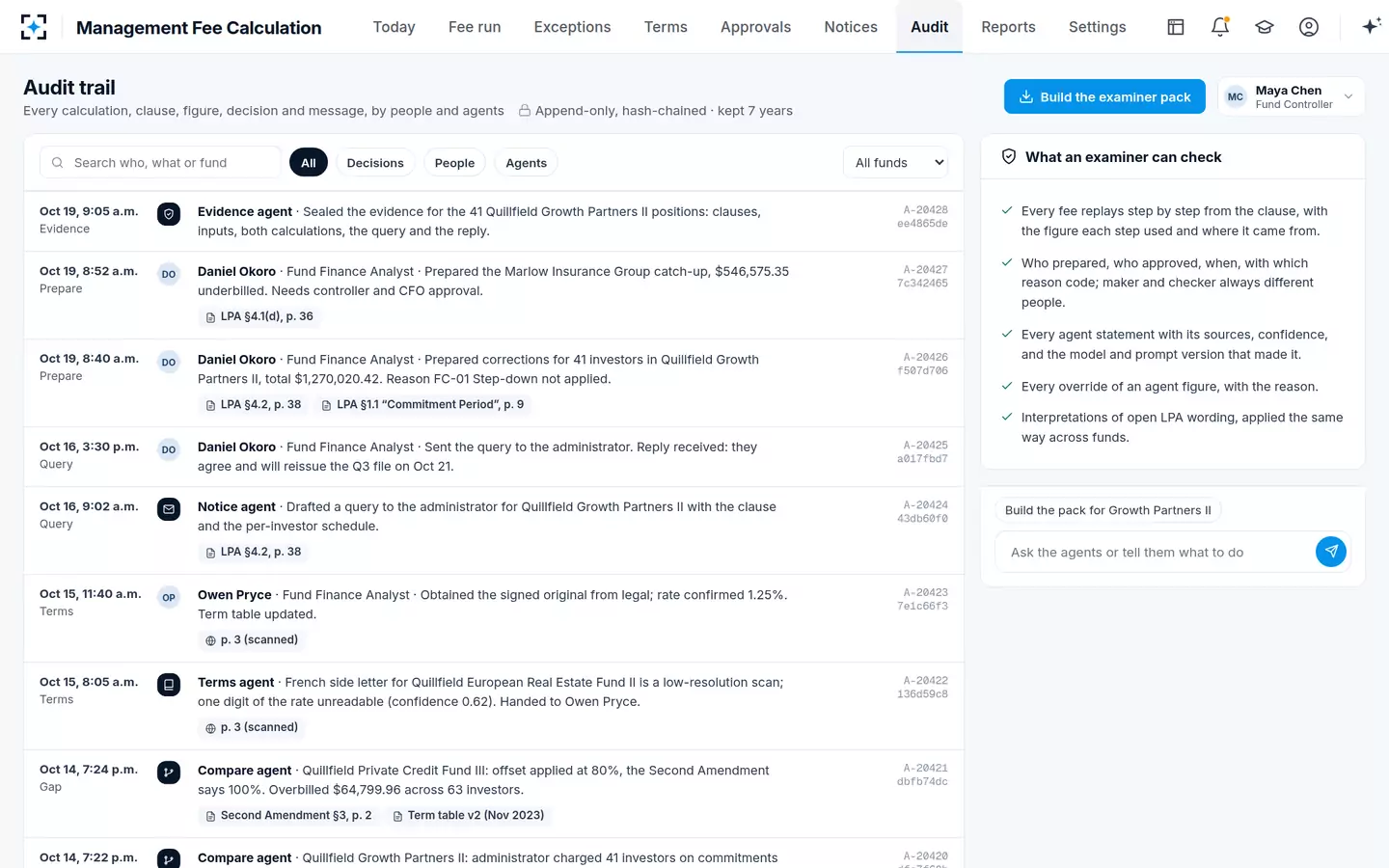
An offset percentage changed by amendment has to change in every place the calculation reads it, from the first fee period the amendment governs. In the sample quarter, Quillfield Private Credit Fund III's Second Amendment raised its offset from 80% to 100%. The administrator offset 80% of a $324,000 transaction fee. Management Fee Calculation's Compare agent found $64,799.96 overbilled across 63 investors and cited the amendment's section 3 on page 2.
The offset at the old rate, on the audit trail with the amendment that changed it
Global Infrastructure Partners shows the same failure in a different form. Its Fund III documents credited directors' fees at 100%, but the adviser "miscalculated the offset and only credited Fund III limited partners a portion"; on review it remediated $674,362 plus interest on $1.26 million of directors' fees. For Fund I, which owned about 41.9% of a company that paid the adviser about $12.4 million in advisory fees between December 2009 and March 2019, the adviser did not apply the 80% offset at all and later remediated $4,164,153 plus interest. The order found no written procedures "to confirm the calculations were being made in a manner consistent with the LPAs".
What happens when offsets exceed the management fee?
When offsets exceed the fee, the LPA decides whether the excess is carried forward to later periods, paid to investors, or lost, and the answer changes what a fund's investors receive. A large transaction fee in a quarter when the fee basis has fallen can produce an offset bigger than the fee; on the illustrative fund, a $5 million fee at 60% ownership would offset $3,000,000 against a $3,000,000 gross fee and leave nothing to credit next time unless the LPA carries it forward.
Three details need a written answer. Does the carry-forward survive the end of the commitment period and the switch to invested capital? Does it expire at the end of the fund's term, and if so is anything paid out? And if the fund has several fee-paying classes or parallel funds, how is a carry-forward shared? The sample manager's setting carries the excess to the next quarter and never pays it out, and the setting can change only with the fund controller's approval.
How is a management fee offset booked?
A management fee offset is usually booked so that the gross fee and the offset stay visible separately, then netted to the amount payable. Keeping them apart lets investors and auditors see both what the fee would have been and how much portfolio company income reduced it. One way to write the entries, at the fund and at the manager, is below; your auditors and your fund's accounting policies decide the accounts.
One way to book the illustrative quarter's fee and offset
| Entry | Debit | Credit | Amount |
|---|---|---|---|
| Fund A: accrue the gross fee | Management fee expense | Management fee payable | $3,000,000 |
| Fund A: apply the offset | Management fee payable | Management fee offset (reduces fee expense) | $1,572,000 |
| Fund A: pay the net fee | Management fee payable | Cash | $1,428,000 |
| Manager: receive portfolio company fees | Cash | Transaction, monitoring and directors’ fee income | $2,620,000 (all owners) |
| Manager: recognise Fund A’s net fee | Management fee receivable | Management fee revenue, net of offset | $1,428,000 |
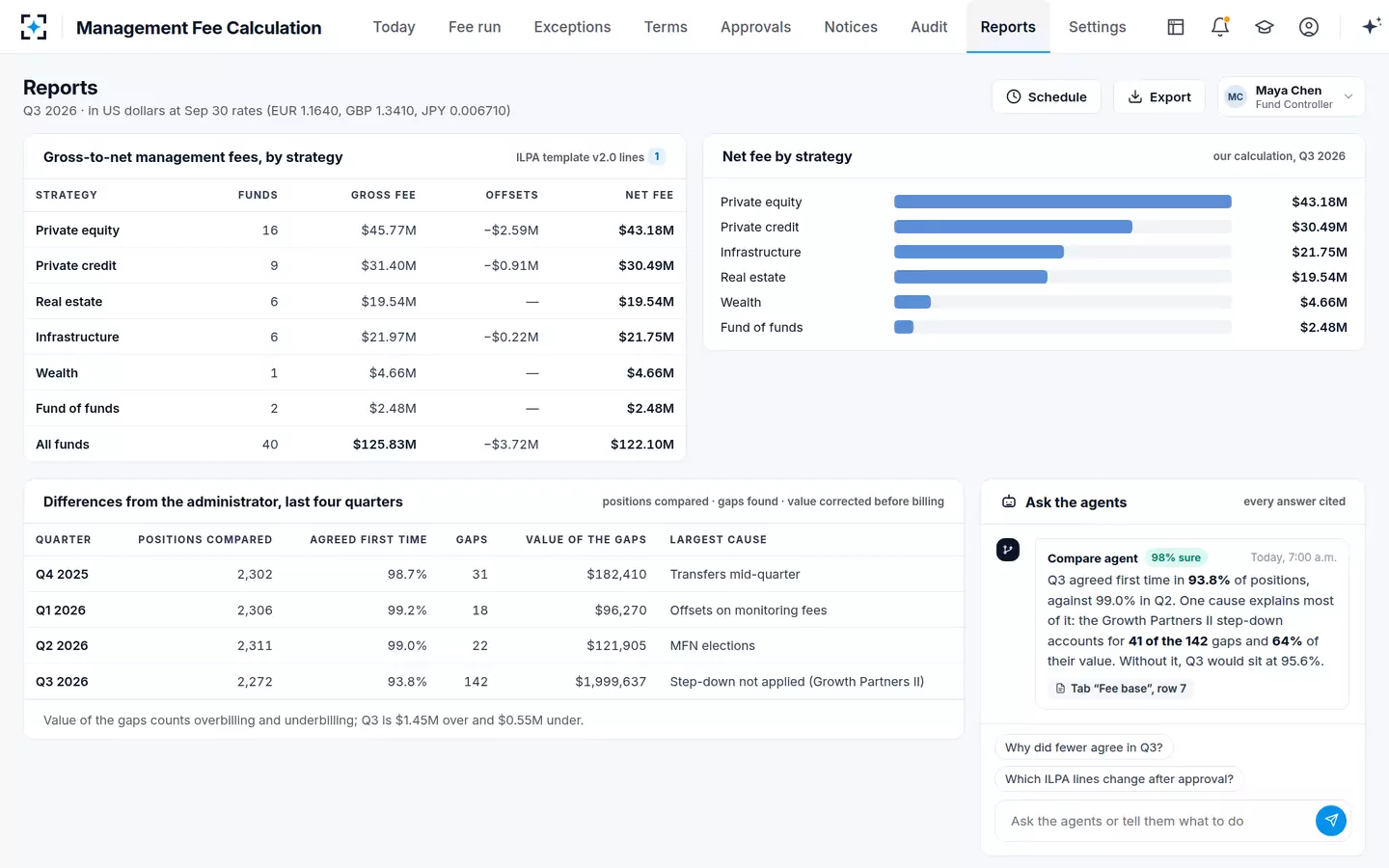
Separate lines also make the offset testable. If the offset sits on its own line each quarter, a reviewer can tie it to the fee income register and the ownership percentages; if it is netted inside the fee, the only test left is whether the net fee looks plausible. Management Fee Calculation's reports show gross fee, offsets and net fee by strategy in the lines of ILPA's Reporting Template v2.0, from its own recalculation.
Gross-to-net management fees by strategy in Management Fee Calculation
Management fee waiver vs offset
A waiver and an offset both reduce the fee, but they come from different places. An offset is a contractual credit the LPA requires whenever the manager receives certain income, at a set percentage, every period. A waiver is the manager choosing, or agreeing in a side letter or the LPA, to give up some or all of the fee, for a period, a class of investor or in exchange for something else the documents describe. An offset must be calculated from portfolio company receipts; a waiver must be applied exactly as its terms say and only to the investors and periods it covers.
For a calculation, the difference is in the inputs. An offset needs the fee income register, ownership percentages and the offset clause; a waiver needs the waiver terms and the investors they cover. Their tax treatment is a separate question for the fund's tax advisers and is not covered here. Both belong in the fee replay as their own lines, so that a reader can see which reduced the fee and why. The basis reductions that follow the commitment period are a third, different kind of reduction, worked through in their own guide. To see offsets checked against your own LPAs and amendments, start from Management Fee Calculation.
Questions people ask
What does a management fee offset mean?
It means investors' management fee is reduced by some or all of the fees the manager or its affiliates earn from the fund's portfolio companies. The LPA sets the percentage and the fees that count: TZP's covered 100% of transaction, advisory and monitoring fees received by the manager, its affiliates and their people.
Are transaction fees offset against the management fee in private equity?
When the LPA says so, and at the percentage it sets. In the SEC's Global Infrastructure Partners order, one fund's documents credited 80% of transaction and similar fees and another credited 100% of directors' fees; the adviser applied neither correctly and remediated $4,164,153 and $674,362 plus interest.
Is the offset taken before or after the fund's share is calculated?
After. Start from all fees received, reduce once for the other funds' and co-investors' ownership as the LPA describes, then apply the offset percentage. Reducing twice, as TZP did for at least one company, understates the offset.
Do co-investors get the benefit of fee offsets?
Only if their own agreements give it to them. A fund's offset is reduced for co-investors' ownership so that the fund's investors receive only their share; whether a co-investment vehicle that pays no management fee gets anything is a matter for its own terms.
When is a management fee offset paid out in cash?
Rarely, and only if the LPA provides for it. Otherwise an offset only reduces fees, and an excess is carried forward or lost as the LPA says; the sample manager's setting carries it forward and never pays it out.