Fees on committed capital and fees on invested capital differ in what the rate is multiplied by. Committed capital is the amount each investor has promised the fund, so a fee on it stays the same every quarter whether the money has been called or not. Invested capital is the cost of the investments the fund actually holds, so a fee on it rises as capital is deployed and falls as investments are sold, written down or written off. As the SEC's examiners describe the usual pattern, private equity LPAs use the first while the fund is investing and switch to the second afterwards, and the switch is where fee errors cluster. Botminds' Management Fee Calculation reads the switch date and the definition from each fund's documents, rebuilds every investor's basis from the books and shows each quarter which basis applied and why.
The worked figures below come from two places: an illustrative fund whose numbers are our own arithmetic, and Quillfield Capital, a fictional manager whose sample funds and investors run through the solution.
The same fund, three ways to charge it: fees over ten years, drawn to scale
- Years 1–5 on $400M committed$30.0M
- Years 6–10 still on $400M$30.0M
- Years 1–5 on commitments$30.0M
- Years 6–10 on invested capital$14.7M
- Years 1–5 as capital is deployed$16.8M
- Years 6–10$14.7M
Committed capital vs invested capital: the difference in one line
Committed capital is a promise; invested capital is a cost. An investor's commitment is fixed in its subscription agreement and changes through events such as a transfer, a default, an increase at a later closing or a release. Invested capital is an accounting balance: the acquisition cost of the fund's investments, attributed to each investor by its share, and reduced by whatever the LPA says reduces it.
Two bases for the same rate: what moves each one
Committed capital: The total each investor has agreed to contribute over the fund’s life.
Invested capital: The cost of investments the fund holds, attributed to each investor.
Committed capital: Transfers, defaults, late closings, any release of unfunded commitments.
Invested capital: Every investment, follow-on, sale, partial sale, write-off and, if the LPA says so, write-down.
Committed capital: Subscription agreements and the investor register.
Invested capital: Schedule of investments at cost, with the LPA’s definition applied investment by investment.
Committed capital: Identical to last quarter.
Invested capital: Can still change: a write-down or partial sale moves it without new money.
Committed capital: Kept after the commitment period ends.
Invested capital: Not reduced when it should be, or measured at the wrong unit or date.
The difference between the two is also a difference in who carries the risk of a slow deployment. On commitments, the manager earns its full fee from the first closing, which pays for sourcing deals before any are done. On invested capital, the fee follows the money into investments and out again, which ties the manager's revenue to what the fund holds. An LPA that uses both hands the risk from one to the other on a date it chooses.
Why the switch date decides the fee after year five
The switch date decides the fee because, from that day, the basis falls from a fixed number to a smaller and shrinking one. On the illustrative fund, the commitment period's five years cost investors $30.0 million either way. The post-commitment five years cost $14.7 million if the switch happens and $30.0 million if it does not. Nothing else in the calculation comes close to that size.
The illustrative fund, year by year: invested capital and the fee on each basis
| Year | Invested capital at cost | Fee on commitments | Fee on invested capital |
|---|---|---|---|
| 1 | $80M | $6.00M | $1.20M |
| 2 | $160M | $6.00M | $2.40M |
| 3 | $240M | $6.00M | $3.60M |
| 4 | $300M | $6.00M | $4.50M |
| 5 | $340M | $6.00M | $5.10M |
| 6 | $320M | $6.00M | $4.80M |
| 7 | $270M | $6.00M | $4.05M |
| 8 | $200M | $6.00M | $3.00M |
| 9 | $130M | $6.00M | $1.95M |
| 10 | $60M | $6.00M | $0.90M |
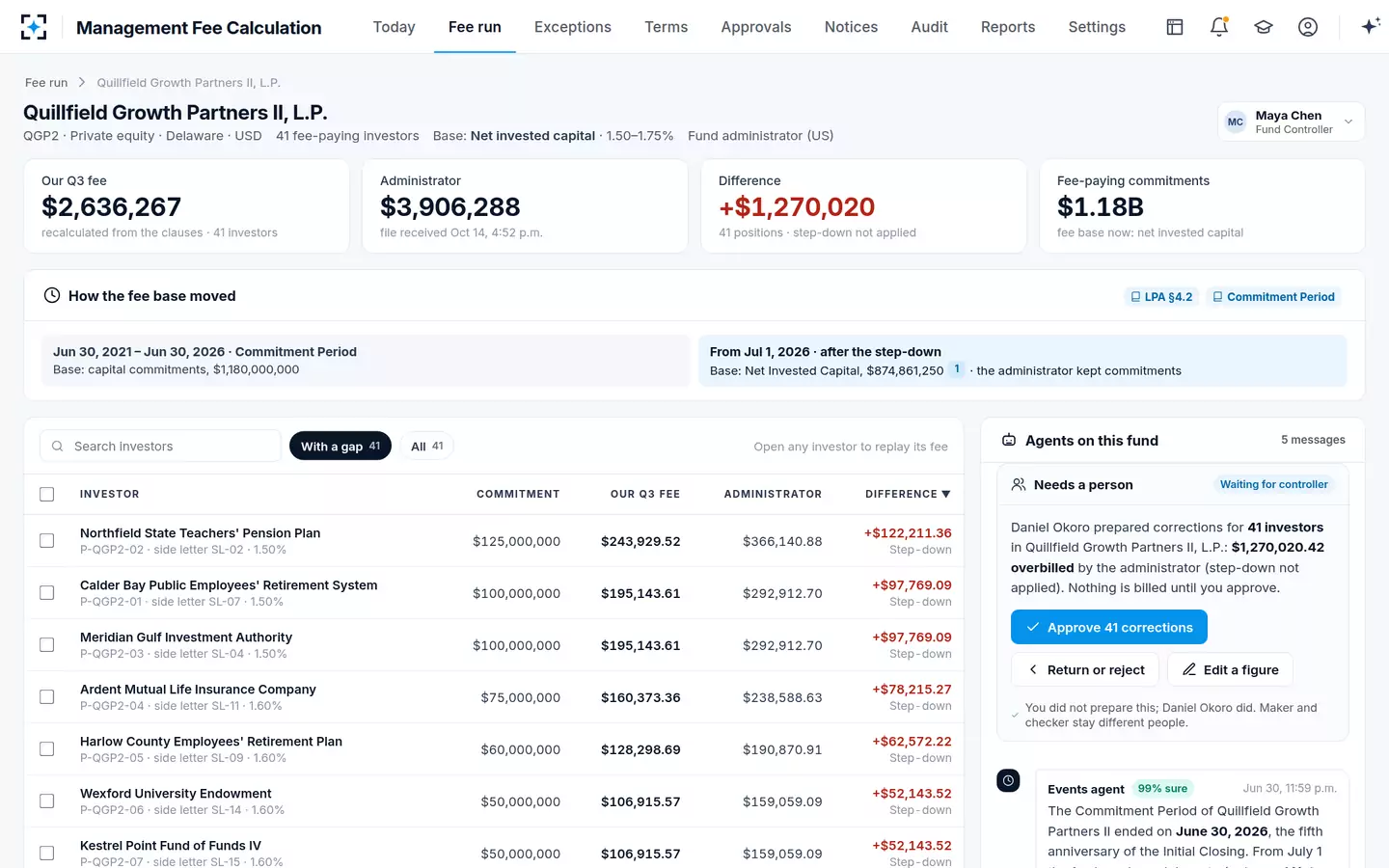
In a real fund the switch rarely falls on a year-end, and the date matters to the day. Energy Innovation Capital's LPAs ended the commitment period on January 15, 2020; the SEC found the adviser charged the whole first quarter of 2020 on committed capital instead of switching on January 16 (Advisers Act Release 6104, 2022). The sample fund's commitment period ended on June 30, 2026, the fifth anniversary of its initial closing, and from July 1 its LPA charges on each investor's share of net invested capital.
One sample fund's switch, seen in Management Fee Calculation
What is net invested capital?
Net invested capital is invested capital after the reductions the LPA lists, usually the cost of investments sold, written off or written down. The word "net" carries the definition, and the definition is the fund's own. In the sample LPA it is each limited partner's share of net invested capital, fixed on the first day of each quarter and adjusted for any reduction during the quarter. Other LPAs measure it at quarter-end, exclude bridge loans, or count only write-downs that someone has judged permanent.
Three things net invested capital is not. It is not net asset value: it is measured at cost, so a fund whose investments have doubled in value still pays on what it paid for them. It is not contributed capital: contributions include the management fees and fund expenses investors paid through capital calls, which are not investments. And it is not a single fund-level number multiplied by a rate: each investor's share has to be computed, because late closings, transfers and excused investments can make shares differ from commitment percentages.
"Ultimately, consistent with the LPA but contrary to the PPM disclosures, Global fund finance employees consistently did not reduce Global’s fund-level management fee calculation for Fund I and II to incorporate partial dispositions."
SEC order, In re Global Infrastructure Management, LLC (2021)
Partial sales, write-downs and recycling: where invested capital moves
Invested capital moves on events that a fee run must see, and partial sales are the event most often disputed. Global Infrastructure Partners' private placement memoranda for Funds I and II said that after a partial sale the fee would be based on the fund's remaining interest; the LPAs said a partial disposition would not reduce the fee. In 2011 one investor asked and was told in writing that partial dispositions would reduce fees; other investors were told they would not; the fund finance team followed the LPA. The SEC's order states that the adviser remediated that investor $563,792 plus interest, and imposed a $4,500,000 civil penalty for this and its fee-offset failures (Advisers Act Release 5930, December 20, 2021).
Write-downs are the second event, and the definition decides whether they count at all. Insight's LPAs reduced invested capital only after the adviser determined that an investment had suffered a "permanent impairment"; the SEC found that Insight tested impairment at the portfolio company level when the LPAs required each portfolio investment, and that its undisclosed criteria were "narrow and subjective" (Advisers Act Release 6332, June 20, 2023). How to write the step-down tests that would have caught each of these is the subject of a guide to the management fee step-down.
Recycling works in the opposite direction. A recycling clause lets the fund add realised proceeds back to investors' commitments so they can be invested again, which can keep the commitment basis, or the invested capital basis, higher than the money investors have actually left at risk. The SEC's examiners reported in 2022 that some advisers did not accurately describe their recycling practices and that this may have led to excess management fees (risk alert, January 27, 2022). A fee check has to know which proceeds were recycled and how the LPA counts them.
When does the fee basis switch to invested capital?
The basis switches on the day the LPA's commitment period ends, and an LPA can end it in more than one way. The sample fund's ends on the fifth anniversary of its initial closing. Some LPAs also end it early, for example when the manager starts charging a fee on a successor fund, when investors vote to end it, or after a key person event. Each of those is a different trigger, documented in a different place: a calendar, a successor fund's first capital call, a written consent, a notice. A fee calculation that only checks the anniversary will miss the rest.
The switch also has an administrative tail. The fund administrator has to be told, its term table updated and the first post-switch quarter recomputed. In the sample quarter the administrator's file of October 14 still charged the 41 investors on commitments: the term changed in the LPA on July 1 and never reached the table the administrator calculated from. In Management Fee Calculation the Events agent watches for the end of each commitment period and drafts the notice to the administrator 30 days ahead for a person to send, then re-runs the fees on the day.
Fees by basis over a fund's life: the shape investors should expect
On a two-period LPA, the fee is flat through the commitment period and falls in steps after it. Plotted year by year, the illustrative fund's fee looks like this:
The illustrative fund's annual fee under a two-period LPA
The shape gives an investor two cheap tests. In the first year after the commitment period, the fee should drop; if it does not, ask for the basis schedule. In each later year, the fee should fall after each sale or write-off the fund reports; if a quarterly report shows a realisation and the next fee notice does not move, ask why. Neither test proves the fee right, but both catch the errors that cost the most.
What limited partners should ask for each quarter
A limited partner can check the basis only if it can see it. The useful request is a basis schedule: each investment, its cost, every reduction the LPA allows this quarter with its date and reason, and the investor's share, tied to the schedule of investments in the fund's financial statements. With it, an investor can re-perform the fee; without it, the investor can only compare this quarter's total with last quarter's.
Three questions make the schedule useful. Which events reduced invested capital this quarter, and under which clause? Was any write-down left out because the manager judged it temporary, and what test did it use? Were any proceeds recycled, and did they increase the basis? The SEC's 2020 staff report found advisers that disclosed fee offsets "but did not have adequate policies and procedures to track the receipt of portfolio company fees" (OCIE, June 23, 2020); the same is true of the basis, which depends on tracking events in time.
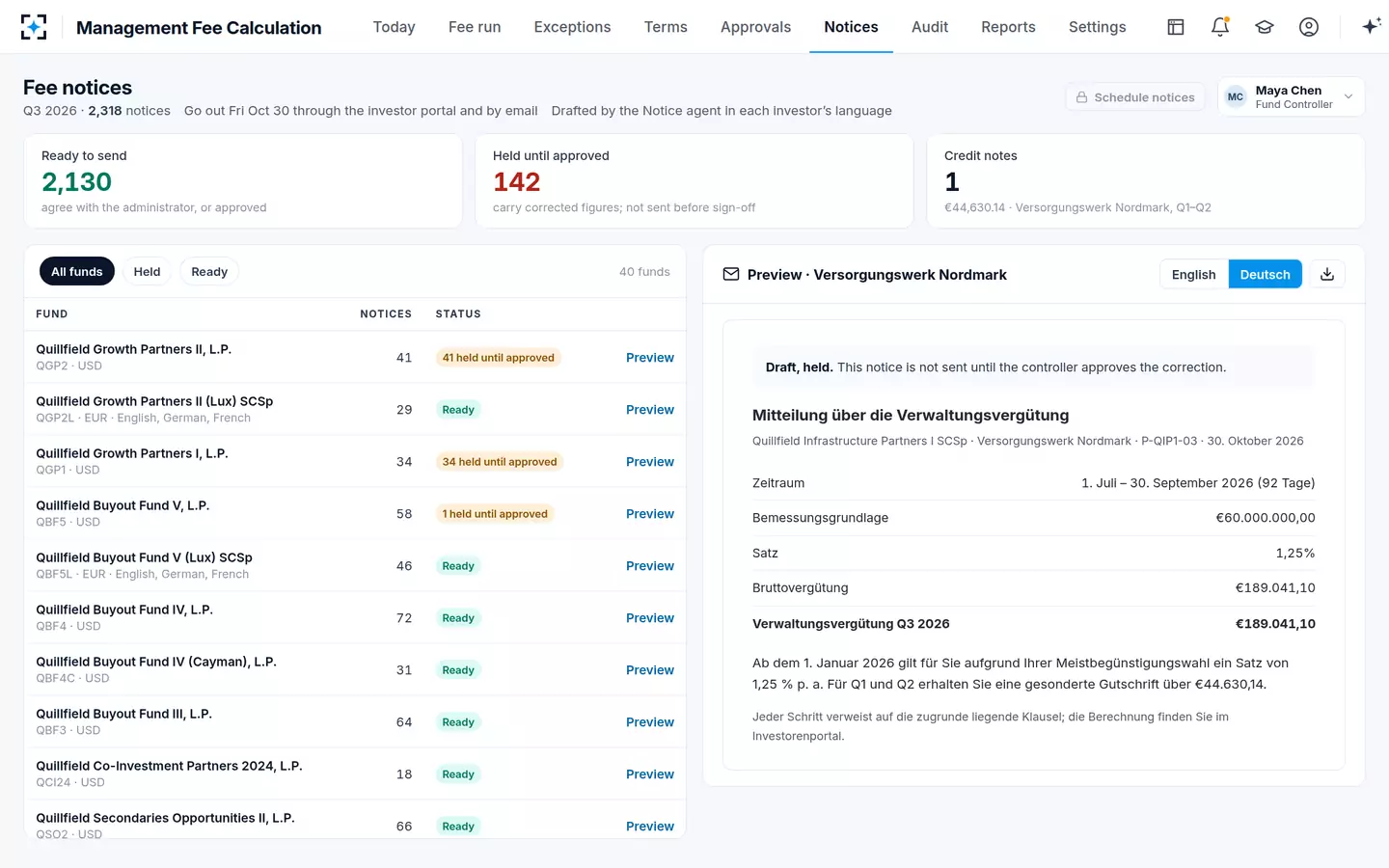
What investors are told when their basis changes
How Management Fee Calculation checks the switch
The solution checks the switch in three places, each with a named owner. The Terms agent reads the commitment period clause, every amendment and every side letter in the language it was signed in, and keeps one fee term table per fund and investor: the basis in each period, the trigger that ends the commitment period, the reductions the definition allows and the day count. It never infers a term that is not written; below 90% confidence an analyst confirms the term against the passage before any calculation uses it.
The Calc agent then rebuilds each investor's basis from the fund accounting platform's schedule of investments and the investor register, quarter by quarter, and computes the fee from the clause. Where the definition leaves a word open, such as whether a write-down is "permanent", it computes each reading and leaves the choice to the fund controller. The Compare agent reconciles every position with the administrator's file and marks the first step where the two part; in the sample quarter, that was step 2, the basis, for all 41 investors in one fund. A fund finance analyst prepares the corrections and the controller approves them, and corrections of $250,000 or more also need the CFO.
For the manager, the same schedule is the answer an examiner will ask for. Management Fee Calculation keeps it for every investor every quarter, with each reduction tied to the event and the clause behind it, and holds notices until the corrections are approved. The full management fee calculation, from formula to net fee, shows where the basis sits among the other terms. To see the basis rebuilt for your own funds, start from Management Fee Calculation.
Questions people ask
What is the difference between committed capital and called capital?
Committed capital is what an investor has agreed to contribute; called capital is the part the fund has asked for so far. Called capital includes money used for management fees and expenses, so it is larger than invested capital, which counts only the cost of investments.
Do investors pay fees on capital that has not been called?
Under a commitment basis, yes: the fee is charged on the whole commitment from the first closing, called or not. That is why the switch to invested capital matters, and why a fee still charged on commitments after the commitment period ends overbills every investor in the fund.
Is net invested capital the same as net asset value?
No. Net invested capital is measured at cost less the reductions the LPA lists, while net asset value is measured at fair value. A fund whose investments have risen in value pays on the lower cost basis; one whose investments have fallen may pay on cost unless the LPA reduces the basis for write-downs.
Can the commitment period end early?
If the LPA provides for it. Triggers some LPAs use include a successor fund starting to charge its fee, an investor vote and a key person event. The fee basis switches on whatever date the triggering clause sets, not at the next quarter-end.
Does a partial sale reduce the management fee?
Only if the LPA says so. In the Global Infrastructure Partners order, the offering memoranda said a partial sale would reduce the fee and the LPAs said it would not; the adviser remediated one investor $563,792 plus interest after telling it in writing that partial sales would count.