RIA fee billing software calculates each client's advisory fee from the fee schedule, the account values and the billing rules, and produces the invoices and the custodian instructions that deduct the fee from client accounts. Choosing one takes weeks; taking it live safely takes a plan that ends with the first quarterly bill, and the plan is mostly reconciliation: load every schedule and household, rebuild one past quarter in the new system, explain every difference from what clients were actually billed and from what their agreements say, and only then bill live with a second person approving. The SEC's examiners have found the same errors in software-calculated fees as in hand-calculated ones, because software bills what it is given. Botminds' Management Fee Calculation is not billing software; it recalculates fees independently from the governing documents, which is the check a go-live needs and the one this guide shows how to plan.
The plan below is built from the errors the SEC's examination staff has reported. Where the solution's own setup is described, the examples come from Quillfield Capital, a fictional manager whose data runs through it as a sample.
Ten weeks to the first live bill: who does what each fortnight
| Weeks | Work | Responsible | Approves | Done when |
|---|---|---|---|---|
| 1–2 | Inventory every fee schedule, household rule, exclusion and billing term in agreements and Form ADV; resolve conflicts between them | Billing operations lead | Chief compliance officer | One approved list of schedules and rules, each traced to the agreement and brochure |
| 3–4 | Load schedules, households, exclusions and account links into the new software; map custodian feeds | Billing analyst with the vendor | Billing operations lead | Every account billed has a schedule, a household and a valuation source |
| 5–6 | Rebuild one closed quarter in the new software from that quarter’s data | Billing analyst | Billing operations lead | A fee for every account, ready to compare |
| 7–8 | Reconcile three ways: new software, the fee actually billed, an independent recalculation from the agreement | Billing analyst and a second reviewer | CFO or head of finance | Every difference explained as an old error (refund) or a set-up error (fixed) |
| 9 | Run the live quarter in parallel with the old process | Billing analyst | Billing operations lead | Both agree, or every difference is explained |
| 10 | Release the first live bill and custodian instructions | Billing operations lead | Second approver, named in the procedures | Bill sent; old process kept for one more quarter as a fallback |
What is RIA billing?
RIA billing is how a registered investment adviser charges its advisory fee: usually a percentage of assets under management, calculated for each billing period from account values, and either invoiced or deducted from the client's account by the custodian. The SEC's examiners described the typical adviser in their 2021 fee initiative: it "quarterly assessed its advisory fees", "deducted advisory fees directly from clients' accounts", "calculated fees based on the account value at the beginning or ending date of the billing period" and "used software or third-party service providers to calculate fees" (Division of Examinations, November 10, 2021).
An RIA fee is therefore a contract term applied to a data feed. The contract is the advisory agreement and the brochure, which set the schedule, any breakpoints and householding, the assets excluded, the valuation basis and whether fees are paid in advance or in arrears. The data feed is the custodian's account values and cash flows. Billing software joins the two. A go-live has to prove that it joins them as the contract says.
What RIA fee billing software must do, and what the custody rule adds
Billing software must calculate each account's fee under its own terms, group accounts into households, handle mid-period deposits, withdrawals, openings and closings, produce client invoices and the instructions the custodian needs to deduct fees, and keep the calculation for the books. If the adviser deducts fees from client accounts, the custody rule is engaged: custody includes any arrangement "under which you are authorized or permitted to withdraw client funds or securities maintained with a custodian upon your instruction to the custodian" (17 CFR 275.206(4)-2).
The rule then gives fee deduction a narrow concession and a built-in check. An adviser is not required to obtain the surprise examination of client assets if it has custody "solely as a consequence of your authority to make withdrawals from client accounts to pay your advisory fee". And the adviser must have a reasonable basis for believing that the qualified custodian sends each client an account statement "at least quarterly" showing all transactions, the deducted fee among them. Every client can see the fee; the adviser's job is to make sure the number they see is the one their agreement produces.
Where the ten weeks go: most of the time is proving the numbers, not loading them
- Inventory the terms2 wks
- Load and map2 wks
- Rebuild a past quarter2 wks
- Reconcile three ways2 wks
- Parallel run1 wk
- Live1 wk
How long does it take to switch RIA billing software?
Switching takes as long as it takes to prove one past quarter, and that depends on the terms, not the software. No regulator or independent study publishes conversion times, and vendors' estimates describe their installation, not your reconciliation. A firm with one standard schedule, no exclusions and clean households might prove a quarter in days; one with dozens of negotiated schedules, legacy positions excluded from fees and households built by individual representatives will spend weeks finding out what its own rules are.
Plan backwards from a billing date. If the next quarterly bill is calculated on the first business day after quarter-end, the parallel run has to finish the week before, the reconciliation two weeks before that, and so on. If the plan does not fit, bill one more quarter on the old process rather than compress the reconciliation; the SEC's 2021 alert notes errors from "stale account balance information as a result of the loss of data during transitions of portfolio management systems".
What has to be tested before the first live bill?
Before the first live bill, test every rule that differs between clients and every event that changes a fee mid-period, against the agreement rather than against the old system. The SEC's examiners have reported failures on each of the items below.
Ten things to prove in the rebuilt quarter before billing live
- Each schedule: rates, thresholds, and tiered or level
A schedule loaded with the wrong method is wrong for every client above the first breakpoint.
- Each household: who and which accounts
Householding not applied, or applied to the wrong accounts, is a finding in the 2018, 2021 and 2026 alerts.
- Exclusions: assets the agreement says are not billed
Advisers billed on legacy positions, cash and fixed income that disclosures excluded.
- Valuation basis and date
Period-end values where agreements said average daily balance, and the wrong valuation date.
- Advance or arrears, as each agreement says
Clients billed in advance whose agreements said arrears, and the reverse.
- Prorating for new accounts and large mid-period flows
Prorating only where the agreement provides for it, by the method it describes.
- Refunds of prepaid fees on termination
Refunds withheld until clients asked in writing, or not paid at all.
- Minimum fees and fee caps
A minimum or maximum in the agreement that the brochure states differently.
- Rebates and credits the agreement promises
Transaction fees the agreement said clients would not pay, left unrebated.
- Inactive and closed accounts
Fees charged on accounts clients had asked in writing to close.
Rebuilding one past quarter, three ways
The most informative test of new billing software is a closed quarter rebuilt in it and compared three ways: with what clients were actually billed, and with an independent recalculation from their agreements. Two numbers can agree and both be wrong, if the new system was loaded from the old one's settings. The third number, computed from the agreement, is what decides which is right.
Every difference falls into one of two kinds, and both matter. A set-up error in the new software, a schedule loaded as level instead of tiered or a household missing an account, is fixed before go-live. An old error, where the new software and the agreement agree and the old bill does not, means clients were billed wrongly before the conversion; it has to be quantified for every affected period and refunded, and the compliance officer has to know. A conversion that finds old errors has done its job.
The staff observed advisers whose controls did not "Monitor for the accuracy of all types of client fees assessed" or evaluate "whether rebates and refunds were issued to terminated accounts, including validating that the adviser did not continue charging advisory fees to clients who terminated their relationships with the advisers."
SEC Division of Examinations, risk alert of June 9, 2026
Records an RIA keeps for fee billing
An RIA keeps the books and records that support each fee for at least five years, and its fee disclosures must match its billing. Rule 204-2 requires every registered adviser to "make and keep true, accurate and current" books and records, including journals, ledgers and its written communications about any "receipt, disbursement or delivery of funds or securities", and to preserve most of them for at least five years from the end of the fiscal year of the last entry, the first two in an office of the adviser (17 CFR 275.204-2).
For a billing conversion that means keeping both systems' calculations for the overlap, the reconciliation and its sign-off, and every refund decided because of it. It also means checking the brochure: Form ADV Part 2A Item 5 requires an adviser whose clients may pay in advance to "Explain how a client may obtain a refund of a pre-paid fee if the advisory contract is terminated before the end of the billing period", as the SEC's 2018 alert quoted it (OCIE, April 12, 2018). New software that refunds differently from the brochure turns a disclosure into a misstatement.
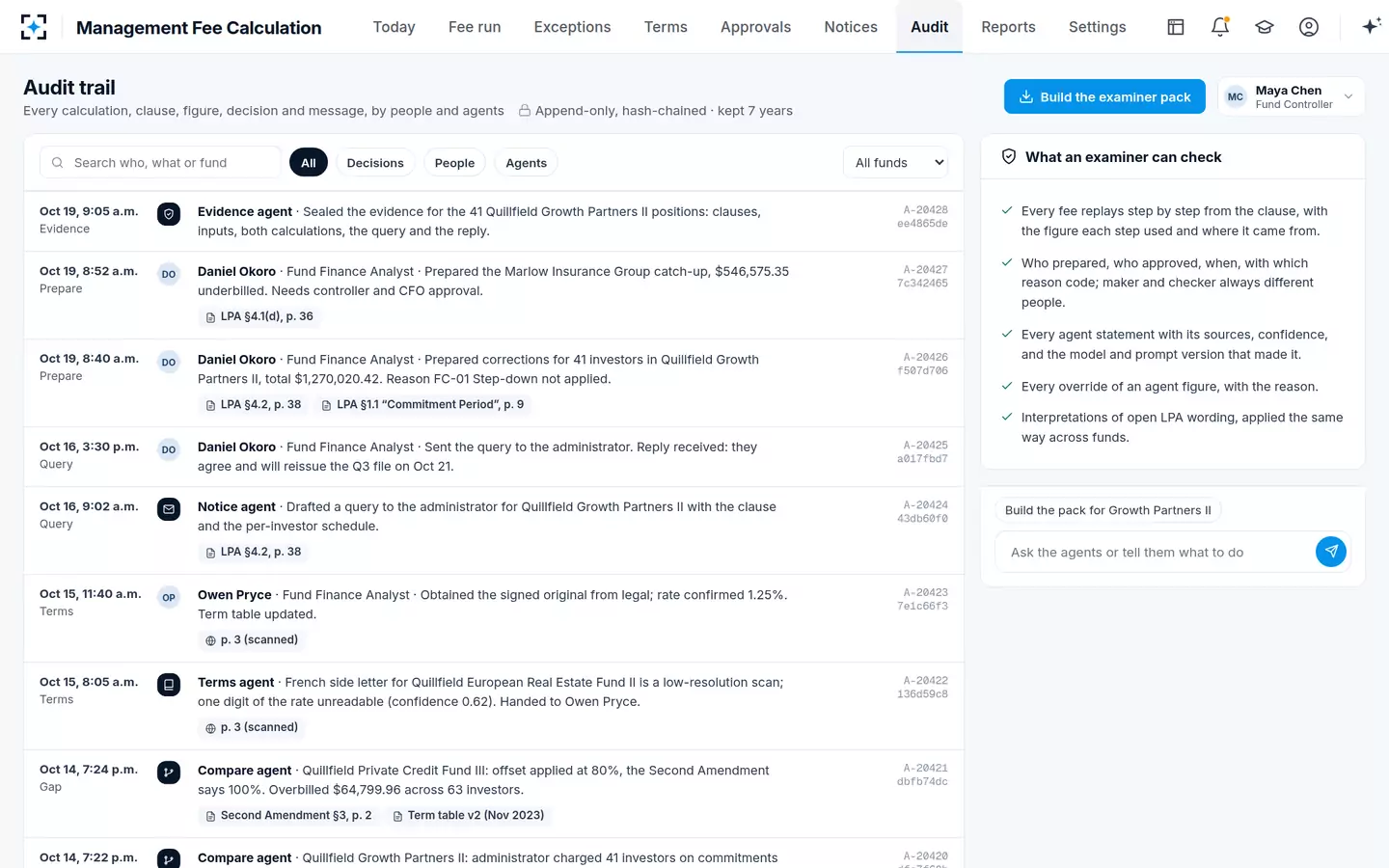
Every calculation, decision and message kept, append-only, in Management Fee Calculation
Running live with a second person approving
Once live, every bill should be released by someone other than the person who prepared it, with the differences from the independent recalculation decided before release. The SEC's 2021 alert found that advisers with "centralized billing" had fewer clients billed incorrectly than those whose billing was spread across supervised persons, and recommended validating "that the fees charged to clients are consistent with compliance procedures, advisory contracts, and disclosures". A second approver is the cheapest form of that validation.
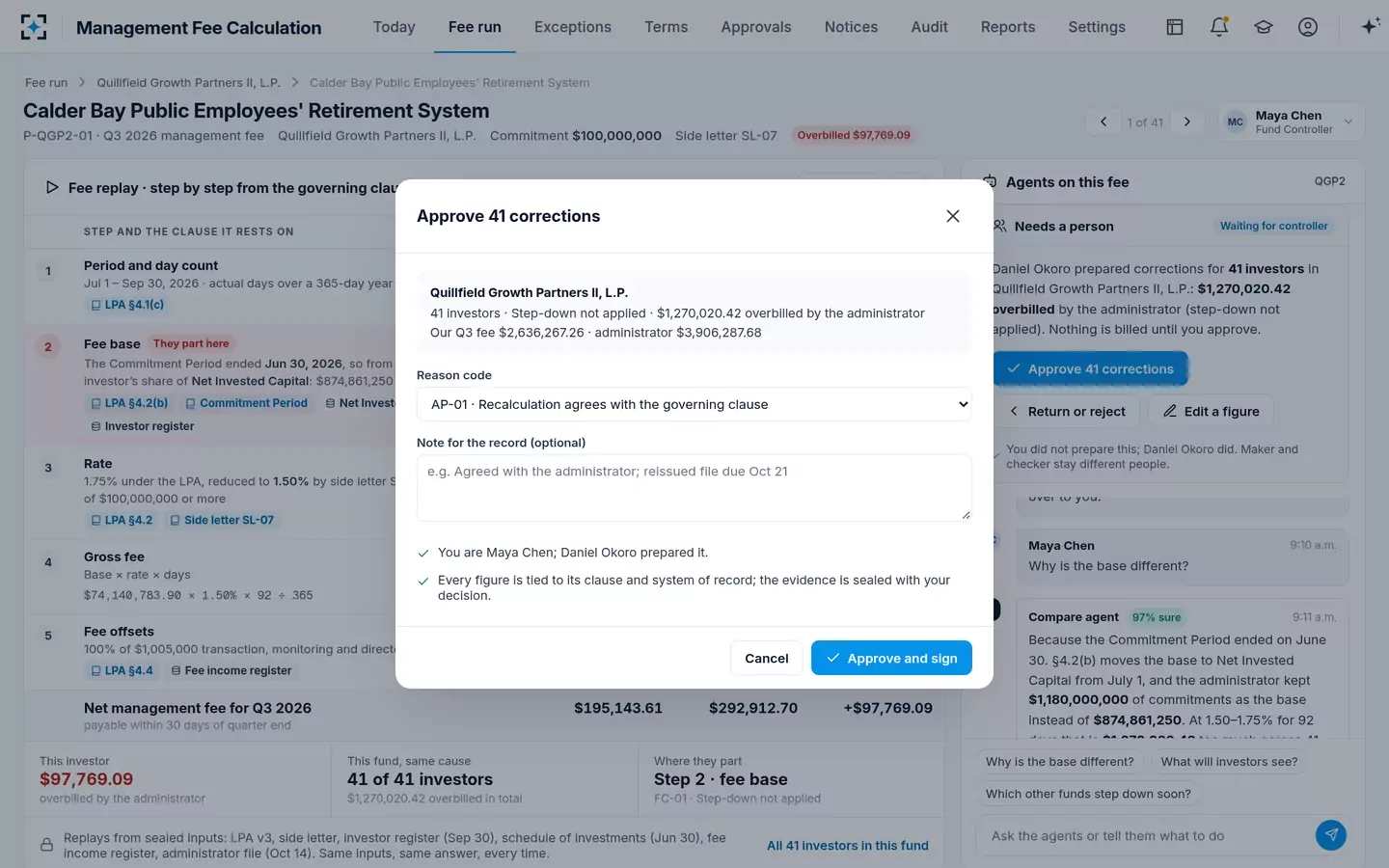
The approval needs a defined scope. In the sample private markets manager, a fund finance analyst prepares each correction, the fund controller approves it with a reason code, and the CFO adds a second approval for corrections of $250,000 or more and for every undercharge, because asking a client for more money is the decision most likely to be questioned. An RIA's thresholds will differ; the principle that preparer and approver differ, and that the approval says what was checked, does not.
Approval with the preparer named and a reason code
Where Management Fee Calculation fits, and where it does not
Management Fee Calculation fits a billing go-live as the independent recalculation: the third number in the three-way reconciliation, and the check that runs every billing period afterwards. It reads the governing documents, recomputes every fee step by step from the clause, and explains each difference from the figure being checked. In its own onboarding, each new fund is added in six steps, including a parallel run on four past quarters, and the fund controller approves the go-live: the same discipline this guide recommends for billing software.
It does not replace billing software. It was built for private markets fees, with LPAs, side letters, MFN elections and fund administrators' fee files as its inputs; it does not produce custodian fee-deduction instructions or client invoices, and its sample runs on private funds rather than retail advisory accounts. An adviser with a large retail book should test whether its own agreements and custodian data fit before relying on it, and keep billing in the system built to bill. Why billing and recalculation are two different jobs, and what a missed breakpoint costs across a book, are covered in companion guides. To see the recalculation run on your own documents and a past quarter, start from Management Fee Calculation.
Questions people ask
What is an RIA fee?
The advisory fee a registered investment adviser charges under its agreement and Form ADV, usually a percentage of assets under management billed each quarter. The SEC's examiners found the typical adviser in their 2021 initiative used a tiered schedule and deducted the fee directly from client accounts.
Does deducting fees from client accounts give an adviser custody?
Yes: the custody rule's definition covers authority to withdraw client funds on the adviser's instruction. An adviser whose only custody is fee deduction is excused from the surprise examination, but its clients still receive at least quarterly statements from the qualified custodian.
Should we refund errors the conversion finds in old bills?
Errors that overbilled clients should be quantified for every affected period and refunded, with the compliance officer involved; the SEC's alerts repeatedly report advisers returning money after finding fee errors. Errors that underbilled clients need a decision on whether, and how, to bill them.
Can we go live mid-quarter?
It is safer to switch at a billing boundary, so that one system calculates each period. If a mid-quarter switch is unavoidable, both systems' calculations and the handover values must be kept, because a prorated fee is where the SEC found manual input errors.
Who should approve the first live bill?
Someone other than the person who loaded the schedules and ran the reconciliation, named in the billing procedures, with the reconciliation in front of them. The compliance officer should approve the list of rules the software was loaded with.