The top reporting and billing companies for RIAs offer platforms that aggregate custodian data, report performance and calculate and collect advisory fees from the fee schedules an adviser loads into them; some are portfolio accounting systems with a billing module, some are standalone billing tools, and some advisers use the billing offered by a custodian or an outsourced provider. Whichever you choose, the platform bills the schedule it is given. Whether that schedule matches each client's agreement, brochure and household is a different question, and the SEC's examiners keep finding errors in exactly that gap. Botminds' Management Fee Calculation does the second job: it recomputes each fee from the governing documents and explains every difference from the billed figure. This guide compares the two jobs, gives the questions to put to any billing vendor, and says where the solution fits.
Where the solution's screens appear, they show Quillfield Capital, a fictional private markets manager whose funds and investors run through it as sample data.
A billing platform and an independent recalculation do two different jobs
Reporting and billing platform: The fee schedules, households and exclusions set up in it.
Independent fee recalculation: The agreements, brochure and fund documents themselves.
Reporting and billing platform: Each account’s fee, the invoice, the custodian deduction file and client reports.
Independent fee recalculation: Each fee recomputed step by step, compared with the billed fee.
Reporting and billing platform: Arithmetic slips, missing account values, feed failures.
Independent fee recalculation: A schedule, household or exclusion that does not match the contract.
Reporting and billing platform: A wrong schedule loaded correctly; a term changed outside it.
Independent fee recalculation: Nothing it can bill: it does not invoice or collect.
Reporting and billing platform: “How was this fee calculated?”
Independent fee recalculation: “Is this the fee the agreement provides for?”
What do the top reporting and billing companies for RIAs actually do?
Reporting and billing platforms for RIAs take daily or periodic data from custodians, reconcile positions and transactions, produce client performance reports, and calculate fees from the schedules and rules an adviser sets up, generating invoices and the files custodians use to deduct fees. They save the operational work of billing hundreds or thousands of accounts. The SEC's examiners noted in their 2026 economic conflicts alert that the staff "evaluates whether advisers are accurately calculating and charging clients advisory fees and expenses in accordance with client disclosures" (Division of Examinations, June 9, 2026): the standard is the disclosure, not the platform's output.
Advisers can get billing in four shapes: a portfolio accounting and reporting system with billing built in; a standalone billing tool fed by the reporting system; billing offered by a custodian or a turnkey platform; or billing outsourced to a service provider. Each is a reasonable choice. None changes who answers for the fee: the adviser.
Why this guide compares jobs, not companies
No regulator or independent study ranks RIA billing platforms, and the published rankings are vendors' and publishers' marketing. What can be compared, and what predicts whether your bills will be right, is how each platform handles your own fee terms and how you will check its output. A shortlist built on that will survive the first examination; one built on a ranking may not.
The practical test is the same for every candidate: load one of your closed quarters, bill it, and compare the result with what you billed and with a recalculation from the agreements. A ten-week go-live plan around that test sets out who does what before the first live bill.
Does a billing platform check the contract?
No. A billing platform applies the schedule it holds; it has no way to know whether that schedule is the one in the client's agreement, the latest fee addendum or the brochure. Every one of the SEC's fee-calculation findings that starts with a term, a rate that differs from the agreement, a household not linked, an asset billed that the agreement excluded, can be produced by a platform working perfectly on the wrong set-up.
The SEC's 2021 initiative found advisory fees "double-billed", with errors "typically due to oversights, such as not updating a system following a change in billing practices" (Division of Examinations, November 10, 2021). The 2026 alert found advisers whose policies, disclosures and signed client agreements "contained conflicting information regarding fees", including schedules or narratives "that were inconsistent" (June 9, 2026). A platform loaded from one of those documents bills consistently with it and inconsistently with the others.
Four layers of a fee, and the one only a recalculation tests
1
The terms
Advisory agreements, fee addenda, Form ADV brochure; for funds, the LPA, side letters and elections.
Written by the firm and its clients
2
The schedule loaded
Rates, thresholds, households, exclusions and billing rules as set up in the platform.
Set up by billing operations
3
The bill
Each account’s fee, the invoice and the custodian instruction, from the loaded schedule and account values.
Produced by the billing platform
4
The recalculation
Each fee recomputed from layer 1, not layer 2, and compared with layer 3; every difference explained.
Independent check
Where the SEC's findings sit: between the contract and the set-up
Most of the SEC's billing findings sit between what the documents say and what the billing system was told. The 2018 alert's examples include advisers that billed monthly when the agreement said quarterly, billed in advance when it said arrears, and included in the fee "assets ... that were excluded by the advisory agreement from the management fee, such as cash or cash equivalents, alternative investments, or variable annuities" (OCIE, April 12, 2018). The 2026 alert adds fees charged on accounts clients had asked in writing to close, and on accounts left unassigned after the representative who managed them departed.
The examination focus has not moved. The SEC's fiscal 2027 priorities say reviews of advisers' economic conflicts will assess "whether advisers' financial conflicts may affect the impartiality of their advice in certain areas, such as fee rebates, fee and expense calculations, cash management" and related arrangements (Examination Priorities, Fiscal Year 2027, October 23, 2026). A fee calculation is examined as a conflict: the adviser is calculating its own pay.
What does an independent fee check add?
An independent fee check adds a second derivation of every fee, from the contract rather than from the set-up, and an explanation of every difference. That is the one thing a billing platform's controls cannot give, because those controls test the platform against itself. The check is independent in two senses: it does not read the platform's schedules, and the person who decides each difference is not the person who set them up.
Done every billing period, it does three things. It catches set-up errors before clients see them; it turns each finding into a reason that can be fixed at its source, a schedule, a household rule, an exclusion; and it leaves evidence that the adviser tested what it billed. The SEC's 2021 alert observed that "checklists and other resources for reconciling client fee calculations with client advisory agreements may be useful tools when used consistently by all advisory personnel". A recalculation is that reconciliation, run on every account.
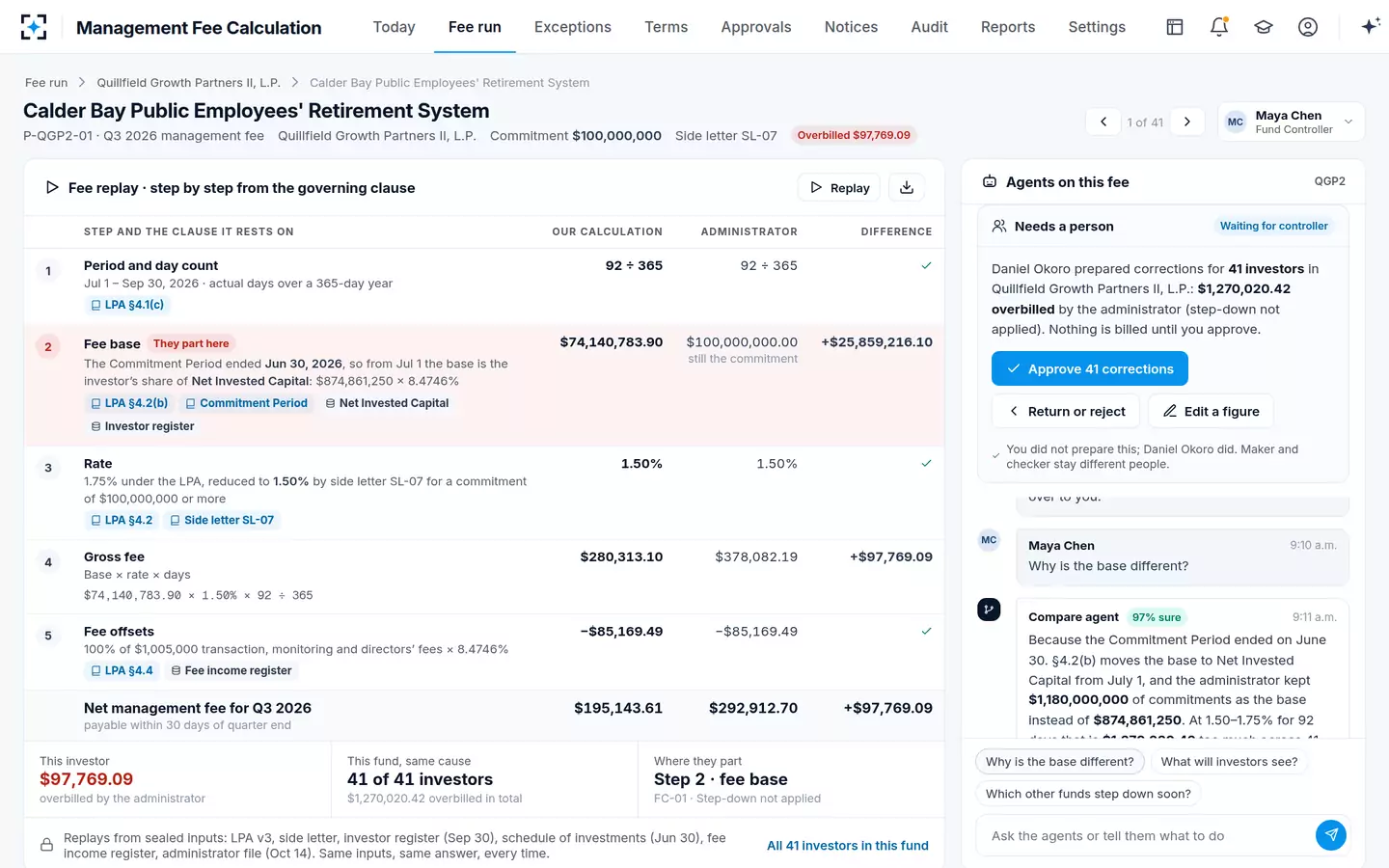
The step where two calculations part, with the clause behind it
How to compare RIA billing software
Compare RIA billing software on how it handles your hardest terms and how much of its work you can check, not on the length of its feature list. The table below is a scoring frame; fill it in for each candidate on one of your own closed quarters.
A scoring frame for billing platforms, using your own terms
| Criterion | What to test on your data | Why it matters |
|---|---|---|
| Schedules | Load every negotiated schedule; confirm tiered or level and every threshold. | A misconfigured method is wrong for every client above the first breakpoint. |
| Households | Rebuild households from your written rule, including trusts and entities. | Householding failures recur in the 2018, 2021 and 2026 alerts. |
| Exclusions and valuation | Bill a quarter with excluded assets, average-daily accounts and a mid-quarter deposit. | Wrong values put clients in the wrong band and bill assets the agreement excluded. |
| Openings, closings, refunds | Close an account mid-quarter; open one; check the refund and the proration. | Refunds withheld and prorations applied without a basis in the agreement are recurring findings. |
| Change control | Change a schedule and see who approved it, when, and which bills used it. | Double-billing after a change in billing practice is a named finding. |
| Explainability | Pick five bills and trace each fee to its rate, value and household. | If you cannot trace it, you cannot show an examiner. |
| Export for checking | Export every account’s fee with its inputs for an independent recalculation. | A platform that cannot be checked from outside asks to be trusted. |
Questions to ask any billing vendor
Five questions separate a vendor that bills from a vendor whose bills you can defend. Ask them in a demonstration on your data, not in a questionnaire.
Five questions for a billing vendor, each answered on your own data
- Will you bill one of our closed quarters before we sign, and let us reconcile it?
The only demonstration that predicts your first live bill.
- How does a schedule change take effect, who approves it, and can we see every bill it touched?
Change control is where double-billing and stale schedules come from.
- How do you build households, and can our rule be applied exactly as written?
A household rule approximated by the platform is a household rule not followed.
- Can we export every fee with every input, so we can recalculate it independently?
Your check needs the platform’s output, not its settings.
- What happens to a closed account’s prepaid fee, by default?
Refund practice must match your Form ADV; the default may not.
What a recalculation needs from the billing platform
An independent recalculation needs the platform's output and the client's documents, never the platform's settings. From the platform it needs, for every account and billing period, the fee billed, the account value and valuation date used, the household or group the account was billed in, and any proration, credit or refund applied. From the firm it needs the governing agreement, every fee addendum, the brochure in force and the written household rule. With those, every fee can be rebuilt without reading the schedule the platform holds.
Two practical rules keep the check honest. First, match every billed account to the client list before comparing anything: a file with accounts the check cannot place should be set aside whole and explained, not compared in part, which is the rule the sample manager applies to administrators' files. Second, agree the tolerance before the comparison, and log both figures whenever it is used, so that rounding never hides a schedule error. Those two rules are the difference between a reconciliation and a reassurance.
Management Fee Calculation beside a billing platform
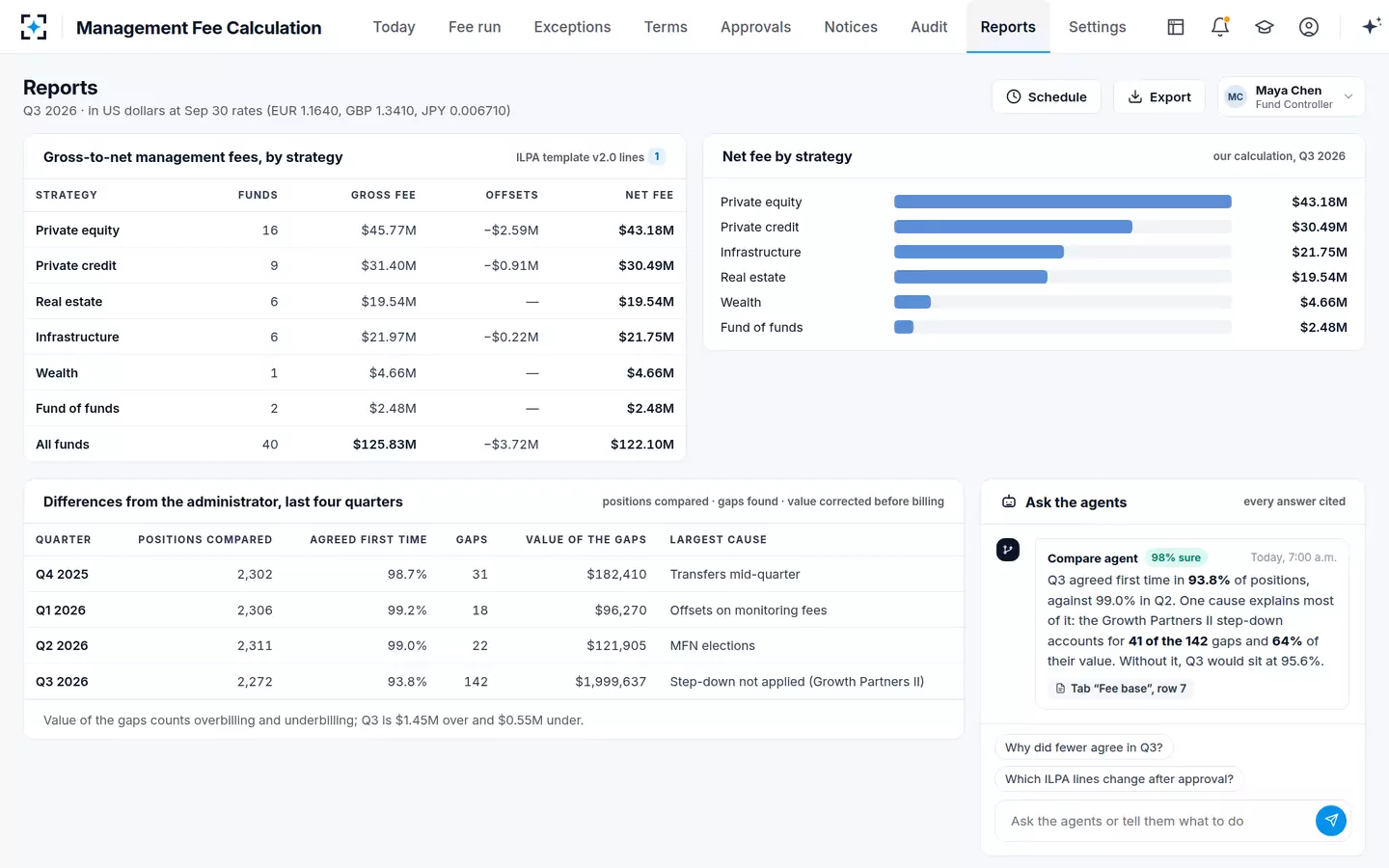
Management Fee Calculation sits beside a billing platform as the recalculation layer: it reads the governing documents, recomputes every fee step by step, compares it with the billed or administered figure, and explains each difference by cause and clause. In its sample quarter it compared 2,272 positions with the fund administrator's files, found 142 differences in six funds, cleared 460 rounding differences under its $25 tolerance with both figures kept, and drafted queries for an analyst to send. An analyst prepares each correction, the fund controller approves it, and nothing is billed until they have.
Four quarters of differences from the billed figure, by cause
Its fit is clearest for private markets managers, where the terms are LPAs, side letters and MFN elections and the billed figure comes from a fund administrator. For an RIA's retail book it is a candidate for the recalculation layer, not the billing platform: it does not produce invoices or custodian deduction files, and its sample data is private funds, so test it on your own agreements and a past quarter before relying on it. What a missed breakpoint or household costs shows why the check is worth running on the terms that differ between clients. To run it against a quarter your platform has already billed, start from Management Fee Calculation.
Questions people ask
What is the best billing software for financial advisors?
The one that bills your own hardest terms correctly on a past quarter and lets you export every fee with its inputs. No regulator or independent study ranks them, so the test on your data is the comparison that counts.
Can billing software be relied on for SEC compliance?
The adviser remains responsible for charging fees as its agreements and disclosures describe. The typical adviser in the SEC's 2021 fee initiative used software or third-party providers to calculate fees, and the staff still found fee deficiencies in most of the examinations, so the software's output needs to be tested against the agreements.
Is an independent fee check the same as an audit?
No. An auditor tests the adviser's financial statements at a materiality set for the whole firm; an independent fee check recomputes each client's fee from its agreement every billing period and explains each difference.
How often should billed fees be recalculated?
Every billing period for the accounts with negotiated terms, households or exclusions, and in full at least once a year. The sample manager recalculates every position every quarter before notices go out.
What do examiners ask for when they review billing?
The 2021 initiative reviewed the accuracy of the fees charged, the fee disclosures, and the compliance program and books and records behind them. The 2026 alert found advisers lacking controls to monitor fee accuracy, test for calculation errors and check refunds to terminated accounts.