Advisory fee breakpoints are the asset levels at which an adviser's fee schedule drops to a lower rate, such as 1.00% on the first $1 million and 0.80% above it; householding is the rule that adds related accounts together so a family or an institution reaches those levels as one client. Missing either is a small error on one account and a large one across a book, because the same mistake repeats every billing period for every eligible client until someone finds it. The SEC's examiners have listed missed breakpoints and householding failures among the most frequent fee deficiencies since at least 2018. Botminds' Management Fee Calculation, built for private fund fees, applies breakpoints and the aggregation of affiliates from each investor's own clause; the methods below apply to any fee schedule with tiers.
The cost examples on this page are illustrative arithmetic on an invented fee schedule. Sample screens show Quillfield Capital, a fictional private markets manager whose funds and investors run through the solution.
One missed household, scaled from one client-year to a book over three years
What are advisory fee breakpoints?
Advisory fee breakpoints are the points in an asset-based fee schedule where the rate changes, written into the advisory agreement and disclosed in the adviser's Form ADV brochure. They exist because the cost of managing an account does not rise in proportion to its size, and they are one of the main ways a client's fee falls as the relationship grows. The SEC's examiners described the typical adviser in their 2021 fee initiative as having "a standard fee schedule with tiered fee levels based upon assets under management" and combining family account values "when such actions resulted in lower fees (i.e., householding of accounts)" (Division of Examinations, November 10, 2021).
The same idea appears under other names. Mutual funds use breakpoint discounts on front-end sales charges; fund boards negotiate breakpoints in the advisory fee a fund pays its adviser; private funds give lower management fee rates to larger commitments through side letters, often aggregating an investor's affiliates. Each is a schedule of thresholds and rates, and each fails the same way: the balance that should be compared with the threshold is not the one that is.
Tiered or level: two breakpoint fee schedules
A breakpoint schedule is either tiered, where each slice of assets is charged at its own rate, or level, where the whole balance is charged at the rate of the band it reaches; the agreement must say which. The difference is large at each threshold, and a billing system set up with the wrong method is wrong for every client above the first breakpoint.
The same $1.5 million household on two breakpoint schedules
| Calculation | Tiered (each slice at its own rate) | Level (whole balance at one rate) |
|---|---|---|
| Accounts billed separately: $600k + $500k + $400k | Each under $1M at 1.00%: $15,000 a year | Each under $1M at 1.00%: $15,000 a year |
| Accounts householded: $1.5M together | $1M × 1.00% + $0.5M × 0.80% = $14,000 a year | $1.5M × 0.80% = $12,000 a year |
| Overcharge if the household is missed | $1,000 a year | $3,000 a year |
| Effective rate when householded | 0.93% | 0.80% |
Level schedules also create a cliff: a client at $990,000 pays 1.00% on all of it, and one at $1,010,000 pays 0.80% on all of it, so $20,000 more of assets lowers the annual fee from $9,900 to $8,080. Clients near a threshold notice, and an adviser that values accounts on the wrong date can push one either side of it. The SEC's 2021 initiative found valuations that used "incorrect valuation dates for client billings" among its calculation errors.
How is householding applied to fees?
Householding is applied by adding together the balances of every account the agreement or brochure says belongs to one household, comparing the total with the breakpoints, and charging each account the resulting rate. The rule has three parts that must all be written down: who counts as the household (spouses, dependants, trusts, entities they control), which accounts count (all advisory accounts, or only some programmes), and which date's balances are used. The staff's 2026 risk alert added a fourth: policies that did not address "fee reductions (e.g., householding of accounts)" at all (Division of Examinations, June 9, 2026).
Advisers "did not aggregate client account values for members of the same household for fee-billing purposes, which would have qualified such clients for discounted fees according to the adviser's Form ADV or advisory agreement."
SEC Office of Compliance Inspections and Examinations, risk alert of April 12, 2018
The failures repeat across a decade of exams. The 2018 alert, drawn from deficiency letters in more than 1,500 examinations, also found advisers that did not reduce a client's rate "when the value of that client's account reached a prearranged breakpoint level". The 2021 alert listed householding not "correctly calculated" and breakpoint or tiered rates "not correctly calculated" or not "applied at all", and cited a 2018 settled case alleging an adviser had "inconsistently applied tiered 'breakpoints'" and "failed to aggregate or 'household' related account balances". The 2026 alert found advisers "not householding accounts for fee rate breakpoints".
Householding is also a disclosure question. The 2021 alert found advisers that did not disclose "the process for implementing householding and eligibility criteria". A client cannot check a household it was never told about, and an adviser cannot apply a rule it has not written down consistently across its representatives.
What does a missed breakpoint cost?
A missed breakpoint costs the rate difference times the balance above, or in a level schedule including, the threshold, for every period it is missed, plus interest when it is refunded. On the illustrative schedule, one missed household costs $1,000 a year if the schedule is tiered and $3,000 if it is level. The cost that matters is the book: if 500 households are set up the same way, the overcharge is $1.5 million a year on the level schedule, and an error found after three years means refunding $4.5 million before interest.
Three features make this error expensive out of proportion to its size per account. It is systematic, because it lives in how accounts are linked, not in a single calculation. It is invisible to the client, who sees a correct-looking rate on each account. And it is cumulative, because nobody checks the household link once it is set up. The SEC's 2021 conclusion was that examinations "often lead to advisers returning money owed to clients due to fee billing and calculation errors".
What is a breakpoint discount on mutual funds?
A breakpoint discount on mutual funds is a lower front-end sales charge for larger purchases, set out in the fund's prospectus, and it is a broker-dealer obligation rather than an advisory fee. FINRA Rule 2342 prohibits members from selling fund shares "in dollar amounts just below the point at which the sales charge is reduced on quantity transactions so as to share in the higher sales charges applicable on sales below the breakpoint" (FINRA Rule 2342).
What a 2003 regulatory sweep found in breakpoint discounts
43
broker-dealers selling front-end load funds examined in the sweep
32%
of sampled transactions eligible for a discount did not receive one
$364
average discount not provided per transaction in the sample
The report's figures are old, but the mechanism is the one that matters for any breakpoint: "The discounts apparently not provided in the sample amounted to a total of $637,023.69 and averaged $364 per transaction." Small per client, repeated across many, and invisible unless someone links the related accounts and compares the total with the threshold.
What the 2018 SEC risk alert on advisory fees found
The 2018 SEC risk alert on advisory fees found five recurring problems across deficiency letters from more than 1,500 adviser examinations: fees billed on incorrect account valuations, fees billed in advance or at the wrong frequency, incorrect fee rates, rebates and discounts omitted or applied incorrectly, and disclosure that did not match practice, plus expense misallocations at private and registered funds (OCIE, April 12, 2018). Breakpoints and householding sit in the fourth group, with wrap-fee clients charged brokerage fees their bundled fee already covered.
The alert's examples of valuation errors matter for breakpoints too: advisers that used period-end market value where the agreement said average daily balance, and included assets, such as cash or alternative investments, that the agreement excluded from the fee. A wrong balance on the right schedule puts the client in the wrong band. The staff also noted that "some advisers have elected to change their practices, enhance policies and procedures, and reimburse clients by the overbilled amount".
Breakpoints for a fund board: economies of scale
For a registered fund, breakpoints in the advisory fee are how a board shows that investors share in economies of scale, and the board must say whether they do. Section 15(c) of the Investment Company Act makes it the duty of directors "to request and evaluate, and the duty of an investment adviser to such company to furnish, such information as may reasonably be necessary to evaluate the terms" of the advisory contract (15 U.S.C. 80a-15(c)). In 2004 the SEC began requiring funds to discuss, in their reports, the factors behind the board's approval, including "the extent to which economies of scale would be realized as the fund grows" and "whether fee levels reflect these economies of scale for the benefit of fund investors" (69 FR 39798, June 30, 2004).
The courts use the same factors. In Jones v. Harris Associates (2010), the Supreme Court held that the Gartenberg standard applies to an adviser's fiduciary duty over its compensation under Section 36(b): the adviser must charge a fee "so disproportionately large it bears no reasonable relationship to the services rendered and could not have been the product of arm's length bargaining" to be liable (No. 08-586, decided March 30, 2010). For a board, the practical point is narrower: once a breakpoint is agreed, the fund's administrator must apply it on the day the fund's assets cross it, and the board's materials should show that it did.
Breakpoints in private fund side letters
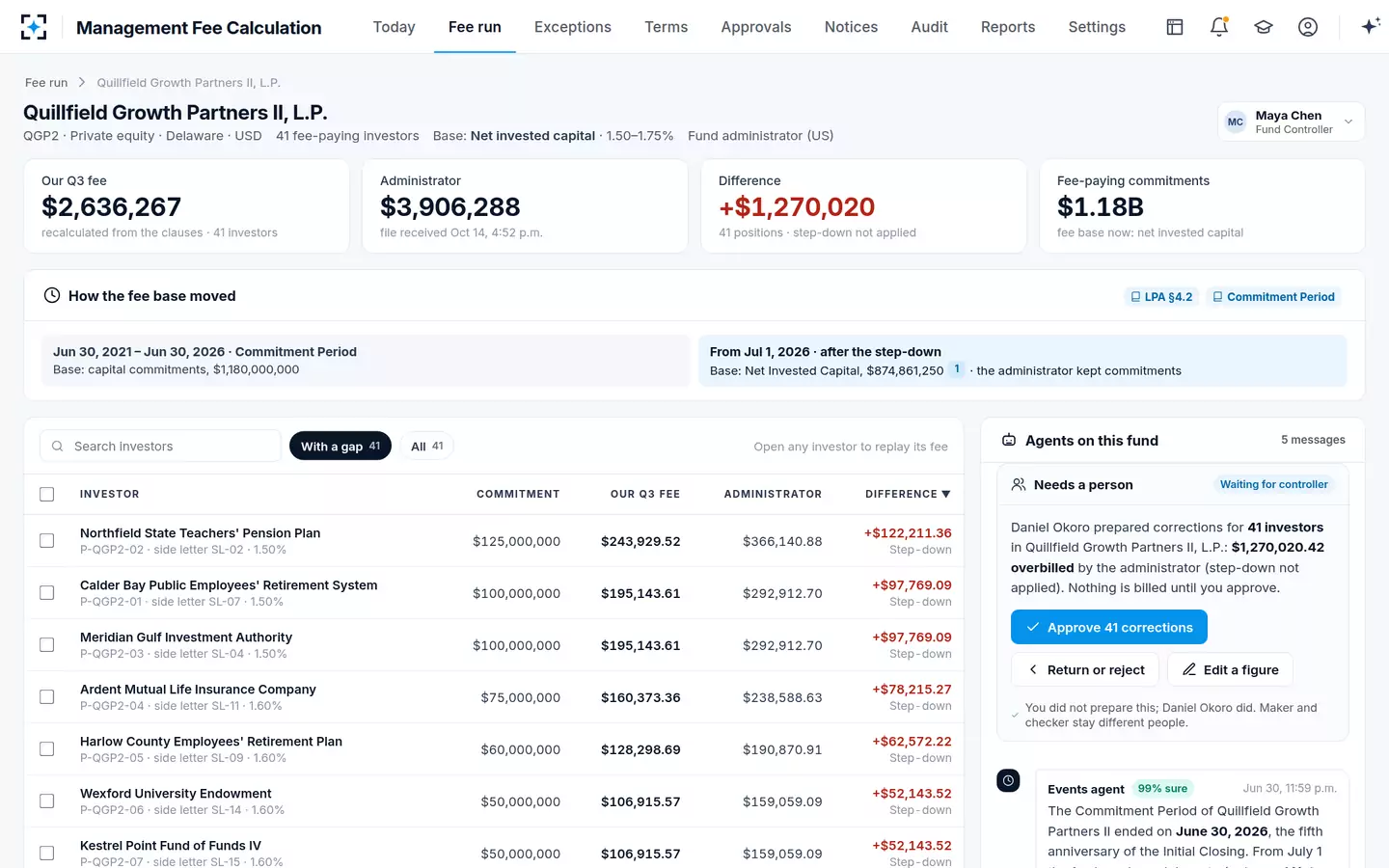
Private funds use breakpoints too, usually in side letters that lower an investor's management fee rate for a larger commitment, sometimes counting the commitments of the investor's affiliates together. They are the private fund version of householding, and they fail the same way: the aggregation is in a side letter clause, and the administrator's term table holds the investor's own commitment only.
A commitment-size breakpoint, applied in one investor's fee replay
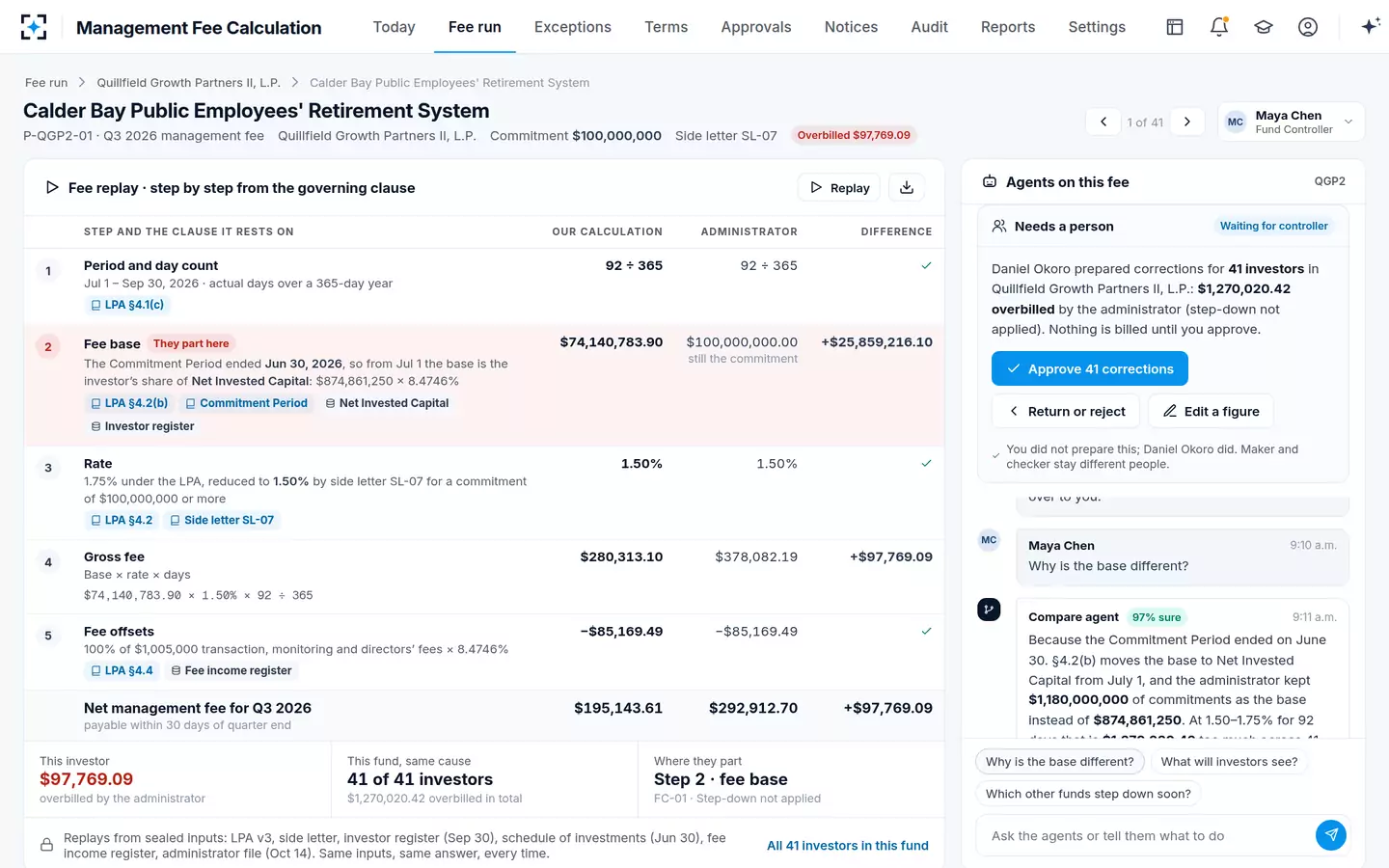
In the sample quarter, the Compare agent found one breakpoint applied without the aggregation its clause required, in Quillfield Real Estate Partners IV: 2 of 57 positions, $50,411 overbilled for the quarter. A fund-level review would not find it, because the fund's other 55 positions agreed. The solution's Terms agent reads each side letter's breakpoint, threshold and aggregation rule into the investor's fee term table, and the Calc agent applies it from the clause each quarter.
The fund page behind a breakpoint: each investor's rate and the side letter that sets it
Testing breakpoints every billing cycle
Breakpoints are tested by recomputing every eligible client's rate from its household or affiliate group, not by checking the rate field on each account. The checks below work for an adviser's retail book, a fund board's advisory fee and a private fund's side letters alike.
Five breakpoint checks to run before each bill goes out
- Rebuild every household or affiliate group from the agreement’s definition
Not from the links set up when the accounts were opened; new accounts, marriages, trusts and affiliates change the group.
- Compare the group’s balance, on the agreement’s valuation date, with each threshold
The wrong date or the wrong excluded assets put a client in the wrong band.
- Confirm tiered or level for each schedule
One misconfigured method is wrong for every client above the first breakpoint.
- List every client within 5% of a threshold
They are where valuation timing and cash flows move the band; check them by hand.
- Recompute a full billing period independently once a year
Errors that sit in how accounts are linked do not show up in a sample of individual bills.
Where a breakpoint has been missed, the fix is the same as for any fee error: compute every affected client's overcharge for every period, refund it with interest, and change the procedure that let it happen. Five tests for a fee spreadsheet apply the same discipline to the whole calculation, and why a billing platform does not check the schedule it is given is set out separately. To see breakpoints and aggregation applied from your own side letters, start from Management Fee Calculation.
Questions people ask
What is a breakpoint fee schedule?
A fee schedule whose rate falls as assets cross set levels, such as 1.00% on the first $1 million and 0.80% above. It can be tiered, charging each slice at its own rate, or level, charging the whole balance at the rate of the band reached; the agreement must say which.
Do advisers have to offer breakpoints?
Breakpoints are a commercial term of the advisory agreement; what the rules demand is that an adviser that offers them applies them as its agreement and Form ADV describe. The SEC's examiners have repeatedly found advisers that disclosed breakpoints or householding and did not apply them.
Can accounts at different custodians be householded?
If the agreement's household definition includes them. The difficulty is data, not rules: the billing system must see all the household's accounts on the same valuation date, which is harder when they sit at different custodians.
How far back should a missed breakpoint be refunded?
To the first period it was missed, with interest, unless counsel advises otherwise. In the SEC's settled fee orders on these pages, advisers repaid the full excess for the whole period plus prejudgment interest.
Are mutual fund breakpoint discounts the same as advisory fee breakpoints?
No. A mutual fund breakpoint discount lowers the sales charge on a purchase and is a broker-dealer obligation under FINRA rules; an advisory fee breakpoint lowers the ongoing advisory fee. Both depend on adding related accounts together correctly.