Management fee calculation in fund accounting is the quarterly work of computing what each investor owes the manager under the fund's documents, booking it as the fund's expense and the manager's revenue, and getting it approved before investors are billed. In a private fund it usually involves the fund administrator's accountants, who calculate and send a fee file; the manager's fund finance analysts, who check it against the books; a fund controller, who approves corrections; the CFO, who signs the quarter; and the investors, some of whom re-perform it. Each seat checks something, and the SEC's orders show what none of them may check: whether the basis follows the LPA's definition. Botminds' Management Fee Calculation is built around those seats, with agents that recompute every fee from the clause and people who decide every difference.
The roles below draw on the SEC's orders and risk alerts and on the way fee work is divided in Quillfield Capital, a fictional manager whose staff, funds and investors appear as sample data in the solution.
Six seats a quarterly management fee passes through, and what each keeps
Today
Calculates each investor’s fee from the administrator’s term table and sends the fee file after quarter end; the sample file arrived October 14.
With agents
Receives a query that names the clause, the step where the two calculations part and the per-investor schedule.
Still theirs: The administrator’s own calculation and file, and the reply.
Today
Ties dozens of fee files to the books in spreadsheets each quarter: totals and a sample.
With agents
Starts from every difference already explained by cause, clause and step; prepares a fund’s corrections at once.
Still theirs: Preparing every correction and sending every query.
Today
Approves fees checked on totals and a sample, and answers for any term the administrator missed.
With agents
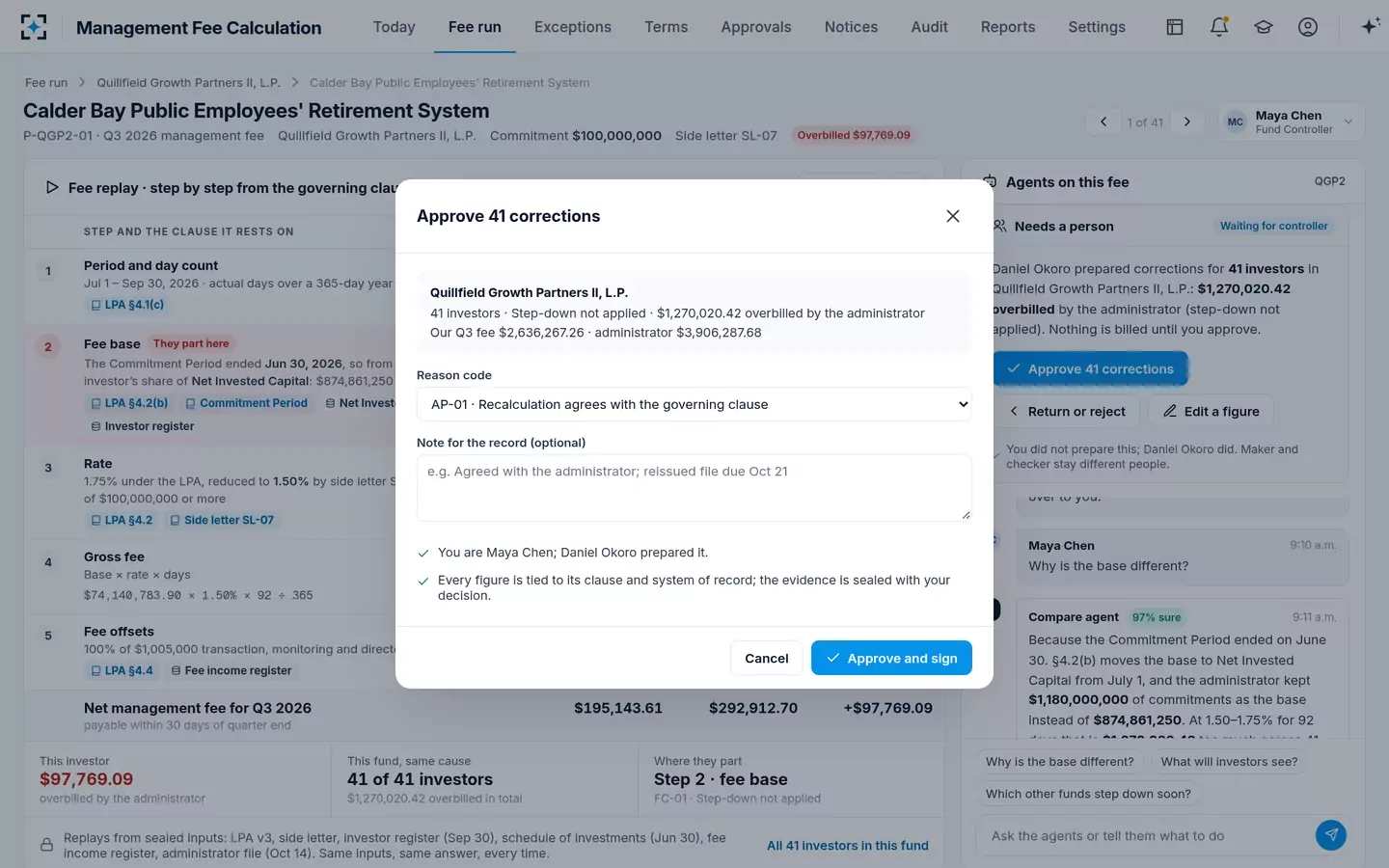
Opens each difference as a step-by-step replay beside its clause, then approves, returns or decides an open reading.
Still theirs: Approval, with a reason code; one reading of each open word.
Today
Signs large corrections and the quarter on the controller’s word.
With agents
Gives the second approval on corrections of $250,000 or more and every undercharge; signs a checklist that opens only when every gap is decided.
Still theirs: The quarter’s sign-off.
Today
Learns how an undefined word was read when an examiner asks.
With agents
Is informed each time an open word is decided, and sees the same reading applied to every fund with the same wording.
Still theirs: The compliance program and its annual review.
Today
Answers investors’ fee questions after notices have gone out.
With agents
Sends only approved notices, each in the investor’s language, with a reply drafted from the clause and checked by the controller.
Still theirs: Every message to investors; never a figure.
What is management fee calculation in fund accounting?
In fund accounting, the management fee is an expense of the fund, accrued each period and paid to the manager, and a revenue of the manager, recognised as it is earned. The calculation produces both sides from one set of inputs: the fund's documents, the investor register and the fund's books. For a registered fund the timing is set by rule: Rule 2a-4 under the Investment Company Act requires expenses, investment advisory fees among them, to be included in net asset value up to the date of each calculation (17 CFR 270.2a-4). A private fund follows its LPA and its accounting policies, which usually means a quarterly fee accrued over the quarter.
The fee is also an allocation. Each investor's share is computed separately because rates, side letters, closing dates and offsets differ between investors, and the result is charged to that investor's capital account or called from it. A fund-level number that is right in total can still be wrong for every investor if, for example, a side-letter rate has been applied to the wrong investor.
Who calculates the management fee?
The manager is responsible for the calculation, even when the administrator performs it. The SEC said so in its order against Global Infrastructure Partners: "Pursuant to the Fund I and III LPAs, Global was responsible for accurately calculating the management fees it charged limited partners, including accurately applying the management fee offsets" (Release IA-5930, December 20, 2021). In Energy Innovation Capital's case, the excess fees reached investors through the adviser's own quarterly capital calls, which "contained inaccurate and inflated management fee assessments" (Release IA-6104, 2022).
In practice the work is often done twice. The administrator calculates the fee from its term table as part of its fund accounting service; the manager's fund finance team checks the administrator's figure or calculates its own. Where the two agree, the fee goes out. Where they differ, someone has to find out why, and that investigation, not the arithmetic, is most of the work: in the sample manager's own estimate, querying the administrator and waiting for its answer takes two of the eleven days a quarter's fee review takes by hand.
Who approves the quarterly management fee?
Someone other than the person who prepared the fee should approve it, and the approval should say what was checked. The SEC's 2021 fee-calculation review, which focused on retail accounts but says many of its principles also apply to fund clients, reported that the staff "generally observed fewer errors when the examined advisers had specific written policies and procedures addressing the supervision, calculation, review, and billing of advisory fees" (Division of Examinations, November 10, 2021). Insight and Global Infrastructure Partners were both found to lack written procedures for the fee calculations at issue.
Who does what to one quarter's fee in Management Fee Calculation
Agent
Terms and Events agentsKeep each fund’s fee terms cited to their clauses; watch for commitment period ends, write-downs, transfers and elections, and draft notices to the administrator.
Never: infer a term that is not written, or send anything
Agent
Calc and Compare agentsRecompute every investor’s fee from the clause and reconcile it with the administrator’s file, marking the first step where the two part.
Never: approve, or choose between two readings of open wording
A person decides
Fund finance analystPrepares the corrections for a fund and sends the drafted query to the administrator.
A person decides
Fund controllerApproves or returns each correction with a reason code; decides open wording once for every fund that uses it.
A person decides
CFOSecond approval on corrections of $250,000 or more and on every undercharge; signs the quarter.
A person decides
Investor relationsSends the approved notices; never changes a figure.
The sample manager's thresholds are worth reading as a design, not a benchmark. A second approval above $250,000 puts the CFO on the corrections that matter most; a second approval on every undercharge, whatever its size, puts the CFO on every case where an investor will be asked for more money, which is where investor relations has the hardest conversation. In the sample quarter the one undercharge, a missing late-closer catch-up of $546,575.35, goes to the CFO after the controller.
A quarter's calendar, from quarter end to the notices
The seats work against a calendar that the administrator's file sets at one end and the notice date at the other. In the sample quarter the window is 30 days, the sample manager's setting for releasing notices after quarter end, and almost half of it passes before the administrator's file arrives.
The sample third quarter: 30 days from quarter end to fee notices
- Waiting for the administrator’s file14 d · Oct 14
- Query2 d
- Administrator reissues5 d · Oct 21
- Prepare and approve6 d · Oct 27
- Sign-off3 d · Oct 30
The calendar explains why the explanation of each gap has to be ready the day the file arrives. Sixteen days after quarter end, the sample manager had already sent the administrator a query with the clause and every investor's difference, which left time for the reissue, two approvals and the sign-off before notices went out. A review that starts by tying out totals on day 14 and writes its queries by hand would still be asking questions when the notices are due.
The management fee accrual journal entry
A management fee is accrued at the fund as an expense and a payable, and at the manager as revenue and a receivable, in the period the fee is earned. When the fee is paid in advance, the fund carries a prepaid amount and expenses it over the quarter; when it is paid in arrears, as in the sample fund, the fund accrues it over the quarter and pays within 30 days of quarter end. The entries below use one sample investor's third-quarter fee.
The sample investor's Q3 fee, booked at the fund and at the manager
| When | Fund (debit / credit) | Manager (debit / credit) | Amount |
|---|---|---|---|
| Through the quarter | Management fee expense / Management fee payable | Management fee receivable / Management fee revenue | $195,143.61, accrued over 92 days |
| Within 30 days of quarter end | Management fee payable / Cash, or a capital call from the investor | Cash / Management fee receivable | $195,143.61 |
| If the administrator’s figure was booked first | Management fee payable / Management fee expense (reversal of the overbilling) | Management fee revenue / Management fee receivable | $97,769.09 |
The third row is why the order of approvals matters. If the administrator's $292,912.70 is booked before the difference is decided, the books carry an overbilling that has to be reversed, and the investor's capital account statement may already show it. The sample manager posts management fee accruals and reversals to the general ledger only after approval. How the offset lines are booked beside the gross fee is shown in the offset guide.
Why each seat checks arithmetic, not the definition
Each seat checks what it can see, and none of them can see the definition unless someone puts it in front of them. The administrator's accountant sees its term table, not the LPA amendment that changed it. The analyst sees the administrator's file and the books, and checks that totals tie and that a sample of investors recompute. The controller sees the analyst's tie-out. The CFO sees the controller's approval. Every check is real, and every check takes the definition of the basis as given.
That is how the SEC's cases survive several pairs of eyes. EDG's write-downs went unreflected through thirteen quarterly payment dates; Energy Innovation Capital's four errors ran for more than two years; Insight's company-level test ran from August 2017 to April 2021 (Release IA-6332). In each, the error was not in the multiplication but in what was multiplied, and that is visible only to someone who reads the definition and rebuilds the basis from the books.
A sample does not fix it. A missed step-down or a misread definition is a fund-level term, so it is wrong for every investor at once; a sample of five investors will contain five wrong fees that all agree with the administrator. The check that catches it compares every investor's fee with one recomputed independently from the clause. That is the seat Management Fee Calculation's agents fill, and in the sample quarter it found the step-down the administrator missed for all 41 investors of one fund.
How limited partners check the fee
A limited partner checks the fee by re-performing it from its own documents, and it can do so only as well as the manager's reporting allows. An investor has its own side letter, its MFN elections and the LPA; it does not usually have the fund's schedule of investments at cost, the list of write-downs the manager treated as reducing the basis, or the portfolio company fees behind the offset. Without them it can test the rate and the days and little else.
The audit adds a check but not the same one. Private funds that rely on the custody rule's audit provision deliver audited financial statements to investors within 120 days of the fiscal year-end (17 CFR 275.206(4)-2); the auditor tests the management fee as one expense of the fund, and plans that work against a materiality set for the fund as a whole. A basis error of a few hundred thousand dollars in a large fund can sit below that line and still be a real overcharge to every investor. Investors who want more ask for the basis schedule and a per-investor reconciliation of gross fee, offsets and net fee each quarter.
The approval seat in Management Fee Calculation: preparer and approver named
Where a quarter's fee review hours go
Most of the hours in a manual fee review go to collecting, tying out and chasing, not to deciding. The sample manager's estimate for one quarter of 40 funds and vehicles splits about eleven working days this way, and shows how the split changes when the recomputation and the explanation of each gap are done before a person looks.
One quarter's fee review across 40 funds: where the days go, by hand and with the agents
By hand: about 11 days
- Collecting files, logging term changes 1.5 d · 13.6%
- Tying fee files to the books 3 d · 27.3%
- Tracing side letters and elections 2 d · 18.2%
- Querying the administrator 2 d · 18.2%
- Corrections 1 d · 9.1%
- Notices and questions 1.5 d · 13.6%
With the agents: about 1.4 days
- Files 0.1 d · 7.1%
- Tie-out 0.2 d · 14.3%
- Terms 0.1 d · 7.1%
- Administrator 0.5 d · 35.7%
- Corrections 0.2 d · 14.3%
- Notices 0.3 d · 21.4%
What does not shrink is the part that needs the administrator. Half a day of the remaining 1.4 is the query and the wait for an answer, because the administrator has to agree, reissue its file or explain. That is also where the agents' work changes the conversation: a query that names the clause, the step and every investor's difference is answered faster than one that says the totals do not tie. Which tasks software can take and which stay with these seats is set out task by task in a companion guide.
The CFO's seat: a sign-off that opens only when every gap is decided
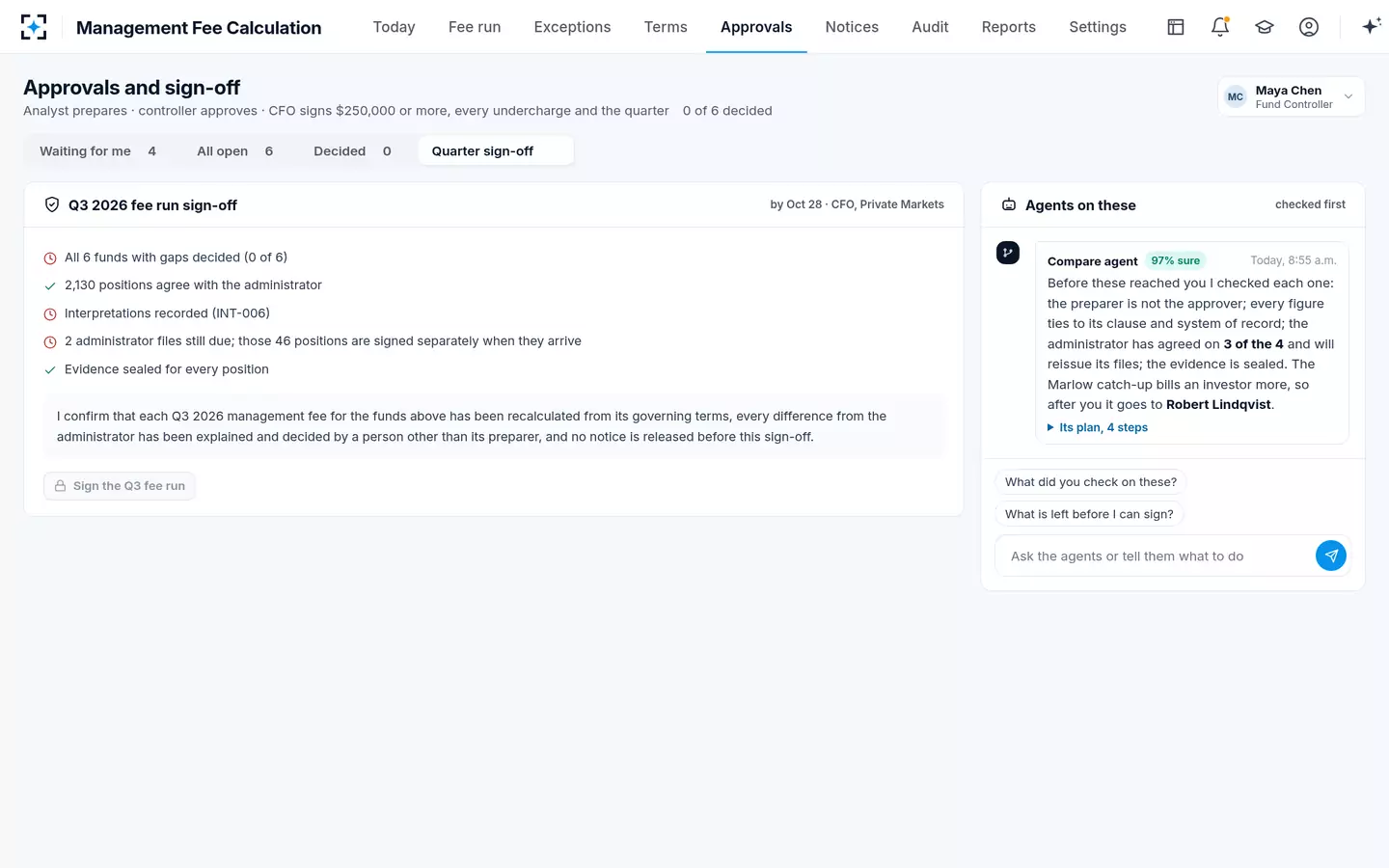
The seats stay; what changes is what reaches them. The analyst prepares instead of tying out, the controller decides instead of re-checking, the CFO signs a checklist instead of a summary, and the compliance officer sees each reading of an open word when it is made rather than when it is examined. To see the seats working on your own funds, start from Management Fee Calculation.
Questions people ask
Is the management fee calculated by the fund administrator or the manager?
Often both: the administrator calculates as part of its service and the manager checks or recalculates. Responsibility stays with the manager; the SEC's Global Infrastructure Partners order says the adviser "was responsible for accurately calculating the management fees it charged limited partners".
Is a management fee an operating expense of the fund?
Yes, it is an expense of the fund in its statement of operations, accrued over the period it covers. At the manager it is revenue. For registered funds, Rule 2a-4 requires advisory fees to be accrued to the date of each net asset value calculation.
How is a management fee paid by limited partners?
Either from the fund's cash or through capital calls on investors, depending on the LPA. Energy Innovation Capital's fees reached investors through quarterly capital calls; the SEC found those calls contained inflated fee assessments.
Who should approve a management fee correction?
Someone other than its preparer, with a reason recorded. In the sample manager, an analyst prepares, the fund controller approves, and the CFO adds a second approval at $250,000 or more and on every undercharge before any investor is billed.
Does the annual audit check the management fee?
The auditor tests the fee as an expense of the fund at a materiality set for the whole fund, so a basis error can fall below its threshold. A per-investor recalculation from the clause is a different test, aimed at whether each investor paid what its documents say.