Management fee calculation in private equity follows one formula: the fee basis the limited partnership agreement sets for the period, times the annual rate after any side letter, times the share of the year the period covers, less the offsets the LPA requires. During the commitment period the basis is usually each investor's capital commitment; after it, the basis usually falls to invested capital less what the fund has sold, written down or written off. The arithmetic is simple and the inputs are not, which is why Botminds built Management Fee Calculation: its agents read every fee clause, rebuild each investor's basis from the fund's own books, recompute every fee step by step and show where the administrator's figure parts from the clause before anyone is billed.
The worked examples come from fictional sample data: Quillfield Capital's private markets arm, whose people, funds and investors are invented, as it runs its third-quarter 2026 fee calculation through the solution.
How many fee clauses the SEC's own count implies
27,682
private equity funds reported to the SEC at the end of 2025, each with its own fee terms
$8.5T
net asset value of those private equity funds, the pool the fees are drawn from
58,891
private funds of all kinds in the same count
How are management fees calculated in private equity?
Private equity management fees are calculated each period, usually each quarter, as the investor's fee basis times the annual rate times the fraction of the year, less that investor's share of any offsets. The SEC's examination staff described the usual pattern in a 2022 risk alert: advisers "typically assess a management fee based on a percentage of limited partner capital commitments" while the fund deploys capital, and the basis "is generally reduced to 'invested capital,' less dispositions, write downs and write offs" after that. The same footnote adds the qualification that matters most: "These arrangements vary in accordance with contractual provisions" (SEC Division of Examinations, January 27, 2022).
That last sentence is the whole job. There is no statutory formula for a private fund's management fee. The LPA is the rulebook, and amendments, side letters and elections under a most-favoured-nation clause change it for some investors and not others. A calculation is right when it follows the words of the documents that govern that investor on that day, and wrong when it follows a template, last quarter's workbook or the administrator's term table instead.
The management fee calculation formula, term by term
The management fee calculation formula has four terms an LPA defines and one it sometimes adds. Each term has its own source document and its own way of going wrong, so the formula is best read as a list of questions, each answered from a clause.
The management fee calculation formula, with the source of each term
Gross fee
basis × annual rate × days ÷ days in year
Basis from the LPA definition for the period; rate from the LPA, cut by any side letter or MFN election; day count from the LPA, or a stated default where it is silent.
LPA, side letters, investor register
Late-closer catch-up
+ fee from initial closing to admission
Where the LPA requires it, an investor admitted at a later closing pays the fee it would have paid from the first closing, plus any charge for the delay the LPA sets.
LPA closing provisions
Offsets
− share of portfolio company fees
Transaction, monitoring and directors’ fees received by the manager or its affiliates, at the percentage the LPA or a later amendment sets.
LPA, fee income register
Credits from earlier periods
− corrections and unused offsets
Overcharges found later, and offsets larger than the fee if the LPA carries them forward.
Prior quarters’ files
In the SEC's orders, most errors live in the first term, and within it, in the basis. A rate is one number written once in the LPA and once in each side letter that reduces it. A basis is a balance that moves every time the fund calls capital, sells part of a company, writes an investment down or admits a late investor, and it has to be computed per investor, per period, under a definition that may differ between funds managed by the same adviser.
What is the management fee calculation basis in each period?
The basis is commitments while the fund is investing and some form of invested capital afterwards, with the switch on a date the LPA fixes. The LPA fixes when the commitment period ends: in the sample fund, the fifth anniversary of the initial closing; some LPAs also end it early on an event, such as a successor fund starting to charge its fee. After it, the basis tracks the cost of what the fund still holds. How the fee on committed capital and the fee on invested capital diverge over a fund's life is worked through year by year in a companion guide.
One fund's management fee basis over its life: three periods, three questions
- Commitment period: on commitmentsYears 1–5
- After it: on net invested capitalYears 6–10
- ExtensionsYears 11–12
Each period asks a different question. In the commitment period: is the commitment the right one, after transfers, defaults and late closings? After it: which investments count, at what cost, and what has reduced them this quarter? In an extension: does the LPA allow a fee at all, at what rate, and were the approvals it requires obtained before the fee was charged? A fee run that treats these as one calculation with one basis is the source of most of the cases below.
One investor's quarter, calculated from the clause
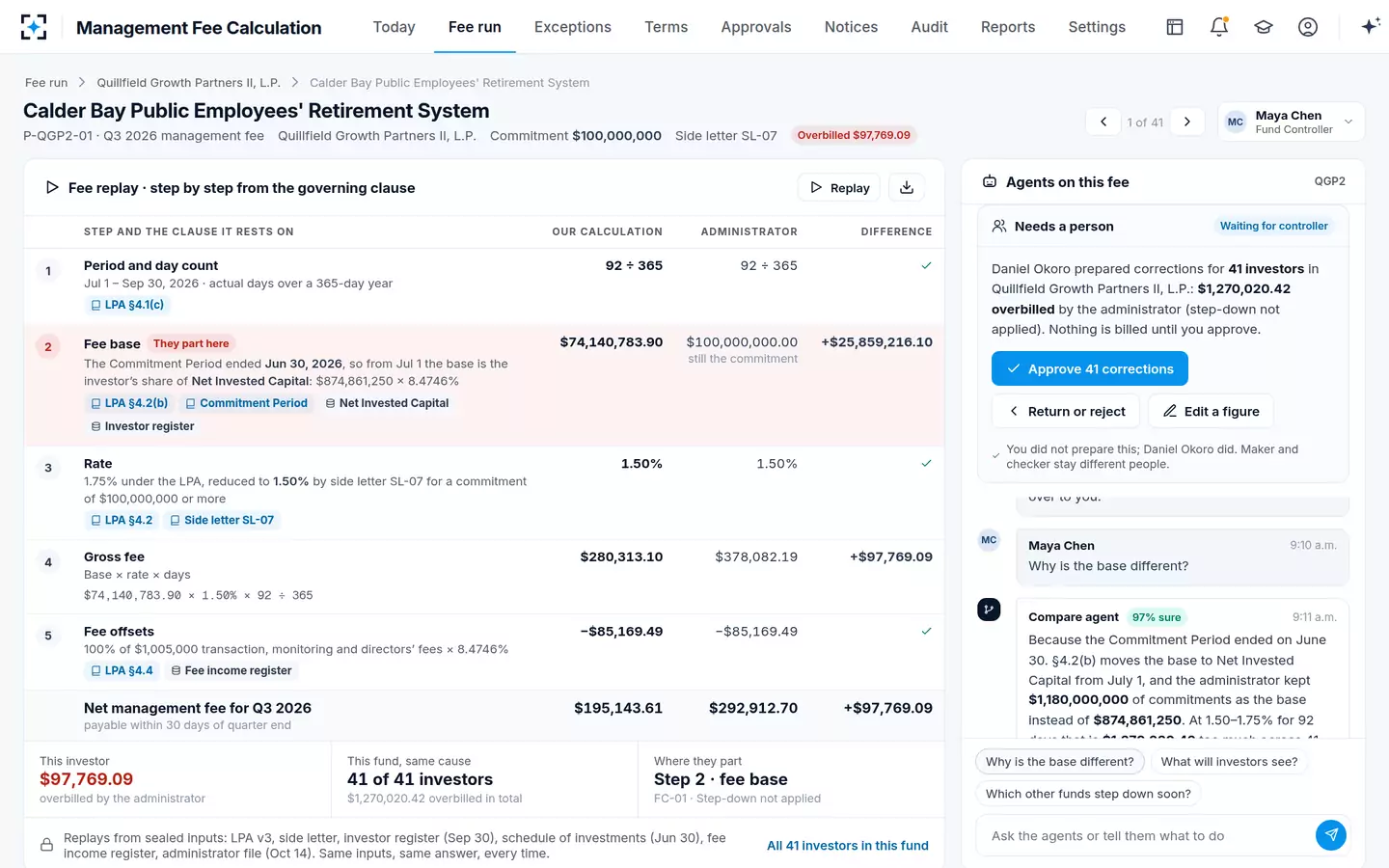
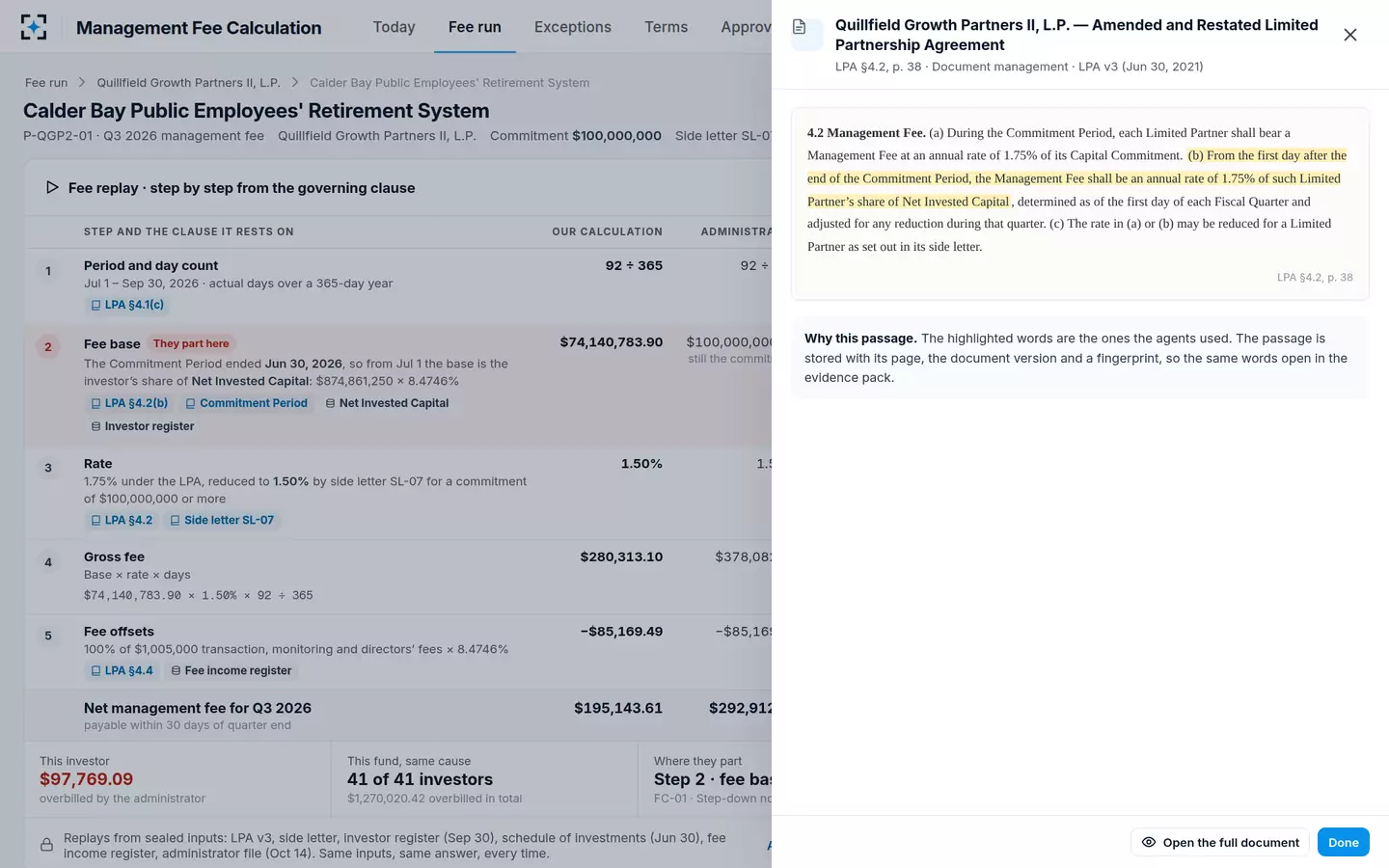
Take one sample investor through one quarter. Calder Bay Public Employees' Retirement System has a $100,000,000 commitment to Quillfield Growth Partners II, whose commitment period ended on June 30, 2026. Section 4.2(b) of the sample LPA says that from the first day after the end of the commitment period, the fee is an annual rate of 1.75% of each limited partner's share of net invested capital; section 4.2(c) lets a side letter reduce the rate, and Calder Bay's does, to 1.50% for commitments of $100 million or more.
Calder Bay's third-quarter 2026 fee, step by step, against the administrator's
| Step | From the clause | Administrator |
|---|---|---|
| 1. Period and day count | July 1 to September 30: 92 ÷ 365, actual days over a 365-day year (LPA §4.1(c)) | 92 ÷ 365 |
| 2. Basis | 8.4746% share × $874,861,250 net invested capital = $74,140,783.90 (LPA §4.2(b)) | $100,000,000, still the commitment |
| 3. Rate | 1.75% under the LPA, reduced to 1.50% by side letter SL-07 | 1.50% |
| 4. Gross fee | $74,140,783.90 × 1.50% × 92 ÷ 365 = $280,313.10 | $378,082.19 |
| 5. Offsets | 100% of $1,005,000 of transaction, monitoring and directors’ fees × 8.4746% = −$85,169.49 (LPA §4.4) | −$85,169.49 |
| 6. Net fee for the quarter | $195,143.61, payable within 30 days of quarter end | $292,912.70 |
Everything that matters happens in row 2. The administrator applied the right rate to the wrong number, because its term table still said "commitments". A review that checks the rate, the days and the offsets against the LPA sees three green ticks. The gross fee is about 35% too high, and it is too high for every investor in the fund, because the missing step-down is a fund-level term, not an investor-level slip.
The fee replay in Management Fee Calculation: each step beside the clause it rests on
Management fee calculation methods in private equity: the bases an LPA can choose
The method is whatever the LPA's definitions say, and the SEC's orders show how much those definitions vary. EDG's LPA charged 1.5% a year on "total invested capital contributions", reduced for triggering events including write-downs. Energy Innovation Capital's LPAs used commitments during the commitment period, then 2% (Fund I) or 1.5% (the parallel fund) of invested capital, reduced for any "Disposition", which the LPAs defined to include a write-down. Insight's LPAs used invested capital equal to acquisition cost, reduced only when the adviser determined that an investment had suffered a "permanent impairment". TZP's LPAs generally charged between 1% and 2% of commitments during the commitment period and between 1% and 2% of invested capital afterwards, "paid quarterly in advance".
Four variables separate these methods, and a calculation has to pin down each one before it multiplies anything:
- The unit. Is invested capital measured per security, per investment or per portfolio company? One of EIC's four errors was aggregating at the company level when the LPAs required each portfolio company security.
- What reduces it. Full sales only, or partial sales, write-offs, write-downs, or only write-downs that someone has judged permanent?
- When it is measured. At the start of the quarter, at the end, or adjusted for reductions during it? The sample LPA fixes net invested capital as of the first day of each quarter and adjusts it for reductions during the quarter.
- What is excluded. Accrued but unpaid interest, bridge financings, fund expenses and fees themselves can sit inside or outside "invested capital" depending on the definition. EIC included accrued, unpaid interest that its LPAs did not allow.
No one of these is exotic. Each is a sentence in a definitions section, and each moves the basis of every investor in the fund.
Errors sit in the basis, not the rate
In the SEC's settled orders against EDG (2020), Energy Innovation Capital (2022) and Insight (2023), the error was in the basis, not the rate. The clearest single case is Energy Innovation Capital Management, a venture capital adviser that the SEC found had made "four errors in calculating the management fee" between January 2020 and March 2022, after its funds' commitment period ended on January 15, 2020 (In re Energy Innovation Capital Management, Advisers Act Release 6104, September 2, 2022). Every one of the four was in the basis or its timing; none was in the rate.
Four basis errors in one SEC order, written as checks for your own calculation
- Has every write-down this quarter reduced the basis, if the LPA says it should?
EIC wrote down and wrote off portfolio company securities but "did not incorporate any of these write-downs" into its post-commitment fee calculations.
- Is the basis measured at the unit the LPA names?
EIC aggregated invested capital at the portfolio company level; the LPAs required the individual portfolio company security.
- Does the basis exclude what the definition excludes?
EIC included accrued but unpaid interest on certain securities, which the LPAs did not permit.
- Did the switch happen on the day, not at the next quarter?
EIC charged the whole first quarter of 2020 on committed capital; the post-commitment basis applied from January 16, 2020.
The other orders follow the same shape. EDG did not reduce the basis for write-downs across thirteen quarterly fee dates; Insight tested impairment at the wrong level; Global Infrastructure Partners' offering memoranda and LPAs disagreed about whether a partial sale reduced the fee. Each of those orders, turned into a test of the step-down, has a guide of its own. Valuation feeds the basis too: in 2020 the SEC's staff reported advisers whose failure to follow their own valuation process "led to overcharging management fees and carried interest because such fees were based on inappropriately overvalued holdings" (OCIE risk alert, June 23, 2020).
The clause behind step 2, opened at its page
Timing: advance or arrears, start dates and late closers
Three timing rules change a fee without changing its rate or basis, and each has caught advisers out. The first is whether the fee is paid in advance or in arrears. TZP's LPAs charged "quarterly in advance"; the sample fund charges in arrears, payable within 30 days of quarter end. An advance fee is calculated on a basis that may change during the quarter, so the LPA has to say whether a sale or write-down in the quarter produces a credit next time; the sample LPA adjusts the basis for reductions during the quarter.
The second is the start date of each period. EIC's error was charging a whole quarter on commitments when the commitment period ended on its sixteenth day. A fee run that only changes the basis at quarter boundaries will get every mid-quarter switch wrong. The third is the late closer. Where the LPA requires it, as the sample LPAs do, an investor admitted at a later closing pays the fee it would have paid from the initial closing, and the LPA may add a charge for the delay; in the sample quarter, a missing catch-up for one investor in Quillfield Buyout Fund V left $546,575.35 underbilled, the quarter's only undercharge.
Day counts deserve a sentence of their own. The sample LPA states its day count, actual days over a 365-day year, in §4.1(c); where an LPA is silent, a calculation needs a stated default rather than whatever the workbook happens to do. The solution uses actual days over a 365-day year only where an LPA says nothing, and that default is a setting the fund controller approves.
How is a hedge fund management fee calculated?
A hedge fund's management fee is calculated the same way, a rate times a basis times a period, but where the basis is net asset value, the hard input moves from the definitions section to the valuation. The fee is then only as right as the NAV it is charged on, and the offering documents decide whether it is measured at the start of the period, the end, or as an average. The SEC's 2021 fee-calculation risk alert found advisers using month-end account values rather than the average daily values they had disclosed (Division of Examinations, November 10, 2021), a basis error of the same kind as the private equity cases above.
The performance fee is a separate calculation with its own protections. The SEC described the most common one in its October 2026 proposal on performance-based compensation: many arrangements "stipulate that an adviser may collect performance fees only on returns above a 'high-water mark,' which is the fund's prior peak NAV", and such provisions "require that any prior losses be fully recovered before additional performance fees may be charged" (SEC proposed rule, 91 FR 63676, October 6, 2026). That release is a proposal, with comments due by December 7, 2026. The law it would amend is older: Section 205(a)(1) of the Advisers Act bars registered advisers from contracts that pay "on the basis of a share of capital gains upon or capital appreciation of the funds", with exemptions such as clients who meet Rule 205-3's qualified client test (15 U.S.C. 80b-5).
What the LPA says, not what is typical
No regulator publishes a typical private equity management fee rate, and no independent study we know of publishes a current one. The question a fund accountant can answer is narrower and more useful: what rate and basis do this fund's documents give this investor today? The research that does exist argues for asking it investor by investor.
Begenau and Siriwardane studied $438 billion of investments by 218 US public pension funds to 2,400 private market funds. Clustering in investors' net-of-fee returns suggested that 61% of the funds had two tiers of fees and only 36% had one; within the average private equity fund, they estimated the dispersion of management fees between investors at about 83 basis points (NBER working paper 29887, 2022; published as "Fee Variation in Private Equity", Journal of Finance, 2024). Two investors in the same fund, with the same basis, can owe different fees because of the side letters each negotiated. In the sample fund, rates from 1.50% to 1.75% apply across its 41 fee-paying investors.
That is the case for recalculating every investor rather than the fund. A fund-level check of total fees against total commitments times the headline rate cannot see a side-letter rate applied to the wrong investor, an MFN election not carried into the fee, or a breakpoint that should have aggregated an investor's affiliates. Management Fee Calculation recalculates every position, compares it with the administrator's file and clears only differences under a $25 rounding tolerance, each logged with both figures. If your calculation lives in a spreadsheet, five tests show whether it would catch the same errors. To see the replay on your own LPAs, start from Management Fee Calculation.
Questions people ask
What is the formula for a private equity management fee?
The gross fee is the fee basis times the annual rate times the days in the period over the days in the year. Add any late-closer catch-up and subtract offsets and credits to reach the net fee. In the sample quarter, $74,140,783.90 × 1.50% × 92 ÷ 365 gives $280,313.10 before $85,169.49 of offsets.
Is the management fee charged on committed or invested capital?
Usually on commitments while the fund is investing and on invested capital afterwards, as the SEC's examination staff described in January 2022, but the LPA decides. EDG's LPA used invested capital contributions throughout; Insight's used acquisition cost after the commitment period.
How often are private equity management fees paid?
Most LPAs in the SEC's orders set a quarterly fee: EDG, EIC and TZP all charged quarterly, TZP in advance. Whether the fee is paid in advance or in arrears changes how a mid-quarter sale or write-down is treated, so the LPA's adjustment clause matters as much as the payment date.
What reduces the fee basis after the investment period?
Whatever the LPA lists. The SEC's 2022 risk alert describes the usual reductions as dispositions, write-downs and write-offs, and found advisers that did not reduce the basis after selling or writing down part of an investment. Some LPAs reduce it only for write-downs judged permanent, which needs a written test.
What is a typical private equity management fee?
No regulator or independent study publishes a current typical rate. What the research does show is variation inside funds: in Begenau and Siriwardane's sample, the dispersion of management fees between investors within the average private equity fund was about 83 basis points.
Can a management fee be charged during a fund extension?
Only if the LPA provides for it, at the rate it sets and after the approvals it requires. The SEC's examiners reported advisers that extended private equity funds without the required approvals, which resulted in potentially inappropriate management fees.