A private equity management fee step-down is the reduction in the fee that the LPA requires once the commitment period ends: the basis falls from investors' commitments to invested capital, and in some funds the rate falls too. The step-down is not one event. After the switch, the basis must keep falling each time the fund sells, writes off or, if the LPA says so, writes down an investment, and each of those reductions has been the subject of an SEC order. Botminds' Management Fee Calculation reads each fund's step-down clause and definitions, watches for the events that move the basis, recomputes every investor's fee on the reduced basis and leaves open words, such as "permanent", for a named person to decide once.
The worked numbers are illustrative arithmetic, and the screens show Quillfield Capital, a fictional manager whose funds and investors run through the solution as sample data.
Excess fees in four SEC orders, each from a basis that did not fall
What is a management fee step-down?
A management fee step-down is any contractual reduction in the fee after the fund stops making new investments, and LPAs write it in two ways. The basis step-down changes what the rate is multiplied by, usually from commitments to invested capital. The rate step-down cuts the rate itself, for example when the commitment period ends or when the manager begins charging a fee on a successor fund. Some LPAs use one, some both. The sample fund, Quillfield Growth Partners II, uses only the first: section 4.2 charges 1.75% of commitments during the commitment period and 1.75% of each investor's share of net invested capital after it.
Whichever form the LPA uses, the SEC's examination staff has made clear where they look. Their 2022 risk alert lists, among conduct inconsistent with fund disclosures, advisers that failed to follow their documents on "the calculation of the fund-level management fee during a private fund's Post-Commitment Period", with investors paying more than the documents required.
"For example, private fund advisers did not reduce the cost basis of an investment when calculating their management fee after selling, writing off, writing down or otherwise disposing of a portion of an investment."
SEC Division of Examinations, risk alert of January 27, 2022
When does the management fee step down?
The fee steps down on the day the LPA's commitment period ends, not at the next quarter-end and not when the administrator is told. Energy Innovation Capital's funds' commitment period ran from January 15, 2016 to January 15, 2020; the SEC found the adviser charged the whole first quarter of 2020 on committed capital when the post-commitment basis applied from January 16 (Release IA-6104, September 2, 2022). The sample fund's commitment period ended at 11:59 p.m. on June 30, 2026, the fifth anniversary of its initial closing, and the reduced basis applied from July 1.
An early end is a step-down too. If the LPA ends the commitment period when a successor fund starts charging its fee, or when investors vote after a key person event, the step-down date is the date of that event. A calendar of anniversaries will not show it; someone has to watch the events. The sample manager's three funds stepping down in the next twelve months, on December 15, 2026, March 31, 2027 and June 30, 2027, are on a list the solution's Events agent keeps, with a notice to each administrator drafted 30 days ahead for a person to send.
Does a write-down reduce the management fee?
A write-down reduces the management fee only if the LPA's definition of the basis says it does, and when it does, every quarter's calculation must pick it up. EDG's LPA charged 1.5% a year of total invested capital contributions, reduced for "certain triggering events, including, but not limited to, write downs of portfolio securities". Five portfolio securities were written down between January 2016 and October 2019; EDG did not adjust the fee on thirteen quarterly payment dates, and its fund's limited partners paid $901,760.91 too much. The order required that sum back with $124,881.11 of prejudgment interest and a $175,000 penalty (Release IA-5617, October 22, 2020).
The cost of a missed reduction grows every quarter it is missed, because the basis stays too high until someone corrects it. The roll-forward below shows one illustrative year after the commitment period.
One illustrative post-commitment year: the basis each quarter, and the fee if it never falls
| Quarter | Event in the prior quarter | Basis at the start | Fee at 1.5% a year | Fee on an unreduced basis |
|---|---|---|---|---|
| Q1 | None | $340.0M | $1.275M | $1.275M |
| Q2 | Half of one investment sold, cost $20M | $320.0M | $1.200M | $1.275M |
| Q3 | Write-down of $15M that the LPA counts | $305.0M | $1.144M | $1.275M |
| Q4 | Write-off of an investment that cost $10M | $295.0M | $1.106M | $1.275M |
| Year | $4.725M | $5.100M |
What is a permanent impairment for fee purposes?
A permanent impairment is whatever the LPA and the manager's written test say it is, and if neither defines it, the manager's discretion decides the fee. Insight's LPAs removed from invested capital "the difference between the acquisition cost and the impaired value" of any portfolio investment the adviser determined had suffered a "permanent impairment", and let the adviser reverse that determination if the value later recovered. The LPAs did not disclose the test. The SEC described the one Insight used in practice (Release IA-6332, June 20, 2023):
Insight's undisclosed four-part test for a permanent impairment
| Prong | What had to be true | Why it narrowed the reduction |
|---|---|---|
| 1. Depth | The fund’s aggregated investments in a portfolio company written down by more than 50% of their aggregate cost | Smaller write-downs never reduced the basis |
| 2. Duration | Written down below aggregate cost for six consecutive quarters | A year and a half of fees on the full cost first |
| 3. Cause | Write-down primarily due to weakening operating results, not market conditions or comparables | A subjective judgement about why value fell |
| 4. Funding | The company likely to need additional capital within twelve months | A forecast, also subjective |
The level of the test mattered as much as its content. Insight's LPAs defined a "portfolio investment" as any debt or equity investment and said that when part of one is sold, the parts are separate investments; a "portfolio company" could hold several. By testing the company as a whole, Insight netted impaired investments against healthy ones in the same company. During the examination it adopted and disclosed more objective criteria, gave up its right to reverse an impairment, applied the new test to four companies the examiners had identified and reimbursed $3,821,032.32 of fees and interest; the $773,754.41 came from applying its old test at the right level across all funds.
The SEC's examiners have seen the same problem without the four prongs: advisers "used broad, undefined terms in the LPA, such as 'impaired,' 'permanently impaired,' 'written down,' or 'permanently written down,' but did not implement policies and procedures reasonably designed to apply these terms consistently" (risk alert, January 27, 2022). The fix is not a better guess each quarter. It is a written test, applied at the level the LPA names, disclosed to investors, and the same for every fund whose LPA uses the same words.
Does a partial sale reduce the management fee?
A partial sale reduces the fee if the LPA treats the sold part as a disposition, and the documents must agree on it. Global Infrastructure Partners' offering memoranda for Funds I and II said that after the commitment period the fee would follow the "retained portion" of investments not completely disposed of; the LPAs said a partial disposition would not reduce the fee. The fund finance team followed the LPAs, while investors were told different things: one was told in writing in 2011 that partial dispositions would reduce fees and was later remediated $563,792 plus interest (Release IA-5930, December 20, 2021).
Two lessons follow for anyone calculating a step-down. Read every document that describes the fee, not only the LPA, and resolve a conflict before the first post-commitment quarter, not when an investor asks. And measure the basis at the unit the LPA names: Insight's definition split a partly sold investment into two, and Energy Innovation Capital's required each portfolio company security rather than the company as a whole.
Four orders, four tests for every post-commitment quarter
Each order describes a test that would have caught its error before the fee went out. Run together each quarter, they cover the ways the basis has been found not to fall.
The step-down tests, one from each order
- Did the basis switch on the day the commitment period ended?
Energy Innovation Capital charged a full quarter on commitments when the switch fell on its sixteenth day.
- Did every sale, write-off and countable write-down this quarter reduce the basis?
EDG missed write-downs on five securities across thirteen quarterly payment dates.
- Is any judgement word applied by a written test, at the level the LPA names?
Insight tested "permanent impairment" by company, not by investment, under criteria it had not disclosed.
- Do the LPA, offering memorandum and investor answers agree on what reduces the basis?
Global Infrastructure Partners’ PPMs and LPAs disagreed about partial sales, and investors were told both.
The tests share one input: a list of every event in the quarter that could move the basis, tied to the clause that says whether it does. That list is the hard part, because the events live in different systems: sales in the deal team's files and the general ledger, write-downs in the valuation committee's minutes, the end of the commitment period in the LPA, an early end in a successor fund's documents.
Watching for the events that move the basis
A step-down calculation is only as current as the events it knows about. In Management Fee Calculation the Events agent watches for the end of each commitment period, a successor fund's first fee, write-downs, dispositions, transfers, late closers and MFN elections; it drafts the notice to the administrator for a person to send and re-runs the fees on the day. The Calc agent recomputes the reduced basis investor by investor, and the Compare agent finds the first step where the administrator's calculation parts from it.
Every gap in one quarter, grouped by its cause
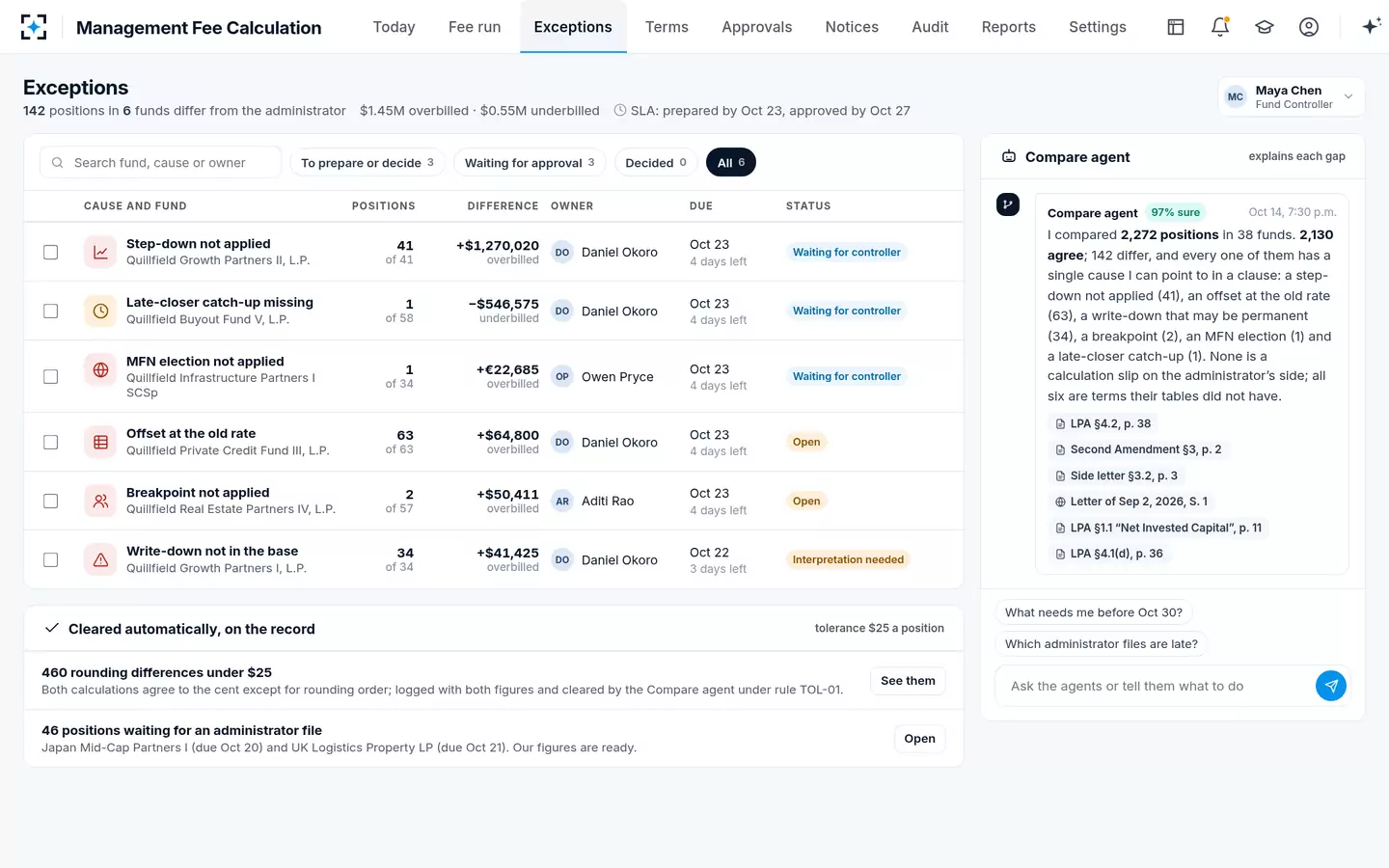
In the sample quarter the step-down that never happened is by far the largest gap: $1,270,020.42 across all 41 fee-paying investors of one fund, 64% of the value of every gap the quarter found. It is also the easiest to prevent, because the date was known five years in advance. The write-down is the opposite: small, and impossible to calculate until someone decides what a word means.
Deciding open words once, for every fund that uses them
Where an LPA leaves a word open, the honest calculation computes every reading and a named person chooses, once, for every fund with the same wording. In the sample quarter, Brightwell Dental Partners was written down $18.0 million on August 14, and the Growth Partners I LPA reduces the basis only for a write-down that is "permanent", a word it does not define. The Calc agent computed both readings: if the write-down is permanent, 34 investors were overbilled $41,424.72. Its confidence was below 90%, so it did not choose.
One reading of an open word, applied to every fund that uses it
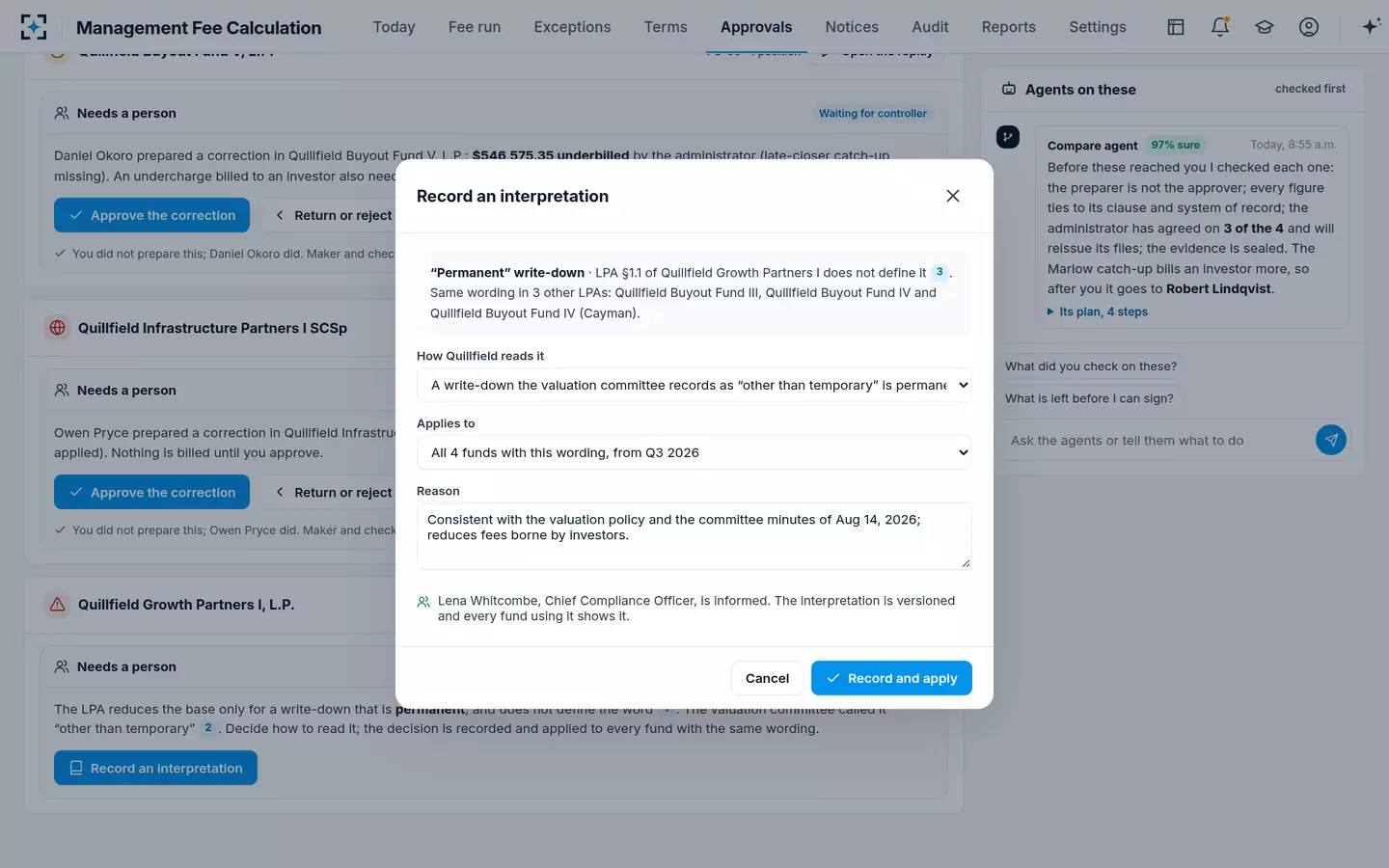
The fund controller ties "permanent" to the valuation committee's finding that a write-down is other than temporary, applies the reading to all four funds with the same words from the third quarter of 2026, and the chief compliance officer is informed. That answers, for this manager, each of the examiners' complaints: a defined test, applied consistently, decided by a person other than the one who prepared the numbers. How the commitment and invested capital bases compare over a fund's whole life and who in fund accounting calculates, checks and signs the fee are covered in companion guides. To run the step-down tests on your own funds, start from Management Fee Calculation.
Questions people ask
Is the management fee step-down automatic?
The obligation is automatic once the LPA's trigger occurs; the calculation is not. Someone has to tell the administrator, change the basis in the calculation and recompute from the right day, and in the sample quarter that step was missed for one fund, overbilling 41 investors $1,270,020.42.
Does the rate change at the end of the investment period?
Only if the LPA says so. Some LPAs reduce the rate as well as the basis, for example when a successor fund starts charging its fee; others, like the sample fund's, keep the rate and change only the basis.
Can a manager reverse a permanent impairment and raise the fee again?
If the LPA allows it. Insight's LPAs let it reverse an impairment if value recovered; as part of its remediation it waived that right going forward. A reversal right is one more judgement that needs a written test.
Does a write-off reduce the management fee?
Under the usual post-commitment basis the SEC's examiners describe, yes: the basis is reduced for dispositions, write-downs and write-offs. Energy Innovation Capital's LPAs counted write-downs as dispositions; its failure to apply them was one of four errors in its order.
What does the SEC do when it finds a missed step-down?
In the settled orders on this page, the adviser repaid the excess fees, usually with interest, and paid a civil penalty, from $175,000 to $1,500,000 for the basis failures. Energy Innovation Capital had returned its $678,861 with interest before the order.