A management fee calculator multiplies a fee basis by an annual rate and the fraction of the year, and subtracts offsets; any spreadsheet can do that. For a private fund the hard part is everything before the multiplication: finding the right basis, rate, offsets and dates for each investor in documents that change by amendment, side letter and election, and explaining every difference from the administrator's figure. Botminds' Management Fee Calculation is a calculator in that larger sense: six agents read the terms, watch the events, recompute every fee step by step from the clause and explain each gap, while an analyst prepares each correction and a fund controller approves it. This guide splits a quarter's fee run into fourteen tasks and says which ones software can take and which must stay with a named person.
The examples come from Quillfield Capital, a fictional manager whose funds, investors and staff appear as sample data in the solution.
One sample quarter's fee run in Management Fee Calculation
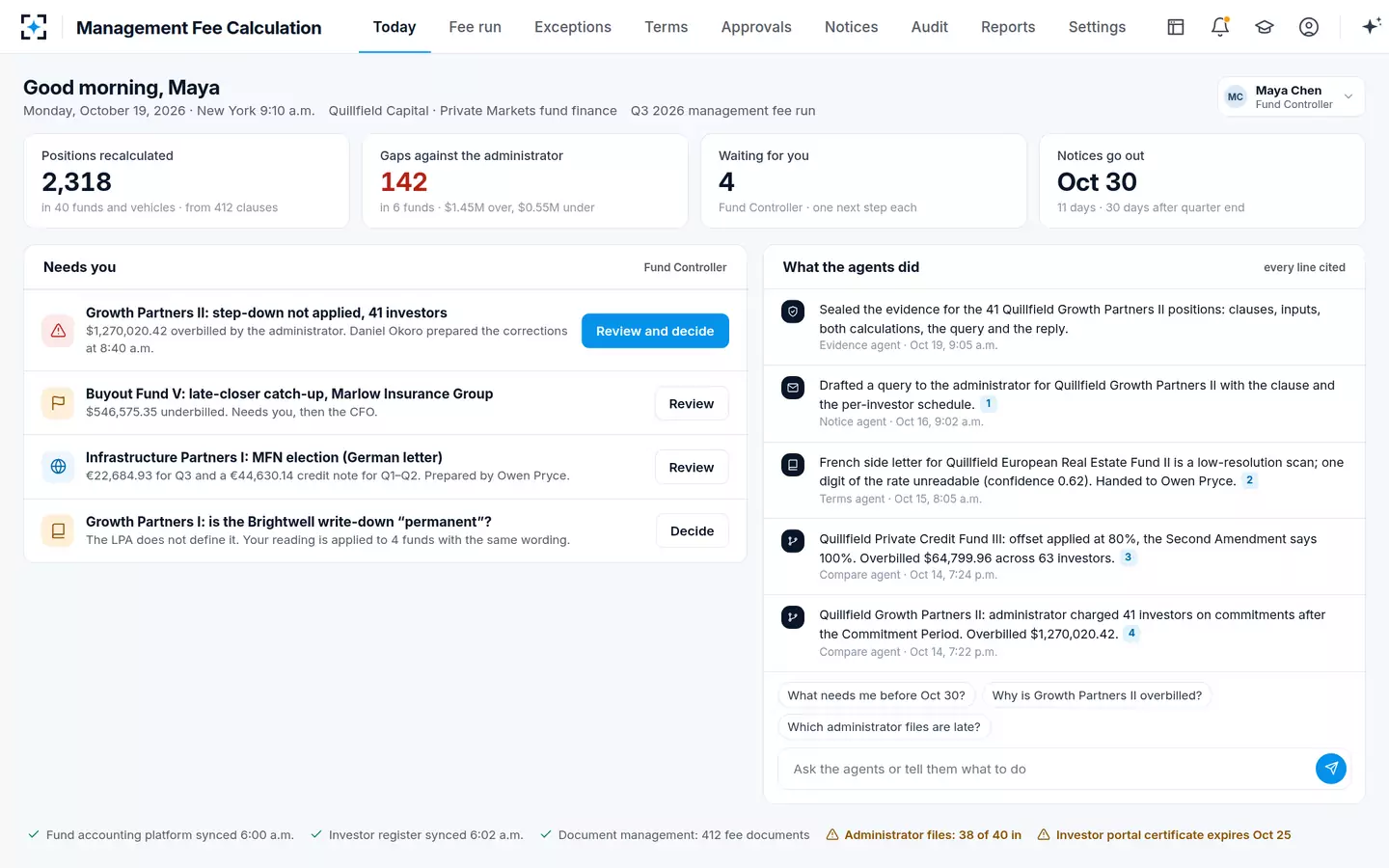
2,318
investor positions in 40 funds recalculated from 412 governing clauses, in 48 minutes
142
differences from the administrator in 6 funds, each traced to one cause in a clause
100%
of fees, offsets and breakpoints recalculated from the clause before billing: the design target
How does a management fee calculator work?
A simple management fee calculator takes three inputs, an amount, a rate and a period, and returns a fee. That is enough to check the arithmetic of a single number someone else has already prepared. It is not enough to calculate a private fund's fee, because the amount is not an input anyone hands you: it is the output of applying the LPA's definition of the basis to the fund's books for that investor on those dates.
An online management fee calculator against a fee calculation that shows its work
Rate-times-amount calculator: Typed in by the user.
Clause-driven fee calculation: Rebuilt per investor from the LPA definition, the schedule of investments and the investor register.
Rate-times-amount calculator: One rate.
Clause-driven fee calculation: The LPA rate, cut by each side letter, breakpoint and MFN election in force on the day.
Rate-times-amount calculator: A number of days or months.
Clause-driven fee calculation: Start and end dates from the LPA, including mid-quarter switches and late closers.
Rate-times-amount calculator: Not handled, or one number.
Clause-driven fee calculation: Each portfolio company fee received, the fund’s share and the percentage in force.
Rate-times-amount calculator: A fee.
Clause-driven fee calculation: A fee per investor with every step, its clause and its source, and the step where it differs from the administrator.
A fund management fee calculation example a calculator must pass
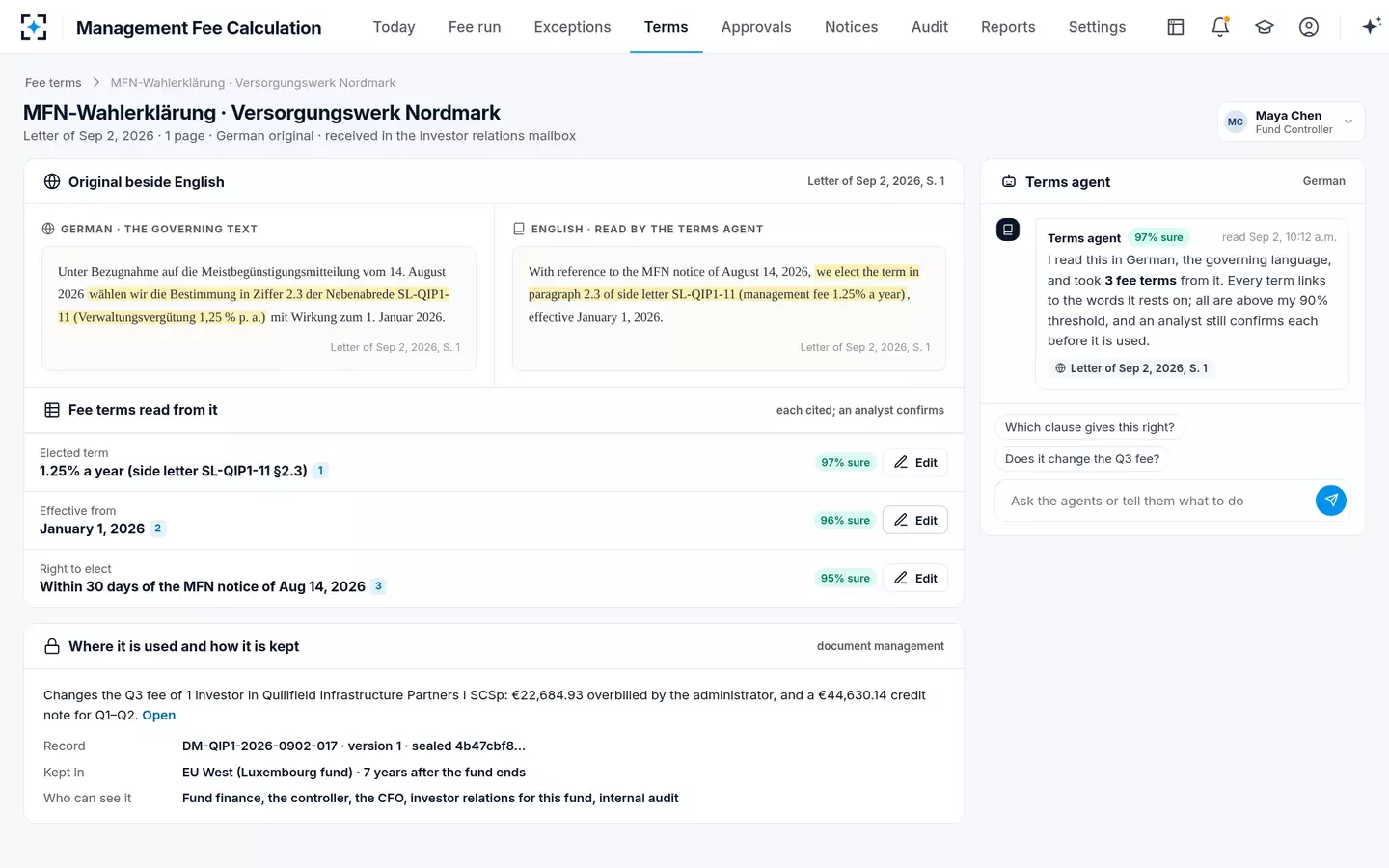
A good test is a real quarter with something hard in it. In the sample run, Versorgungswerk Nordmark, an investor in Quillfield Infrastructure Partners I SCSp, wrote on September 2, 2026 in German to elect, under its most-favoured-nation rights, the 1.25% rate in paragraph 2.3 of side letter SL-QIP1-11, effective January 1, 2026. The administrator still charged 1.40%. On a €60,000,000 basis, the difference is €60,000,000 × 0.15% × 92 ÷ 365 = €22,684.93 for the third quarter, and €60,000,000 × 0.15% × 181 ÷ 365 = €44,630.14 for the first half of the year, owed back as a credit note.
Five things have to happen for a calculator to get that right. It has to receive a letter that arrived in the investor relations mailbox, not the document store; read it in German; link it to the side letter clause it elects; apply the new rate from January 1 rather than from the date of the letter; and produce both a corrected third-quarter fee and a credit for two quarters already billed. A calculator that only multiplies passes none of these. A test set for any tool should include an election, an amendment, a mid-quarter switch, a late closer and an undefined word, with the answers worked out by hand first.
An MFN election read in German, with the terms it changes
Fourteen tasks in a fee run, split between the calculator and people
A quarter's fee run breaks into fourteen tasks. Software can take most of the reading, rebuilding, recomputing and drafting; people keep every decision that changes what an investor pays or what a word means. The split below is the one the solution uses; it is also a fair way to test any tool, by asking it to show which column each task sits in and why.
The fourteen tasks of a quarterly fee run in Management Fee Calculation
| Task | What the software does | What a person keeps |
|---|---|---|
| 1. Collect administrator fee files | Takes each file by secure transfer; sets aside, whole, any file with rows it cannot match to the investor register. | Chasing late files; deciding to run without one. |
| 2. Read LPAs, amendments, side letters, elections | Builds one fee term table per fund and investor, each term cited to its clause and page, in the document’s own language. | Confirming every new document, and any term read below 90% confidence. |
| 3. Watch fee events | Flags commitment period ends, successor funds, write-downs, sales, transfers, late closers and elections. | Sending the drafted notice to the administrator. |
| 4. Rebuild each investor’s basis | From the schedule of investments, the investor register and the LPA definition, for each period. | Nothing, unless the definition is open (task 9). |
| 5. Apply rate, side letters, breakpoints, MFN | Applies the terms in force on each day, with aggregation of affiliates where the clause requires it. | Nothing, once the terms are confirmed. |
| 6. Compute offsets | From the fee income register, ownership and the percentage in force after amendments. | Making sure every receipt reaches the register. |
| 7. Late-closer catch-ups and credits | Computes the catch-up from the initial closing and any credit from earlier quarters. | Deciding when an undercharge is billed. |
| 8. Day counts and partial periods | Uses the LPA’s day count; where it is silent, the default the controller approved. | Approving the default. |
| 9. Decide open wording | Computes each reading and its effect; never chooses. | Choosing one reading, once, for every fund with the same words. |
| 10. Reconcile with the administrator | Finds the first step where the two calculations part, and its cause; clears only differences under $25, logged. | Agreeing or disputing with the administrator. |
| 11. Prepare corrections | Drafts the per-investor schedule and the query. | An analyst prepares and sends. |
| 12. Approve corrections | Checks that preparer and approver differ and that every figure is tied to its source. | The controller approves; the CFO adds a second approval at $250,000 or more and on undercharges. |
| 13. Notices and investor replies | Drafts each notice in the investor’s language from approved figures only. | Investor relations sends; the controller checks replies. |
| 14. Keep the evidence | Seals inputs, statements and decisions on an append-only, hash-chained trail; builds the examiner file. | Internal audit reads; nobody edits. |
The right-hand column is short on purpose. The tasks people keep are the ones where a mistake changes what investors pay or how a contract is read, and where a regulator expects a named person to answer. The rest is reading, matching and arithmetic, done the same way for every investor, which is what software does better than a team under deadline.
Can software read the LPA fee clause?
Software can read an LPA fee clause and turn it into terms, if it shows exactly which words each term came from and hands anything uncertain to a person. In the sample run, the Terms agent read 412 fee documents in five languages, cited every term to its clause and page and never inferred a term that was not written. Below 90% confidence it hands the term to an analyst with the passage: a low-resolution French scan of one side letter left one digit of a rate unreadable at 62% confidence, and the analyst confirmed it from the signed original.
Two design choices make that reading safe to rely on. The original language governs, so a German or Japanese side letter is read in German or Japanese, with an English reading beside it rather than instead of it. And every new document is confirmed by an analyst before its terms are used, whatever the confidence, because a new side letter changes what an investor pays from the day it takes effect. A tool that cannot show the passage behind each term should not be trusted with it.
Who decides what counts as an impairment?
A person decides, and writes the decision down so it applies the same way to every fund with the same words. When an LPA reduces the fee basis only for "permanent" write-downs or "impaired" investments and does not define the word, the calculation cannot be finished by arithmetic. The SEC's examiners have criticised advisers that used such undefined terms without procedures to apply them consistently (risk alert, January 27, 2022), and in Insight's case found that the adviser's own narrow criteria gave it "significant latitude" over its own fee (Release IA-6332, 2023).
Software has a precise role here: compute every reading and show what each costs. In the sample quarter the Calc agent computed both readings of a $18.0 million write-down in Quillfield Growth Partners I: $41,424.72 overbilled across 34 investors if the write-down is permanent, nothing if it is not. It did not choose. The fund controller chose, tying "permanent" to the valuation committee's finding that a write-down is other than temporary, applied the reading to all four funds with the same wording, and the chief compliance officer was informed. The step-down guide follows that decision from the clause to the fee.
“This latitude presented a conflict of interest that was not disclosed in the sections of the Fund governing documents that explicitly discussed conflicts of interest or in the sections that discussed permanent impairment.”
SEC order, In re Insight Venture Management, Release IA-6332, June 20, 2023
Latitude over one's own fee is exactly what a calculator must not quietly exercise. ESMA, writing about firms that serve retail investors, has warned that firms and their clients may lean on AI for decisions and lose the human judgment those decisions need (ESMA public statement, May 30, 2024), and that describes the fee run's risk too. The danger is not that software multiplies wrongly; it is that a confident answer to an open question is accepted because it arrived with a number attached. A calculator that chooses a reading on its own has made a fee decision nobody signed.
What should a management fee calculator show?
A management fee calculator should show every step of every investor's fee, the clause each step rests on, the system each input came from, and the first step where it disagrees with the administrator. Without that, a difference is just two totals, and someone has to rebuild both to find out why. With it, the reviewer reads one row.
The fund controller's morning: four numbers and the decisions waiting
Three more properties separate a calculator you can defend from one you cannot. The same inputs must give the same answer every time, so a fee calculated in October can be reproduced for an examiner a year later; the sample replays run from sealed inputs: the LPA version, the side letter, the investor register, the schedule of investments, the fee income register and the administrator's file. Every change a person makes to a figure must keep the old figure beside it with a reason. And tolerances must be explicit: the sample manager clears differences under $25 a position, logs both figures, and clears nothing larger without a person.
Can AI calculate management fees?
AI can read the documents and explain the differences; the fee itself should be computed by deterministic arithmetic from the terms it read, so that the same inputs always give the same fee. That division is what makes the work reviewable. A language model that reads a side letter can be checked against the passage it cites; a language model that produces a fee from a prompt cannot be checked except by doing the calculation again.
Regulators are watching how firms draw that line. The SEC's Division of Examinations, in its fiscal 2027 priorities, notes that registrants are adopting what it calls "super intelligence (SI)", and says it is working harder to understand how these tools shape outcomes and whether firms still meet obligations that apply whatever the technology (Examination Priorities, Fiscal Year 2027, October 23, 2026). For a fee run, the technology-neutral obligation is unchanged: charge what the documents say, and be able to show it.
Buying a management fee calculator: what to ask, and where this one fits
Buy on evidence from your own funds, not a demonstration. Five questions separate tools that calculate fees from tools that calculate fees you can defend:
Five questions to put to any management fee calculator
- Will it run a past quarter of ours and match, or explain, every difference from the administrator?
A tool that cannot reproduce a closed quarter will not catch an error in an open one.
- Can it show the passage behind every term, in the language it was signed in?
If a term cannot be traced to a clause, nobody can confirm it.
- What does it do with an undefined word?
The right answer is: compute each reading and wait for a person.
- Who can change a tolerance, a default day count or a threshold, and is the change versioned?
Settings are fee policy; changing one should take an approval.
- Can an examiner replay a fee from a year ago and get the same answer?
Sealed inputs and an append-only trail are the test.
Management Fee Calculation fits private markets managers that bill fees under LPAs, amendments, side letters and MFN elections, usually through one or more administrators, and want every fee recalculated and every difference explained before notices go out. It works beside the administrator and the fund accounting platform rather than replacing them: it reads their files, posts accruals to the general ledger only after approval, and leaves the administrator's own calculation in place. It is not a billing platform for retail advisory accounts, and it does not value investments; it takes the valuation committee's figures as inputs. If the calculator you have today is a spreadsheet, five tests show what it catches and what it misses. To run it on a past quarter of your own, start from Management Fee Calculation.
Questions people ask
What inputs does a management fee calculator need?
For a private fund: the LPA, every amendment, side letter and election; the investor register with commitments and closing dates; the schedule of investments at cost with sales and write-downs; the portfolio company fees received; and the administrator's file to compare with. The sample run drew on 412 fee documents for 40 funds.
Is there a free management fee calculator for private equity?
A rate-times-amount calculator is easy to find or build, and it will check the arithmetic of a fee once you know the basis. It will not find the basis, apply side letters or explain a difference from the administrator, which is where the SEC's cases arise.
How accurate is software at reading side letters?
Accurate enough to be useful only if it reports its confidence and shows its passage. In the sample run, terms read below 90% confidence go to an analyst, and every new side letter is confirmed by an analyst before use, whatever the confidence.
Does fee calculation software replace the fund administrator?
Not this one. It recalculates independently and compares with the administrator's file, sending a query with the clause and per-investor schedule when they differ; the administrator keeps its own calculation and service.
How long does a fee run take with a calculator like this?
In the sample run, 2,318 positions in 40 funds were recalculated in 48 minutes; the people's work that follows, deciding 142 differences in six funds, is what fills the days before notices go out.