A management fee calculation in Excel multiplies each investor's fee basis by the annual rate and the fraction of the year, then subtracts offsets, row by row; the formula is one line, such as =basis*rate*days/365-offset. The risk is not the formula. It is that the basis, rate, dates and offsets typed into the workbook no longer match the LPA, the side letters and the books, and a spreadsheet cannot test that against itself. The five tests below check a fee workbook against its sources: recompute from the clause, rebuild the basis from the books, check investor-specific terms, check dates, and measure the difference with errors you planted yourself. Botminds' Management Fee Calculation runs the same five tests on every investor position each quarter and explains every difference from the administrator's figure, while fund finance teams that still check fees by hand can use them on their own workbooks.
Sample figures come from Quillfield Capital, a fictional manager whose funds and investors run through the solution.
Five tests for a management fee spreadsheet, each against a source outside it
- Recompute every fee from the clause, not from last quarter’s workbook
Catches a rate or basis that changed by amendment, side letter or election and never reached the spreadsheet.
- Rebuild each investor’s basis from the books
Catches sales, write-offs and write-downs the fee basis did not pick up.
- Check investor-specific terms one by one
Catches side-letter rates, breakpoints, MFN elections and offsets applied to the wrong investors or not at all.
- Check every date that moves the fee
Catches mid-quarter switches, late closers, advance billing and day counts.
- Measure the difference, and seed errors to see if the review finds them
Turns “looks right” into a number you can track quarter by quarter.
How are management fees calculated in a spreadsheet?
In a spreadsheet, a management fee is calculated one investor per row: a column for the basis, one for the rate, one for the days in the period, one for offsets, and a formula for the net fee. The workbook usually also holds a tab of fund-level inputs (invested capital, portfolio company fees, the period dates) and a lookup of each investor's rate. That structure is sound. Its weakness is that every input arrives by copy and paste or by hand, and the workbook carries forward whatever it held last quarter unless someone changes it.
A quick sanity check is to recompute one investor with a calculator: basis × rate × days ÷ 365, less its share of offsets. If that matches the workbook, the arithmetic is fine. Every test below assumes the arithmetic is fine and asks the harder question: is the workbook calculating the fee the documents describe?
What errors did the SEC find in fee calculations?
The SEC's examination staff found deficiencies related to advisory fees in most of about 130 examinations in its 2021 advisory fee initiative, and listed the calculation errors precisely. Among the "inaccurate percentages", examined advisers had "charged fees that were different from contractually agreed-upon rates", "used the incorrect fee schedule", "failed to convert all clients to their new or updated fee schedule" and "had errors in fee percentages manually entered into their portfolio management systems" (Division of Examinations, Investment Advisers' Fee Calculations, November 10, 2021). The initiative focused on retail accounts, but every one of those errors has a spreadsheet equivalent: a rate cell nobody updated after an amendment.
The private fund orders add the basis errors. Energy Innovation Capital's four errors, set out in its 2022 order, were all in what the rate was applied to: write-downs not deducted, invested capital aggregated at the wrong level, accrued interest included, and the post-commitment basis started a quarter late (Release IA-6104). The staff's 2018 risk alert, drawn from deficiency letters in more than 1,500 examinations, also noted advisers that "proactively reimbursed clients for incorrect fees and expenses that they identified through the implementation of policies and procedures that provided for periodic internal testing of billing practices" (OCIE, April 12, 2018). Testing is how errors get found before an examiner finds them.
Test 1: recompute every fee from the clause, not from last quarter
The first test is an independent recomputation: rebuild the fee for every investor from the governing documents, without opening last quarter's workbook, and compare. A workbook rolled forward from quarter to quarter inherits every past mistake and misses every change that happened outside it, such as a side letter signed in August or an MFN election made by letter. An independent rebuild starts from the LPA, the latest amendment, each side letter and each election, and asks what each investor's rate and basis should be today.
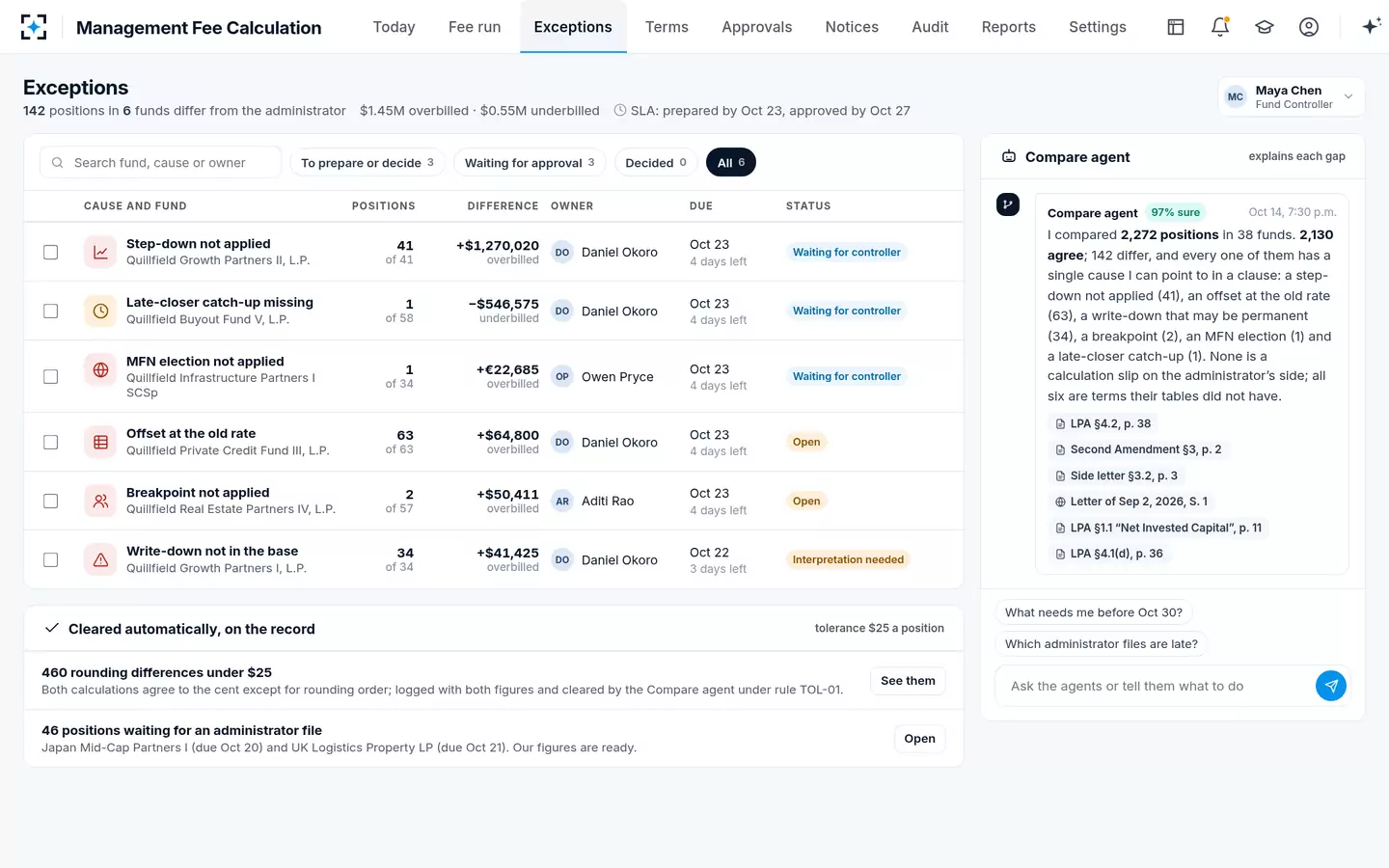
The comparison has to be per investor, not per fund. A fund total can agree by accident when one investor is overbilled and another underbilled, and a fund-level term such as a missed step-down is wrong for every investor at once, so a sample of five investors shows five fees that all agree with the administrator. In the sample quarter, Management Fee Calculation's independent recalculation of 2,272 positions disagreed with the administrator on 142, in six funds.
Test 2: rebuild each investor's basis from the books
The second test rebuilds the fee basis from the fund's books, not from the workbook's basis column. Take the schedule of investments at cost from the fund accounting platform, apply every sale, write-off and write-down the LPA counts, at the unit the LPA names, and attribute the result to investors. If the workbook's basis is higher, find which event it missed.
This is the test that would have caught most of the private fund orders. EDG missed write-downs on five securities across thirteen quarters; Energy Innovation Capital aggregated at the company level when its LPAs required each security; Insight tested impairment by company, not by investment. The step-down guide turns each of those into a quarterly check.
Test 3: check investor-specific terms one by one
The third test goes investor by investor through every term that applies to some investors and not others: side-letter rates, breakpoints that depend on commitment size or affiliate aggregation, most-favoured-nation elections, fee waivers, and each investor's share of offsets. For each, confirm the workbook applies it to exactly the investors it covers, from the date it takes effect. In the sample quarter, one breakpoint was applied without aggregating an investor's affiliates (2 positions, $50,411 overbilled) and one MFN election made in a German letter was never carried into the fee (€22,684.93 for the quarter).
Investor-specific terms that a fund-level check cannot see, found in one quarter
Offsets belong in this test because they are computed at the fund and shared among investors. Check that the offset percentage is the one in force after any amendment, that interest on deferred portfolio company fees is included if the LPA counts it, and that investors who pay no fee do not dilute the offset. A worked offset example shows each of those edges.
Test 4: check every date that moves the fee
The fourth test lists every date in the period that should change a fee and checks the workbook moved on that date: the end of a commitment period, a late closing, a transfer between investors, an election's effective date, a sale or write-down if the LPA adjusts the basis within the quarter. A workbook that changes inputs only at quarter-end will be wrong on every mid-quarter event. The same test checks the day count against the LPA and whether the fee is billed in advance or arrears, which decides whether a mid-quarter change produces a credit next quarter.
The SEC's 2026 economic conflicts risk alert lists the controls advisers lacked, including "establishing procedures to test for calculation errors (e.g., to identify manual input errors when calculating prorated fees)" (Division of Examinations, June 9, 2026). Prorated fees are where dates and manual inputs meet, which is why the staff singled them out.
Test 5: measure the difference, and seed errors to see if you find them
The fifth test turns the first four into numbers. Count how many investor positions agree with the independent recalculation within a stated tolerance, the value of the differences in each direction, and their causes. Then test the test: take a copy of a closed quarter, plant errors you know the answer to (change one side-letter rate, drop one write-down, set one offset to its pre-amendment percentage, start one switch a quarter late) and see how many the review finds.
How to measure a fee spreadsheet's accuracy: four numbers, not one
Agreement rate
Share of investor positions where the spreadsheet and the independent recalculation agree within a stated tolerance.
Sample: 93.8% in Q3 2026, 99.0% in Q2
Value of differences
Overbilling and underbilling, counted separately and in total, before anything is corrected.
Sample: $1.45M over, $0.55M under
Differences by cause
Each difference traced to one cause: basis, rate, offset, breakpoint, dates, catch-up.
Sample: six causes, one fund-level step-down 64% of the value
Seeded errors caught
Of the errors planted in a copy of a closed quarter, how many the review found.
Your own test: aim for all of them
Four quarters of the sample manager's numbers show why the agreement rate alone misleads. Agreement ran between 98.7% and 99.2% for three quarters, then fell to 93.8% in the third quarter of 2026. Nothing got worse in the administrator's arithmetic; one fund's commitment period ended and the administrator missed the step-down, which alone accounts for 41 of the quarter's 142 differences and 64% of their value. Without it, agreement would have been 95.6%.
Differences from the administrator in four sample quarters
How do you test a fee spreadsheet without trusting it?
You test a fee spreadsheet without trusting it by never using it as a source for its own test. Every comparison in tests 1–4 starts from a document or a system outside the workbook: the LPA and side letters, the fund accounting platform, the investor register, the fee income register. If the only way to answer a question is to look in the workbook, that is the input to test next.
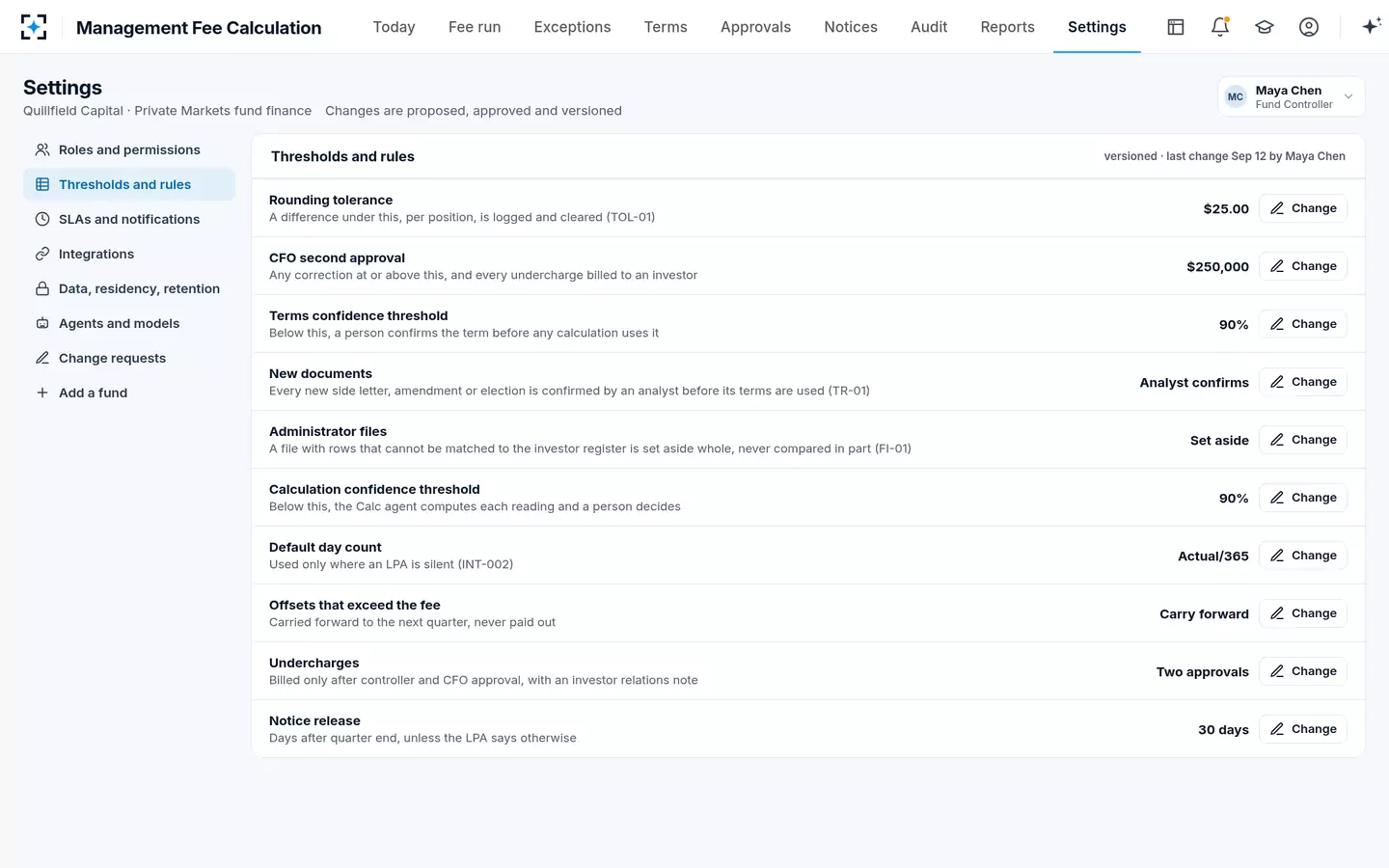
Two controls make the tests stick. First, the person who tests is not the person who maintains the workbook, so a misreading is not repeated by the same reader. Second, the tolerance is written down: the sample manager clears differences under $25 a position, logs both figures, and investigates everything else. A tolerance set after the differences are known is not a tolerance.
The tolerance, the thresholds and the day count, written down as settings
Performance fee calculation in Excel: the high-water mark test
A performance fee calculation in Excel needs one more test: that the high-water mark is carried correctly from period to period. The SEC describes the high-water mark in its October 2026 proposal as "the fund's prior peak NAV", above which alone a performance fee may be charged, so that prior losses are recovered first (91 FR 63676, a proposal; comments due December 7, 2026). In a spreadsheet the mark lives in a cell that each period's formula must read and, when NAV sets a new peak, update.
A high-water mark carried through five periods (illustrative 20% performance fee)
| Period | NAV per unit before fee | High-water mark in force | Fee base | Performance fee |
|---|---|---|---|---|
| 1 | 100.00 | 100.00 | — | None: no gain above the mark |
| 2 | 110.00 | 100.00 | 10.00 | 2.00, and the mark resets to 108.00 after the fee |
| 3 | 95.00 | 108.00 | — | None: below the mark |
| 4 | 105.00 | 108.00 | — | None: still below the mark |
| 5 | 120.00 | 108.00 | 12.00 | 2.40 |
The seeded-error approach works here too: copy a closed year, lower one period's NAV so that the next period should earn no fee, and check the workbook charges none. If it does, the mark is being reset to the trough or not carried forward at all.
When to stop testing the spreadsheet and replace it
Replace the spreadsheet when the tests take longer than the calculation, or when they keep finding the same kind of error. Both are signs that the workbook's structure, not its users, is the problem: it holds inputs that should come from documents and systems, and it has no way to show which clause each number rests on. A fee calculation that rebuilds every input from its source, shows every step beside its clause and reports the five numbers above each quarter runs the tests as part of calculating.
That is what Management Fee Calculation does. Its agents recompute every investor's fee from the clause, compare it with the administrator's file, and explain each difference by cause and step; an analyst prepares corrections, the fund controller approves them, and the CFO signs the quarter. Which of the fee run's tasks it takes and which stay with people is set out in a companion guide. To run the five tests on one of your own past quarters, start from Management Fee Calculation.
Questions people ask
What is the Excel formula for a management fee?
For one investor and one period, =basis*rate*days/365 gives the gross fee where the LPA uses actual days over a 365-day year; subtract the investor's share of offsets for the net fee. The hard inputs are the basis and the rate, which come from the LPA, side letters and the books, not from the formula.
How do I calculate a management fee percentage?
Divide the annual fee by the basis it was charged on. If a quarter's gross fee of $280,313.10 was charged on $74,140,783.90 for 92 days, the annual rate is $280,313.10 ÷ $74,140,783.90 × 365 ÷ 92, or 1.50%.
How often should a fee spreadsheet be tested?
Every billing period for the per-investor comparison, and at least once a year with seeded errors. The SEC's staff has noted advisers that found and repaid fee errors through periodic internal testing of billing practices.
Should the administrator's fee file be the test?
It is one comparison, not a test of the documents. In the sample quarter the administrator's file and the manager's own figures would both have missed the step-down if both had relied on the same term table; the test is a recalculation from the clause.
What tolerance should a fee check use?
A small, written rounding tolerance per position, decided before the comparison and logged when used. The sample manager uses $25 a position and cleared 460 rounding differences under it in one quarter, each with both figures kept.