Private equity accounting software pricing is hard to compare because vendors don't publish prices, and the quotes they give are built on different units: per fund or vehicle, per user, per module, a share of assets, or an annual platform fee. The way through is to price the unit of work you already pay for: one vendor invoice, read, tested against the fund documents, split across the right vehicles, approved and evidenced. Once you know what that unit costs your team today, from your own time records and a defensible hourly rate, any quote can be divided by your invoice volume and compared like for like, and so can the cost of the errors examiners find. Botminds' Fund Expense Allocation is an agentic solution that does the reading, testing, splitting and checking on that unit while people approve; this guide shows how to judge whether that is worth paying for.
The rates below come from the SEC's own burden estimates and the US Bureau of Labor Statistics; the touch times are our assumptions for you to replace with your own; and the sample firm, Quillfield Capital, is fictional data from the solution.
An illustrative cost per invoice, by how hard the invoice is
Why private equity accounting software pricing is hard to compare
Because the prices are private and the units differ. One quote is per vehicle per year, another per user, a third a platform fee plus implementation, a fourth bundled with fund administration. Each is rational for the seller; none tells you what you pay to get one invoice allocated correctly. And the scope differs as much as the unit: a fund accounting platform keeps the books and capital accounts, an accounts payable tool captures and pays invoices, and neither, by default, decides which vehicle should bear a line on a law firm's bill.
The market is large enough that the comparison matters. The SEC counted 58,891 private funds reporting on Form PF or Form ADV at the end of 2025, 27,682 of them private equity funds, with private equity net assets of $8,523 billion (SEC Division of Investment Management, Private Fund Statistics, fourth quarter 2025). Every one of those funds pays invoices, and every manager with parallel or co-investment vehicles splits them.
Price the unit you control: one allocated invoice
The unit is one invoice taken from receipt to an approved, evidenced allocation. It includes logging it, reading it (sometimes in another language), deciding what each line is under the LPA and side letters, building the split, checking caps and investor limits, chasing the evidence, approving, and keeping the file. It excludes the payment run, which costs the same whoever allocates.
The cost of one allocated invoice
Preparation
minutes × loaded rate
Logging, reading, classifying each line, building the split, checking caps.
Fund accountant
Approval
minutes × loaded rate, per approver
Controller on every invoice; CFO above a threshold; compliance on caps and conflicts.
Controller, CFO, CCO
Rework
share returned × minutes to fix
Invoices sent back for evidence, a missing engagement letter, a wrong vehicle.
Fund accountant
Expected error
error rate × average amount misallocated × cost per dollar to correct
Look-backs, repayment with interest, and in the cases examiners find, penalties.
The firm
The first two terms are what most comparisons stop at. The last two are what make allocation different from ordinary payables: an invoice coded to the wrong cost centre is a reclass, but an expense charged to the wrong fund is money taken from one group of investors for another, and it is what the SEC's orders are about.
What does a fund accountant's hour cost?
Use a loaded rate, not a salary. The SEC's own paperwork estimates price "a senior accountant" at $266 an hour, a chief compliance officer at $652 and an assistant general counsel at $573, figures it says are "adjusted to account for bonuses, firm size, employee benefits, and overhead" on an 1,800-hour working year (SEC, 91 FR 5545, February 6, 2026). Those are rates a regulator was willing to publish for fund work, which makes them a defensible starting point for a business case.
What finance and compliance time costs, in public figures
$266/hr
SEC’s loaded rate for a senior accountant
$652/hr
SEC’s loaded rate for a chief compliance officer
$93,290
median annual wage, accountants and auditors in finance and insurance, May 2025
$83,680
median annual wage, accountants and auditors in all industries, May 2025
The BLS figure is a wage, not a cost: $93,290 a year is about $45 an hour over 2,080 hours (our arithmetic), before bonus, benefits, payroll taxes, space and systems. The gap between that and the SEC's $266 is the loading, and your finance team's own figure for it is better than either. What matters is to use the same loaded rate for every option you compare.
The cost of one invoice, done by hand
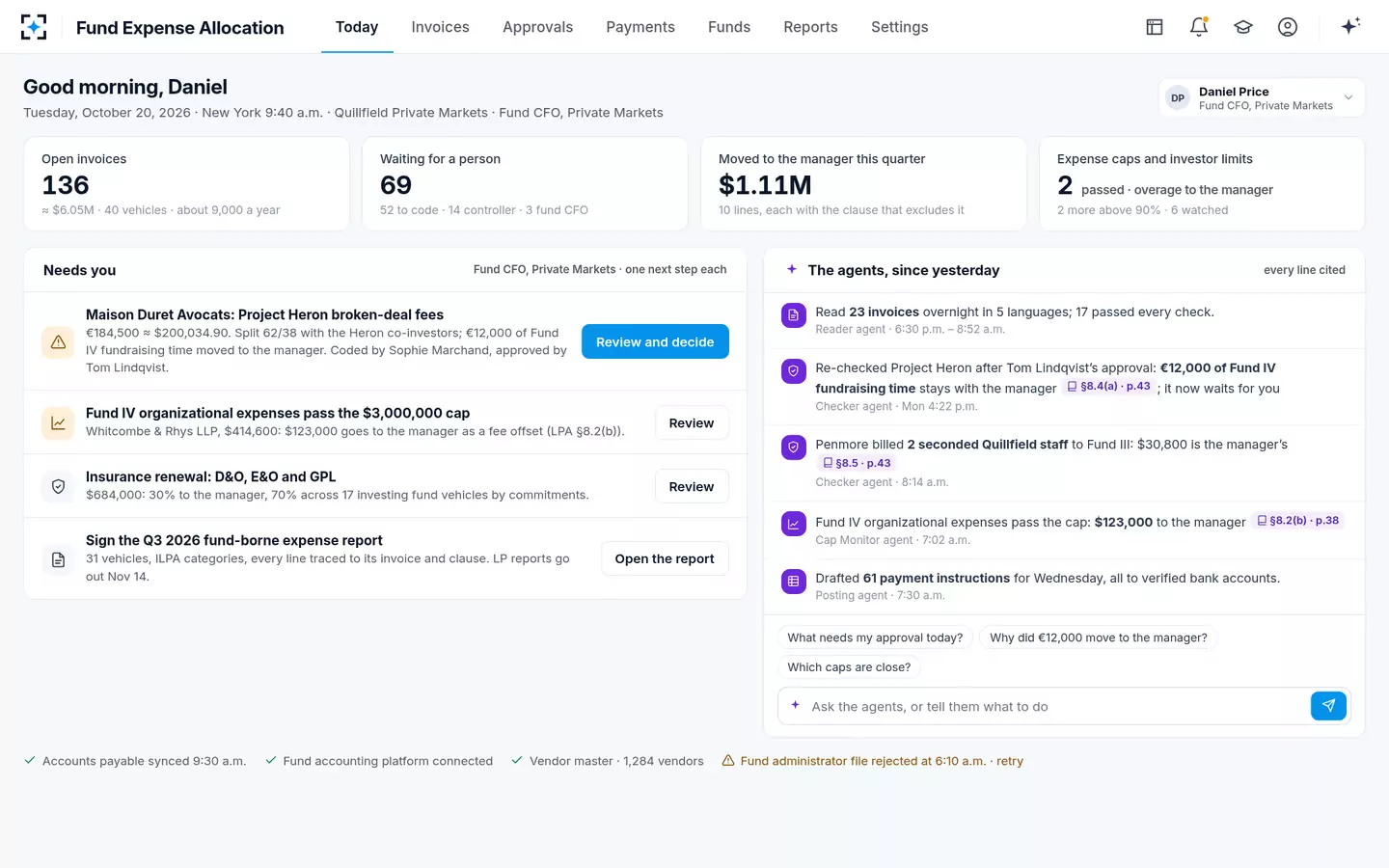
The cost is dominated by the hard invoices, not the many easy ones. Take the sample firm's scale, about 9,000 invoices a year across 40 vehicles, and suppose 60% are single-fund bills, 30% multi-vehicle deal or shared-service bills, and 10% hit a cap, a side-letter limit or a policy question. At the illustrative unit costs above, that is about $2.96 million a year of finance and compliance time, and the hardest tenth of invoices accounts for over a third of it.
The hard invoices are a tenth of the count and a third of the cost
Share of invoices
- Single-fund · 60%
- Multi-vehicle · 30%
- Caps and limits · 10%
Share of cost
- Single-fund · 16.2%
- Multi-vehicle · 48.5%
- Caps and limits · 35.3%
That shape decides what to buy. A tool that captures invoices faster saves minutes on the 60% that were already cheap. The money is in the multi-vehicle and exception invoices, where the time goes to finding the clause, the deal's investor list and the cap position. Botminds' own estimate for one multi-vehicle invoice at a 40-vehicle manager puts deciding what each line is under the fund documents at a day and a half of elapsed business days by hand, against a fifth of a day with the agents; that is an estimate for planning, not a measured result.
What does a misallocated expense cost?
Far more than the time to process it. When an allocation error is found, the firm rebuilds the affected periods, repays the funds, usually with interest, and, if the SEC found it, pays a penalty and lives with a public order. The table below shows what the SEC's expense allocation orders cost the firms involved; every one of them also found a missing or inadequate written policy.
What expense misallocation cost in SEC orders
| Case and year | What was misallocated | Repaid to funds | Penalty |
|---|---|---|---|
| KKR, 2015 | Broken-deal costs not shared with co-investors | $18.68M disgorgement and interest | $10M |
| Energy Capital Partners, 2022 | Bridge-loan fees above the fund’s ownership share | $3.318M plus interest | $1M |
| Rialto, 2020 | In-house service costs owed by co-investment vehicles | About $3M, fully remediated | $350,000 |
| Platinum Equity, 2017 | Co-investors’ share of broken-deal costs | $1.90M disgorgement and interest | $1.5M |
| NB Alternatives, 2018 | Staff time unrelated to the service the funds paid for | $2.36M disgorgement and interest | $375,000 |
Two lessons for a business case. First, the penalty is often smaller than the repayment; the expensive part is the money that should never have left the fund. Second, an error rate cannot be guessed. The only way to put a number in the expected-error term is to replay a closed year of your own invoices and count what moved.
What does private equity accounting software cost against the in-house unit?
Divide any annual quote by your invoice volume and compare it with your unit cost, term by term. A quote of a given annual amount for 9,000 invoices is that amount divided by 9,000 per invoice; set it against the preparation and rework minutes it removes, at your loaded rate, plus whatever it does to the expected-error term. A tool that removes preparation time but leaves allocation to your team saves less on exactly the invoices that cost most.
Count what stays. Approvals should not shrink much: they are where judgment and accountability sit, and the sample firm keeps the controller on every invoice and the CFO above $50,000. Compliance time moves rather than disappears, from answering examiners late to approving policy and fund terms early. And implementation is real cost: reading the LPAs, side letters and co-investment agreements into rules someone approves, connecting the fund accounting platform and the administrator's files, and replaying a quarter before go-live.
The workload a unit cost is multiplied by, on Fund Expense Allocation's home screen
Three mistakes in comparing software prices
The first mistake is comparing a quote with a salary. A tool's annual price set against one accountant's wage ignores the loading on that wage, the controller's and CFO's time that the tool may or may not save, and the error term. Compare total cost per allocated invoice, at the same loaded rates, for every option, including doing nothing.
The second is counting minutes saved on easy invoices. Capture and coding speed show well in a demo, and they matter on the 60% of single-fund bills in the illustration above, but those were already the cheapest invoices. Ask instead what the tool does to the two hours of a multi-vehicle bill and the hours of an invoice that crosses a cap: whether it finds the clause, builds the split on the written basis, and shows its evidence, or hands those steps back to your team.
The third is leaving out the examination. An examiner's request for every expense allocated to a fund and its co-investment vehicles over two years, with the basis, is a predictable cost for a registered adviser, and the SEC's Division of Examinations lists the accuracy of fee and expense calculations, at fund and at investment level, among its fiscal 2027 priorities for private fund advisers (SEC, October 23, 2026). A tool that produces that evidence file in a day changes the cost of every future examination; one that does not leaves it at weeks of rebuilding.
Questions to ask providers about price
Ask questions whose answers can be compared, and ask for them in writing. The aim is to turn each proposal into a cost per allocated invoice, with the same scope behind it.
Pricing questions for private equity accounting software providers
- What is the pricing unit, and what triggers the next tier?
Per fund, per vehicle, per user, per invoice or a share of assets; and what happens when you launch a fund or add a co-investment vehicle.
- Which steps of the invoice does it do, and which does your team?
Capture, chargeability against the LPA, allocation, independent re-check, caps, evidence. Price only what it does.
- Does it read your fund documents, or do you configure them?
Someone must turn LPAs and side letters into rules; ask who, how long, and who approves the result.
- What does implementation cost, and what does it include?
Document reading, connections to the fund accounting platform and administrator, a replay of a closed period.
- Which languages and scanned documents does it handle at no extra cost?
A foreign-language bill is an exception in one tool and routine in another.
- What does it cost to produce an examiner’s evidence file?
Every allocation for a fund and its related vehicles over a period, with basis, clause, policy version and approvers.
- Can we test it on our own closed invoices before we sign?
A replay on your files is the only accuracy figure worth paying for.
- What does leaving cost?
Exporting every allocation, its evidence and the audit trail in a form your next system can read.
Where Fund Expense Allocation fits, and where it does not
It fits where the expensive invoices are: managers with parallel funds, co-investment and employee vehicles, caps and side-letter limits, and bills in several languages. There, the agents do the preparation work, reading, classifying with the clause, splitting on the written basis, re-performing the split and watching caps, so people spend their time approving with the evidence in front of them. The sample firm's targets are every invoice line tested against the LPA and side letters before a fund bears it, and coding within one day of receipt inside a two-business-day service level.
It does not replace the fund accounting platform, the fund administrator or the payables system; it works beside them and posts only after final approval. It does not set policy; the Chief Compliance Officer approves the policy and every fund term before an agent uses them. And for a manager with a single fund and no co-investors, most invoices are single-vehicle bills, where the allocation saving is small and the case rests on reading, evidence and control instead.
What the unit buys: every fund-borne dollar traced, and the manager's share shown
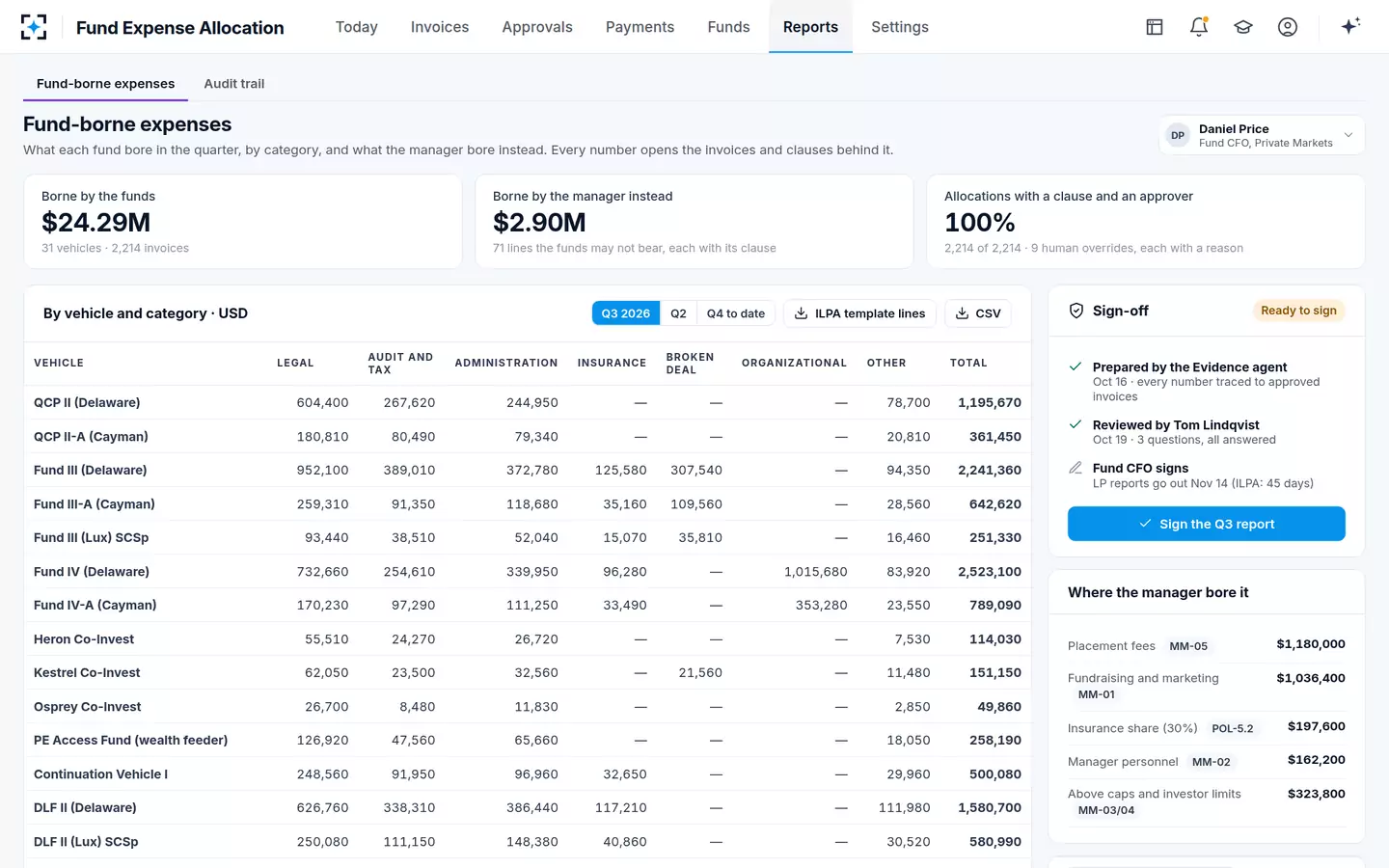
A business case that survives the CFO's questions has three numbers from your own books: invoices a year by difficulty, minutes per invoice by step, and the error rate from a replay. One invoice through the agents, step by step shows what the preparation work looks like, and Fund Expense Allocation is where to start with your own invoices.
Questions people ask
How much does private equity accounting software cost?
Vendors don't publish prices, and no regulator or independent study publishes a price survey, so any single figure is a guess. Ask each provider for a written quote on the same scope, divide it by your annual invoice volume, and compare it with your own cost per allocated invoice.
What does a fund accountant cost per hour?
The SEC's own burden estimates use $266 an hour for a senior accountant, adjusted for bonuses, benefits and overhead on an 1,800-hour year. The Bureau of Labor Statistics reports a May 2025 median wage of $93,290 for accountants and auditors in finance and insurance, about $45 an hour before any loading.
Who are the providers of private equity accounting software?
They fall into groups by job: fund accounting and investor-reporting platforms, accounts payable and invoice capture tools, fund administrators that bundle software with service, and tools that allocate expenses against the fund documents. Compare them on the steps of the invoice each one actually does, not on the category name.
Is it cheaper to outsource expense allocation to the administrator?
It can be cheaper per invoice, but the decision about who bears an expense stays with the manager, whose fiduciary duty and compliance programme the SEC examines. Price the oversight you will still need: reviewing the administrator's allocations against the LPA, and keeping the evidence an examiner will ask for.
How do you compare private equity software prices fairly?
Fix the scope, fix the volume and convert every quote to a cost per allocated invoice, including implementation spread over the contract term. Then add your remaining in-house minutes per invoice at the same loaded rate for every option, and an error term from a replay of your own closed invoices.