A private equity fund expense ratio is not something a private fund is required to publish. Registered mutual funds report expense ratios; private funds report expenses in their audited financial statements and in whatever investor reports their LPAs and side letters require, and the SEC's 2023 attempt to standardise quarterly expense reporting was vacated by a federal court in 2024. An LP or a fund CFO can still compute the ratio that matters: partnership expenses, excluding the management fee and carried interest, as a share of commitments for a fund in its investment period and as a share of NAV later, measured over the fund's life rather than one year. Botminds' Fund Expense Allocation keeps the numbers behind such a ratio honest: every fund-borne expense is traced to its invoice, clause and approver, so the numerator is a count of what the fund was entitled to bear, not just what it paid.
The figures below come from SEC releases and statistics and from a fictional sample manager, Quillfield Capital, whose quarter runs through the solution.
Where one sample vehicle's quarterly expenses went, by category
Fund III (Delaware), Q3 2026
- Legal · 42.5%
- Audit and tax · 17.4%
- Administration · 16.6%
- Broken deal · 13.7%
- Insurance and other · 9.8%
Is there a private equity fund expense ratio?
There is no required one, and no regulator or independent study publishes expense ratios across private equity funds. Registered funds are different: they disclose expense ratios under SEC forms, and the SEC itself drew the contrast, noting that "certain kinds of expense ratios are required in the registered funds context" while "fees and expenses are more likely to vary over time in the private fund space" (88 FR 63206, September 14, 2023).
What a private fund does produce is the raw material. Its audited financial statements show expenses by category, its capital account statements show each investor's share, and its LPA, side letters and investor reports may require more. An LP who wants a ratio has to build it, which means deciding what goes in the numerator, what goes in the denominator, and over what period.
The market this question covers is large. At the end of 2025 the SEC counted 58,891 private funds reporting on Form PF or Form ADV, of which 27,682 were private equity funds, with private equity net assets of $8,523 billion (SEC, Private Fund Statistics, fourth quarter 2025).
The private funds without a standard expense ratio
58,891
private funds reported to the SEC, Q4 2025
27,682
of them private equity funds
$8.5T
private equity funds’ net asset value
Why the SEC declined to require one
The SEC considered requiring an expense ratio when it wrote its 2023 quarterly statement rule for private fund advisers, and chose not to. Its reasons are the best short guide to what a private fund ratio can and cannot tell an investor. First, a ratio can hide the very problem investors most need to see: "if an adviser is misallocating certain smaller expenses, an expense ratio may obscure this practice if overall changes to the top-line cost figure are not obvious." Second, it "may fail to capture some of the nuances of private fund fee and expense structures, such as with respect to the current and future impact of offsets, rebates and waivers" (88 FR 63206).
If investors receive this information reliably, they will be better able to calculate their own applicable expense ratios.
SEC, Private Fund Advisers adopting release, 88 FR 63206 (September 14, 2023)
The SEC's answer was detail instead of a ratio: a table each quarter with every category of fund expense on its own line. That rule no longer exists. The Fifth Circuit held that the Commission lacked authority to adopt it and vacated the rules on June 5, 2024 (Nat'l Ass'n of Private Fund Managers v. SEC, No. 23-60471, 5th Cir. June 5, 2024), and the SEC removed the rule text from the Code of Federal Regulations on November 19, 2024 (89 FR 91252). The reasoning about ratios survives as the regulator's view; the duty to report in that format does not.
What are private equity fund expenses?
Fund expenses are the costs the partnership itself bears under its LPA, as distinct from what it pays the manager. The vacated rule's list is a good inventory: it would have required "separate line items for each category of fee or expense", "including, but not limited to, organizational, accounting, legal, administration, audit, tax, due diligence, and travel fees and expenses" (88 FR 63206). Broken-deal costs, insurance and the annual meeting are common additions, and the SEC's 2020 risk alert lists broken-deal, due diligence, annual meeting, consultants and insurance as costs examiners found shared incorrectly (SEC OCIE, 2020).
The rule also said what would not do: "a general reference to ``fund expenses'' on the quarterly statement will not satisfy the rule's detailed accounting requirement" if the fund paid, say, insurance premiums, administrator expenses and audit fees. An LP building a ratio should ask for the same granularity, because a single "partnership expenses" line cannot be checked against the LPA.
Are management fees an operating expense of the fund?
In a fund's statement of operations the management fee usually sits among the expenses, but for measuring expenses it belongs in a separate bucket. The SEC's 2023 table split the two: "adviser compensation", meaning "all compensation, fees, and other amounts allocated or paid to the adviser or any of its related persons by the private fund", including management fees and performance-based compensation, and "fund expenses", meaning all other fees and expenses the fund paid (88 FR 63206).
Keeping them apart matters for two reasons. The management fee is set by formula and can be checked against the LPA; fund expenses are decided invoice by invoice and are where misallocation hides. And offsets connect them: a placement fee or excess organizational expense the fund advanced should reduce the management fee, so a placement fee advanced and offset appears on both sides of the ratio until the offset is taken.
Three ratios an LP can compute
Compute three, because each answers a different question. The first, fund expenses as a share of commitments, compares funds in their investment period, when NAV is small and still building. The second, fund expenses as a share of average NAV, compares funds that are mostly invested. The third, cumulative fund expenses as a share of commitments since inception, is the only one that is fair across a fund's whole life.
Three private fund expense ratios, and what goes into each
Annual expenses to commitments
fund expenses for the year ÷ total commitments
Best in the investment period. Excludes management fee and carry.
LP or fund CFO
Annual expenses to NAV
fund expenses for the year ÷ average NAV
Best once the fund is mostly invested; moves with valuations.
LP or fund CFO
Life-to-date expenses to commitments
cumulative fund expenses ÷ total commitments
Fair across the fund’s life; compare funds of the same age.
LP or fund CFO
Manager-borne adjustments
− offsets taken, − amounts the manager reimbursed
Expenses the fund advanced but the manager bore should not count against the fund.
Fund CFO
Two adjustments make the ratio honest. Remove anything the fund advanced but the manager bore by offset or reimbursement, or the fund looks more expensive than it is. And add anything that should have been the fund's but was charged elsewhere, which an LP cannot see without the allocation detail. The second is why a ratio alone cannot prove expenses were right; only the allocations behind it can.
Why one year's ratio misleads
Because private fund expenses follow the fund's life cycle. The SEC put it directly: "a private equity fund may incur a disproportionate amount of expenses early in its life when it is making the majority of its investments and incur fewer expenses during the middle part of its life when it is focused on holding these investments. The use of an expense ratio in these periods may overstate or understate, respectively, the expense burdens over the life of the fund" (88 FR 63206). Formation costs, diligence and broken deals bunch in the first years; audit, tax and administration run steadily; legal costs return at exits and extensions.
An illustrative fund: annual expenses as a share of commitments, year by year
So compare like with like: funds of the same vintage year and age, and life-to-date figures where possible. A young fund with a high annual ratio may be normal; an old fund whose ratio rises without exits or an extension is worth a question.
What the vacated quarterly statement rule would have shown
It would have given each investor, every quarter, a table of adviser compensation and fund expenses by category, "presented both before and after the application of any offsets, rebates, or waivers", with cross-references to the sections of the fund documents that set the calculation methods. That is still a good specification for what an LP should ask for in a side letter or a reporting request, and for what a fund CFO should be able to produce whether or not anyone asks.
It would not have shown how a shared cost was split between the fund and its co-investors, parallel vehicles or the manager. The SEC acknowledged that investors "are unable to compare amounts borne by their fund with amounts borne by the adviser's other clients" to assess whether joint costs were allocated consistently with the fund's terms. That gap is where the SEC's expense cases sit, and where a ratio is silent. The expense allocation policy is what decides it.
Measuring fund expenses with Fund Expense Allocation
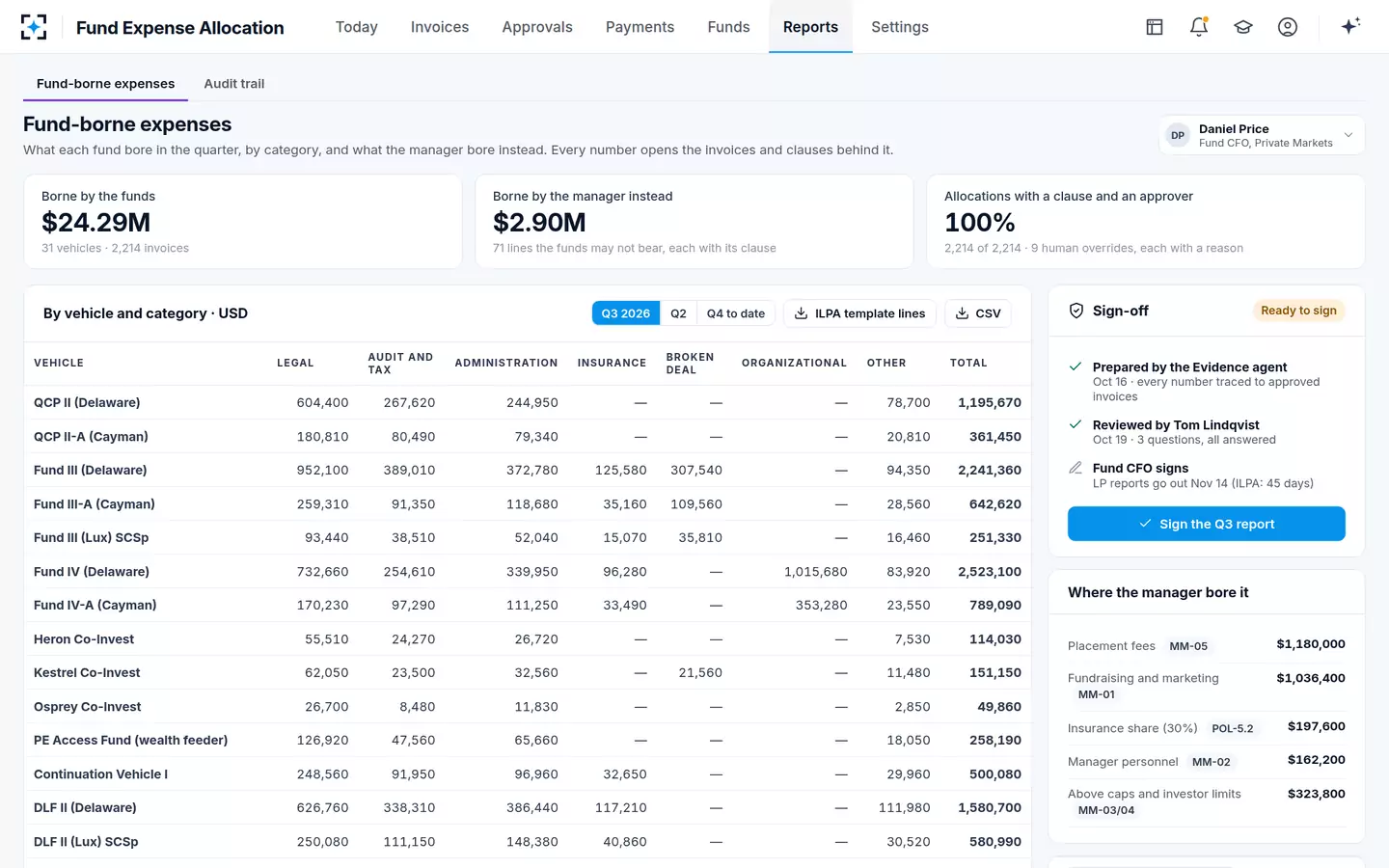
Fund Expense Allocation produces the quarterly fund-borne expense report by vehicle and category, with every number traced to approved invoices, and shows on the same page what the manager bore instead and why. On the sample firm's third quarter that was $24.29 million borne by 31 vehicles across 2,214 invoices, $2.90 million borne by the manager instead on 71 lines, and every allocation carrying a clause and an approver. The fund CFO signs the report after the controller has reviewed it.
Fund-borne expenses by vehicle and category, and what the manager bore instead
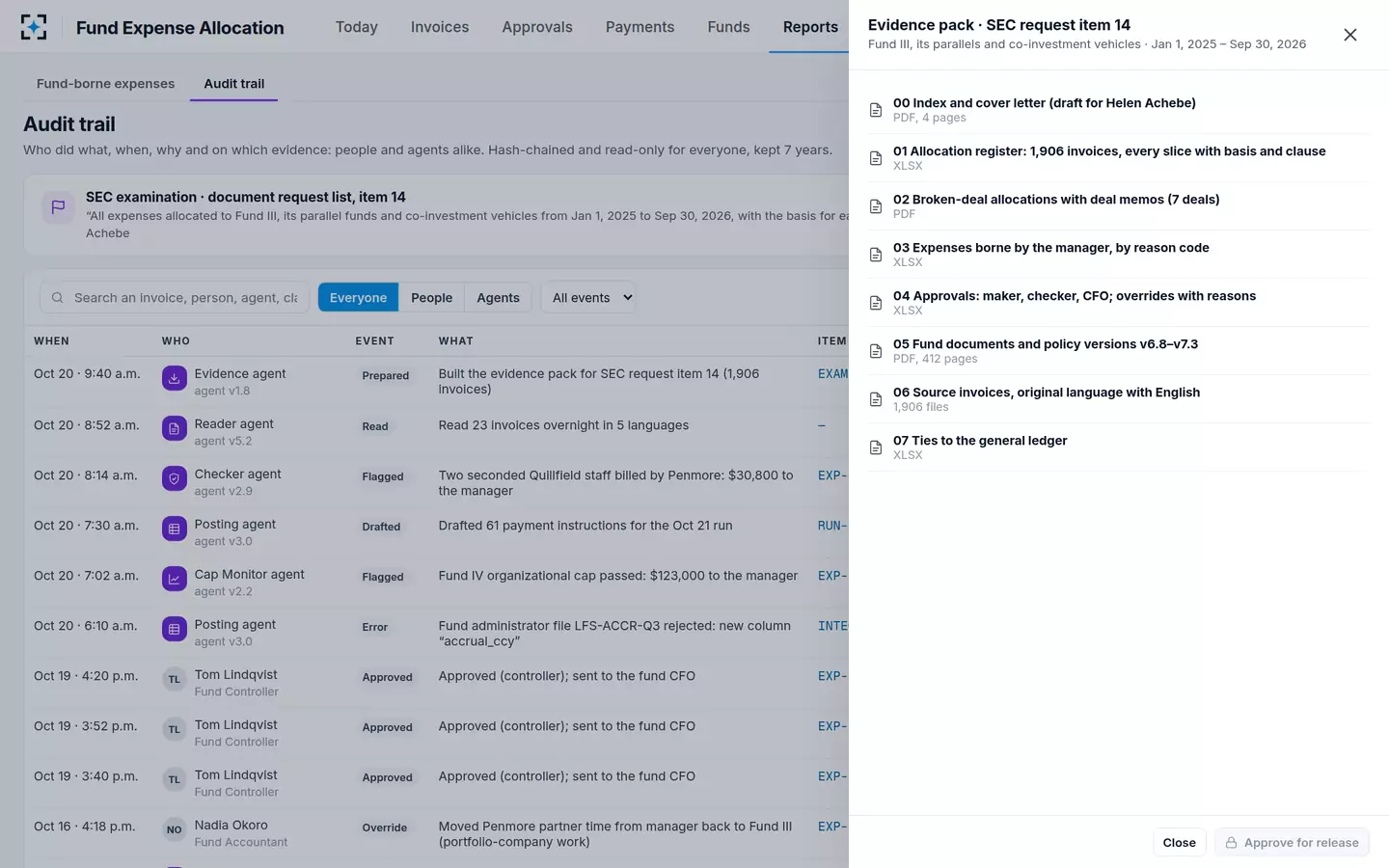
For an examiner or an LP's auditor, the Evidence agent assembles every allocation for a fund and its related vehicles over a period, with its basis, clause, policy version, approvals and source invoice, tied to the general ledger; the Chief Compliance Officer reviews it before anything leaves the firm. The sample firm's file for one SEC document request covered 21 months and 1,906 invoices.
The evidence file behind the numbers, for an SEC document request
What an LP should ask for to compute a fund's expense ratio
- Fund expenses by category, each quarter
Separate lines for legal, audit, tax, administration, insurance, broken deal, organizational and others, not one total.
- Adviser compensation on its own table
Management fees and carried interest kept apart from fund expenses.
- Offsets, rebates and waivers, before and after
Including advances the manager still owes the fund.
- Cumulative figures since inception
So the ratio can be compared across funds of different ages.
- Cap positions
Organizational and annual caps, with amounts borne by the manager above them.
- The allocation basis for shared costs
How costs shared with co-investors, parallels and the manager were split, with the clause.
- Anything borne by the manager instead
With the reason, so excluded costs can be checked against the LPA.
Questions people ask
What share of commitments goes to fund expenses?
No regulator or independent study publishes the figure across private equity funds, and it varies with the fund's age, size and strategy. Compute it yourself from the audited statements: fund expenses, excluding management fees and carry, divided by commitments, both for each year and cumulatively since inception.
What is the private equity fund fee structure?
Three layers: a management fee paid to the manager, carried interest paid to the general partner out of profits, and fund expenses the partnership bears under its LPA. The SEC's 2023 table treated the first two as adviser compensation and the third as fund expenses, and the clearest reporting keeps them on separate lines.
Why is there no expense ratio for private equity?
No rule requires one, and when the SEC considered it in 2023 it declined, saying a ratio could obscure misallocated smaller expenses, miss the effect of offsets and waivers, and overstate or understate expenses depending on the fund's stage. It required a detailed expense table instead, and that rule was vacated in June 2024.
Should offsets be counted in a fund's expense ratio?
Count the gross expense and the offset separately, then use the net figure in the ratio. An expense the fund advanced and recovered through a management fee offset was borne by the manager; one still waiting for its offset is a balance the manager owes. The SEC's 2023 table would have shown fund expenses before and after offsets, rebates and waivers for exactly this reason.
How do you calculate a private fund expense ratio?
Take partnership expenses other than management fees and carried interest, remove amounts the manager bore by offset or reimbursement, and divide by commitments during the investment period or by average NAV later. Track the cumulative figure since inception, and compare funds only with others of the same vintage and age.