An organizational expense cap in private equity is the maximum amount of formation costs the LPA lets the fund bear: legal work on the partnership agreement and side letters, filing fees, the accounting to set the fund up. Costs above the cap belong to the manager, which typically pays them by a dollar-for-dollar cut in its management fee. The cap is simple; what counts toward it is not, because the LPA defines organizational expenses in its own words, and formation bills arrive for months after the first close, mixed with placement agent invoices, later-close side letters and deal costs. Botminds' Fund Expense Allocation tracks each cap as a running total by close and category, tests every line against the LPA's definition, and moves any overage to the manager with the clause.
The examples below come from a fictional sample manager, Quillfield Capital, as its fourth fund runs through the solution.
The sample Fund IV cap, before and after one formation bill
What is an organizational expense cap in private equity?
It is a ceiling in the LPA on the organizational expenses the partnership bears, written in the cases and sample on this page as a fixed dollar amount, and for the sample fund covering its parallel vehicles together. Above it, the manager pays. In the 2023 release adopting private fund rules that a court later vacated, the SEC described the arrangement plainly: "some private fund governing documents limit organizational expenses and provide that any amount of organizational expenses paid by the fund above the expense cap may be offset against the adviser's management fee" (88 FR 63206, September 14, 2023).
The cap protects investors from a manager who would otherwise fund its own fundraising out of their capital. It is also a contractual limit of exactly the kind the SEC's examiners test. Their June 2020 risk alert listed advisers that "failed to comply with contractual limits on certain expenses that could be charged to investors, such as legal fees or placement agent fees, thereby causing investors to overpay expenses" (SEC OCIE, June 23, 2020).
Three features of a cap clause decide how hard it is to apply. Is it one cap for the whole fund family or one per vehicle? Is it a lifetime cap or per close? And does it say what happens to costs incurred after the final close, such as side letters negotiated with a late investor? The sample Fund IV cap is lifetime and covers all Fund IV vehicles, which means a bill for a Cayman vehicle's documents counts against the same $3,000,000 as a bill for the Delaware partnership.
What are organizational expenses? The tax definition and the LPA's
For tax, organizational expenses are costs incident to creating the partnership, chargeable to capital and of a kind that would be amortized over its life. The Treasury regulation gives examples: "Legal fees for services incident to the organization of the partnership, such as negotiation and preparation of a partnership agreement; accounting fees for services incident to the organization of the partnership; and filing fees" (26 CFR 1.709-2(a)).
The same regulation lists what is not, "regardless of how the partnership characterizes them": costs of acquiring assets, "expenses connected with the admission or removal of partners other than at the time the partnership is first organized", contracts for running the business, and syndication expenses. Syndication expenses are "expenses connected with the issuing and marketing of interests in the partnership", among them "brokerage fees; registration fees; legal fees of the underwriter or placement agent and the issuer ... for securities advice" and printing the placement memorandum (26 CFR 1.709-2(b)).
The LPA's definition is the one that governs the cap, and it can be wider or narrower. Corinthian's LPA, below, carved placement fees out of it. The sample Fund IV LPA brings "side letter negotiation and the MFN process" inside its cap, though for tax the costs of admitting partners after the first organization are not organizational expenses at all. The accountant needs both definitions and must not confuse them.
Four kinds of formation-season cost, and where each lands for tax and for the cap
Organizational
Legal fees for negotiating and drafting the partnership agreement; accounting fees for organizing the partnership; filing fees.
For taxUp to $5,000 deductible in the first year, the rest over 180 months.
Against the capInside the cap wherever the LPA defines organizational expenses to include formation work, as the sample Fund IV LPA does.
Syndication
Placement agent and brokerage fees; registration fees; securities and tax-disclosure advice on the placement memorandum; printing and marketing the offering.
For taxCapitalised. Never deducted or amortised.
Against the capDepends on the LPA: Corinthian’s excluded placement fees from organizational expenses; other offering costs follow the definition.
Later admissions
Admitting or removing partners after the partnership is first organized, including later closes.
For taxNot organizational expenses under the regulation.
Against the capInside the cap only if the LPA says so, as the sample Fund IV LPA does for side letters and the MFN process.
Operating
Acquiring assets, deal costs, contracts for running the business.
For taxNot organizational expenses; treated under the ordinary rules.
Against the capOutside an organizational cap; tested under the fund-expense or deal-cost clause instead.
Is a placement fee an organizational expense?
Not for tax, and often not under the LPA either. The regulation treats placement agent and brokerage fees as syndication expenses, which fall outside the organizational-expense election and must be capitalized. The sample firm's LPAs go further and make placement fees the manager's cost, letting the fund advance them only against a full offset of the management fee. Who bears placement agent fees, and how the offset works follows that path invoice by invoice.
The distinction is where the SEC's organizational-expense case turned. Corinthian Capital's second fund, with about $130 million of commitments, was responsible for "up to $1.5 million in organizational expenses"; the LPA's definition "specifically excluded placement fees". The firm "charged the limited partners for placement fees despite the fact that the LPA specifically excluded them from organizational expenses" (SEC IA-5229, May 6, 2019).
Corinthian: a $1.5 million cap, charged on estimates
Corinthian's order shows how a cap is breached without anyone deciding to breach it. The firm's practice had been to call capital for organizational expenses "based on estimated and actual organizational expenses", and it moved money from the fund to itself "based on estimates before the expenses were actually incurred". A new CFO continued the practice, transferring amounts based on "the prior year's audited financial statements and estimated future charges". Add the misclassified placement fees, and in 2014 the limited partners "overpaid $588,394 in organizational expenses" (SEC IA-5229).
The auditor found it. It identified the transfers and the misclassification in 2015, withdrew from the engagement, and withdrew its unqualified opinion on the fund's 2013 statements because of the misclassified expenses. Corinthian reimbursed the fund in full with interest by year-end 2015. The order fined the firm $100,000, its chief executive $25,000 for failing to supervise, and its CFO $15,000.
One organizational-expense case, in the SEC's figures
$1.5M
cap on organizational expenses in the LPA, placement fees excluded
$588,394
overpaid by limited partners in 2014
3
people fined: the firm, its CEO and its CFO
Three controls would have stopped each part of it: charge the fund only for invoices actually received, never estimates; classify every line against the LPA's definition before it counts; and keep the running total where the people approving the next bill can see it.
Who pays formation costs above the cap?
The manager pays everything above the cap. The LPA says how: in the arrangement the SEC described, the fund pays the invoice and the management fee is offset by the excess; in others the manager pays the vendor directly. Either way the fund's books must show the gross cost, the amount over the cap and the offset, so that investors can see the cap was honoured. The vacated quarterly statement rule would have required advisers to show "any placement agent fees or excess organizational expenses before and after any management fee offset" (88 FR 63206). The rule is gone; the bookkeeping it describes is still the clearest way to prove a cap was honoured.
The overage is calculated on the invoice that crosses the line, not averaged across the year. In the sample fund, $291,600 of the $414,600 bill fits under the cap and $123,000 does not. The $123,000 goes to the manager, and the Cap Monitor agent drafts the note to the advisory committee; the management fee arithmetic itself belongs to the fee calculation, not the expense desk.
Fund Expense Allocation's caps screen: the clause, the running total and the overage
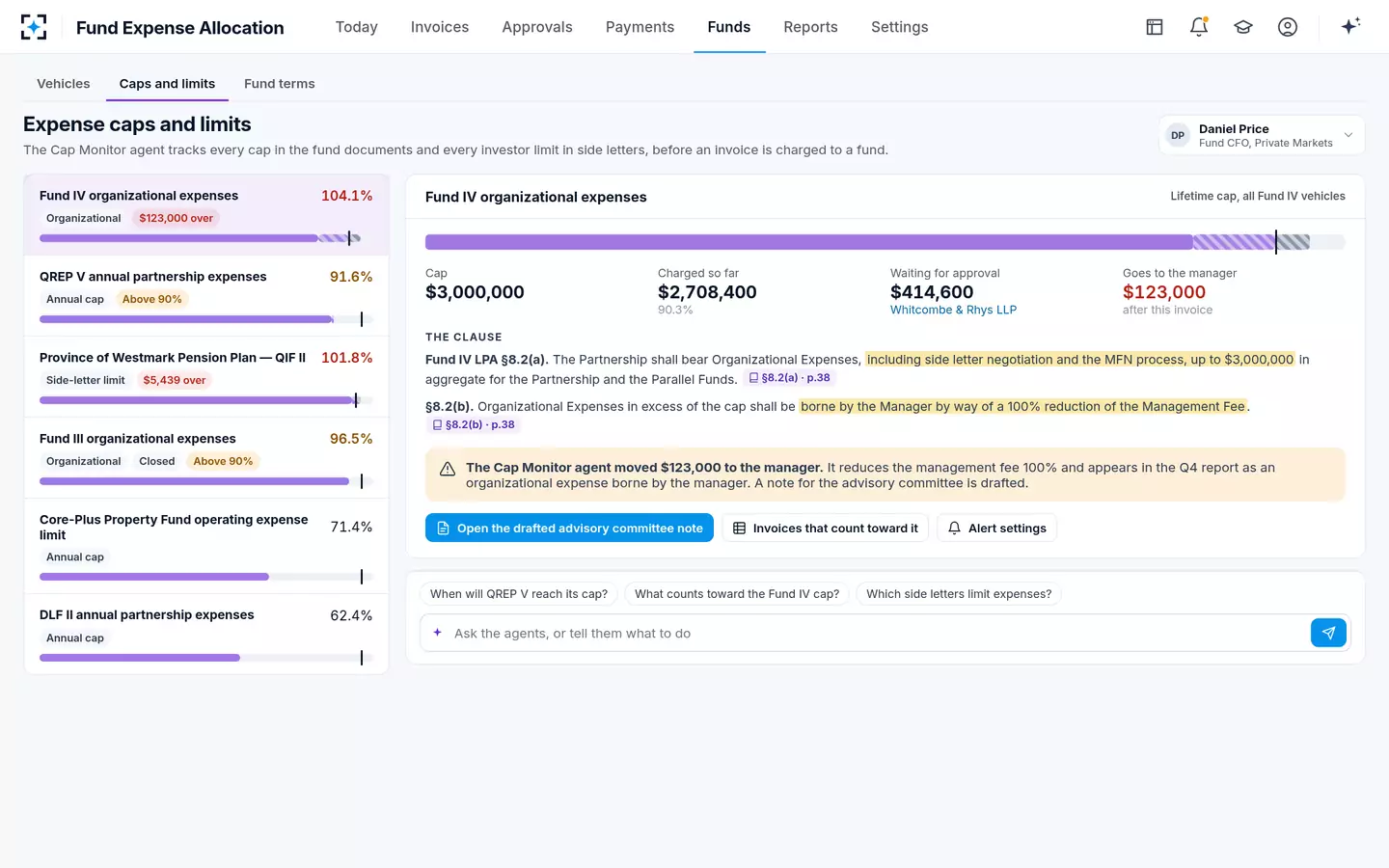
How to track an organizational expense cap: a running total by close and category
Track the cap the way an auditor will test it: invoice by invoice, from the first formation bill, with each line classified against the LPA's definition and dated to the close it served. A single spreadsheet total cannot answer the questions that matter later. Which costs were the second close's side letters? Which were placement fees the LPA excludes? How much was estimated rather than billed? Which vehicle paid?
The columns a cap tracker needs, and the question each answers
| Column | Why it is there |
|---|---|
| Invoice and line | The cap is tested line by line; one law-firm bill can mix formation work, a later-close side letter and fundraising time. |
| Classification under the LPA | Organizational, offering, placement, operating or manager: the LPA’s words, not the tax code’s. |
| Clause and page | So a reviewer can check the classification without re-reading the agreement. |
| Close served | First close, later closes, MFN process: some LPAs treat them differently, and the tax rules do. |
| Vehicle that paid | For a family-wide cap, every parallel and feeder counts against one number. |
| Billed or estimated | Only billed amounts count. Corinthian charged on estimates. |
| Running total and % of cap | Warn before the cap, not after: the sample firm warns the controller at 90% and the CFO and CCO at 100%. |
| Overage and offset period | The amount over the cap, and the management-fee period that absorbs it. |
Warnings matter more than the total. A cap that is 90% used with formation bills still due for a later close is a problem in waiting: the next law-firm invoice will cross it. The sample firm's Fund III cap closed at 96.5%, which is how a cap should end: close to the limit, never over it unseen.
Organizational expenses for tax: $5,000, $50,000 and 180 months
The tax treatment is separate from the cap, and it often trips up fund controllers because the numbers are small and fixed. A partnership may deduct, in the year it begins business, "the lesser of the amount of the organizational expenses of the partnership, or $5,000 (reduced (but not below zero) by the amount by which the organizational expenses exceed $50,000)"; "the remainder of the organizational expenses is deductible ratably over the 180-month period beginning with the month in which the partnership begins business" (26 CFR 1.709-1(b)).
Once organizational expenses pass $55,000, as the sample fund's $3,000,000 cap shows they easily can, the immediate $5,000 deduction is gone and everything is amortized. The regulation's own example uses $450,000: the partnership deducts $15,000 for the six months it is in business in its first year and amortizes the remaining $435,000 over the next 174 months. Syndication expenses get nothing, not even on liquidation.
The classification therefore has to be made twice and kept apart. A side-letter negotiation at the third close may count toward the cap under the LPA and still be a cost of admitting partners, not an organizational expense, for tax. A fund whose cap tracker and tax workpapers share one column will get one of them wrong.
How Fund Expense Allocation watches the cap
In Fund Expense Allocation, the Chargeability agent classifies each line of a formation-season invoice against the LPA's definition and cites the clause; on the sample bill, the side-letter work at the second close counted because the sample LPA's cap clause names it. The Cap Monitor agent keeps each organizational cap per close, each annual expense cap and each investor's side-letter limit, projects them to year end and warns at 90%. When an invoice would pass a cap, it moves the overage to the manager with the clause and drafts the advisory committee note.
People keep the decisions. The fund accountant codes the invoice; the controller approves; the fund CFO approves above $50,000 and is told when a cap reaches 100%, together with the Chief Compliance Officer. A cap can never be passed without a person seeing it, and the quarter's report shows the overage as an organizational expense borne by the manager. The expense allocation policy sets out where the cap sits among the other questions every invoice must answer.
A cap checklist for the formation season
- Copy the LPA’s definition, word for word, into the tracker
And list what it excludes, such as placement fees or fundraising travel.
- Record whether the cap is per vehicle, per family, per close or lifetime
Then test every bill against the right number.
- Charge only billed amounts
An estimate is not an expense; Corinthian’s capital calls on estimates were part of what the SEC found.
- Split mixed bills line by line
Formation work, later-close side letters, placement advice and fundraising time often share an invoice.
- Warn at 90%
Before the last formation bills arrive, not after.
- Book the overage gross, with its offset period
Show the cost, the excess and the management-fee reduction that pays it.
- Keep a separate tax classification
Organizational, syndication and later-admission costs follow different tax rules from the LPA cap.
- Report the closing position to the advisory committee
Total, cap, overage and how it was borne, when the last close is done.
Questions people ask
What are organizational expenses?
For tax, they are costs incident to creating a partnership, such as legal fees for negotiating and preparing the partnership agreement, accounting fees for organizing it and filing fees. For a fund's cap, they are whatever the LPA defines, which is often wider. The LPA's definition governs who pays; the tax definition governs the deduction.
How big is a typical organizational expense cap?
No regulator or independent study publishes cap levels across funds, so any "typical" figure is anecdote. The only cap in the SEC orders read for this guide is Corinthian's $1.5 million on a fund of about $130 million. Benchmark your own cap against the formation bills you actually expect, by close.
Do side letters count toward the organizational expense cap?
Only if the LPA says so. Some caps include the legal cost of negotiating side letters and running the most-favoured-nation process, as the sample Fund IV LPA does. For tax, though, costs of admitting partners after the partnership was first organized are not organizational expenses, so the same bill can count toward the cap and be treated differently in the return.
Are fund formation costs deductible?
Partly, and slowly. Organizational expenses are deductible up to $5,000 in the first year, reduced dollar for dollar above $50,000, with the rest amortized over 180 months. Syndication costs, such as placement and brokerage fees and the offering's legal and printing costs, are capitalized and never deducted.
What happens if the fund pays more than the cap?
The excess is the manager's, and it must be returned or offset as the LPA says, usually by reducing the management fee. If nobody noticed, the correction runs back through every period affected, with interest if the investors are owed it. Corinthian reimbursed its fund in full with interest after its auditor found the overcharge, and still paid penalties.