Invoice processing using agentic AI means giving the work on each invoice to several software agents that each do one step, reading, classifying, splitting, checking, and hand the decisions to people. For an ordinary supplier invoice, the job ends when the vendor, date, lines and total are captured and matched to a purchase order. For a private fund it has barely started: someone still has to decide whether the fund documents allow a fund to bear each line, which funds and co-investors benefited, and on what basis the cost is split. Botminds' Fund Expense Allocation is an agentic solution built for that second half: seven agents read each vendor invoice in its own language, test every line against the LPA and side letters, split it across vehicles with the clause on every slice, and re-do the work independently, while the fund accountant codes it and the controller and CFO approve.
This guide follows one invoice from the AP mailbox to a signed allocation: a Paris law firm's bill for a deal that died, at a fictional sample manager, Quillfield Capital. Every figure about it is sample data from the solution.
Anatomy of one fund invoice: what each line is, who bears it, and the clause
1
Audit juridique (due diligence) de Valcourt Instruments SAS — 64,0 h
Amount€78,400.00
What it isBroken-deal cost · 98%
Who bears itFund III and Heron Co-Invest
ClauseLPA §8.3(b) · p.41
2
Négociation du contrat de cession d’actions — 52,5 h
Amount€61,250.00
What it isBroken-deal cost · 98%
Who bears itFund III and Heron Co-Invest
ClauseLPA §8.3(b) · p.41
3
Analyse réglementaire et contrôle des concentrations — 17,5 h
Amount€21,350.00
What it isBroken-deal cost · 97%
Who bears itFund III and Heron Co-Invest
ClauseLPA §8.3(b) · p.41
4
Échanges avec des investisseurs potentiels du Fonds IV au sujet de l’opération — 9,6 h
Amount€12,000.00
What it isFundraising for a successor fund · 95%
Who bears itThe manager
ClauseLPA §8.4(a) · p.43
5
Débours : salle de données, déplacements Lyon–Paris, traductions
Amount€11,500.00
What it isBroken-deal cost · 96%
Who bears itFund III and Heron Co-Invest
ClauseLPA §8.3(b) · p.41
What does invoice processing using agentic AI mean for a fund?
It means splitting the judgment on a fund invoice into steps small enough that each can be checked, and giving each step to an agent that cites its evidence or stops. One agent reads; one tests chargeability; one allocates; one re-does the allocation and argues the opposite case; one watches caps; one drafts entries and payments; one assembles evidence. None of them approves, posts an unapproved entry or releases a payment. The word that matters is not "AI" but "limited": each agent's permissions are narrower than the person whose work it prepares.
Regulators are watching this shift. The SEC's Division of Examinations, in its priorities for fiscal year 2027, uses its own term for these tools, noting that registrants are building what it calls "super intelligence (SI)" into more of their business, compliance monitoring and surveillance included (SEC, Examination Priorities FY2027, October 23, 2026). The same document puts the accuracy of private funds' fee and expense calculations on its examination list. A fund that hands expense work to agents has to be able to show both.
The Division is intensifying its efforts to understand how the technologies influence outcomes and whether firms continue to comply with existing, technology-neutral obligations.
SEC Division of Examinations, Examination Priorities, Fiscal Year 2027
Why a fund invoice is harder than a supplier invoice
A supplier invoice has one buyer. A fund invoice has a fund family behind it: Delaware, Cayman and Luxembourg vehicles, a co-investment vehicle, an employee fund and the manager, each a separate client with its own documents. The same law firm can bill all of them on one page, in French, with one line that belongs to none of them. The facts that decide the split are not on the invoice: the date the deal broke, the investors who would have joined it, the side letter that limits one investor's share.
What generic invoice AI captures, and what a fund invoice needs
Generic invoice AI: Vendor, number, date, lines and total, matched to a purchase order.
A fund invoice: The same, in the bill’s own language, with each value pointing to its place on the page, and the engagement letter matched.
Generic invoice AI: A general ledger account and a cost centre.
A fund invoice: A classification under the fund documents: allowed fund expense, broken-deal cost, live-deal cost, organizational expense or the manager’s, with the clause.
Generic invoice AI: Usually none, or a fixed percentage.
A fund invoice: Across parallels, co-investors and the manager on the basis the policy names, measured on the right date, tied to the cent.
Generic invoice AI: Duplicate and three-way match.
A fund invoice: Duplicate check, plus an independent re-allocation that argues the manager’s side, plus caps and side-letter limits.
Generic invoice AI: The image of the invoice.
A fund invoice: The invoice, the clause, the basis inputs, the policy version, the approvers and their reasons, ready for an examiner.
Step one: reading the bill in its own language
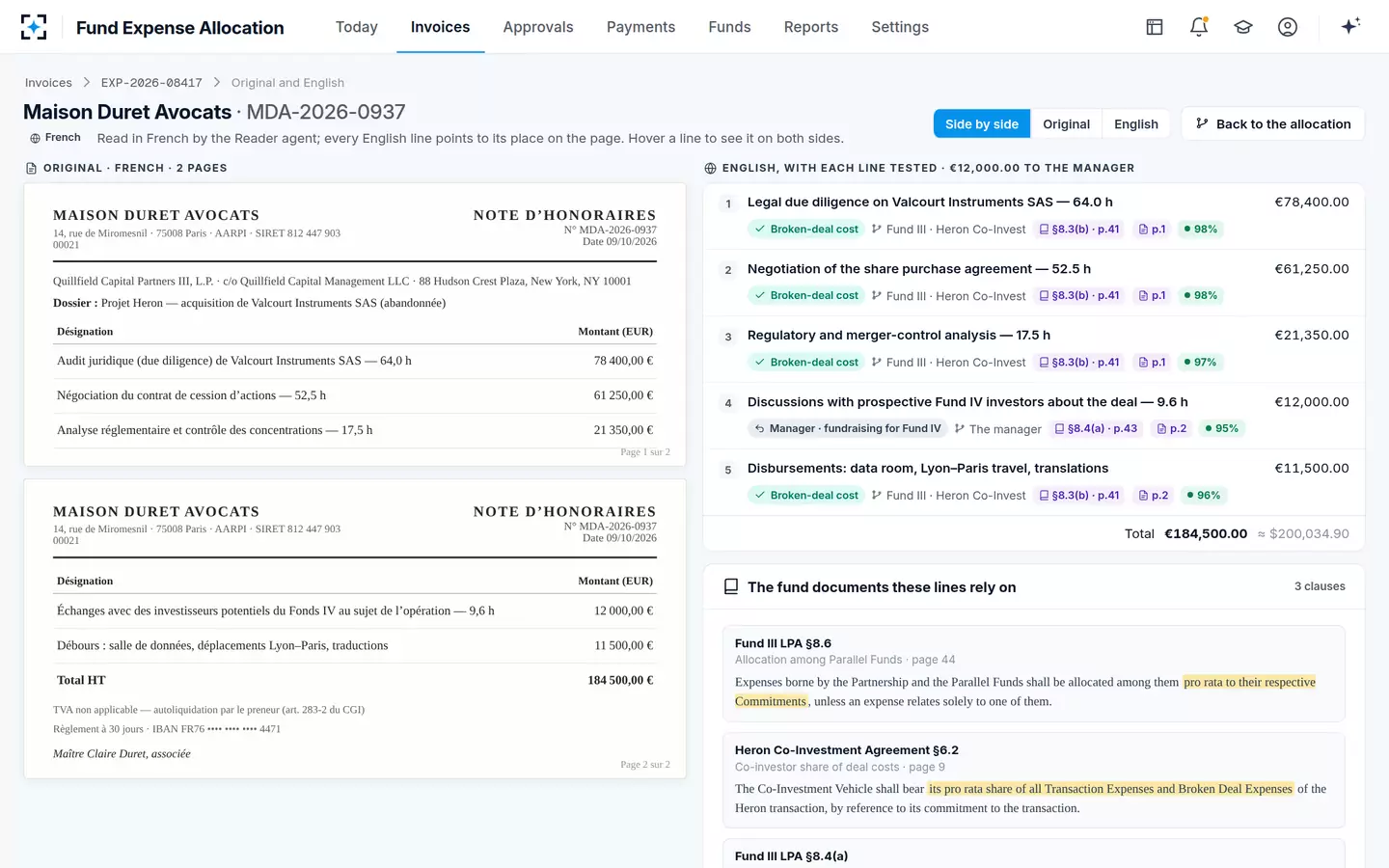
The Reader agent read the two-page note d'honoraires in French on October 12: five lines, €184,500.00 excluding VAT, with the VAT self-assessed by the buyer under the reverse charge. It matched the bill to engagement letter EL-2026-019 and confirmed it was not a duplicate by vendor, number and amount across seven years. Every English line points to its place on the original page, so the fund accountant, who reads French, can check the translation line by line instead of trusting it.
Two limits define this agent. It never fills a value it cannot read; it hands the invoice to a person, who types the value in on the audit trail. And it never takes bank details from an email. Amounts, dates and hours are copied from the page, not translated. That matters because language models can be fluent and wrong: ESMA has warned that text-generating AI tools can state things that are simply untrue in language that sounds accurate (ESMA public statement on AI in investment services, May 30, 2024). Citing each value to its place on the page turns a fluent answer into a checkable one.
The French original beside the English, each line tested, in Fund Expense Allocation
Step two: testing each line against the fund documents
Two minutes later the Chargeability agent tested every line. Lines 1, 2, 3 and 5, €172,500, were broken-deal costs: the investment committee memo recorded that exclusivity ended on September 18, and the LPA says the fund and the co-investors that committed bear such costs. Line 4 was 9.6 hours of "échanges avec des investisseurs potentiels du Fonds IV": talks with prospective investors in the next fund. Fundraising for a successor fund is the manager's under the LPA, so the agent moved the €12,000 to the manager with a reason code.
This is the step generic tools skip and examiners test. The SEC's 2020 risk alert lists advisers that charged funds for the adviser's own salaries, compliance, regulatory filings and office costs (SEC OCIE, 2020); a fundraising line inside a deal bill is the same failure in a smaller package. The agent's rule is simple: cite a clause for every line, or hand the line to a person.
Step three: splitting it across vehicles
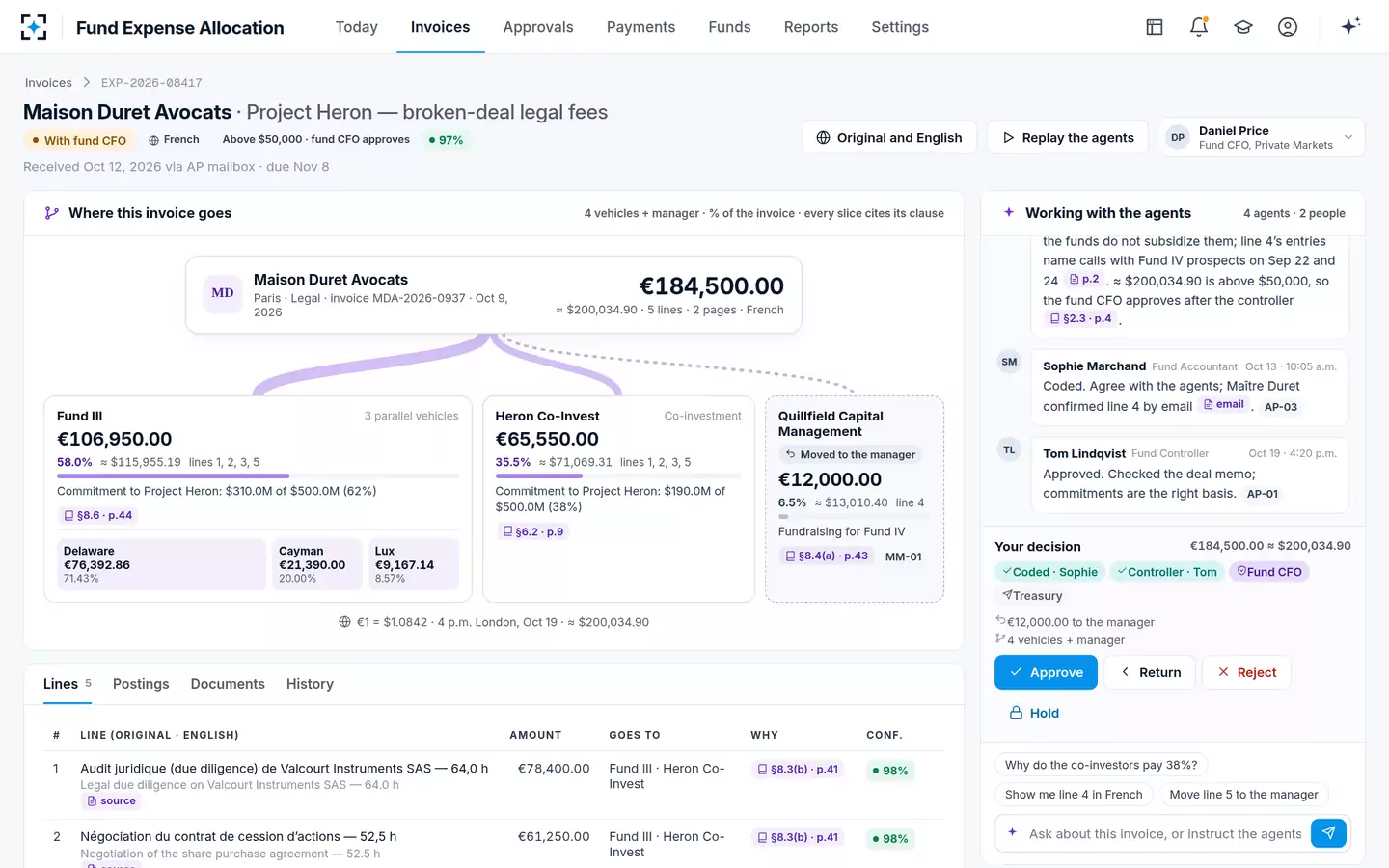
The Allocation agent split the €172,500 by commitments to the deal, from the deal allocation memo: Fund III's family $310.0 million and Heron Co-Invest $190.0 million of $500.0 million. Fund III bore €106,950.00 and Heron Co-Invest €65,550.00, as its co-investment agreement requires. Fund III's share then ran across its parallels by commitments under the LPA: Delaware €76,392.86, Cayman €21,390.00, Luxembourg €9,167.14. The euro amount was converted at €1 = $1.0842, the 4 p.m. London rate, giving about $200,034.90, which is above the $50,000 CFO threshold. Which allocation basis to use, and how to test it is a question of its own.
The allocation fan: each slice sized by share, labelled with its basis and clause
Step four: a second agent re-does the work
The Checker agent re-did the split from scratch, without the Allocation agent's working, and agreed to the cent. Its job is to argue the manager's side: it looks for seconded staff, fundraising time, co-investor shares, events for prospects and related parties. On this bill it confirmed no manager staff time was billed and that the co-investors carried their full share, so the funds were not subsidizing them. The Checker cannot approve, and any disagreement goes to a person.
Disagreement is the useful output. On another sample invoice, a $38,900 annual meeting bill, the Checker wanted to move $2,543.48 of the venue to the manager because 18 of 230 guests were prospective investors in the next fund; the Allocation agent kept it with the funds under the policy's attendee basis. Approval was blocked until the controller decided, with a reason code. Two agents that can disagree surface the gaps in a policy that one agent, or one spreadsheet, would paper over.
Who does what on one fund invoice in Fund Expense Allocation
Agent
Reader agentReads the bill in its own language, cites every value to its page, matches the engagement letter, checks for duplicates.
Never: fills a value it cannot read
Agent
Chargeability agentTests each line against the LPA, side letters and co-investment agreements; cites a clause or hands the line to a person.
Never: changes the fund terms
Agent
Allocation agentApplies the written basis across parallels, co-investors and the manager; ties the split to the cent.
Never: posts
Agent
Checker agentRe-does the split independently and argues the manager’s side.
Never: approves; a disagreement goes to a person
A person decides
Fund accountantCodes the invoice: confirms the agents’ work or edits it with a reason code.
A person decides
Fund controller, then fund CFOApproves; above $50,000 the CFO approves after the controller, seeing every slice, basis and clause.
Agent
Posting agentDrafts one entry per vehicle and one for the manager, and the payment to a verified account.
Never: releases a payment
A person decides
TreasuryReleases the payment run; two releasers above $1,000,000.
Can AI allocate a legal bill across funds?
Yes, if allocate means propose with evidence and a person decides. An agent can find the clause, the deal's commitments and the excluded hours faster than a person searching shared drives, and a second agent can re-perform the arithmetic. What it should not do is approve its own split, or allocate a line it cannot tie to a clause. On the sample bill the fund accountant coded it the next day, the controller approved after checking the deal memo, and the fund CFO signed as the third person.
Legal bills deserve one more test that has nothing to do with language models. In 2015 the SEC found that Blackstone had negotiated "a single legal services arrangement with its primary outside law firm" for itself and its funds, under which it "received a discount that was substantially greater than the discount received by the funds", undisclosed until 2012; the order, which also covered accelerated monitoring fees, imposed a $10,000,000 penalty (SEC IA-4219, October 7, 2015). An invoice tool that reads rates and hours line by line can compare the rates billed to the funds with the rates billed to the manager.
What people still approve
People keep every decision that changes who bears money or that sends money out. The fund accountant codes, the controller approves every coded invoice, the fund CFO approves above $50,000, and treasury releases payments to accounts verified by call-back. The Chief Compliance Officer approves the allocation policy and every fund term before an agent may use them, and a new version of an agent is used only after it has been re-run on a fixed test set of past invoices and approved by the controller and the Chief Compliance Officer. Overrides carry a reason code and join the next evaluation of the agents.
That division answers the record-keeping point regulators make. ESMA expects firms using these tools to keep records of how each decision was reached, which data and algorithms were used, and every change made along the way (ESMA, 2024). In the solution every event shows who did it, a person or an agent with its version, what, when, the reason code and the evidence, in a hash-chained, read-only trail kept seven years.
What to ask before buying an invoice AI for fund expenses
Ask to see your own invoices processed, not a vendor's, and ask questions that can fail. A tool that cannot answer the first four below is an extraction tool with a fund label, which may still be useful, but it leaves the allocation, and the examiner's questions, with your team. What the unit of work costs and how a team comes to trust the proposals are the other two halves of the decision.
Questions to put to any invoice AI for private fund expenses
- Does every allocation cite the clause it relies on?
With the document, section and page, readable by your controller in one click.
- What happens to a line it cannot tie to a clause?
The right answer is that a person decides; the wrong answer is a default account.
- Does a second, independent process re-perform the split?
And does a disagreement block approval until a person decides?
- Can it read the bill in its own language and point each value to the page?
Translation without a trace back to the original is not evidence.
- Who can approve, post and release, and can the software do any of it?
Coding, approval and release should stay with separate people.
- How are caps and side-letter limits tracked?
Per investor and per close, with warnings before the limit, not after.
- What evidence can it produce for an examiner?
Every allocation for a fund and its co-investment vehicles over a period, with basis, clause, policy version and approvers, tied to the general ledger.
- How is a new version of the agents tested before use?
On your own closed invoices, with the results approved by the controller and compliance.
Where Fund Expense Allocation does not fit is worth saying. It is not an accounts payable system or a fund accounting platform; it works beside them, posting only after approval. It does not decide policy; compliance does. And on a fund family with one vehicle and no co-investors, most of what it adds is reading and evidence, not allocation. To see it run on sample invoices, start from Fund Expense Allocation.
Questions people ask
What is agentic AI in accounts payable?
It is accounts payable work divided among software agents that each perform one step, such as reading, classifying, allocating or checking, and pass the result to the next step or to a person. The difference from a single extraction model is that each agent has limited permissions and must show its evidence, and people make the approvals.
Can an AI agent read invoices in other languages?
Yes, and the safe way is to read the original and show it beside the translation, with every value pointing to its place on the page. Amounts, dates and hours should be copied from the original, not translated, and a value the agent cannot read should go to a person rather than be guessed.
What does a person still approve when AI processes fund invoices?
Everything that moves money or changes who bears it: coding, approval, any override of an agent's split, the release of payment, and the rules themselves. In the sample firm, the controller approves every invoice, the CFO approves above $50,000 and the Chief Compliance Officer approves the policy and every fund term.
Can an AI agent create an invoice?
For fund expenses it should not. Invoices come from vendors; an agent's job is to read them, not to make them. The useful thing an agent creates is the draft journal entries and the payment instruction after a person has approved, which the person who approved cannot then release.
How accurate is AI invoice processing for funds?
No regulator or independent study publishes accuracy figures for allocating fund expenses with AI, and vendor claims are not evidence. Measure it yourself: replay a closed year of your own invoices through the tool and read every difference against what was booked. The sample firm hands any line below 90% confidence, or 85% on a scanned page, to a person.