Quality of earnings vs audit comes down to the question each one answers. An audit gives an opinion on whether a company's financial statements are presented fairly, in all material respects, under an accounting framework, based on reasonable assurance from testing. A quality of earnings report gives no opinion; it asks whether the earnings a buyer is about to pay a multiple for are accurate, recurring and backed by cash, and it works on adjusted EBITDA, a number that sits outside the audited statements. Confusing the two is how buyers pay for add-backs: a company can have a clean audit and still present "one-time" costs that recur every year. Botminds' Quality of Earnings Analysis does the second job for a deal team, testing every add-back against the general ledger, and leaves the first where it belongs, with the auditor.
The examples come from a fictional sample deal as it runs through the solution: Project Lantern, the purchase of Halvorsen Industrial Services, whose FY2025 statements were audited by a fictional firm, Kessling & Hart LLP. Standards and research are quoted from the standard-setters and journals that publish them, linked where they appear.
Quality of earnings vs audit, row by row
Financial statement audit: Are the statements presented fairly, in all material respects, under the framework?
Quality of earnings report: What will the business earn in a normal year, and how much of management's adjusted EBITDA is real?
Financial statement audit: An opinion, signed by the audit firm
Quality of earnings report: Findings and adjusted figures; no opinion
Financial statement audit: GAAP net income, the balance sheet and cash flows
Quality of earnings report: Adjusted EBITDA, a non-GAAP measure built outside the statements
Financial statement audit: Reasonable assurance, from evidence examined on a test basis
Quality of earnings report: None formally; as deep as the buyer and the engagement letter require
Financial statement audit: A fiscal year, closed
Quality of earnings report: Usually two or three years plus the trailing twelve months, often monthly
Financial statement audit: The company, for its owners, lenders or regulators
Quality of earnings report: The buyer, the seller or a lender, for the transaction
Financial statement audit: No view on whether an expense will recur
Quality of earnings report: The core of the work
Financial statement audit: No
Quality of earnings report: Yes, on the purchase agreement's definitions
Is a quality of earnings report an audit?
No. A quality of earnings report is a piece of financial due diligence for a transaction, and it ends in findings and adjusted figures, not an opinion. Whoever prepares it, the report describes what was examined and what was found; it does not certify the financial statements. The SBA's definition, written into its lending rulebook in 2026, makes the purpose explicit: a QoE is financial due diligence that tests how reliable, sustainable and accurate a business's past and projected earnings are (SBA SOP 50 10 8.1). The word sustainability does not appear in an audit opinion.
People search for a "quality of earnings audit" because the work looks like auditing. Both read the general ledger, vouch entries to invoices and ask for contracts. The difference is what the work is for. An auditor tests whether amounts are recorded correctly; a QoE team accepts that they are, or measures where they are not, and then asks which of them a new owner will keep paying.
What an audit opinion covers, in the standard's words
An audit opinion covers whether the statements, taken as a whole, are fairly presented, and it rests on reasonable assurance, not on checking everything. The PCAOB's standard on the auditor's report, which governs audits of public companies, says the auditor may give an unqualified opinion on concluding that the statements are "presented fairly, in all material respects, in conformity with the applicable financial reporting framework" (PCAOB AS 3101.02). Audits of private companies in the US are performed under the AICPA's standards instead, but the opinion is of the same kind.
"Those standards require that we plan and perform the audit to obtain reasonable assurance about whether the financial statements are free of material misstatement, whether due to error or fraud."
PCAOB AS 3101, the illustrative auditor's report
Three phrases in the standards set the limits. Reasonable assurance "is obtained by reducing audit risk to an appropriately low level through applying due professional care, including obtaining sufficient appropriate audit evidence" (AS 1101.03). The procedures included "examining, on a test basis, evidence regarding the amounts and disclosures in the financial statements" (AS 3101). And sampling, by definition, applies a procedure to less than every item in a balance or class of transactions (AS 2315.01).
None of that is a weakness of auditing. It is the right design for its question: whether the statements as a whole are free of material misstatement. A consulting invoice of $150,000 a month, correctly recorded in the right account, is not a misstatement, however the seller later describes it.
What a quality of earnings report asks that an audit does not
A QoE asks forward-looking questions of historical numbers: will this cost recur, is this revenue repeatable, is this owner's salary at market, would this rent be the same with an unrelated landlord. Those are questions about the economics behind correctly recorded entries, and they matter only because a price is about to be set as a multiple of one year's earnings.
The SEC's rules for public companies show how far apart the two worlds sit. A registrant must not "Present non-GAAP financial measures on the face of the registrant's financial statements prepared in accordance with GAAP or in the accompanying notes," and must not adjust a performance measure "to eliminate or smooth items identified as non-recurring, infrequent or unusual, when the nature of the charge or gain is such that it is reasonably likely to recur within two years or there was a similar charge or gain within the prior two years" (17 CFR 229.10(e)). Adjusted EBITDA lives outside the audited statements by rule, and so does the judgement about what recurs.
IFRS is moving part of that judgement inside. IFRS 18, which applies from annual periods starting 1 January 2027, requires entities to disclose "management-defined performance measures—subtotals of income and expenses not specified by IFRS Accounting Standards that are used in public communications" (IFRS Foundation, IFRS 18). That reaches measures a company uses in public; a private target's adjusted EBITDA in a CIM is a private communication to bidders, so for most buyouts the gap remains.
Quality of earnings vs audited financials: where the numbers meet
The two meet at one point: the audited year anchors the QoE rebuild. A QoE team rebuilds monthly EBITDA from trial balances and then proves that its rebuilt year equals the audited year, so that every later adjustment starts from a number someone else has already tested. If the rebuild does not tie, either the trial balances are not the ones the auditor used or there were post-closing entries, and the QoE must explain which.
On the sample deal the Rebuild agent's FY2025 EBITDA is $17,700,000 against $17,712,000 in the audited statements: a $12,000 difference traced to a post-closing audit entry. The trailing twelve months, which no auditor has looked at, are built from the same trial balances, which is why the tie on the audited year matters: it is the evidence that the unaudited months were built the same way.
Everything after the tie is outside the audit. Management's fourteen add-backs, $11.0 million in all, take reported LTM EBITDA of $18.19 million to $29.19 million. None of them is a misstatement. Several are not one-time.
Why a clean audit can sit beside a bad add-back
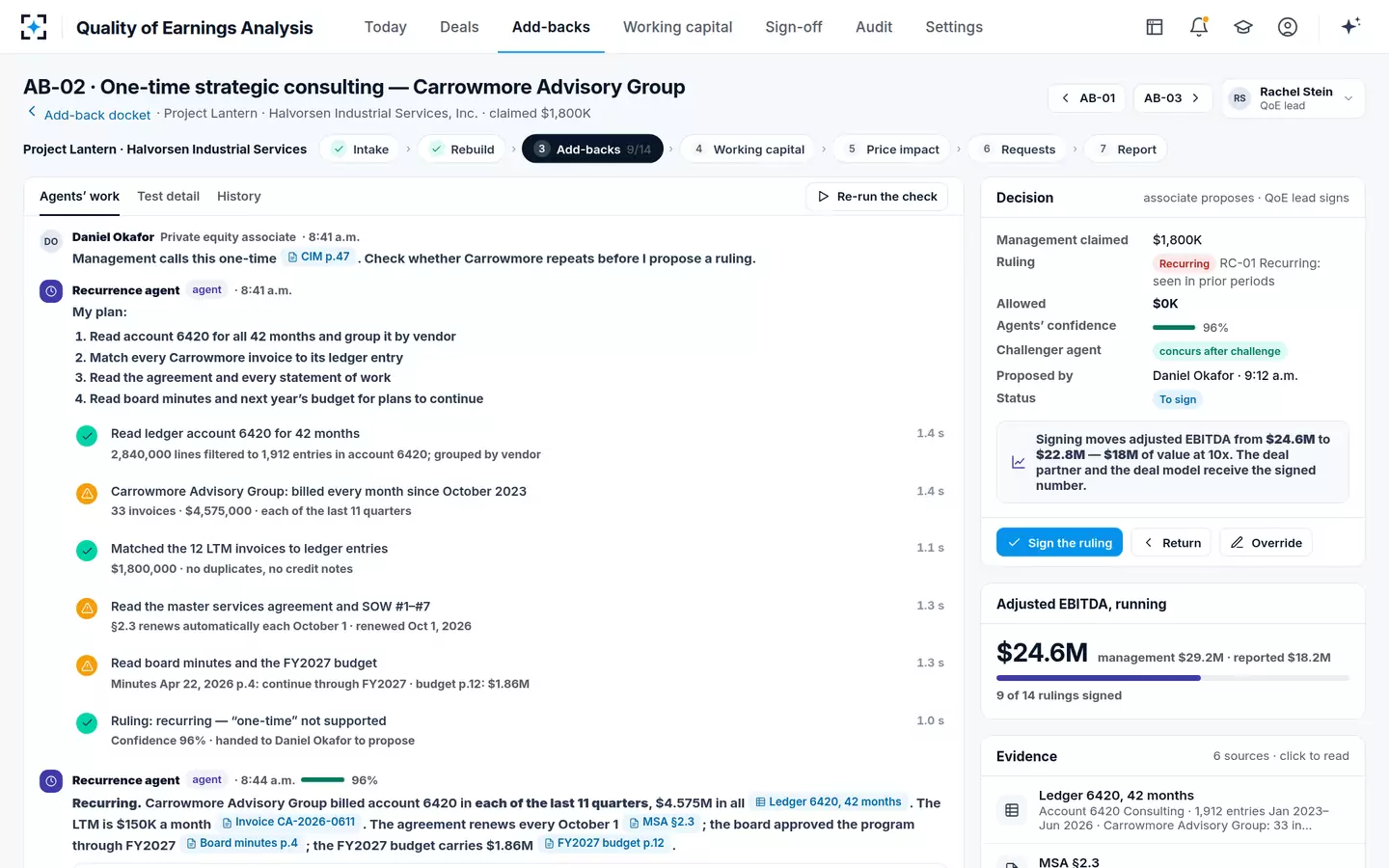
Because the audit never asked whether the cost was one-time. The sample deal's largest add-back is $1.8 million of "one-time strategic consulting" from Carrowmore Advisory Group. The invoices are real, the amounts are correctly recorded in account 6420, and the audited statements are right to show them as an expense. Reading 42 months of that account by vendor, the Recurrence agent found Carrowmore billed in each of the last eleven quarters, $4.575 million in all, under a master services agreement that renews automatically each October 1, with the program in next year's budget.
One add-back the audit had no reason to question
The CFOs who prepare earnings would recognise the problem. In a survey of 169 public-company CFOs, Dichev, Graham, Harvey and Rajgopal report that CFOs believe "above all, high-quality earnings are sustainable and repeatable," with characteristics including the "absence of one-time items and long-term estimates" (Journal of Accounting and Economics, 2013). Their survey also asked how often earnings are managed.
What CFOs themselves say about earnings quality
169
CFOs of public companies surveyed, plus 12 interviewed in depth
20%
of firms that CFOs believe manage earnings to misrepresent performance in a given period
10%
of EPS typically managed at those firms, in the CFOs' estimate
50%
of earnings quality driven by non-discretionary factors such as industry and the economy
The same study adds a line that every QoE team should keep in mind: CFOs say manipulation is hard to unravel from outside, "but peer comparisons and lack of correspondence between earnings and cash flows provide helpful red flags" (Dichev et al.). Earnings against cash is precisely the cash proof the SBA now requires in every QoE on its acquisition loans, and precisely what an add-back schedule in a CIM does not show.
Materiality: why the same $150,000 matters more to a buyer
Materiality is where the two jobs part company in numbers. An auditor sets materiality for the financial statements as a whole and designs tests so that misstatements below it, alone or together, would not change a reader's view of those statements. A buyer's materiality is set by the multiple: at 10x EBITDA, every $100,000 of earnings that is not real is $1 million of price.
That arithmetic is why QoE teams write their own thresholds. On the sample deal the firm's settings put QoE materiality at $100,000 of EBITDA and flag any vendor, account or narrative that appears in three or more periods as a recurrence candidate, whatever its size. A $150,000 monthly consulting charge, immaterial as a misstatement because it is not one, becomes the largest price item in the deal once the question is whether it recurs.
The direction of the error matters too. An auditor's concern is symmetric: misstatement up or down. A buyer's is not, because the seller prepared the add-back schedule and every add-back raises the price. The QoE therefore spends its time on the claims that move EBITDA up, and on the adjustments the seller had no reason to propose, which move it down.
Do I need an audit and a quality of earnings report?
For a buyout of any size, usually yes, because each covers what the other cannot. Audited statements give the QoE a tested starting point; without them, the QoE has to do more of that testing itself, reconciling to tax returns and bank statements. The QoE, in turn, gives the buyer what the audit never claimed to: a view on recurring earnings, the working capital peg and debt-like items.
Smaller targets often have reviewed or compiled statements rather than audited ones, and some have only tax returns. The SBA's rule is written for that world: the QoE has to reconcile the accountant's statements, the tax returns, the internal accounts and the IRS transcripts to each other (SOP 50 10 8.1). Where there is no audit, the reconciliation and the cash proof carry more of the weight, and the report should say how much.
Can the company's auditor do the quality of earnings?
A buyer's QoE is normally done by someone other than the target's auditor, because the auditor works for the target and has already formed views on its accounts. The SBA's rule for its loans states the principle bluntly: the report "must not be prepared by or for the seller" (SOP 50 10 8.1). A seller can commission its own sell-side QoE, but a buyer reads it as the seller's case.
What the buyer can and should use from the audit is its evidence trail: the audited statements, the auditor's adjustments, and anything the audit established about related parties. The PCAOB's objective for that area is to determine whether related parties and their transactions "have been properly identified, accounted for, and disclosed" (AS 2410.02). Whether the founder's rent is at market is a separate, price question, and on the sample deal it is one of the five adjustments management did not propose.
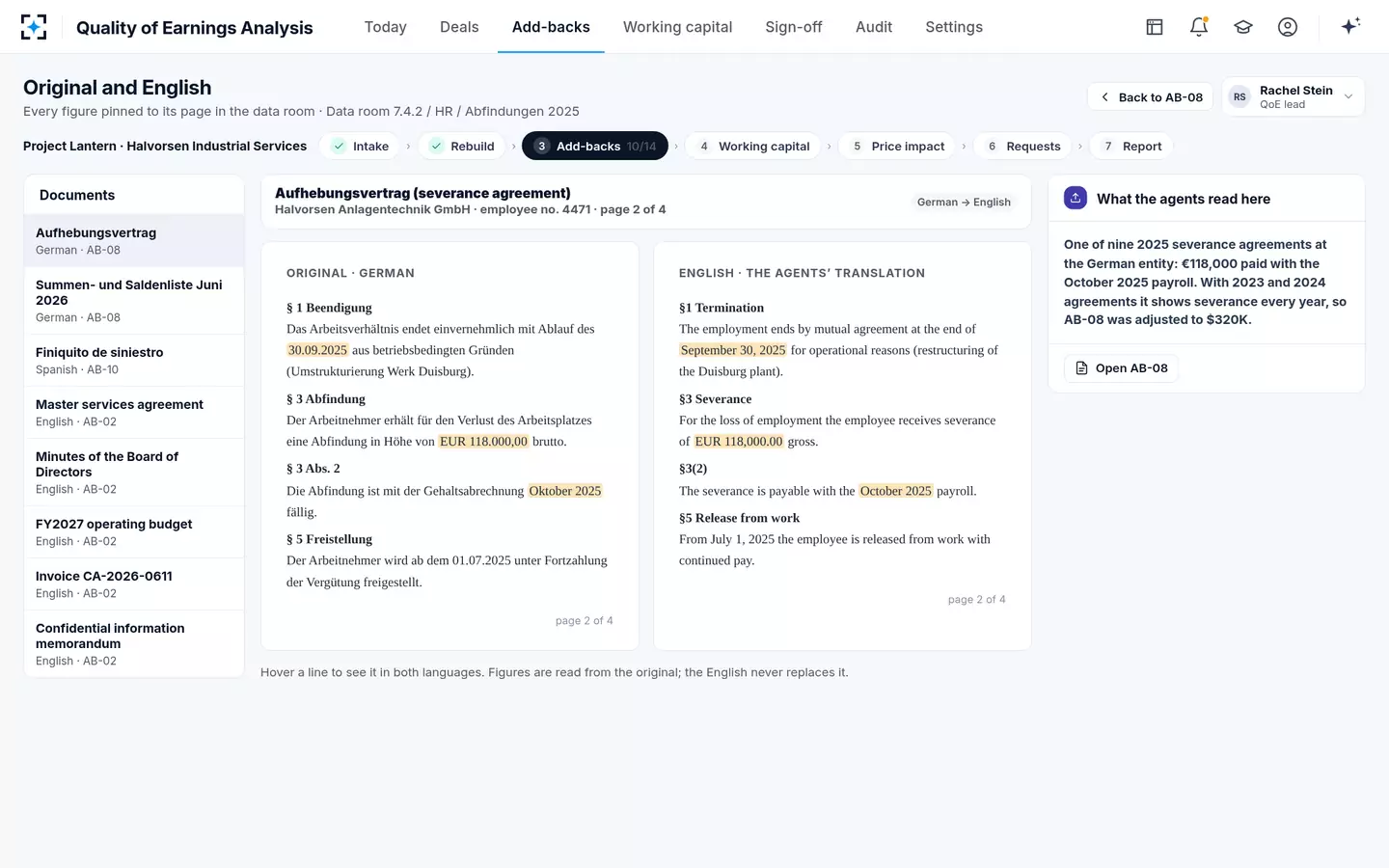
Reading the evidence in the language it was signed in
What is a quality of earnings review, then?
"Quality of earnings review", "QoE analysis" and "quality of earnings report" describe the same piece of work; the report is its written output. What varies is depth: a first-cut review before the letter of intent may rebuild EBITDA and test the largest add-backs, while the final report covers every add-back, the peg and debt-like items. How the stages fit around the price is covered in the quality of earnings process, and what each section of the final report contains in the quality of earnings report, section by section.
There is a third report people confuse with both: a valuation. Fair value under IFRS 13 is measured from the market participant's side, as an exit price at the measurement date (IFRS Foundation, IFRS 13), whereas a QoE measures earnings and the buyer applies its own multiple. A QoE report should not be read as a valuation, and a valuation does not test add-backs.
What to ask for from each side before relying on either report
- From the audit: the signed opinion and the period it covers
An unqualified opinion on FY2025 says nothing about the trailing twelve months.
- From the audit: adjustments booked after the trial balance
They explain why a rebuild differs from the audited figure.
- From the audit: related-party disclosures
The starting list for rent, management fees and family payroll.
- From the QoE: the tie of the rebuild to the audited year
With every difference explained.
- From the QoE: a recurrence test on every add-back
Across the whole period, by account and by vendor.
- From the QoE: a cash proof
Revenue reconciled to bank deposits, for the LTM at least.
- From the QoE: a statement of what it is not
No audit, no opinion, no assurance beyond the procedures described.
Questions people ask
Does a quality of earnings report give an opinion?
No. It reports procedures performed, findings and adjusted figures. On the sample deal the draft report says so in one sentence: it is a buyer's first-cut analysis, not an audit, and carries no opinion.
Is a QoE more detailed than an audit?
In one direction, yes: it goes deeper into earnings, often monthly and by vendor, because a price depends on them. In another, no: it does not test the balance sheet and disclosures to the standard an audit does. An audit samples many accounts to reasonable assurance; a QoE examines fewer questions, sometimes on 100% of the entries that bear on them.
Can a QoE find fraud that an audit missed?
It can find signs of it, because it compares earnings with cash and reads the same accounts at a different grain. CFOs in Dichev and colleagues' survey named the lack of correspondence between earnings and cash flows as a helpful red flag. A QoE is not designed as a fraud investigation, and its report should not be read as one.
Does an audit cover EBITDA?
Not adjusted EBITDA. SEC rules bar public registrants from presenting non-GAAP measures on the face of their GAAP statements or in the notes, and a private company's adjusted EBITDA in a CIM is management's own figure. Under IFRS 18, from 2027, management-defined performance measures used in public communications move into the notes.
Which comes first, the audit or the QoE?
The audit of the last fiscal year usually exists before a sale process starts; the QoE is done during the process and rebuilds forward from it into the trailing twelve months. Where the audit is late or missing, the QoE has to reconcile to tax returns and bank statements instead.