A quality of earnings report's cost is set engagement by engagement: advisers quote a fee based on the target's size, the number of entities and periods, the state of its books, the number of add-backs and the deadline, and neither regulators nor independent researchers publish the fees that result. That makes the fee a poor thing to compare. The better comparison is with what the report protects: at a 10x multiple, each $1 of adjusted EBITDA that turns out not to be real costs $10 of purchase price, so the value of a QoE is measured in the add-backs it removes before the price is fixed. Botminds' Quality of Earnings Analysis changes the cost side by doing the reading with agents, so a deal team has its own first cut in days, and changes the value side by doing it before the price hardens.
The figures below come from a fictional sample deal as it runs through the solution: Project Lantern, Quillfield Capital Partners IV's purchase of Halvorsen Industrial Services, with a letter of intent at 10.0x management's adjusted EBITDA of $29.19 million. Wage figures are from the Bureau of Labor Statistics; the $10-per-$1 rule is arithmetic, not a market statistic.
The fee is not the number that matters
$10per $1
of price behind each dollar of EBITDA at a 10x multiple: arithmetic, not a market figure
$63.9M
enterprise value the signed rulings took off the sample LOI
sample deal
25 → 3days
working days for a first-cut QoE by hand and with agents, by Botminds' estimate
$83,680
median annual wage of US accountants and auditors, May 2025
How much does a quality of earnings report cost?
There is no published market rate. Advisers do not publish fee schedules, no regulator collects QoE fees, and the figures that circulate online come from the firms that sell the work. What can be said with evidence is what the work consists of and what the people who do it earn, which gives a buyer the means to estimate its own cost and to test a quote.
The work is accounting labour. A QoE is performed mostly by accountants, and accountants and auditors earned a median $83,680 in May 2025, $40.23 an hour, by the Bureau of Labor Statistics' count (BLS Occupational Outlook Handbook). That is wage only; a firm's billing rate adds benefits, overhead, partner time and margin, and a buyer's in-house cost adds benefits and the opportunity cost of an associate's time. The method below turns those inputs into an estimate you can defend.
What drives quality of earnings fees
Six things drive the hours, and the hours drive the fee. Each can be counted before a quote is requested.
What drives the hours in a quality of earnings engagement
| Driver | Why it adds hours | On the sample deal |
|---|---|---|
| Entities and charts of accounts | Each entity's books must be mapped to one definition and translated | Three entities: US GAAP, German DATEV SKR04, Mexican SAT code list |
| Languages | Contracts, payroll and minutes read in the original | English, German and Spanish |
| Periods and granularity | Monthly rebuilds over several years multiply the tie-outs | 42 months, 125 of 126 monthly trial balances |
| General-ledger volume | Vouching and recurrence scale with the entries behind each add-back | 2.84 million general-ledger lines |
| Add-backs and disputes | Each add-back needs evidence; each dispute a re-test | 14 add-backs claimed, one disputed by the seller |
| Data readiness and deadline | Missing or unreadable files stall every later step | One missing month, one password-protected payroll file, committee in nine days |
Scope choices matter as much as size. A QoE that samples each account is cheaper per hour of coverage than one that reads every entry, and a report delivered after the letter of intent is cheaper than one delivered before it, because the data room is open and the buyer has exclusivity. Both savings are real, and both move risk to the buyer. A quote should say plainly which choices it has made.
The arithmetic that matters more than the fee
The value of a QoE is the price of the add-backs it removes, multiplied by the deal multiple. On the sample deal the signed rulings and the adjustments management did not propose took diligence-adjusted EBITDA from management's $29.19 million to $22.8 million: $6.39 million of EBITDA, or $63.9 million of enterprise value at 10.0x, 21.9% of the LOI. Debt-like items took a further $6.8 million off the equity price, without a multiple.
What each finding was worth at 10x on the sample deal
The multiple is also a sensitivity. The difference between management's EBITDA and the signed figure is worth more the more the buyer pays per dollar of earnings, as the table shows. A buyer that expects to pay a higher multiple for a better business should expect to spend more on testing its earnings, not less.
The same $6.39M of EBITDA, priced at five multiples
| Multiple | At management's $29.19M | At signed $22.8M | Difference |
|---|---|---|---|
| 9.0x | $262.7M | $205.2M | $57.5M |
| 9.5x | $277.3M | $216.6M | $60.7M |
| 10.0x | $291.9M | $228.0M | $63.9M |
| 10.5x | $306.5M | $239.4M | $67.1M |
| 11.0x | $321.1M | $250.8M | $70.3M |
Buyers already discount what management tells them about the future. In a survey of private equity investors, Gompers, Kaplan and Mukharlyamov report a median and average discount of 20% to management's EBITDA forecasts among the 44 investors who gave a number (NBER working paper 21133, published in the Journal of Financial Economics, 2016). A QoE is the evidence-based version of that haircut for the historical number, where a discount by rule of thumb is hardest to defend in a negotiation.
Is a quality of earnings report worth it?
For a buyout priced on adjusted EBITDA, almost always, because the gap between reported and adjusted earnings is where the price is most exposed. Research on public companies shows which way that gap leans. Bradshaw and Sloan, comparing GAAP and Street earnings over twenty years, found Street earnings far more often above GAAP earnings than below, with management actively shaping and promoting the Street figure (Journal of Accounting Research, 2002).
That does not make every adjustment suspect, and a QoE that rejects everything is as wrong as one that accepts everything. Studying companies that report losses, Leung and Veenman found their non-GAAP earnings "highly predictive of future performance," while "the expenses excluded from GAAP earnings are not" (Journal of Accounting Research, 2018). Some exclusions are genuinely transitory. The report earns its fee by telling the two kinds apart, line by line, with evidence. On the sample deal, of $11.0 million of add-backs claimed, $5.78 million were allowed or proposed as accepted, and $5.22 million were not.
Who pays for a quality of earnings report, and who bears it if the deal fails?
The party that commissions it. A buyer pays for its buy-side QoE and usually bears the cost whether or not the deal closes; that broken-deal risk is one reason buyers delay the full QoE until exclusivity. A seller pays for a sell-side QoE before marketing. For SBA 7(a) acquisitions of $3 million or more the lender must obtain a QoE, and the SBA allows a lender to have a buyer's existing report reviewed by one of its approved vendors "to help mitigate costs" (SBA SOP 50 10 8.1).
Is a sell-side QoE cheaper?
It can be, for the buyer, because the seller paid for it; but it does not replace the buyer's own testing, because it is the seller's case. The useful way to use one is as a map: it tells the buyer which add-backs the seller has thought hardest about and where the evidence is filed. The add-backs the buyer should re-test from the general ledger are the large ones, the ones with a recurring vendor or account, and the pro forma ones; on the sample deal those three groups covered every ruling that moved the price by more than $5 million.
Where the hours go in a first cut
By Botminds' estimate, a first-cut QoE on a mid-market buyout with three entities takes about 25 working days by hand: 4 for intake and chart-of-accounts mapping, 5 for the rebuild and tie-out, 7 for vouching add-backs, 3 for recurrence and the adjustments management did not propose, 3 for working capital and debt-like items, and 3 for the databook, report and deal model. With the solution the same steps take about 3 days in all, which is also the solution's design target from the day the data room opens. These are estimates and a target, not results measured at a customer.
Adviser QoE and an in-house first cut, on cost
Adviser QoE, by hand: Fee per engagement, quoted deal by deal
In-house first cut with agents: Software and the deal team's own time
Adviser QoE, by hand: The buyer, usually
In-house first cut with agents: The buyer
Adviser QoE, by hand: Usually after the LOI, in exclusivity
In-house first cut with agents: As soon as trial balances and the add-back schedule arrive
Adviser QoE, by hand: As scoped: often a sample of entries and periods
In-house first cut with agents: Every general-ledger entry behind it, across every month available
Adviser QoE, by hand: An independent report the lender and others can rely on
In-house first cut with agents: Signed internal rulings and an evidence trail the adviser can reuse
Adviser QoE, by hand: On hours of reading and reconciliation
In-house first cut with agents: On review: people read evidence and sign
Signed numbers, a running total and a price effect on every ruling
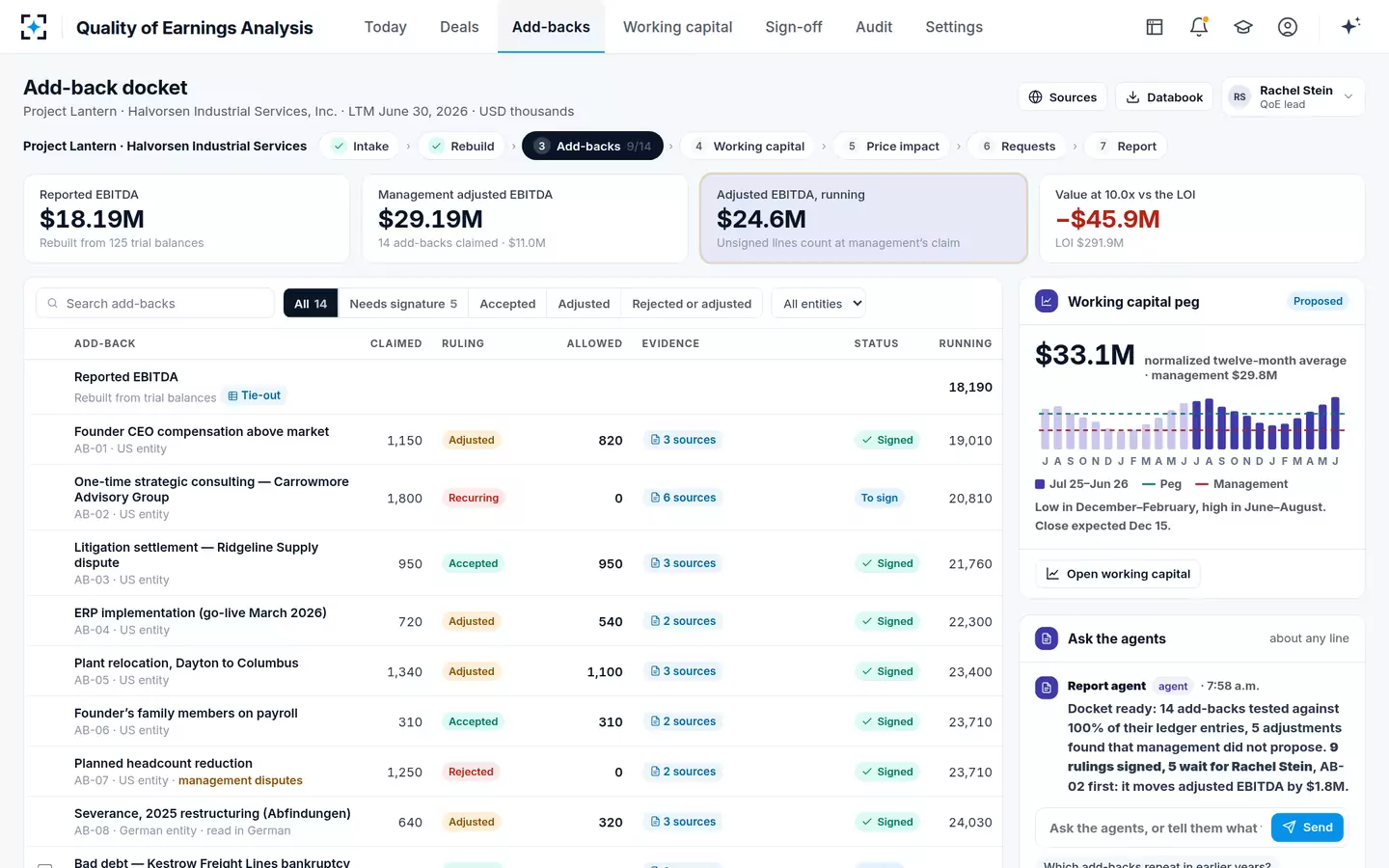
What a quality of earnings quote should state
A quote that states only a fee and a delivery date cannot be compared with another. Ask each provider to state its scope in the same terms, so that two quotes describe the same work or show plainly where they differ. The six drivers above are the terms: the entities and charts of accounts covered, the languages read in the original, the periods and whether they are monthly, the share of each add-back's general-ledger entries that will be tested, the number of add-backs in scope, and what happens when data is missing.
Data readiness is the term most often left vague, and it is where hours escape. On the sample deal the data room held 3,412 files, of which one payroll file could not be opened without a password, and 125 of 126 monthly trial balances, with Mexico's February 2025 missing. Each gap became a request with a due date. A quote should say who chases such gaps, how the work proceeds meanwhile, and whether the fee changes if the seller is slow.
Data readiness, counted before the work starts
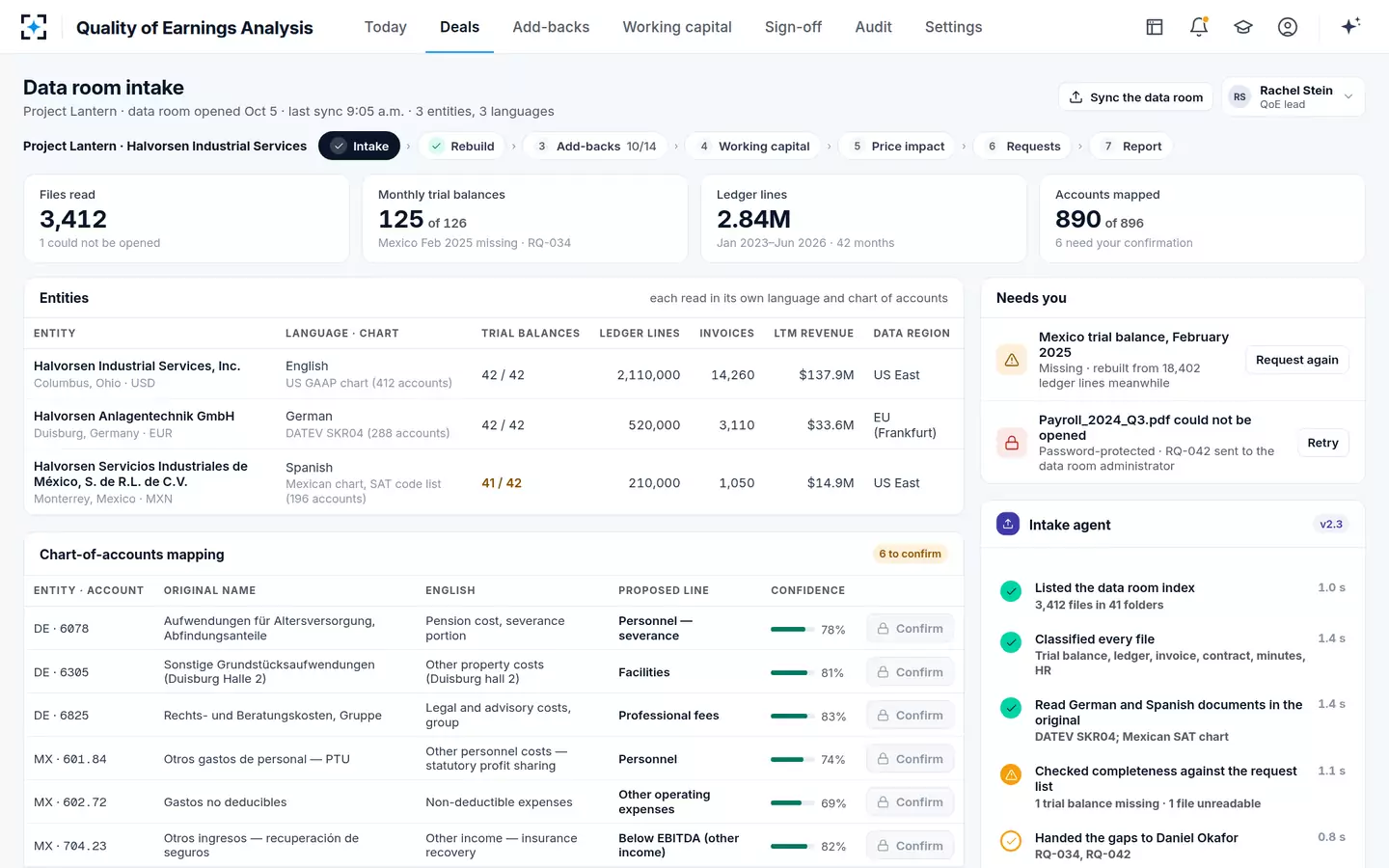
Ask, too, what the provider will hand over. A report and a databook are the usual deliverables; an evidence trail that links each databook cell to its source is what lets the next reader, a lender's reviewer or an insurer, rely on the work without paying for it twice. The SBA's provision for reviewing a buyer's existing QoE rather than commissioning a new one only works if the first report can be checked.
How to estimate your own cost per QoE
Count, then price. Take your last three closed deals and, for each, write down the hours your team spent on the QoE work, the adviser's invoice, the dates of the LOI, the data room and each material ruling, and how far the final adjusted EBITDA sat from management's. Then apply your own loaded cost per hour and your deal multiples.
Five numbers to pull from your last three deals
- Internal hours on QoE work, by role
Associate, QoE lead, partner. Multiply by your loaded cost per hour, not the BLS median wage.
- The adviser's fee and scope
Entities, periods, sampled or full, and the delivery date.
- Days from LOI to each material ruling
The days in which you were negotiating from the seller's number.
- Management's EBITDA against your final figure
Times the multiple: the price the work protected.
- Findings that arrived after the price was agreed
Each one is value the timing cost you, whatever the fee.
The last line is the one that usually decides the question. A QoE that finds a $1.8 million recurring cost after the purchase agreement is signed has found $18 million of price at 10x and saved none of it. The same finding a week after the data room opens is a negotiating position. When you compare quality of earnings providers and an in-house first cut, compare them on that date as well as on the fee, and see the quality of earnings process for why the date moves.
Questions people ask
What is the average cost of a quality of earnings report?
No regulator or independent study publishes one; the figures quoted online come from firms that sell the work. Estimate your own from your last deals' hours, fees and scope, and compare quotes on what they cover: entities, periods, sampled or full testing, and delivery date.
How long does a QoE take?
It depends on data readiness and scope, and advisers do not publish standard timelines. Botminds' estimate for a three-entity mid-market buyout is about 25 working days for a first cut by hand, against a design target of 3 days with the solution.
Can a buyer skip the QoE on a small deal?
It can, but the multiple still applies to every dollar of unsupported EBITDA. For SBA 7(a) acquisitions with a purchase price of $3 million or more, the lender must obtain a QoE in addition to a business valuation.
Is the QoE fee a transaction cost?
For the party that pays it, usually yes: a cost of the deal, not of operating the business. A seller's QoE fee is often added back in the seller's own adjusted EBITDA for the same reason.
Does a cheaper QoE mean less coverage?
Often, through sampling or a later start. Ask each provider how many of each add-back's general-ledger entries it will read, over how many periods, and when the first rulings will arrive relative to the LOI.