An AI quality of earnings review uses software agents to do the reading a QoE requires: they map a target's charts of accounts, rebuild monthly EBITDA from the trial balances and general ledger, vouch every add-back to the entries, invoices and contracts behind it, and test whether costs labelled one-time recur, across the whole period rather than a sample. What it should not do is decide. A good one cites every figure it produces, argues the other side of its own findings, and leaves each ruling to a person who signs it. Botminds' Quality of Earnings Analysis is built that way: seven agents prepare the docket, an associate proposes each ruling and a QoE lead signs it. This page shows the agent that matters most, the one that checks recurrence, working on one add-back.
The example is a fictional sample deal as it runs through the solution: Project Lantern, Quillfield Capital Partners IV's purchase of Halvorsen Industrial Services, where management presents $1.8 million of "one-time strategic consulting" as an add-back. Rules and research are quoted from the SEC, the PCAOB and peer-reviewed work, linked where they appear.
One 'one-time' consulting cost, across 42 months of the general ledger
- Before the agreement9 mo
- Oct 2023–Jun 2025, before the LTM21 mo · $2.775M
- LTM: the claim12 mo · $1.8M
- Not read30 mo not read
- LTM, all matched12 mo
What an AI quality of earnings review should do
It should do the parts of a QoE that are reading and arithmetic, completely, and hand the parts that are judgement to people with the evidence attached. Reading means every file in the data room, in the language it was written in, and every general-ledger line in the accounts that bear on an add-back. Arithmetic means rebuilding monthly EBITDA and the working capital series and tying them to the audited statements. Judgement means the ruling on each add-back, the peg, and what to say to the seller.
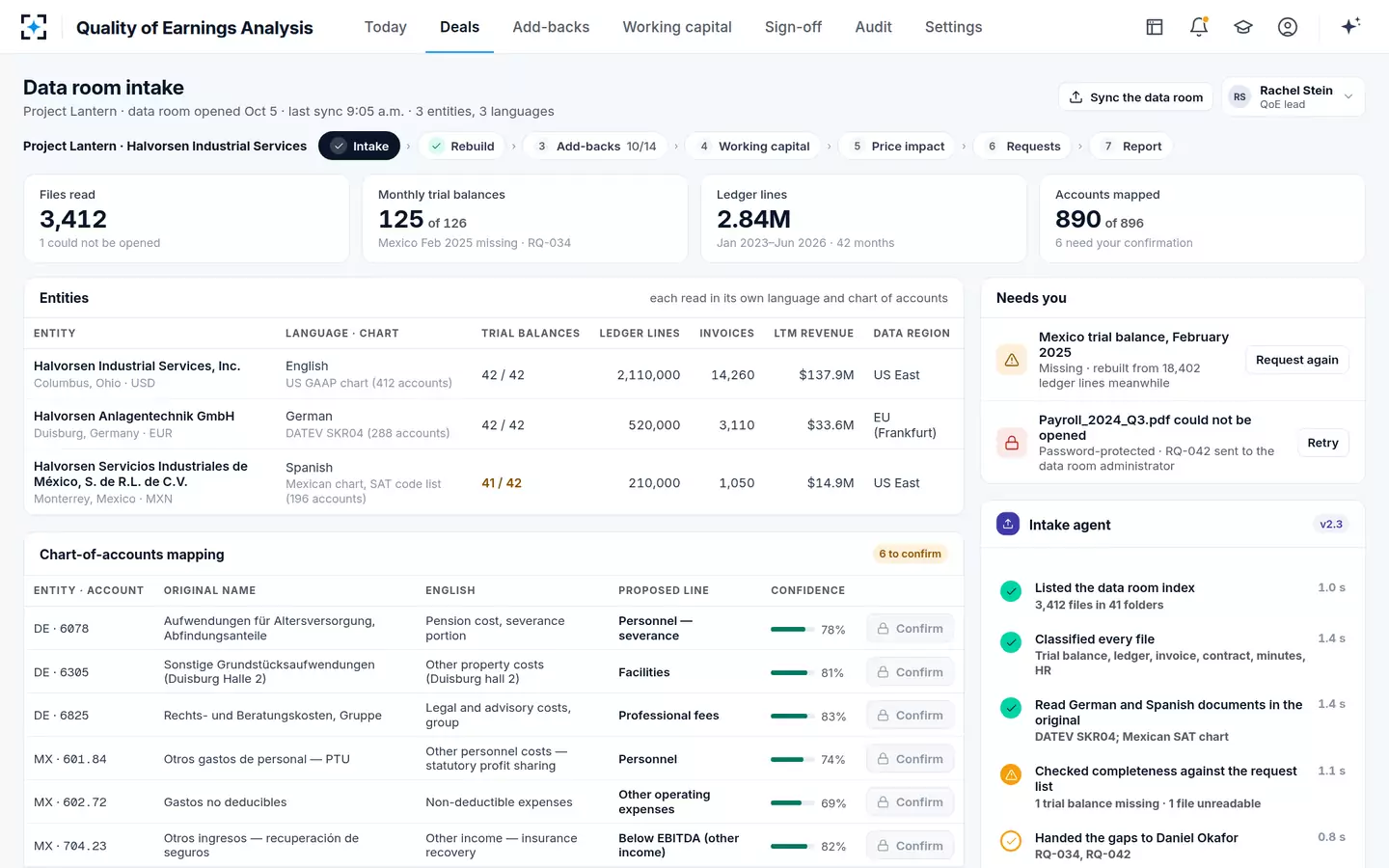
On the sample deal that division of labour is explicit. The Intake agent classified 3,412 data room files and mapped 890 of 896 accounts across three charts, including German books on DATEV SKR04 and Mexican books on the SAT code list; the six mappings under 85% confidence wait for a person. The Rebuild agent rebuilt EBITDA from 2.84 million general-ledger lines. The Test, Recurrence and Challenger agents work each add-back. The associate proposes, the QoE lead signs, and the Report agent releases signed numbers only.
Seven agents prepare; two people decide
Agent
Intake agentClassifies the data room, reads every entity in its own language, maps foreign charts of accounts, checks completeness against the request list.
Never: maps an account under 85% confidence, or fills a missing month.
Agent
Rebuild agentRebuilds monthly EBITDA from the trial balances at monthly average FX rates and ties it to the audit and the CIM.
Never: changes a reported number.
Agent
Test agentVouches each add-back against all of its general-ledger entries, invoices, contracts and payroll; finds adjustments management did not propose.
Never: rules without evidence.
Agent
Recurrence agentReads the account, the vendor and similar narratives across every month, then contracts, minutes and next year's budget.
Never: signs a ruling.
Agent
Challenger agentRe-tests each ruling independently and argues management's side.
Never: approves a ruling, or resolves a disagreement silently.
A person decides
AssociateAsks the agents in plain words, reads what they found and proposes a ruling with a reason code.
A person decides
QoE leadReads the evidence and the counter-argument, then signs. Cannot sign a ruling she proposed.
What is a recurring expense? The SEC's answer
The clearest public test comes from the SEC's rules for listed companies. Item 10(e) of Regulation S-K bars a registrant from adjusting a performance measure to remove items "identified as non-recurring, infrequent or unusual" when such an item is reasonably likely to recur within two years or a similar one occurred in the prior two years (17 CFR 229.10(e)). The staff's interpretation, updated in December 2022, goes further, treating as recurring an operating expense that comes back occasionally or at irregular intervals (SEC non-GAAP C&DI 100.01).
The staff also make a point that every QoE team should borrow: the two-year rule is about words, not arithmetic. "The prohibition is based on the description of the charge or gain that is being adjusted," the staff write; a company may still adjust for an item, but may not call it non-recurring if it fails the test (C&DI 102.03). In a CIM, "one-time" is a description. The recurrence test is how a buyer checks whether the description is true.
What is a non-recurring expense in a QoE?
In a QoE, a non-recurring expense is one that the evidence shows has not happened before in the period examined and will not happen again under the buyer: not the same vendor, not the same account, not the same kind of narrative, and not in next year's plan. That is four separate tests, and each one needs different documents.
The firm's own threshold turns the tests into a flag. On the sample deal the setting is "same vendor, account or narrative in 3 or more periods", applied to every add-back, and changed only by a proposal the head of private equity operations approves. A flag is not a ruling; it sends the add-back to the Recurrence agent for the full read, and the ruling to a person.
The reason to run the test on every add-back, not only the suspicious ones, is research on how expenses move between categories. McVay found evidence "consistent with managers opportunistically shifting expenses from core expenses" to special items, which leaves the bottom line unchanged but overstates core earnings (The Accounting Review, 2006). A recurring cost reclassified as special looks exactly like a one-time cost until someone reads the history.
One add-back, 42 months: how the recurrence test runs
On the sample deal the associate, Daniel Okafor, asks the agents in plain words to check whether the consulting firm, Carrowmore Advisory Group, repeats before he proposes a ruling. The Recurrence agent answers with a plan of four steps and runs them.
First, it reads account 6420 for all 42 months, January 2023 to June 2026, grouped by vendor: 2,840,000 general-ledger lines filtered to 1,912 entries in that account. Carrowmore appears every month since October 2023: 33 invoices, $4,575,000, in each of the last eleven quarters. Second, it matches the twelve LTM invoices, $1,800,000, to twelve entries, with no duplicates and no credit notes: the claimed amount is real. Third, it reads the master services agreement and every statement of work: the agreement, dated September 18, 2023, renews automatically each October 1. Fourth, it reads the board minutes and next year's budget: the April 22, 2026 minutes continue the program through FY2027, and the FY2027 budget carries $1.86 million for it.
The Recurrence agent's plan and what each step found
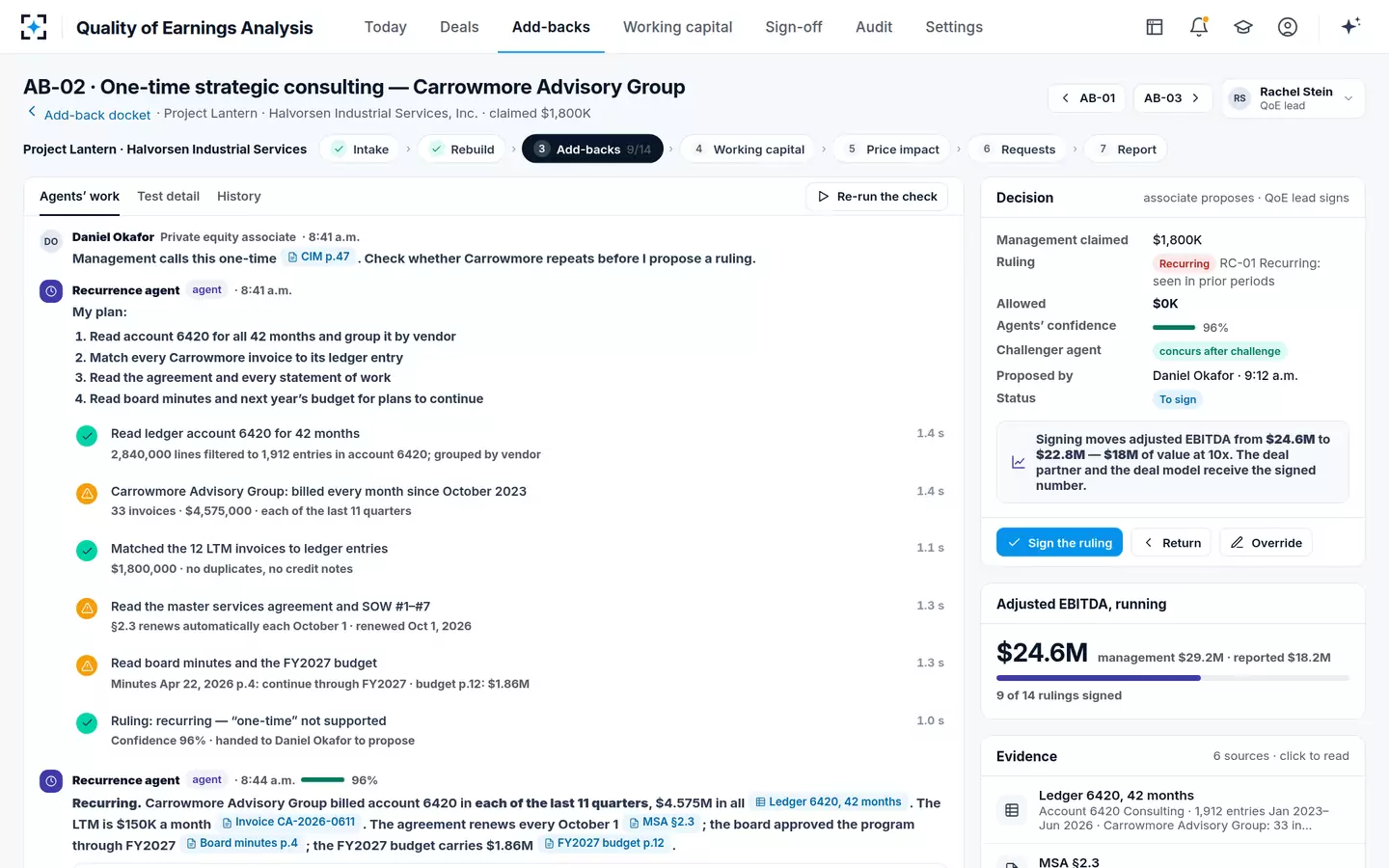
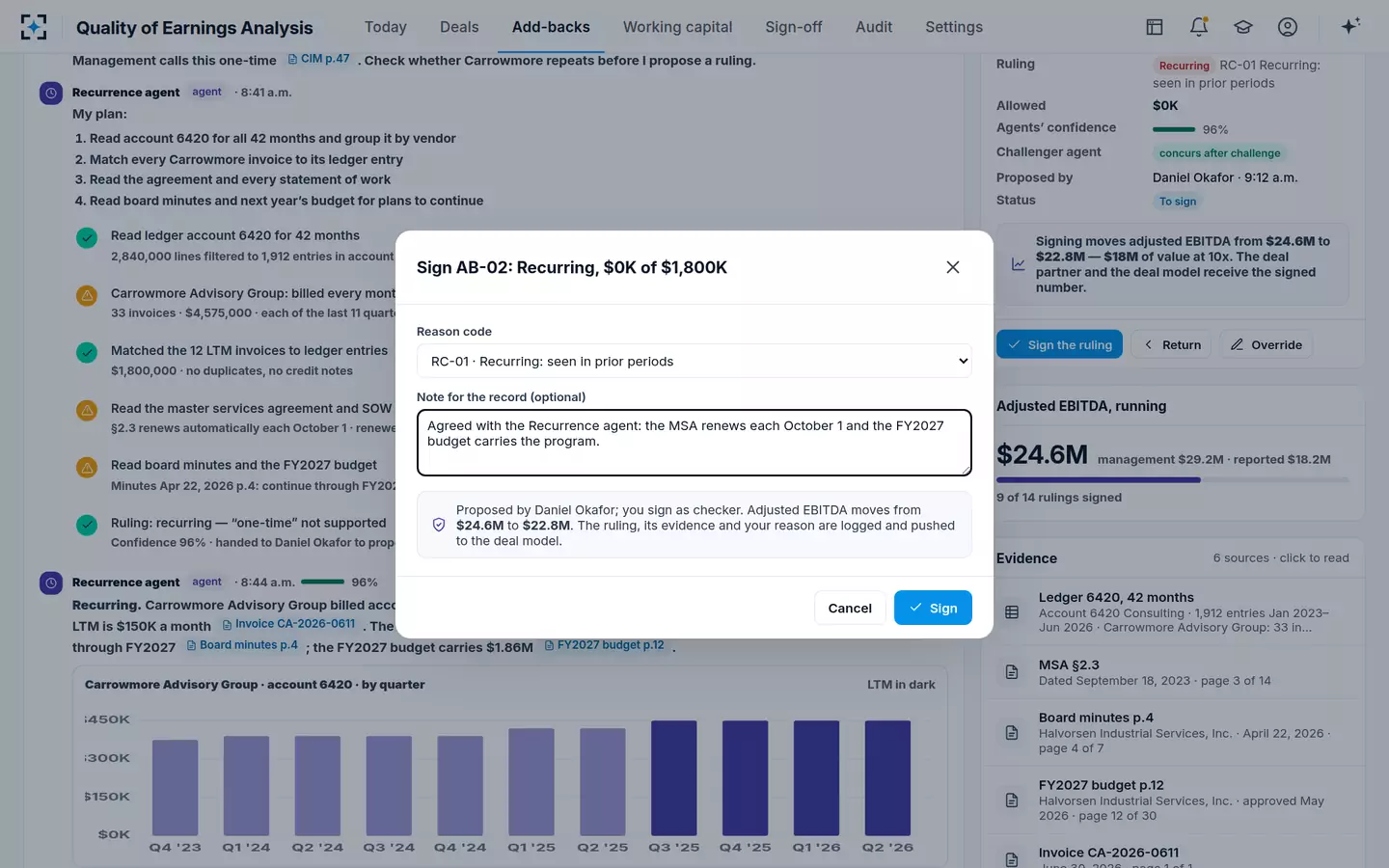
Then the Challenger agent argues the seller's side. Statement of work #7 ends on December 31, 2026, and the CIM says the program completes this year. The Recurrence agent answers with the renewal clause, the board minute and the budget line, and the Challenger concurs, adding the useful point: "If management produces a termination notice, the buyer's model can show it as a future saving, not as an add-back." The ruling the associate proposes is rejected as recurring, $0 allowed of $1,800,000.
The invoices were real and the amount was right. The add-back failed on the eleven quarters before it and the budget line after it.
Sampling vs the whole population
On the sample deal the associate's old method fits in one line: he pulls general-ledger detail and samples four quarters of an account, because nobody has time to read 42 months. On this add-back a sample of the LTM would have found twelve real invoices matching the claim and passed it. The evidence against it sat in the 30 months the sample did not read and in documents that are not in the general ledger at all.
Auditors draw the same line. The PCAOB defines audit sampling as testing fewer than all the items in an account balance or class of transactions, and notes that "Any items that the auditor has decided to examine 100 percent are not part of the items subject to sampling" (PCAOB AS 2315). Sampling is a cost decision. When reading every entry costs seconds instead of days, the decision changes: the solution's design target is 100% of each add-back's general-ledger entries tested before the price is set.
Sign the ruling: the evidence, the reason code and the price effect
Can AI read a general ledger?
Yes; a general ledger is structured data, and reading it is the easy part. The difficult parts are around it: mapping each entity's chart of accounts to one definition, reading descriptions and documents in several languages, and knowing when data is missing rather than zero. On the sample deal one month of the Mexican trial balance, February 2025, was not in the data room; the Intake agent requested it rather than filling it, and the Rebuild agent rebuilt the month from general-ledger lines in the meantime, with differences under $1,000. One payroll file was password-protected and could not be read until the seller's data room administrator supplied a password.
Those are the failure modes to test before buying: what the system does with a gap, an unreadable file and an account it is not sure about. A system that guesses quietly is worse than one that is slow, because its errors look like evidence.
Data room intake: three entities, three languages, six mappings for a person
How accurate is AI on financial statements?
Less accurate than experts at multi-step numerical reasoning, on the published evidence, which is why the arithmetic should not be left to a language model. FinQA, a peer-reviewed dataset of 8,281 question-answer pairs over company financial reports written by financial experts, found that "popular, large, pre-trained models fall far short of expert humans in acquiring finance knowledge and in complex multi-step numerical reasoning on that knowledge" (Chen et al., EMNLP 2021).
Experts still lead on multi-step financial arithmetic
8,281
expert-written questions over company financial reports in the FinQA dataset
91.16%
execution accuracy reached by human financial experts
50.68%
reached by a non-expert crowd
2021
year of the models tested; newer models were not part of the study
The study is from 2021 and its models are older than today's, so its percentages are not a forecast. Its lesson holds: the design that works is one where totals, averages and reconciliations are computed by ordinary code, every figure cites its source, and the language model's job is to read, classify and explain. On the sample deal every statement an agent makes links to the general-ledger lines, invoice page or contract clause it came from, and a confidence below 85% goes to a person instead of becoming a ruling.
Who signs an AI-assisted QoE?
People do, and the order of signatures is the control. On the sample deal the associate proposes each ruling and the QoE lead signs it with a reason code; a person who proposed a ruling can never sign it. Rulings over $1 million of EBITDA effect also need the Challenger agent's concurrence or a written override, and only accepted rulings under $750,000 that the Challenger concurs with can be signed in bulk. Until a ruling is signed, management's claim stands in every number the deal partner sees.
For lenders under the SBA's 7(a) program, the 2026 rule adds an outside signature: the QoE must come from an independent and experienced financial professional, working for the lender's benefit (SBA SOP 50 10 8.1). An AI-assisted first cut does not replace that report; it gives the buyer its own view before the report arrives, and an evidence trail the adviser can use. The roles are compared in detail in who performs a quality of earnings report.
What to ask before buying AI quality of earnings software
Ask to see it run on one of your own past deals, where you already know the answer, and ask these questions of the result.
Ten questions for any AI quality of earnings review
- Does it test every entry behind an add-back, or a sample?
And can it show the count of entries read for each one?
- Does recurrence cover the whole period, by account, vendor and narrative?
Plus contracts, minutes and next year's budget.
- Does every figure link to its source?
General-ledger lines, invoice pages, contract clauses.
- What happens to a missing month or an unreadable file?
It should be requested and flagged, never filled.
- What happens below its confidence threshold?
A person decides; nothing is auto-ruled.
- Can it read foreign charts of accounts and languages in the original?
With the original shown beside any translation.
- Is there an independent challenge before a ruling reaches a person?
An argument for the seller's side, recorded.
- Can the proposer sign their own ruling?
The answer should be no.
- Do unsigned numbers ever reach the deal model or the price?
The answer should be no.
- Where is target data kept, and is it used to train models?
On the sample, data stays in its region and is never used for training.
Be equally clear about where it does not fit. It gives no opinion and is not an audit. It does not replace an independent QoE where a lender requires one. It cannot test what the seller has not provided, and it does not negotiate. Its value is in the weeks between the data room opening and the investment committee: the deal team holds an evidenced view of each add-back while the price can still move. How that view compares with an adviser's report, and when each arrives, is the subject of quality of earnings providers or in-house.
Questions people ask
Can AI do a quality of earnings review on its own?
It can do the reading and the arithmetic; it should not do the ruling. On the sample deal the agents prepared all fourteen add-backs, but every ruling was proposed by an associate and signed by a QoE lead, and unsigned rulings counted at management's claim.
How does AI test EBITDA add-backs?
By vouching every general-ledger entry behind each add-back to its invoice and contract, then reading the account and vendor across every month for recurrence, and finally checking minutes and budgets for plans to continue. On the sample deal that turned a $1.8 million "one-time" consulting claim into a recurring cost billed in eleven straight quarters.
What is a recurring expense in a QoE?
One that has occurred before in the period examined, or will occur under the buyer, even irregularly. The SEC staff treat an operating expense that occurs repeatedly or occasionally, including at irregular intervals, as recurring for listed companies' non-GAAP measures.
Does an AI QoE replace the adviser's report?
No. It gives the deal team a first cut before the adviser's report, and evidence the adviser can rely on. Lenders who require an independent QoE, such as SBA 7(a) lenders on acquisitions of $3 million or more, still need one.
How long does an AI quality of earnings review take?
The solution's design target is a first-cut QoE three days after the data room opens. Real timing depends on how complete the data room is: on the sample deal a missing month of trial balances and a password-protected payroll file were both open requests two weeks into the work.