How do you calculate adjusted EBITDA from a CIM? Start from reported EBITDA, built from the company's GAAP financial statements, then add back only the items that pass two tests: the cost was actually incurred, and it will not recur. A sponsor's confidential information memorandum almost always presents a larger, "adjusted" EBITDA than that; the gap between the sponsor's number and the number a lender actually underwrites is nearly always the add-backs that fail one of those two tests.
Botminds' Private Credit Deal Screening runs that bridge on every memorandum, on a fictional sample deal, Project Lantern: a $285 million unitranche request where the CIM presents $54.2 million of adjusted EBITDA and the fund's own earnings quality analyst brings it down to $46.9 million. The company, the fund and the figures on this page beyond the published research are sample data from that fictional file, not a customer's result.
Two terms, one bridge
Reported EBITDA
Net income + interest + taxes + depreciation + amortization, from the GAAP statements
The number every lender and every sponsor start from; the argument is about what is added to it.
Common ground
Qualifying add-backs
Each add-back that passes the incurred and non-recurring tests, at its allowed percentage
Sorted one line at a time against the fund's own written policy.
Earnings quality analyst
Start from reported EBITDA; then the bridge begins
EBITDA, earnings before interest, taxes, depreciation and amortization, is not itself a GAAP measure, but computed straight from the GAAP income statement it is the least disputed number in a CIM, because every input is audited or reviewed. Everything a sponsor calls "adjusted," "pro forma" or "run-rate" EBITDA is that reported figure plus a list of add-backs the sponsor's bankers chose, and that list is exactly where a lender's own number starts to diverge from the one on the cover page.
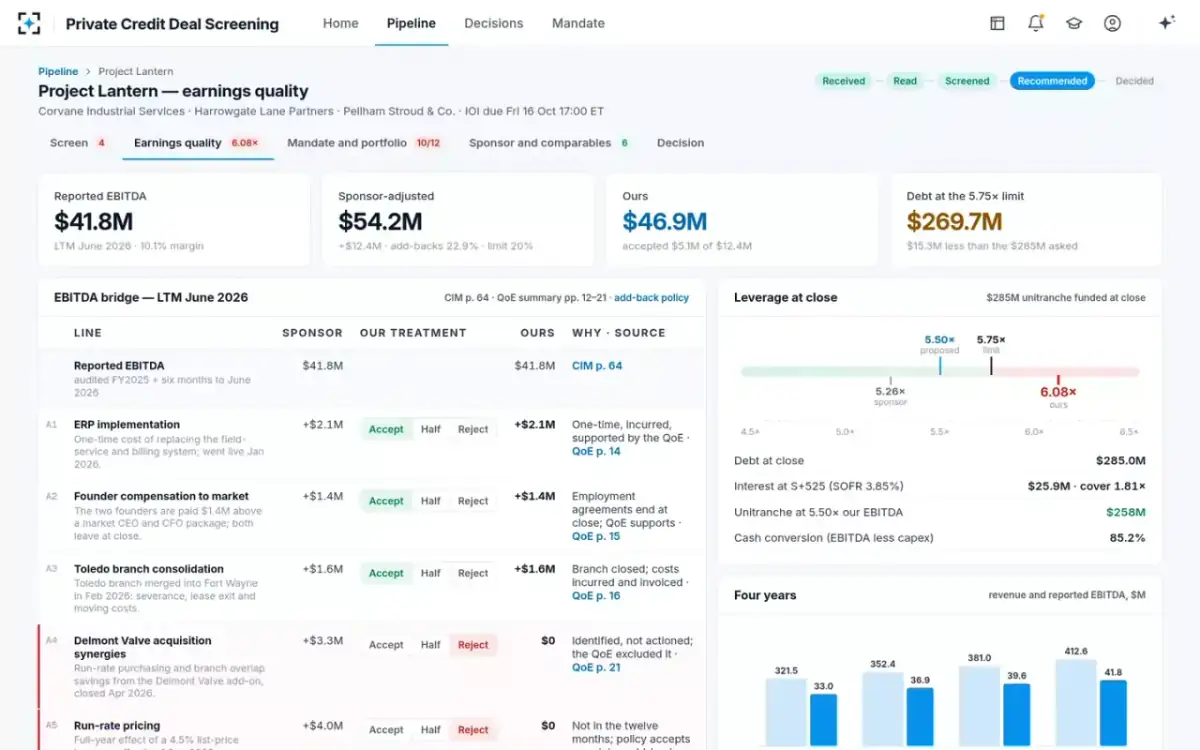
On Project Lantern, the CIM's own adjusted EBITDA of $54.2 million is reported EBITDA of $41.8 million plus $12.4 million of add-backs the sponsor included. A lender's job is not to argue with the reported figure; it is to decide, add-back by add-back, which of that $12.4 million survives.
The two tests every add-back must pass: incurred, and non-recurring
An add-back qualifies when the cost was genuinely incurred — money was actually spent or actually lost, not forecast — and when it will not recur. Both tests have to pass. A cost that was incurred but will keep happening every year is not an add-back; it is simply next year's expense, and taking it out of this year's EBITDA overstates what the business actually earns going forward. A savings that will not recur but has not actually happened yet, such as a synergy still on a slide, fails the other test for the opposite reason: there is no cost to look at, only a projection.
A third test rides along with the first two on the add-backs that cause the most argument: has the change actually been actioned? A price increase that has been announced but not yet billed, or a synergy that has been identified in a model but not yet executed, is neither incurred nor demonstrably non-recurring — it is a plan, and a lender's EBITDA is built from what has happened, not from what a sponsor expects to happen next quarter.
What usually passes: one-time costs, founder-pay normalization, closed-facility consolidation
Three kinds of add-back usually clear both tests when the evidence is there. A one-time restructuring, system-implementation or litigation cost that has already been paid and will not repeat is the cleanest case: the cash is gone, and gone once. Founder or owner compensation normalization, adjusting a privately held company's EBITDA for pay the sponsor's own buyer would not continue at the same level, is standard once the company changes hands, because the inflated pay genuinely ends at close. And costs tied to a facility, branch or product line that has already been shut down qualify once the closure itself, not just the plan to close it, has happened.
On Lantern, all three showed up together: ERP implementation costs, founder-pay normalization and the Toledo branch consolidation, $5.1 million in all, each one supported by a page in the quality of earnings report rather than by the sponsor's own say-so.
What usually fails: unactioned synergies, run-rate pricing, forecast cost saves
The add-backs that fail are nearly always a version of "this will be true soon." A synergy identified in a merger model but not yet realized in the combined business's actual results fails the incurred test, because no cost has actually left and no saving has actually arrived. A run-rate pricing adjustment — "if we annualize the price increase we billed last month, EBITDA would be higher" — fails because the higher revenue is not yet in the trailing twelve months the lender is measuring. A forecast cost saving from a restructuring that has been approved but not completed fails for the same reason twice over: not incurred, and not yet proven non-recurring, because the restructuring itself could stall.
Five add-backs, three tests, one treatment
| Add-back | Incurred? | Non-recurring / actioned? | Fund’s treatment |
|---|---|---|---|
| ERP implementation costs | Yes — cash already spent on the system | Yes — a one-time project | Accepted in full |
| Founder-pay normalization | Yes — above-market pay already recorded | Yes — ends when the sponsor exits | Accepted in full |
| Toledo branch consolidation | Yes — severance and closing costs incurred | Yes — the branch is already closed | Accepted in full |
| Delmont Valve synergies | No — not yet realized | Not actioned | Rejected; half counts once actioned |
| A run-rate pricing increase | No — billed, but not yet in the trailing twelve months | Not yet in trailing results | Rejected until it shows up in trailing EBITDA |
On Lantern, $3.3 million of Delmont Valve synergies and $4.0 million of run-rate pricing, $7.3 million together, were rejected for exactly these reasons. Both might qualify later, once the synergies are actually captured in the business and the pricing shows up in a trailing twelve months the lender can measure, which is the "once actioned, at 50%" clause the fund's own mandate applies to acquisition synergies.
What the research says happens when a weak add-back gets through anyway
The incentive to let a weak add-back through is obvious: a higher adjusted EBITDA lowers measured leverage and makes a deal easier to approve. Research on leveraged loan covenants finds that incentive has a cost. A Federal Reserve Bank of St. Louis working paper by Faria e Castro, Gopalan, Pal, Sánchez and Yerramilli read the EBITDA definitions in 4,940 syndicated credit agreements from 1995 to 2019 and reports that "these addbacks increase the likelihood of loan delinquency and default, and also increase the likelihood of the borrower experiencing a ratings downgrade". All but 344 of those agreements allowed at least one non-GAAP add-back, and about 43% allowed three or more. The add-backs that make a covenant easier to pass on paper are, on average, the same ones that make the loan more likely to go bad.
What each extra add-back in a credit agreement was associated with, 1995–2019
+4.2%
probability of the loan becoming 60 days delinquent within three years, against an unconditional 1.3%
+1.6%
probability of default within three years, against an unconditional 1.1%
93%
of the 4,940 credit agreements read allowed at least one non-GAAP add-back
43%
allowed three or more
Bank supervisors have made the same point about the loans built on top of weak EBITDA definitions. The 2022 Shared National Credit review by the Federal Reserve, the OCC and the FDIC found that leveraged loans continue to have weak structures. These structures often reflect layered risks that include some combination of high leverage, aggressive repayment assumptions, weak covenants, or terms that allow borrowers to increase debt, including draws on incremental facilities. An inflated EBITDA is rarely the only weak point in a deal; it tends to travel with other structural shortcuts, which is one reason a fund's own add-back policy is worth holding to even when a sponsor's banker pushes back.
Worked example: from a sponsor's number to a lender's number
Laid out step by step, the Lantern bridge shows exactly where the $7.3 million difference between the sponsor's leverage and the fund's own comes from.
The EBITDA bridge, Project Lantern, step by step
| Step | Calculation | Result |
|---|---|---|
| 1. Sponsor’s adjusted EBITDA, as presented in the CIM | Reported directly in the offering memorandum | $54.2M |
| 2. Add-backs the sponsor included | $5.1M incurred and non-recurring, plus $3.3M of identified-not-actioned synergies, plus $4.0M of run-rate pricing | $12.4M |
| 3. Reported EBITDA, before any add-back | $54.2M − $12.4M | $41.8M |
| 4. Add-backs the fund accepts | ERP implementation, founder-pay normalization and the Toledo branch consolidation — each incurred, non-recurring and supported by a QoE page | $5.1M |
| 5. Add-backs the fund rejects | Delmont Valve synergies, identified but not actioned, and a run-rate pricing increase not yet in the trailing twelve months | $7.3M |
| 6. The fund’s adjusted EBITDA | $41.8M + $5.1M | $46.9M |
| 7. Leverage on the $285M ask | Sponsor’s number $285M ÷ $54.2M; the fund’s number $285M ÷ $46.9M | 5.26× → 6.08× |
Nothing about this bridge is exotic. It is the same arithmetic a fund that works entirely by hand would do on a whiteboard; the difference is only whether every number is traced back to the page it came from, or re-typed from memory under a Friday deadline.
How one add-back changes leverage, turn by turn
Leverage is the loan amount divided by adjusted EBITDA, so every dollar an add-back fails to qualify pushes the denominator down and leverage up. On the $285 million Lantern ask, the sponsor's own $54.2 million EBITDA puts leverage at 5.26 times. Rejecting the $7.3 million of synergies and run-rate pricing brings EBITDA down to $46.9 million and leverage up to 6.08 times, 0.82 of a turn higher, against a fund mandate capped at 5.75 times.
5.26× on paper, 6.08× on the fund’s own EBITDA
That is the whole point of recomputing add-backs rather than taking a sponsor's leverage figure on trust: the ratio on the cover page and the ratio a fund is actually exposed to can sit on opposite sides of a mandate limit, and the gap between them is entirely made of add-backs, not of anything else in the deal. Half the Delmont synergies, once actioned, would close part of that gap; why a clean deal can still break a fund's concentration limits covers what else can stop a deal even after the leverage math clears.
Where add-back disputes end up: fund policy against sponsor pressure
Every add-back dispute is, underneath the accounting, a negotiation between a sponsor's banker, who is paid to present the largest defensible EBITDA, and a fund's own written policy, which exists precisely so that defense does not get relitigated deal by deal under deadline pressure. NBER research surveying private debt funds found that funds use and negotiate for both financial and incurrence covenants to monitor their investments, and that the presence of PE sponsors helps them lend more and craft more effective covenants — sponsors are a source of discipline on documentation as often as they are a source of pressure on EBITDA.
A written policy is what turns that negotiation from a one-off argument into a repeatable decision. Fund IV's own policy allows acquisition synergies once actioned, at half their value, which is a middle position between accepting a sponsor's projection outright and rejecting every forward-looking adjustment on principle. Private credit itself is still a young enough market that few of its underwriting disputes are settled by regulation; private credit or private debt investments are debt-like, non-publicly traded instruments provided by non-bank entities, as the Federal Reserve's own description puts it, and a fund's add-back policy is one of the few places that market writes its own rules down where everyone on the desk can see them, version by version.
The EBITDA bridge, accept, haircut or reject
One click: half the synergies, still red
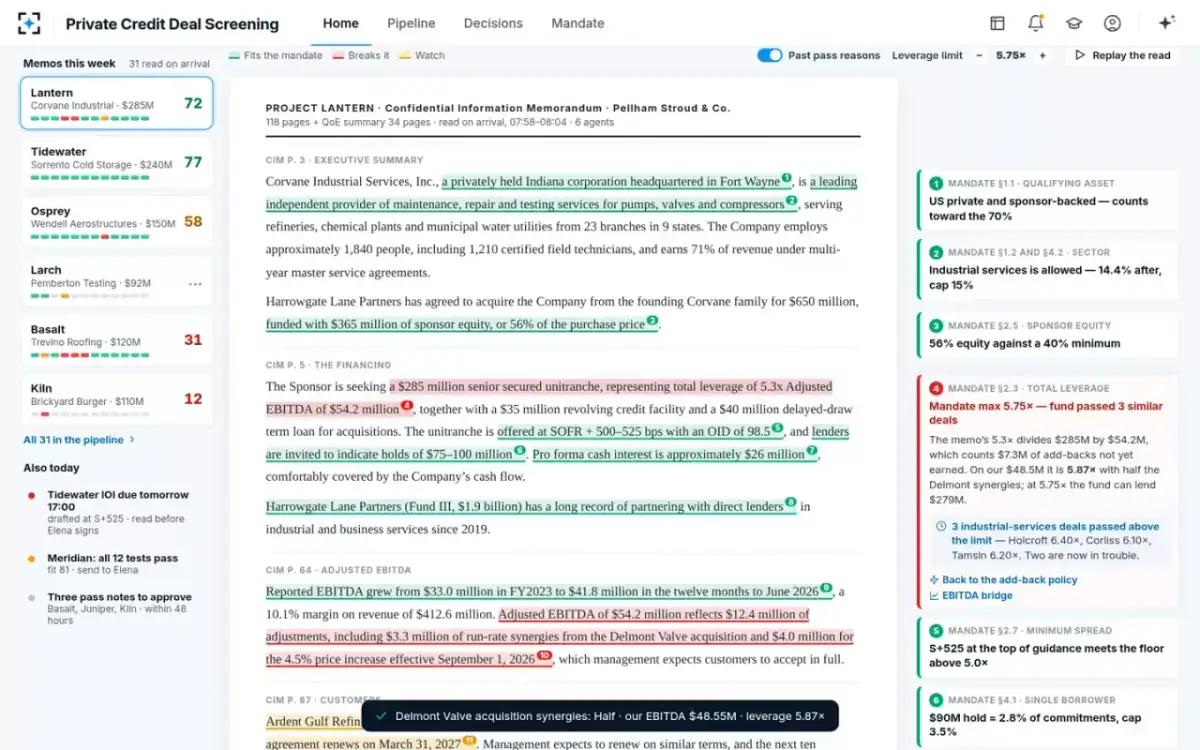
Private Credit Deal Screening does not resolve that negotiation; it makes the fund's own policy the thing being applied, consistently, whoever is reading the memo and however close the IOI deadline is. To see a full bridge built this way on one memorandum, start from Private Credit Deal Screening.
Questions people ask
What is an EBITDA add-back?
A line a sponsor wants restored to earnings before a lender measures leverage against it, usually a cost the sponsor says is one-time or a saving it expects soon. An add-back qualifies only once a lender confirms it was actually incurred and will not recur; until then it is a claim, not a number.
Which add-backs do lenders typically reject?
Synergies identified but not yet captured in the business, price increases not yet reflected in trailing results, and forecast cost savings from a restructuring that has not finished are the three most common rejections, because each describes something expected to happen rather than something that already has.
What is the difference between a one-time cost and a run-rate adjustment?
A one-time cost has already been paid and, by its nature, will not repeat — a system implementation, a closed-facility severance. A run-rate adjustment projects a future period's results from a recent change, such as annualizing a mid-year price increase; it estimates something that has not yet shown up in a full trailing twelve months, which is why lenders treat it far more cautiously.
Can synergies be added back to EBITDA before a deal closes?
That is for each fund's written policy to decide, and a cautious one will not count them in full. The fictional sample fund on this page allows a synergy add-back only once it has actually been actioned in the business, and then at half its projected value, rather than at the number a model projects.
Why does sponsor EBITDA differ from lender EBITDA?
Because the sponsor's bankers choose which add-backs to present, and a lender's own underwriters decide which of those add-backs actually pass the incurred and non-recurring tests. The difference is nearly always the add-backs a lender rejects, not a disagreement about the reported figure underneath them.
How much does one rejected add-back change leverage?
Enough to matter. On the sample deal on this page, rejecting $7.3 million of add-backs out of a $54.2 million claimed EBITDA moved leverage from 5.26 times to 6.08 times on the same $285 million loan amount — most of a full turn, and in this case the difference between a deal inside a fund's mandate and one outside it.