Private credit underwriting team roles are easiest to understand as a relay, not a job description. A teaser lands with origination, a confidential information memorandum moves to underwriting, a one-page screen goes to the Head of Underwriting, and the largest or most exceptional deals go on to an investment committee — five seats, each with its own authority and its own thing to sign. On a direct lending desk, the friction that slows a deal down almost never sits inside one seat's workload; it sits in the gap between two seats, where a memo waits for someone to pick it up. Botminds' Private Credit Deal Screening reads every memo the day it arrives and keeps that relay moving, but it does not change who holds any of the five seats or what each one is trusted to sign.
The desk in this guide is Fund IV, a fictional direct lender, as it runs one memorandum — code name Project Lantern — through the solution. Five named people carry it: Rafael Quintero, Managing Director of Origination; Hannah Zielinski, Associate in Underwriting; Daniel Okafor, Vice President of Underwriting; Elena Marsh, Head of Underwriting; and Marcus Bell, the CIO who chairs the investment committee. The fund, the people and the deal are invented; the five seats, the handoffs between them, and the published research on who does this work and what it pays are not.
The five seats on a private credit deal
On Fund IV, every deal that reaches a signature passes through the same five seats, in the same order; other desks use other titles, but the hand-offs are the ones a direct lender has to make somewhere. Origination owns the sponsor relationship and decides, in the first hours, whether a teaser is worth a second look. Underwriting — usually an associate building the screen and a Vice President who owns it — turns the memorandum into a tested view of the deal. The Head of Underwriting approves spending the desk's time and the sponsor's trust on diligence. And where the loan is large enough or the deal needs an exception to the fund's own rules, an investment committee votes.
Five seats, one deal: who does what between a teaser and a decision
A person decides
Origination — Managing DirectorTakes the banker’s call, decides in hours whether the sponsor relationship and the sector are worth a serious look, and sends the teaser into the pipeline.
Never: Never underwrites the deal — origination opens doors, it does not price them.
A person decides
Underwriting — AssociateWorks the confidential information memorandum and the quality-of-earnings report into the screening template: every figure, every add-back, every customer.
Never: Never signs the one-page screen that goes to the Vice President.
A person decides
Underwriting — Vice PresidentOwns the one-page screen: the fund’s own EBITDA and leverage, the mandate tests, the red flags, and a recommendation — pursue, pursue with an exception, or pass.
Never: Never approves spending diligence money alone.
A person decides
Head of UnderwritingReads the Vice President’s recommendation and approves pursue, which is the decision that commits the desk’s time and the sponsor’s expectations to the deal.
Never: Never sends a note to the banker before approving.
A person decides
Investment Committee ChairTakes the exception requests and the largest commitments — on this desk, any indication above $100 million — to a vote.
Never: Never sees a deal the Head of Underwriting has already passed on.
What makes this a relay rather than five independent jobs is that no seat can finish its own work without what the seat before it produced. An associate cannot build a screen from a teaser; a Vice President cannot recommend pursue from an unscreened memo; a Head of Underwriting cannot approve diligence spend on a recommendation nobody signed. A desk that wants to know where its deals actually slow down has to look at the queue between seats, not at any one seat's calendar.
Origination: the first read and the 48-hour reply
Origination's job starts before there is a deal to underwrite. A banker sends a teaser — a page or two, a sector, a rough size, sometimes a name — and origination has to decide, fast, whether the fund wants to see the confidential information memorandum behind it. Rafael Quintero puts the standard plainly: sponsors remember who answered in 48 hours, and a fund that is slow on the teaser does not get asked back on the next deal, even if its final terms would have been competitive.
That speed is not guesswork. Research on how private debt funds actually choose deals finds that general partners lean heavily on the sponsor behind a deal: a survey of private debt funds that asked general partners how they source, select and evaluate deals reports that “the presence of PE sponsors helps them lend more and craft more effective covenants” (NBER Working Paper 30868, Block, Jang, Kaplan and Schulze, “A Survey of Private Debt Funds”). A private equity sponsor behind a deal is not a detail on page one; it is a large part of why the fund can move quickly and lend confidently at all, because the sponsor's own diligence and governance stand behind the numbers.
What origination can already see about the sponsor
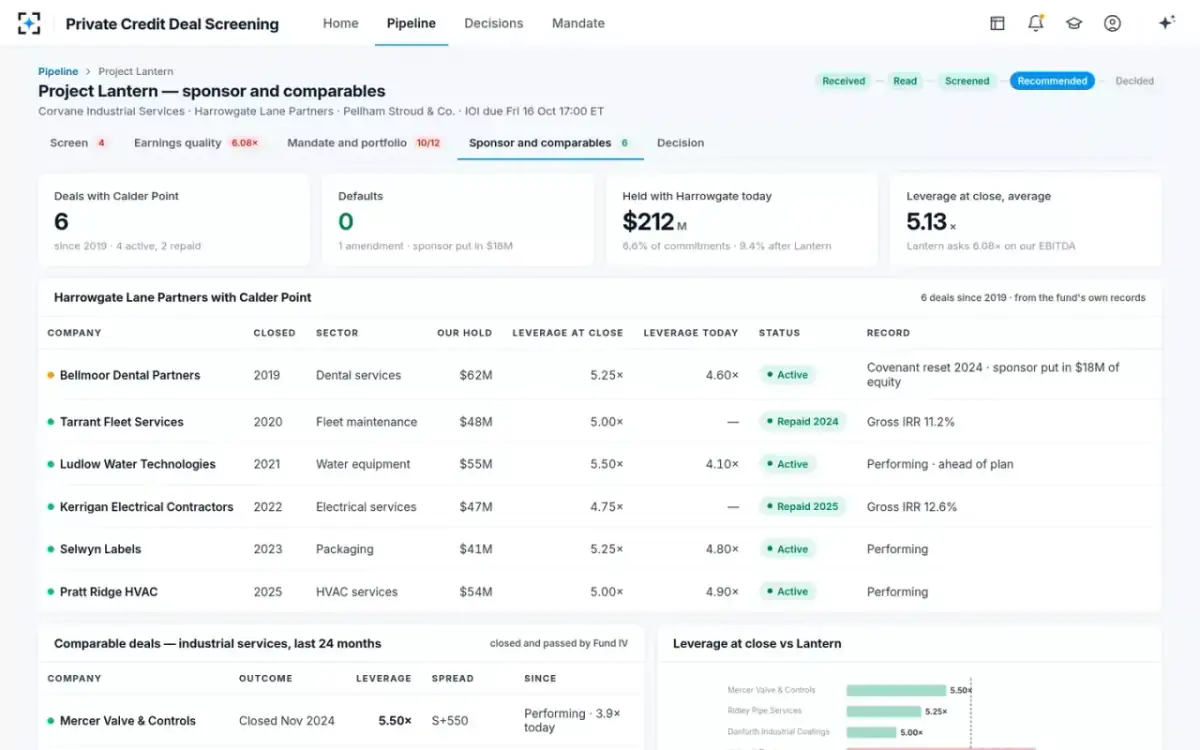
Origination's own seat has a boundary that is easy to miss, because its work looks like the most relationship-driven part of the desk. It decides whether to open a data room, not whether to lend. The moment a confidential information memorandum is in hand, the decision passes to underwriting, and origination's job becomes staying close to the sponsor and the banker while someone else does the testing.
Underwriting: from teaser to one-page screen
Underwriting is the seat with the most reading and the least room for a skim. Project Lantern's confidential information memorandum ran 118 pages, with a 34-page quality-of-earnings summary and a financial model behind it, and an indication of interest due four days after the data room opened. Hannah Zielinski, the associate, used to spend Friday afternoons keying the memorandum's tables into the fund's screening template — revenue, EBITDA, each sponsor add-back, customer concentration — one cell at a time, before she could start the part of the job that actually needed her judgment: which add-backs the fund's policy would accept.
Daniel Okafor, the Vice President, owns what that work becomes: a one-page screen with the fund's own adjusted EBITDA and leverage, the twelve Fund IV mandate and portfolio tests, the deal's red flags, and a recommendation. On Project Lantern, Daniel's Monday starts with the memo already marked up — every sentence a mandate test depends on highlighted, with a margin note naming the clause and the limit — so his first substantive act of the week is judgment, not transcription.
The memo a Vice President opens on Monday morning
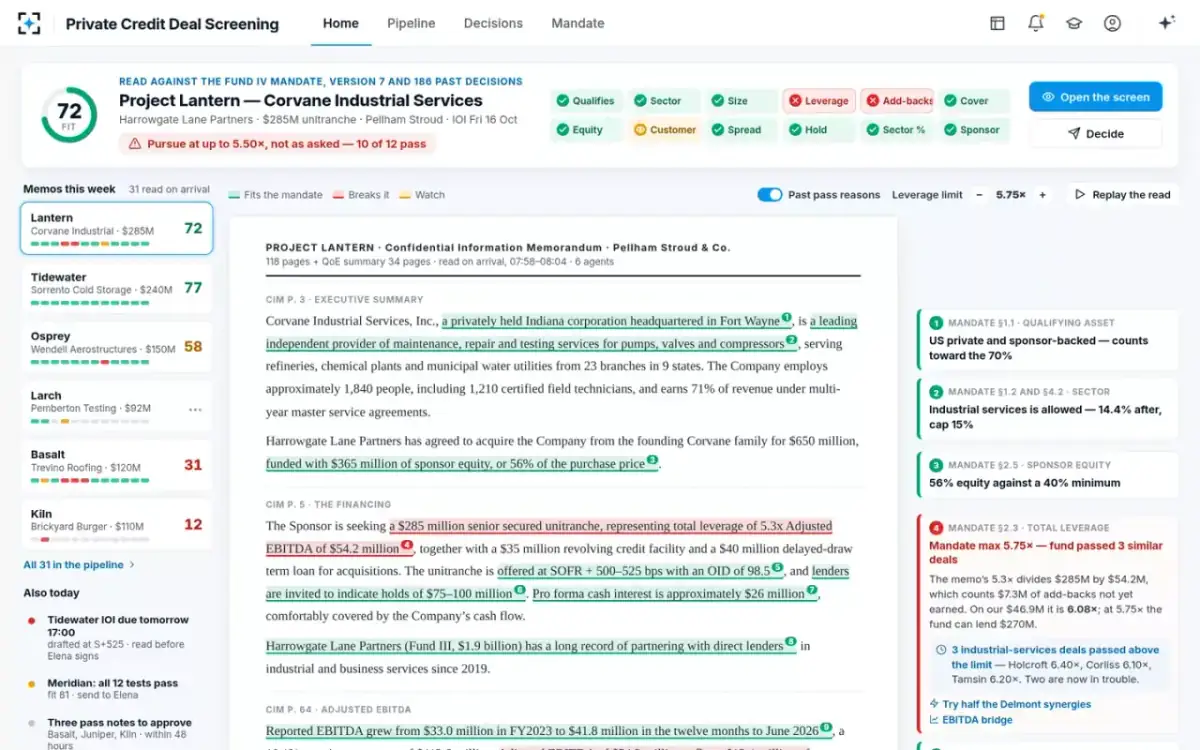
The associate-to-Vice-President handoff inside underwriting is the one most often confused with a single job. An associate's screen is a draft until a Vice President has tested the sponsor's own EBITDA number against the fund's add-back policy and decided whether the deal still fits the mandate once that is done. On Project Lantern that single step moved leverage from the sponsor's reported 5.26× to the fund's own 6.08× — the difference between a deal that looks like it fits and one that does not, and it is a Vice President's signature that says which reading the fund is relying on.
What the Head of Underwriting signs, and what it means
A Vice President's recommendation is not a decision to spend the desk's diligence budget; that authority sits one seat higher. On Fund IV, Elena Marsh is the Head of Underwriting, and her approval is what the fund's own mandate names as the checkpoint between a screen and a live deal: diligence costs money and ties up the deal team's time, and nothing moves past the screen until she has signed off on spending it.
What she is signing is specific, not a general sense that the deal looks fine. Daniel's recommendation on Project Lantern reads “I have read this screen and recommend it,” and Elena's approval — “approve spending diligence money on Lantern” — is a second, separate judgment: not whether the numbers are right, which is the Vice President's job, but whether the fund should commit resources to finding out more. Only once she has signed does the note with the deal team's first diligence questions go out to the banker. A desk that collapses those two signatures into one has, in practice, let a Vice President authorize the fund's own spending.
When a deal needs the investment committee
Most deals that pass the Head of Underwriting never reach an investment committee at all; the committee exists for the deals that are either large or that ask the fund to step outside a rule it wrote for itself. On Fund IV that line is a dollar amount: any indication above $100 million goes to committee, whatever its leverage or its sector. Marcus Bell, the CIO, chairs that committee, and his seat is deliberately the last one in the relay — he sees a deal only after origination has brought it in, underwriting has tested it, and the Head of Underwriting has already judged it worth diligence money.
What the committee chair sees once a deal is approved
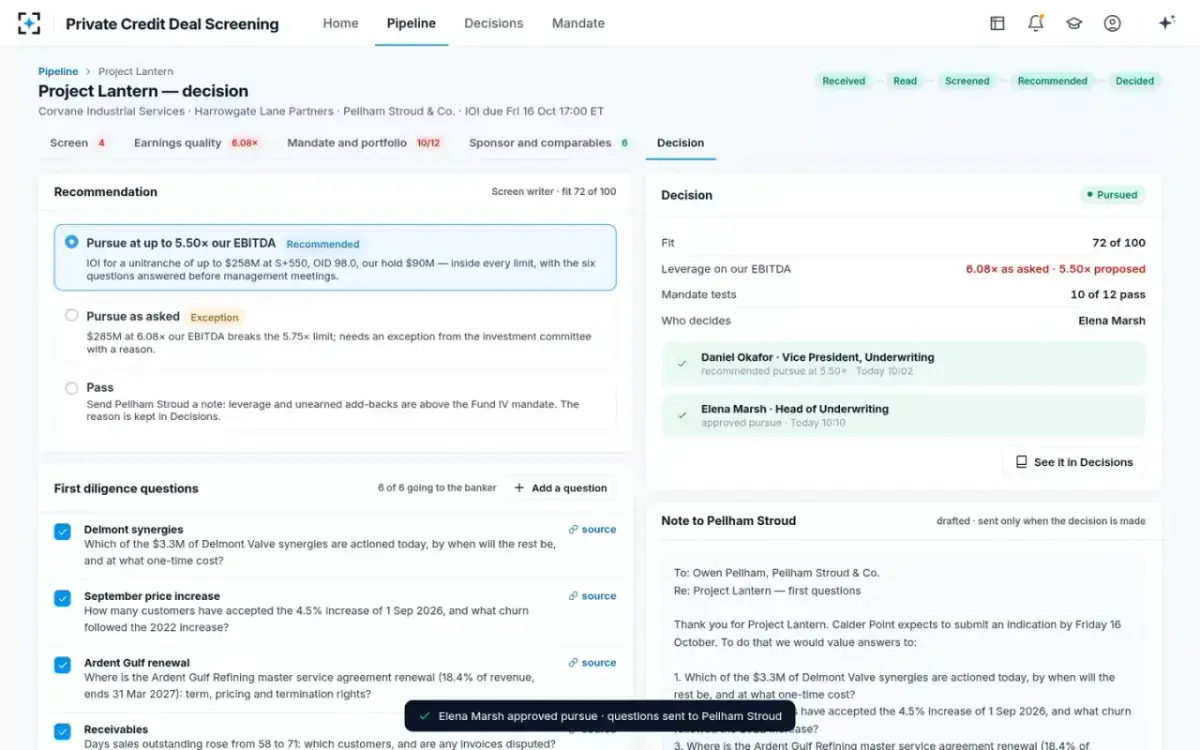
What Marcus asks for is not a re-read of the screen; it is the fund's own history with deals that looked like this one. His own words set the standard: he wants to see the deals the fund passed on and where they ended up, not only the ones it closed. A committee that only ever reviews live deals has no way to tell whether its past “no” decisions were right, and that question belongs to the chair's seat, not to underwriting's.
A VP's week versus an associate's week
Put the five seats' own words next to each other and the difference in what each week is actually made of becomes concrete. An associate's complaint is about the keyboard; a Vice President's is about volume; a Head of Underwriting's is about brevity; a committee chair's is about memory.
What each seat's week held, and what it holds now
Today
“Sponsors remember who answered in 48 hours.”
With agents
Sees the sponsor’s full record with the fund, and every pass goes back to the banker with a reason inside the same window.
Today
“Friday afternoons I am a very expensive typist.” CIM tables keyed into the screening template by hand.
With agents
Starts from the figures already pulled with their pages, and spends the afternoon reviewing add-back treatments instead of retyping them.
Today
“I read the first ten pages of most memos and the whole of very few.”
With agents
Opens every memo already marked against the mandate, with leverage on the fund’s own EBITDA, and spends the week on the deals that fit.
Today
“Tell me on one page why we should spend diligence money on it.”
With agents
Gets that page — fit, leverage as asked and as proposed, the mandate tests and the open questions — before anything reaches the banker.
Today
“Show me the deals we passed on and where they ended up.”
With agents
Has every pass and pursue with its reason and who decided, and the passed deals tracked after they closed elsewhere.
The shift is not that any seat does less work; it is that less of the week goes to work a computer can do as well, and more of it goes to the work that needs a signature. An associate who no longer retypes a memorandum's tables still has to decide whether each add-back the sponsor claims survives the fund's policy. A Vice President who no longer reads page one of ninety unpromising memos still has to recommend pursue, pursue with an exception, or pass on the ones that reach a desk.
One first-pass screen: which seat did each task, and the hours by hand and with agents
| Task | Seat that does it | By hand | With agents | What the seat still does |
|---|---|---|---|---|
| Reading the CIM and the QoE | Associate, then VP | 6 h | 0.2 h | Reads the marked-up pages the tests depend on |
| Keying figures into the template | Associate | 3 h | 0.1 h | Spot-checks figures against their cited pages |
| Sorting add-backs, recomputing leverage | Associate drafts, VP decides | 2 h | 0.3 h | Changes any treatment, with a reason kept |
| Mandate and portfolio limits | VP | 1 h | 0.1 h | Reads every fail and watch |
| Sponsor record and comparables | VP, with origination | 1.5 h | 0.2 h | Adds what the record cannot know |
| Writing the screen and first questions | VP | 2 h | 0.5 h | Edits, recommends and signs |
What published wage data says about these roles
Private credit desks do not use the government's job titles, which makes it tempting to assume the roles are too specialized to compare with anything published. They are not entirely: the work an associate does on a screening template — researching and evaluating financial data, building reports with a recommendation attached — sits squarely inside the Bureau of Labor Statistics' definition of a financial analyst, who, in the Bureau's words, “research and evaluate financial data, forecast future trends, and prepare reports” for businesses and investors, with a median annual pay of $103,570 in 2025 (U.S. Bureau of Labor Statistics, Occupational Outlook Handbook). The narrower occupation of credit analyst, which O*NET tracks separately, carried a median annual wage of $83,510 in 2025, $40.15 an hour.
Two published wage lines that bracket the underwriting desk
Read that bracket for what it is, not more. Neither figure separates a middle-market direct lending desk from a bank's credit department or a public-markets research seat, and a Vice President who recommends pursue or pass on a nine-figure loan is paid for more than either occupation alone describes. What the two figures do show is that the mechanical half of the job — reading, keying and sorting the facts a recommendation rests on — is exactly the kind of work published wage data prices as entry-to-mid-level analytical labor, which is also the half a desk can hand to an agent without touching who signs.
What research says about the people and the method behind direct lending
100h
of due diligence per deal for the average US private debt investor
78%
of US private debt funds’ capital in deals with a private equity sponsor
7%
projected growth in financial analyst jobs, 2025–2035, much faster than average
Where direct lenders specialize their desks by industry
The five seats are not generalists working whatever deal lands on the desk. Research comparing how direct lenders, banks and finance companies underwrite finds that “direct lenders are more highly specialized by industry than banks” (NBER Working Paper 34500, Jang, Kim, Sufi and Chen, “The Lending Technology of Direct Lenders in Private Credit”), and ties that specialization to how direct lenders actually get repaid: because they write loans against a borrower's going-concern value rather than its hard collateral, knowing an industry well enough to judge what a company is worth as a business, not a pile of assets, is the skill the desk is built around.
Fund IV's own numbers show the same pattern from the inside. Its industry concentration test watches industrial services specifically, because that is where the fund has built sponsor relationships and underwriting judgment over several cycles — and where a string of past passes above the leverage limit, tracked and looked back on, has taught the desk more about its own appetite than any single closed deal could. A desk that specializes by sector is, in practice, a desk whose five seats share a deeper, narrower memory than a generalist lender's do, and that memory is exactly what a Head of Underwriting and an investment committee chair draw on when a new deal rhymes with an old one. Private credit's own definition, from the Federal Reserve's note on the sector, is worth keeping in view while reading any of this: “private credit or private debt investments are debt-like, non-publicly traded instruments provided by non-bank entities” (Board of Governors of the Federal Reserve System, FEDS Notes, February 2024) — a non-bank structure that is exactly why these five seats, and not a bank's committee structure, are the ones making the call.
Questions people ask
What does a private credit underwriter do?
A private credit underwriter turns a confidential information memorandum into a tested view of whether a deal fits the fund's mandate: pulling the figures, sorting the sponsor's EBITDA add-backs under the fund's own policy, recomputing leverage and interest cover, and running the deal against credit and portfolio limits before recommending pursue, pursue with an exception, or pass.
Who approves a private credit deal?
No single person does. An underwriting Vice President recommends; the Head of Underwriting approves spending diligence money on the deal; and on the largest indications, or any that need an exception to the fund's own mandate, an investment committee votes. Each sign-off is a separate, named decision, kept on the record with its reason.
What is the difference between a private credit associate and a vice president?
An associate builds the screen: keying the memorandum's figures, checking each add-back against the fund's policy, and drafting the first pass at the numbers. A Vice President owns the result — the recommendation, the sign-off on which add-backs the fund accepts, and the judgment call on whether to pursue, exception or pass. The associate drafts; the Vice President decides what the fund relies on.
Does origination or underwriting screen a deal first?
Origination sees a deal first, in the form of a banker's teaser, and makes the fast call on whether to request the full memorandum. Underwriting only starts once the confidential information memorandum and quality-of-earnings report are in hand; its screen is the first test of the deal's actual numbers against the mandate, not the first look at the deal.
What does a private credit analyst's week actually look like?
Mostly reading and reconciling, not meeting bankers. An associate's week is built around the memorandum and the quality-of-earnings report in front of them: pulling figures, testing add-backs against the fund's policy, and flagging what does not add up, with the keying and re-keying that used to take up a Friday afternoon increasingly handled before the memo reaches them.
Is private credit underwriting a good career?
For someone who wants analytical work with a clear line to a decision, it offers that: an associate's work is tested, signed off and either pursued or passed within days. Published wage data gives a floor, not a ceiling: the BLS median for financial analysts was $103,570 in 2025, and the Bureau projects the occupation to grow 7% from 2025 to 2035, much faster than average; private credit desks set their own pay above that floor, and the published data does not break them out.