Can AI approve a private credit loan? In the agentic solutions Botminds builds, the answer is designed to be no, and the design is specific enough to check: Private Credit Deal Screening gives six agents the reading, sorting and drafting on a deal, and keeps every pass, pursue and approval with a named person. That split is not a disclaimer bolted on after the fact. It is written into what each of the six agents is told it may never do, and into the three decisions — recommend, approve, vote — that only ever carry a human signature. For a desk considering any AI underwriting tool, not only this one, those two lists are what a risk committee should ask to see before a single memo is read.
The deal in this guide is Project Lantern, a fictional 118-page memorandum run through Fund IV's sample instance of the solution. Six agents and three people — Daniel Okafor, Vice President of Underwriting; Elena Marsh, Head of Underwriting; and Marcus Bell, the investment committee chair — carry it from the data room to a decision. The fund and the deal are invented; the authority line between the six and the three is the product's own rule, not a scenario written for this page.
The five decision points on a private credit deal
A private credit deal passes through five points where something is decided, not merely read or calculated, and Fund IV's own rule names a person for every one of them: an underwriting Vice President may pass with a written reason; pursuing needs the Head of Underwriting; an indication above $100 million goes to the investment committee; every sign-off is recorded with who signed and when; and nothing leaves the desk — no note to a banker, no signed indication of interest — without one of those decisions behind it.
Six agents prepare the deal; three people decide it
Agent
Deal intake readerReads teasers, memoranda and process letters; names the company, sponsor, banker and ask; spots the same deal sent by two bankers.
Never: Never opens a data room without a signed confidentiality agreement.
Agent
Financials extractorPulls revenue, EBITDA, add-backs, capex and customer concentration from the memorandum, the QoE report and the model, each with its page.
Never: Never fills in a number that is not in the documents.
Agent
Earnings quality analystSorts each sponsor add-back into accept, haircut or reject under the fund’s written policy, and computes the fund’s own adjusted EBITDA and leverage.
Never: Never accepts a synergy or price increase not yet earned.
Agent
Mandate and portfolio testerRuns every credit and portfolio limit after the proposed hold, and shows the value, the limit and the source for each.
Never: Never waives a limit.
Agent
Sponsor and comparables researcherReads the sponsor’s record with the fund and the fund’s own comparable deals, closed and passed.
Never: Never uses one borrower’s confidential information in another deal’s reply.
Agent
Screen writerWrites the one-page screen, the red flags, the first diligence questions and the proposed terms.
Never: Never sends anything, and never decides pass or pursue.
A person decides
Underwriting Vice PresidentRecommends pursue, pursue with an exception, or pass, and signs what the recommendation means.
A person decides
Head of UnderwritingApproves spending diligence money on the deal; nothing is sent to the banker before this signature.
A person decides
Investment committeeVotes on any indication above the fund’s own dollar threshold, or any exception to its mandate.
Laid out this way, the shape of the authority line is simple: agents sit earlier in the chain and people sit at every point where the deal's outcome actually changes. What a desk's risk and compliance staff need to confirm, on this tool or any other, is that the line is enforced in the software, not only stated in a policy document that nobody is checking against what the product actually lets happen.
Six minutes twelve seconds on Project Lantern, agent by agent
- Intake reader: teaser, process letter, banker email0:24
- Financials extractor: 118-page CIM, QoE, model2:41
- Earnings quality analyst: 5 add-backs1:12
- Mandate and portfolio tester: 12 tests0:31
- Sponsor and comparables researcher0:48
- Screen writer: one page, 4 red flags, 6 questions0:36
What the deal-screening agents may do, and the line they may not cross
Each of the six agents has a narrow, named job and a "never" that bounds it. The deal intake reader names the company, sponsor, banker and ask from a teaser or memorandum, and merges a deal two bankers sent separately — but it never opens a data room without a signed confidentiality agreement. The financials extractor pulls every figure a screen needs, each tied to its page in the memorandum, the quality-of-earnings report or the model — but it never fills in a number the documents do not contain, and where the memorandum and the QoE disagree, it records both rather than picking one.
The earnings quality analyst is the agent with the most consequential judgment to make, because it sorts each of the sponsor's EBITDA add-backs into accept, haircut or reject under the fund's own written policy, and that sort is what turns a sponsor's leverage number into the fund's own. Its line is equally specific: it never accepts a synergy or a price increase that has not yet been earned, whatever the sponsor's memorandum claims about future savings. The mandate and portfolio tester runs every one of Fund IV's credit and portfolio limits after the proposed hold and shows the value, the limit and the source for each — but it never waives a limit, even when every other test on a deal passes comfortably. The sponsor and comparables researcher reads the fund's own deal history to answer what the fund already knows about this relationship — but it never carries one borrower's confidential information into another deal's reply. And the screen writer, which produces the one-page screen, the red flags and the first diligence questions a Vice President will read, has the plainest limit of all: it never sends anything, and it never decides pass or pursue.
Who signs, and what each signature means
Three signatures carry the deal past the point where an agent's work stops. Daniel Okafor's reads "I have read this screen and recommend it" — a statement about the screen's contents, not a rubber stamp on whatever the agents produced. Elena Marsh's approval of "pursue" is a second, separate judgment about spending the fund's diligence budget and the sponsor's goodwill on the deal. And where Fund IV's own $100 million threshold is crossed, Marcus Bell's investment committee votes on the indication itself.
The decision a Vice President actually makes
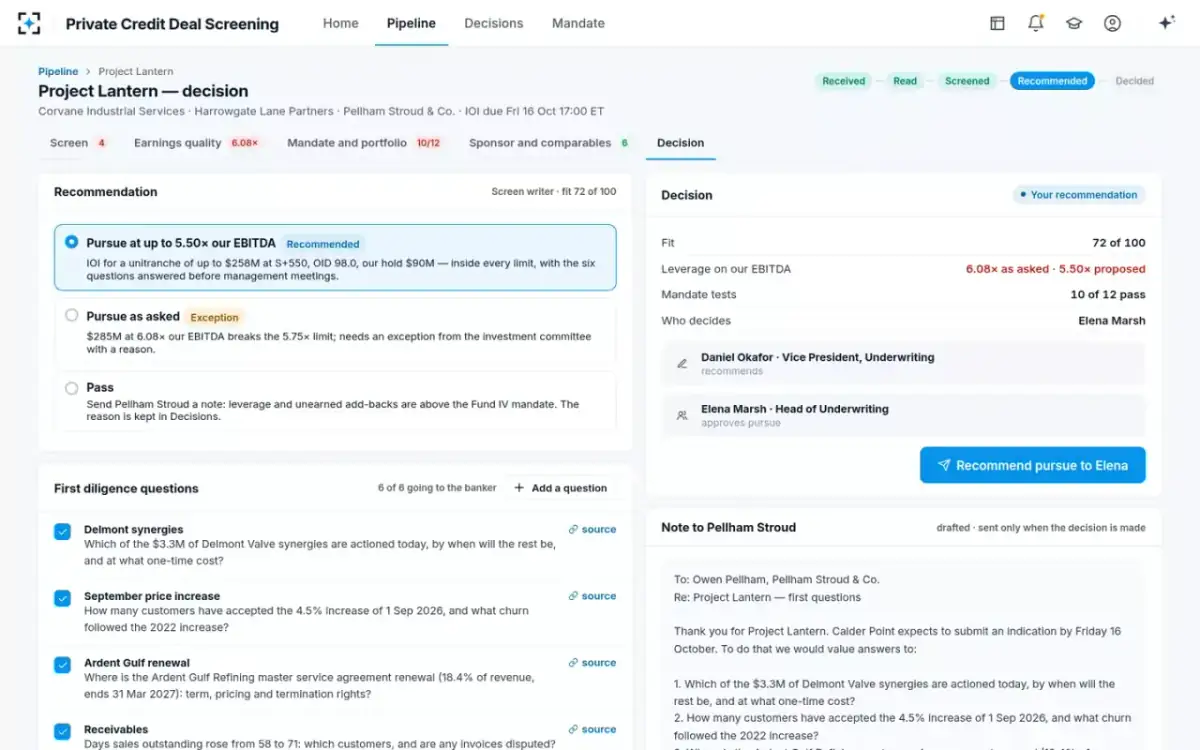
What makes each signature meaningful is that it attaches to something specific and already written down, not to a verbal summary. A Vice President signing "I recommend it" is agreeing to the fund's own adjusted EBITDA, the mandate tests as run, and the red flags as listed — all of which the agents produced and cited to a page, and all of which the Vice President could, in principle, re-check line by line. A signature on a document a person cannot verify is not oversight; it is an outsourced decision with a human name attached to it, and the difference matters as much for an examiner reading the file afterward as it does for the fund's own risk management.
Why regulators ask institutions to write down human-AI roles
Private credit funds are themselves non-bank entities — the Federal Reserve's own description of the sector is that "private credit or private debt investments are debt-like, non-publicly traded instruments provided by non-bank entities" (Board of Governors of the Federal Reserve System, FEDS Notes, February 2024) — so a fund is not itself examined the way a bank is. But the guidance banking regulators have already written for banks buying software from a third party is the reference a fund's own risk and compliance staff reach for anyway, because it asks exactly the questions a deal-screening tool's buyer should be asking. The OCC's interagency bulletin on third-party relationships "describes sound risk management principles to consider when developing and implementing third-party risk management practices, commensurate with the bank's risk profile and complexity as well as the criticality of the activity supported by the third party" (Office of the Comptroller of the Currency, Bulletin 2023-17, June 2023).
Read for a deal-screening tool rather than a bank's own vendor list, that guidance translates into a short set of questions: what exactly does the vendor's software decide versus draft; who at the fund is accountable if it is wrong; and does the criticality of underwriting — a judgment that puts real money at risk — call for more scrutiny than the fund would give a scheduling tool. A fund that cannot answer the first question in one sentence, naming what the software never does, has not yet done the diligence the question demands.
What a national AI risk framework asks you to document
The clearest single line on this question outside banking guidance comes from NIST's AI Risk Management Framework, written for any organization deploying an AI system, not only regulated lenders. Its GOVERN 3.2 subcategory states plainly that "policies and procedures are in place to define and differentiate roles and responsibilities for human-AI configurations and oversight of AI systems" (National Institute of Standards and Technology, AI Risk Management Framework 1.0).
"Policies and procedures are in place to define and differentiate roles and responsibilities for human-AI configurations and oversight of AI systems."
NIST AI Risk Management Framework 1.0, GOVERN 3.2
"Define and differentiate" is doing real work in that sentence: it is not enough to say a person is in the loop somewhere, the framework asks an institution to write down which role does which part. Fund IV's own mandate happens to answer that requirement almost word for word, because it names a person for pass, for pursue and for the vote above $100 million, and because every one of the six agents carries a stated "never" rather than an open-ended permission.
Fund IV's own sign-off chain, mapped to what GOVERN 3.2 asks for
| What the framework asks for | Where Fund IV's mandate answers it |
|---|---|
| Which role reads and drafts | Six named agents, each with a stated "never" |
| Which role decides pass or pursue | Underwriting Vice President recommends; Head of Underwriting approves pursue |
| Which role approves the largest exposures | Investment committee, above $100 million or any mandate exception |
| How oversight of the AI system itself is kept | Every sign-off recorded with who signed and when; mandate changes versioned and approved by the CIO |
Why "not yet fully tested" makes the authority line matter more
The case for keeping that line strict is not abstract; it is written into how regulators already describe the leveraged lending market private credit competes in. The 2022 Shared National Credit review by the Federal Reserve, OCC and FDIC found that leveraged loans "continue to have weak structures," reflecting "layered risks that include some combination of high leverage, aggressive repayment assumptions, weak covenants, or terms that allow borrowers to increase debt," and warned that "the performance of these leveraged loans has not been fully tested in a stressed economic environment that may contribute to higher default and lower recovery rates" (Board of Governors of the Federal Reserve System, OCC and FDIC, Shared National Credit Program review, February 2023).
An underwriting tool's own track record carries the same caveat, for the same reason: a model that sorts add-backs well in a benign credit cycle has not been tested against a sponsor under real pressure to dress up its numbers. That is precisely the scenario in which a strict authority line pays for itself — not when the agents are right, which costs nothing either way, but when a sponsor's EBITDA story is aggressive in a way that is easy to miss and expensive to accept, and a Vice President's signature is what stands between a plausible-looking screen and a loan the fund should not have made.
What happens when a person overrides the agents' sort
The earnings quality analyst's add-back sort is a draft, not a verdict, and the product's own rule for changing it is as specific as the sort itself: a person may change a treatment, but the reason is kept with it. That single sentence does two things a desk's risk committee should want from any AI underwriting tool. It keeps the final call with a person, and it keeps the disagreement itself on the record, so a reviewer can see not only what was decided but what the agent proposed and why a person decided otherwise.
What an agent proposes, and what a person actually decides
The agent's draft: Sorted into accept, haircut or reject under the fund’s written policy, cited to a page in the QoE.
What a person decides, and keeps a reason for: An underwriter may change the treatment; the reason is kept with the change, not only the new number.
The agent's draft: Three options laid out — pursue as proposed, pursue as asked, or pass — with the numbers and limits behind each.
What a person decides, and keeps a reason for: Underwriting VP recommends; Head of Underwriting approves pursue. Both signatures are a judgment, not a formality.
The agent's draft: Flagged where the proposed spread or hold falls outside the mandate’s stated minimum.
What a person decides, and keeps a reason for: Only the investment committee can approve an exception to the mandate; the agent cannot waive the limit it is testing against.
What a false add-back acceptance or a missed red flag costs is not abstract either: it is leverage computed on EBITDA the fund should not have counted, which is exactly the kind of error a second, human read is positioned to catch — provided the sort is visible enough, with its page citations intact, for an underwriter to actually disagree with it rather than simply accept whatever number appears.
What a reviewer will ask of a screened deal, and where the file answers it
| The question | Where the answer is kept | Who put it there |
|---|---|---|
| Where did this EBITDA figure come from? | The page of the CIM, QoE or model cited beside it | Financials extractor |
| Why was this add-back rejected, and who changed it? | The policy rule applied, and any override with its reason | Earnings quality analyst; the underwriter for an override |
| Which limits were tested, in which version? | The twelve tests with value, limit and source, against mandate version 7 | Mandate and portfolio tester; the CIO approved the version |
| Who recommended, and what did the signature mean? | The signed recommendation with its stated meaning and time | Underwriting Vice President |
| Who approved spending diligence money? | The approval, dated, before any note to the banker | Head of Underwriting |
| Why did the fund pass on a similar deal before? | The pass reason kept with that deal, and what happened since | The underwriter who passed it |
Building the sign-off trail an examiner will ask for
None of the authority line matters if the record of it cannot be produced afterward. Fund IV's own practice is to keep every pass and pursue with its reason and who decided, the sponsor's history with the fund, and the mandate version each test ran against — version 7 of the fund's mandate, for instance, carries the CIO's own approval and a date, so a reviewer reading a six-month-old decision can see the exact limits it was tested against, not today's.
What the file shows once a decision is made
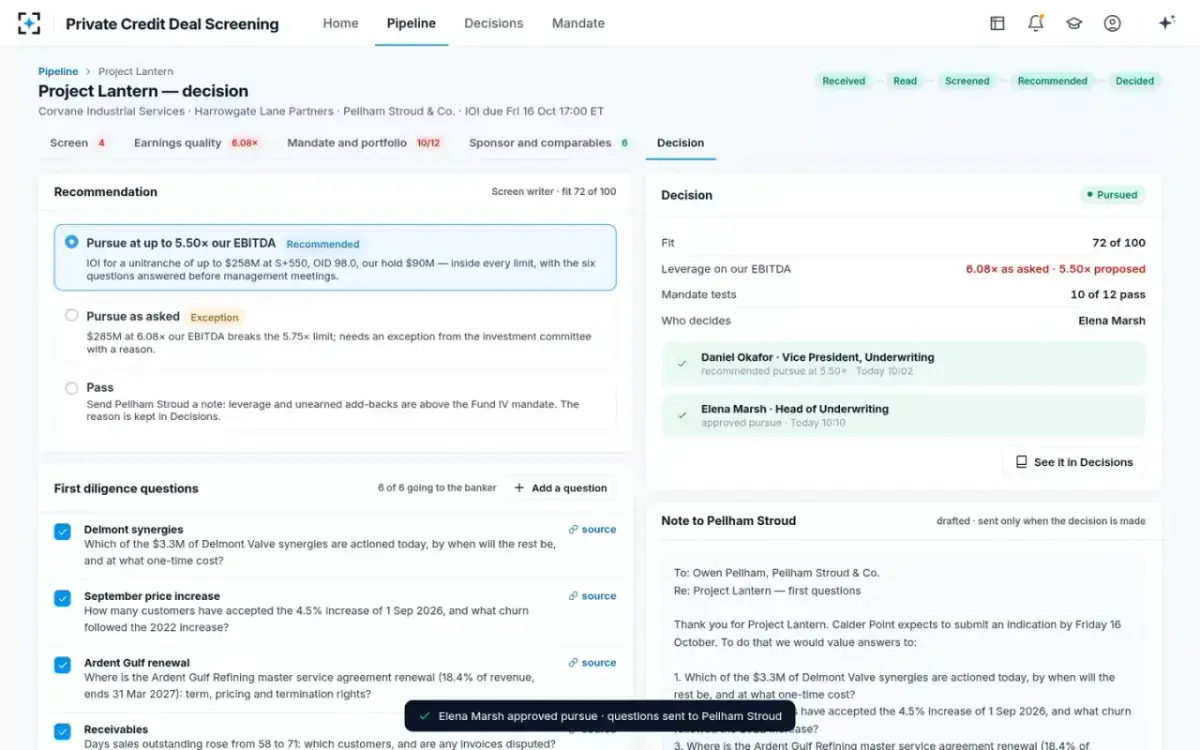
That trail is what turns "a person decided" from a claim into something an examiner, an auditor or the fund's own CIO can check. A desk evaluating any AI underwriting tool should ask to see this exact thing before a live deal touches it: not a description of the authority line in a sales deck, but a finished file where every agent step cites its source and every person step carries a name, a date and a reason.
Questions people ask
What is human-in-the-loop lending?
Human-in-the-loop lending is underwriting where software reads, calculates and drafts, but a named person makes every decision that changes the deal's outcome — pass, pursue, sign, approve. In Private Credit Deal Screening that means six agents prepare the screen and three people, an underwriting Vice President, a Head of Underwriting and an investment committee, carry every signature.
Who has to sign off on a direct lending deal?
At minimum, the underwriter who recommends it and the Head of Underwriting who approves spending diligence money on it. Indications above the fund's own dollar threshold, or any deal that needs an exception to the mandate, also need an investment committee vote. Each signature is recorded separately, with who signed and when.
What can't an AI agent do in underwriting?
In this solution, an agent never opens a data room without a signed confidentiality agreement, never fills in a figure the documents do not contain, never accepts an unearned synergy or price increase, never waives a mandate or portfolio limit, never carries one borrower's confidential information into another deal's reply, and never sends anything or decides pass or pursue on its own.
Does an AI underwriting tool need a model risk review?
Treat it as if it does, even though the banking agencies' April 2026 model risk guidance says generative and agentic AI "are not within the scope of this guidance" and leaves their controls to an institution's own governance. Interagency third-party risk guidance asks a bank to scale its review to the criticality of what a vendor's software does, and underwriting a loan is about as critical as a third-party activity gets. A fund that would not skip a model risk review for an internally built scoring tool should not skip one because the tool was bought rather than built.
What happens if an agent's draft is wrong?
It stays a draft until a person signs it. If the earnings quality analyst's add-back sort is wrong, an underwriter can change the treatment, and the reason for the change is kept with it. If the mandate tester misreads a limit, the Head of Underwriting is approving against the same cited limits and can catch it before diligence money is spent, not after a loan is funded.
How is an AI-drafted credit screen different from an AI decision?
A drafted screen states the numbers, the mandate tests and the options, each cited to a source; a decision commits the fund to one of those options and carries a person's name. The difference is not speed or confidence, it is authorship: a draft can be wrong without cost until someone signs it, and in this product nothing is sent to a banker, a sponsor or a committee without that signature.