A private credit fund's concentration limits are not about any one loan's credit quality; they are about what the fund's book looks like once that loan is added to everything it already holds. A loan can pass every test built around its own numbers — leverage, add-backs, interest cover, sponsor equity — and still be the one that pushes a sector past its cap or a sponsor relationship past its own, which is why a sound screen tests the deal and the fund separately, not the deal alone.
Botminds' Private Credit Deal Screening runs both sets of tests on every memo. On a fictional sample deal, Project Lantern, a $285 million unitranche request for Fund IV, twelve tests run after the proposed $90 million hold: ten pass, and two fail on the loan's own numbers. The fund, the deal and its figures are sample data from that fictional file, not a customer's result.
Two kinds of test: the deal's own numbers, and the whole book's
The first kind of test asks whether this loan, on its own, is a credit a fund should make: is leverage inside the mandate, are the add-backs reasonable, does interest cover hold up, is the sponsor's own equity in the deal large enough, is the borrower too dependent on one customer. The second kind asks a completely different question: once this loan sits inside the fund alongside everything else it has lent, does any part of the book — one sector, one sponsor relationship, the share of assets that actually qualify under the fund's own definition — end up more concentrated than the fund is willing to run.
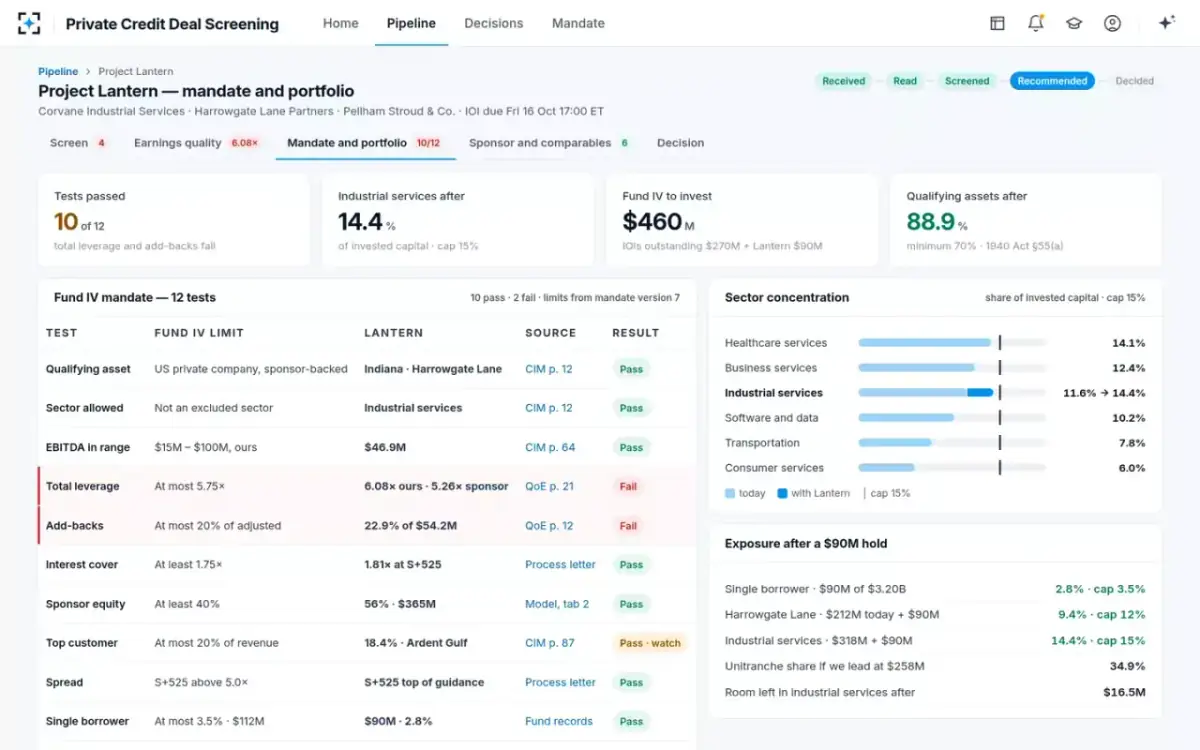
On Lantern, the two kinds of test told different stories. The loan's own leverage, at 6.08 times the fund's recomputed EBITDA, broke the 5.75 times mandate limit, and its add-backs, at 22.9 percent of adjusted EBITDA, broke the 20 percent cap — both deal-level failures. The portfolio-level tests, run on the whole fund after the proposed hold, told the opposite story: industrial services rose from 11.6 percent to 14.4 percent of invested capital, under the 15 percent cap, and qualifying assets sat at 88.9 percent, comfortably above the 70 percent minimum.
Seven of the twelve tests, both kinds, after the proposed $90M hold
| Test | Before this loan | After the proposed hold | Result |
|---|---|---|---|
| Total leverage, on this loan’s own numbers | — | 6.08× on the fund’s own EBITDA | ≤ 5.75× — fails |
| Add-backs, on this loan’s own numbers | — | 22.9% of adjusted EBITDA | ≤ 20% — fails |
| Top customer, on the borrower’s revenue | — | 18.4%, Ardent Gulf Refining | ≤ 20% — a watch |
| Industrial services, share of the whole fund | 11.6% of invested capital | 14.4% of invested capital, after the hold | ≤ 15% — passes |
| Harrowgate Lane, sponsor exposure | $212M | $302M, 9.4% of commitments | ≤ 12% — passes |
| Single borrower hold | — | $90M, 2.8% of $3.20B commitments | ≤ 3.5% — passes |
| Qualifying assets, share of the whole fund | — | 88.9% of the book, after the hold | ≥ 70% — passes |
What regulators mean by "concentration" in private credit
Concentration, in the sense regulators use it, is simply how much of a book's outcome rides on one thing going wrong — one sector turning down, one sponsor relationship souring, one class of asset proving harder to value than assumed. It matters more in private credit than in a diversified bank loan book because a fund's loans are few and large: Fund IV's single-borrower cap alone allows $112 million in one company. For funds organised as business development companies, two federal rules already impose a shape on the book, and a fund's own caps sit inside them.
The statutory concentration rules a BDC lender already lives under
| Rule | What it requires | Tested when |
|---|---|---|
| Investment Company Act §55(a), 15 U.S.C. 80a-54(a) | No new asset may be acquired unless qualifying assets, chiefly privately offered securities of eligible portfolio companies, are "at least 70 per centum of the value of its total assets" | At the time each acquisition is made |
| Internal Revenue Code §851(b)(3)(A), for a BDC taxed as a regulated investment company | At least 50% of total assets in cash, government securities, other RICs, and other securities limited per issuer to 5% of total assets and 10% of its voting securities | At the close of each quarter |
| Internal Revenue Code §851(b)(3)(B) | Not more than 25% of total assets in the securities of any one issuer, or of two or more controlled issuers in the same or related businesses | At the close of each quarter |
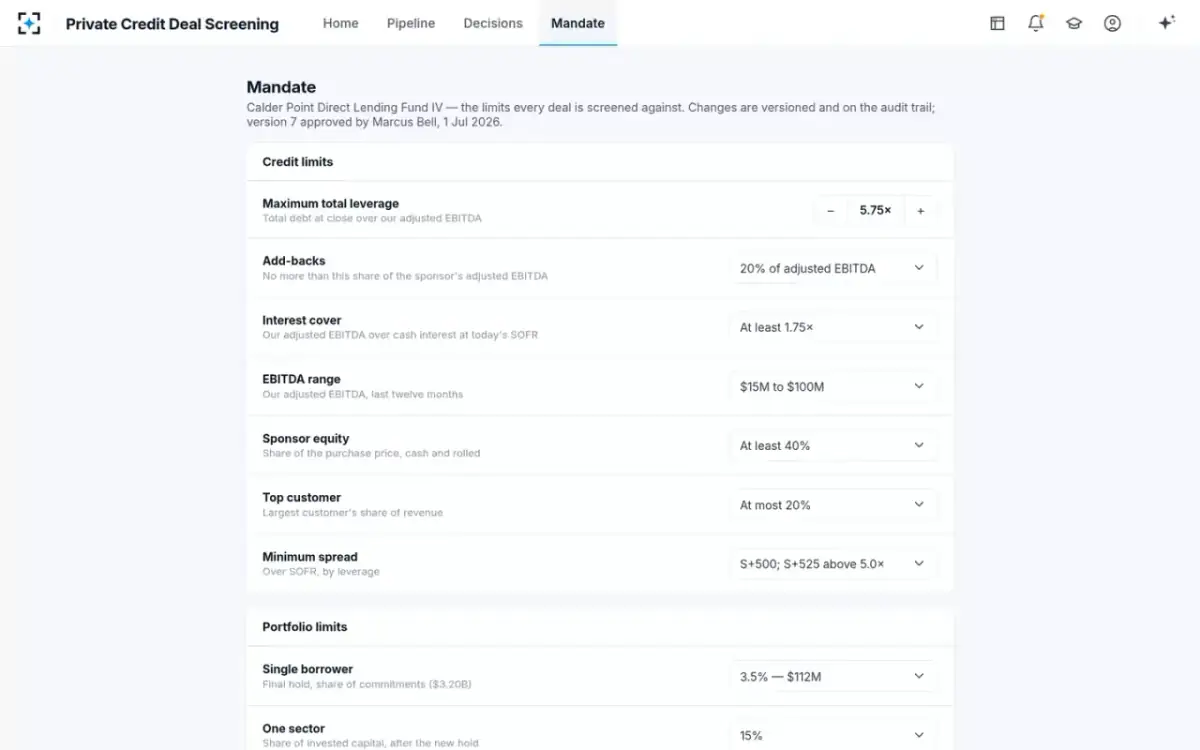
| The fund’s own mandate (Fund IV, sample) | Single borrower ≤ 3.5% of commitments; one sector ≤ 15%; one sponsor ≤ 12% | After each proposed hold, and on a schedule |
The Treasury's Financial Stability Oversight Council frames the systemic side of the same concern: private credit is increasingly interconnected with highly regulated financial institutions, including insurance companies and banks, which means a concentrated private credit book is not fully walled off from the rest of the financial system even though the loans themselves are not publicly traded. A fund's own concentration limits are, in effect, a private version of the diversification rules a bank's own regulators would otherwise impose.
Sector caps: what one more loan does to a desk's largest exposure
A sector cap exists because direct lenders specialize, and specialization concentrates risk by design, not by accident. NBER research on the lending technology behind the industry finds that direct lenders are more highly specialized by industry than banks — the same focus that lets a desk underwrite an industry's cash flows quickly is the focus that can leave a fund overweight exactly the sector it knows best, if nothing stops it.
Industrial services, before and after one more loan
A single loan rarely breaches a sector cap outright; what it does is spend the room the fund has left before the next one in the same sector cannot be made at all, however good that next deal looks on its own numbers. Reading the cap only at the moment of breach, rather than tracking how much room each new loan leaves, is how a fund discovers the limit exists on the one deal it most wants to close.
Sponsor exposure: why a cap travels with the relationship, not the deal
A sponsor exposure cap limits how much of a fund's book can sit with one private equity sponsor across every deal that sponsor brings, not just the one on the desk today. It travels with the relationship because the risk does: a sponsor under financial pressure across its whole portfolio is a risk to every loan it sponsors at once, not to one loan in isolation, and a fund that measures sponsor exposure deal by deal rather than relationship by relationship can end up far more exposed to one sponsor's fortunes than any single credit memo would suggest.
On Lantern, the fund already held $212 million with the sponsor, Harrowgate Lane, across six deals. The proposed $90 million hold takes that to $302 million, 9.4% of commitments against Fund IV's 12% sponsor cap: inside the limit, but with the next Harrowgate deal of the same size it would not be. The sponsor and comparables researcher read that six-deal history before the hold was sized, so the question was answered from the fund's own record rather than from what the sponsor's banker chose to disclose.
Fund IV's own mandate caps a single borrower's hold at 3.5 percent of commitments, $112 million at the fund's current size — a limit written at the borrower level, which is where a credit agreement actually sits. A sponsor cap sits a layer above it, aggregating every borrower that one sponsor controls, because two $90 million holds to two different portfolio companies of the same sponsor are not independent risks in the way two unrelated borrowers would be. A desk that only checks the single-borrower limit can clear every individual hold and still end up with a sponsor concentration no single credit memo ever had to answer for.
The qualifying-asset minimum, and what falls outside it
A qualifying-asset minimum sets a floor, not a ceiling. For a business development company it is the law: under section 55(a) of the Investment Company Act, a BDC may not acquire a non-qualifying asset unless qualifying assets, chiefly privately offered securities of eligible portfolio companies, make up "at least 70 per centum of the value of its total assets" at the time. Fund IV's mandate carries the same 70% floor and labels it with section 55(a). It is the concentration test that runs the other way from a cap: failing it means a book has drifted from what it is allowed to be, not that it has piled too much into one place.
Where Fund IV's book stood after the proposed hold
88.9%
of the book in qualifying assets, after the proposed Lantern hold
70%
the qualifying-asset minimum Fund IV’s mandate requires
14.4%
industrial services’ share of invested capital, against a 15% cap
A fund sitting well above its qualifying-asset minimum, as Fund IV was at 88.9 percent against a 70 percent floor, has room to take on a position outside the core definition without breaching the floor; a fund sitting close to the minimum does not, whatever that next position's own credit quality looks like. Because the statute tests at the time of each acquisition, the check has to run on the proposed hold, not at quarter-end.
Why concentration testing has to run after the proposed hold, not before
Testing concentration against the fund's book as it stands today, before the new loan is added, answers the wrong question. The number that matters is what the book looks like with the loan in it, at the size actually being proposed, because a $90 million hold and a $40 million hold on the same borrower leave the fund in two different places relative to every cap it has. A test run before the hold is sized is a test of a deal that was never actually on the table.
Deal tests first, then the whole fund
Agent
This loan's own testsLeverage, add-backs, interest cover, sponsor equity, top customer and spread — tested against this loan’s own numbers, before anything else runs.
Agent
The whole fund's testsSector concentration, sponsor exposure and the qualifying-asset minimum — tested on the entire book after the proposed hold is added to it.
A person decides
The underwriterReviews all twelve results together — the loan’s own and the fund’s — before recommending pursue, pursue with an exception, or pass.
Sequencing it this way also protects against a specific failure mode: sizing a hold down just far enough to clear the deal's own leverage test without ever checking what that same hold does to the fund's sector or sponsor exposure. Both sets of tests have to clear on the size actually being proposed, or the size that clears one set is not necessarily the size that clears both.
What the research says concentrated private-credit books risk
Concentration risk in leveraged lending is not a hypothetical regulators worry about in the abstract; supervisors have already found it sitting inside the structures funds and banks both hold. The 2022 Shared National Credit review found that leveraged loans continue to have weak structures. These structures often reflect layered risks that include some combination of high leverage, aggressive repayment assumptions, weak covenants, or terms that allow borrowers to increase debt, including draws on incremental facilities. A book that is both concentrated in a few sectors or sponsors and holding loans with those layered structural weaknesses is carrying two risks that amplify each other: a downturn in one sector does not stay contained to one loan's covenants, it tests every loan the fund has concentrated into that sector at once.
That is the practical argument for treating a clean deal that breaks a concentration limit as a real stop, not a technicality to route around. How EBITDA add-backs are calculated covers the deal-level tests that decide whether a loan's own numbers hold up; concentration is the test that decides whether the fund can afford to make the loan at all, independent of how clean those numbers are.
How often to re-test a limit that isn't breached today
A limit that is not breached today can be breached by the next deal, by a markdown on an existing position, or simply by the passage of time as a book's composition drifts without any one transaction causing it. Re-testing concentration only when a new deal arrives catches the first cause and misses the other two. A desk that re-tests its sector, sponsor and qualifying-asset positions on a fixed schedule, not only when a new memo lands, catches drift before a clean-looking deal is the one that happens to tip a limit that had already moved most of the way there on its own.
Here is the scenario the opening argument on this page describes in full: a loan that is clean on every one of its own tests, and still has to be stopped.
Clean on its own numbers, blocked by the fund's
This loan's own tests: 5.40× on the fund’s own EBITDA, inside the 5.75× limit.
The whole fund's test: Not tested here — this is the loan’s own number.
This loan's own tests: 14% of adjusted EBITDA, inside the 20% cap.
The whole fund's test: Not tested here.
This loan's own tests: Both comfortably inside their limits.
The whole fund's test: Not tested here.
This loan's own tests: Not tested here — this is the fund’s number, not the loan’s.
The whole fund's test: About 15.6% of invested capital once this loan is added, above the 15% cap.
Mandate and portfolio, side by side
Where every limit is set, and who approved it
To see both kinds of test run on one memorandum, start from Private Credit Deal Screening.
Questions people ask
What is a sector concentration limit in a private credit fund?
A cap on how much of the fund's invested capital can sit in one industry, tested after each new loan is added rather than before. It exists because direct lenders specialize by industry more than banks do, which concentrates risk in exactly the sectors a fund knows best unless a cap holds it back.
How does one new loan change a fund's portfolio exposure?
It adds its own size to whatever sector, sponsor relationship and asset class it belongs to, which moves every concentration test that touches those categories. A loan that looks small next to the fund's total assets under management can still move a narrower sector or sponsor exposure by several points.
What is a qualifying asset test?
A floor, not a cap: a minimum share of the fund's book that has to sit in assets the fund's own mandate defines as core, so the book does not drift toward opportunistic positions that were never what the fund's investors committed capital for.
Why do regulators worry about private credit concentration?
Because private credit funds are, in the Financial Stability Oversight Council's words, "increasingly interconnected with highly regulated financial institutions, including insurance companies and banks", and because a fund's loans are few and large, so one sector or sponsor turning down can move a whole book. For business development companies, the 70% qualifying-asset rule and the tax diversification tests are concentration rules in their own right.
Can a deal pass every credit test and still be rejected?
Yes. A loan can clear its own leverage, add-back, interest-cover and sponsor-equity tests with room to spare and still be the loan that pushes a sector or a sponsor relationship past the fund's own cap, which is a reason to stop a deal that has nothing to do with that deal's own credit quality.
How often should portfolio limits be re-tested?
On every new deal, at minimum, but also on a fixed schedule independent of new deal flow. A book's composition can drift toward a limit through markdowns, maturities and amendments on loans already held, with no new transaction to trigger a check.