How long does private credit deal screening take? On a typical sponsor process, about a week: a teaser lands, a confidential information memorandum and a quality of earnings summary follow into a data room, and an indication of interest, an IOI, is due about a week later. What convention does not say is where those days go. On most desks, almost none of the week is spent deciding whether the deal fits the fund. Nearly all of it is spent reading the same hundred-odd pages, keying the same figures into a template, and re-checking facts that were already written down the day the memo arrived.
Botminds' Private Credit Deal Screening times every stage of that week on a fictional sample fund and deal: Project Lantern, a $285 million unitranche request that reached Fund IV's inbox at 07:58 on Monday 12 October, with a 118-page CIM, a 34-page quality of earnings summary and a model behind it, and the IOI due Friday. The company, sponsor, fund and people are invented; the stages and their order are not.
The working hours of one first-pass screen, by hand and with agents
- Reading the CIM and QoE6 h
- Keying figures3 h
- Add-backs and leverage2 h
- Mandate limits1 h
- Sponsor and comparables1.5 h
- Writing the screen2 h
- Underwriter’s review of every step1.4 h
Teaser to IOI: the stages, in order
A first-pass deal screen is not one task; it is six, done by five people and, in Private Credit Deal Screening, six agents. The order rarely changes: a deal arrives and is logged, the documents are read for their facts, those facts are tested against the fund's own add-back policy and mandate, the sponsor's record is checked, a recommendation is written, and someone signs it. What changes is how long each stage takes, and who is still doing it by hand.
Six agents read and test; two people decide
Agent
Deal intake readerLogs the teaser the moment it lands, checks the pipeline for a duplicate submission from a second banker, and confirms the confidentiality agreement before the data room opens.
Agent
Financials extractorPulls revenue, EBITDA, add-backs, capex and customer concentration from the CIM, the QoE and the model, each figure cited to its page.
Agent
Earnings quality analystSorts every sponsor add-back into accept, haircut or reject under the fund's own policy, and recomputes EBITDA, leverage and interest cover.
Agent
Mandate and portfolio testerRuns the fund's credit and portfolio limits against the deal and the whole book, after the hold being proposed.
Agent
Sponsor and comparables researcherReads the fund's own history with the sponsor, and its comparable deals, closed and passed.
Agent
Screen writerDrafts the one-page screen, the red flags, the first diligence questions and the note to the banker.
Never: sends anything, or decides pass or pursue
A person decides
Daniel Okafor, Vice President, UnderwritingOpens the marked-up memo, tries the what-ifs, and recommends pursue, pursue with an exception, or pass.
A person decides
Elena Marsh, Head of UnderwritingApproves spending diligence money before the first questions reach the banker.
Two of those eight steps are marked "a person decides" for a reason that has nothing to do with speed. The screen writer drafts the recommendation, the red flags and the questions, but it never sends a note to the banker and never decides pass or pursue. That line does not move no matter how fast the reading gets, which is most of what the rest of this page is about.
Why private credit markets itself on speed
Speed is not an incidental feature of direct lending; it is close to the product. The U.S. Treasury's Financial Stability Oversight Council puts it plainly: from a borrower's side, private credit offers a relationship with one or a relatively small group of private credit lenders, more flexibility, greater ease and speed of execution, and fewer disclosure requirements relative to bank lending and the public markets. A sponsor chooses a direct lender over a syndicated loan or the public markets partly because the answer comes back in days, not months.
That promise is also why direct lenders can specialize the way they do. NBER research on the lending technology behind the industry's growth finds that the dramatic rise of direct lenders over the past 20 years is due to their comparative strength in providing enterprise-value based loans to private equity-backed firms in intangible capital industries — lending that a generalist bank credit process, built for standardized collateral and slower committee cycles, is not built to price quickly. Speed and specialization reinforce each other: a desk that reads fast enough to hold its IOI deadlines can afford to take industries a slower lender would pass on for lack of time, not lack of judgment.
None of that speed is free. Separate NBER research on why firms borrow from nonbanks at all finds that, controlling for firm and loan characteristics, nonbank loans carry 190 basis points higher interest rates, suggesting that access to funding, rather than prices, is why firms borrow from nonbanks. Borrowers pay a premium for the speed and flexibility private credit sells; a fund that cannot actually deliver on the promised turnaround is charging that premium for nothing.
The first-pass screen is only the start of what a fund spends on a deal it pursues. In a survey of US and European private debt funds with more than $300 billion under management, Block, Jang, Kaplan and Schulze found that "the average U.S. private debt investor spends 100 hours conducting due diligence per deal", with funds affiliated with business development companies reporting roughly half as much. Every hour of that is spent only on deals that pass the screen, which is why a screen that lets the wrong deal through costs far more than the screen itself.
What a survey of private debt funds says about screening and diligence
100h
of due diligence per deal for the average US private debt investor
78%
of US funds’ capital in deals with a private equity sponsor, against 42% in Europe
32%
of US funds outsource some due diligence to third parties; 58% in Europe
Where the days go, by hand
Laid end to end, a typical week between a teaser and an IOI looks less like five days of analysis and more like four days of transcription with a decision squeezed into what is left of Friday.
One week, read as a desk that still works by hand would run it
| Day | By hand | With agents reading on arrival |
|---|---|---|
| Monday — teaser and data room open | The CIM joins the reading queue behind whatever else landed that morning. | Read in full within minutes of the data room opening; a one-page screen exists by mid-morning. |
| Monday–Tuesday — the first read | About six working hours to read the CIM and the QoE once, by hand, fitted between other live deals. | Already done. The underwriter opens a memo already marked up against the mandate. |
| Tuesday–Wednesday — keying and sorting | Figures are retyped into the screening template, and add-backs sorted by eye against the policy. | Every figure was pulled with its page on Monday; the underwriter reviews the sort, rather than retyping it. |
| Wednesday — mandate and sponsor checks | Credit and portfolio limits are tested by hand against the fund's own records. | The tests ran the morning the memo arrived, against the fund's book as it stood that day. |
| Thursday — writing the screen | The one-page recommendation is drafted from scratch, with first diligence questions. | The draft has existed since Monday morning; the underwriter edits, questions and signs it. |
| Friday — the IOI is due | Reviewing, signing and sending happen the same day the indication of interest is due. | The underwriter has had four extra days to read, question and decide before signing. |
The Wednesday and Thursday rows are where a deal quietly gets worse odds than its numbers deserve. A mandate check run by hand on day three, against figures keyed in on day two, is testing a copy of a copy. Each retyping is a chance for a transposed digit or a missed page to survive into the number an investment committee eventually sees.
Where the minutes go, with agents reading on arrival
On Project Lantern, Daniel Okafor's Monday did not start with a dashboard. It started with the CIM itself, already read by six agents between 07:58 and 08:04, every sentence a mandate test depends on marked green, red or amber, with a margin note naming the clause and the limit behind each mark. The fit score, the verdict and a strip of all twelve of Fund IV's tests sat above it; beside it, the rest of that week's memos, each with its own strip.
Monday morning, already marked up
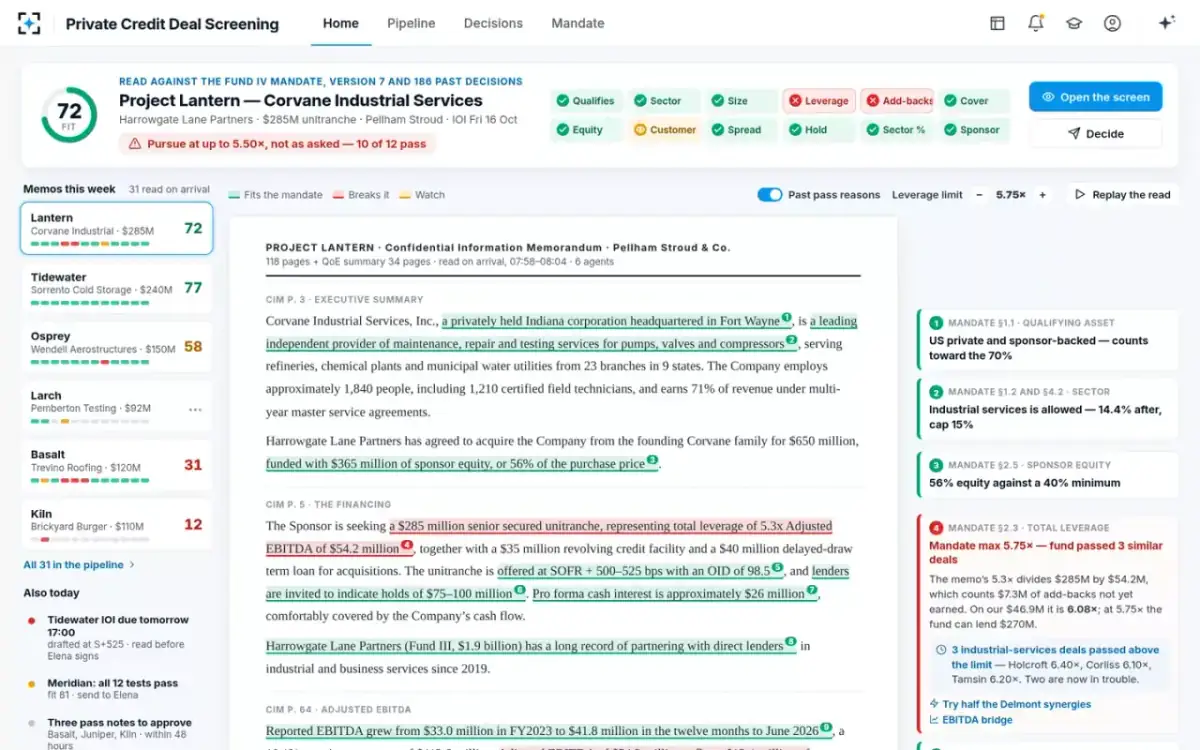
The six minutes are not a trick of a short memo. The Lantern CIM ran 118 pages, its QoE summary 34 more, and the model behind both — 192 pages read, tested and written into a one-page screen before 08:05. The days a by-hand process spends on the first read and the keying do not disappear because the deal is simple; they disappear because the reading itself moved from a queue measured in days to a step measured in minutes.
What a one-week IOI deadline actually demands
A one-week deadline does not actually need five days of reading; it needs one well-reasoned decision, made with enough evidence that the people who have to sign it are confident doing so. The screen Private Credit Deal Screening produces shows each agent's step in order: the intake reader's confirmation that the confidentiality agreement was signed, the 64 figures the extractor pulled from the CIM, the QoE and the model, the five add-backs the earnings quality analyst sorted, and the twelve mandate and portfolio tests the tester ran — four red flags at the end, each linked to the page it came from.
The one-page screen, every figure with its page
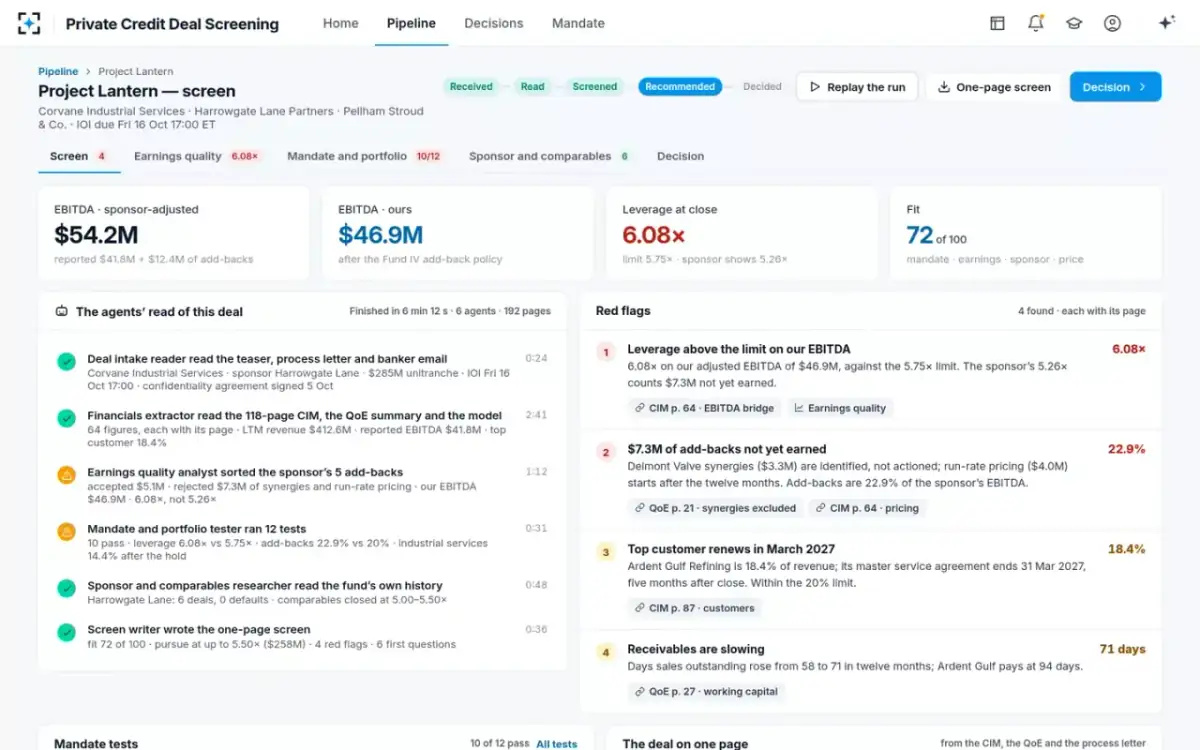
What a one-week IOI deadline demands, in other words, is one afternoon a deal team can trust rather than five days it cannot fully use. The red flags give the underwriter a starting list of questions instead of a blank page; the citations mean a question can be checked against the document itself in seconds rather than by re-reading the CIM to find where a figure came from.
The stage that doesn't shrink: the underwriter's own judgment
Every stage in the week shrinks when agents read on arrival, but not equally. Reading, keying, sorting and checking move from hours to minutes; the writing, which is where the underwriter's judgment goes into the screen, shrinks least, because judgment is not a step that gets faster the same way transcription does.
What shrinks, and what mostly does not
That is not a shortfall in the agents; it is the design. The screen writer drafts the options — pursue at a lower leverage, pursue as asked with an exception, or pass — but it never decides between them and never sends anything. On Lantern, Daniel Okafor tried a what-if on the memo before recommending pursue at 5.50×, not as asked; trying a what-if is judgment, and judgment is the one stage a one-week deadline was always going to need a full day for, agents or not.
What changes when thirty-one memos arrive in one week
A single deal's timeline is the easy case. The harder one is a week where thirty-one memos arrive, because a desk's by-hand capacity does not scale with its deal flow. On the week Project Lantern arrived, all 31 of that week's memos, 1,914 pages between them, were read the day they arrived rather than queued behind whichever deal happened to land first. Eleven stayed in the pipeline, ranked by fit, each showing EBITDA on the sponsor's own number and on the fund's; the other twenty were passed on the teaser.
That is the real effect of compressing the reading stage: not that any one deal's IOI arrives faster, but that a desk stops rationing its attention by order of arrival. A memo that lands on a Thursday, with a Friday deadline no human reader could meet by hand, gets exactly the same first-pass read as one that lands on Monday morning.
When the timeline should slow down, on purpose
None of this argues for a faster IOI deadline; it argues for spending the days a fund already has on the part of the week that benefits from time. A deal that clears its mandate tests cleanly on day one does not need five more days of nothing; one that turns up a red flag on the sponsor's largest customer, or a leverage number that only clears the limit at a lower hold, benefits from every hour a desk can still give it before Friday.
The point of moving the reading, keying and checking into minutes is not to answer faster for its own sake. It is to hand the days a one-week deadline always allowed back to the one stage that was never going to get faster: the underwriter deciding, with the Head of Underwriting signing, whether to spend the fund's diligence money on this deal at all. What to ask a deal-screening vendor before you buy covers how to tell, before a live deal, whether a tool actually gives a desk those days back. To see a memo move through every stage on this page, start from Private Credit Deal Screening.
Questions people ask
How long does it take to screen a private credit deal?
Convention allows a week from teaser to IOI. On a desk still reading and keying by hand, nearly all of that week goes to the first read, retyping figures and re-checking facts, leaving a day or less for the underwriter's own judgment. Where agents read a memo on arrival, the reading and checking take minutes, and the underwriter has most of the week for everything else.
Why is private credit supposed to be faster than bank lending?
Because speed and flexibility are part of what a direct lender sells. The Treasury's Financial Stability Oversight Council names "greater ease and speed of execution" as one of the reasons borrowers choose a small group of private credit lenders over bank lending or the public markets. A fund that cannot actually hold its deadlines is not delivering the thing it is priced for.
What happens between a teaser and an IOI?
A teaser is a short summary that lets a fund decide whether to request the full package; the CIM, the quality of earnings report and the model follow once a confidentiality agreement is signed. Between the two, a desk reads the documents, keys and sorts the figures against its mandate and add-back policy, checks the sponsor's record, and writes the recommendation that becomes the indication of interest.
What takes the longest in a first-pass screen, by hand?
Reading and retyping. On Botminds' estimate for a full CIM with its QoE summary, the first read and the keying take about nine of fifteen and a half working hours, longer than the add-back sort, the mandate check, the sponsor research and the writing combined, because every later stage depends on figures that first have to be found and copied correctly.
Does reading faster change which deals get funded?
It changes which deals get a first-pass read at all. On a week with thirty-one incoming memos, a desk that can only read closely a fraction of them is choosing, by order of arrival rather than by merit, which deals even reach a mandate check. Reading every memo the day it arrives removes that filter; it does not change the mandate itself.
What is the difference between a teaser and a CIM?
A teaser is a one- or two-page anonymized summary a banker circulates to gauge interest before naming the company. A confidential information memorandum, the CIM, is the full offering document, often a hundred pages or more (the fictional Project Lantern's ran to 118), sent once a confidentiality agreement is signed, with the financial detail, the add-backs and the process letter a real screen is built on.