Evaluating private credit deal screening software comes down to four questions wearing twenty different outfits: can it run on your mandate, what happens to your data, who is accountable when it misses something, and can a person still change what it proposes? A vendor's demo answers the fifth question, the one about speed, by default. The other four are the ones a procurement, IT or compliance team has to ask on purpose, because a polished demo rarely volunteers them.
Botminds' Private Credit Deal Screening is built around those four questions rather than around them being an afterthought: every limit lives on a settings page a fund controls, every figure cites its source, every decision point stays with a named person, and a changed treatment keeps its reason. The twenty questions below are written so you can ask them of any vendor, not just this one.
Twenty questions, grouped by what they protect
- Can it run on our mandate, not a generic one?
Leverage, add-back and concentration limits should be your settings, not the vendor’s defaults.
- Can we set our own leverage, add-back and concentration limits?
Ask to see the settings page, not a description of one.
- Does a mandate change apply the same day, or wait for a release?
A limit you change on Monday should test deals on Monday.
- Is every mandate version kept, with who approved it and when?
A changed limit without a record is a limit nobody can defend to an examiner.
- Can we exclude sectors and cap sponsor exposure ourselves?
Your excluded sectors are a fact about your fund, not the vendor’s.
- Does the vendor train its models on our deal data?
A yes here means your competitors’ models are learning from your pipeline.
- What happens to our data after the contract ends?
Get the export and deletion timeline in writing, before you sign, not after.
- Where does our data live, and who can see it?
Ask for the data-residency clause, not the marketing page.
- Is one borrower’s confidential information ever used in another deal’s reply?
This should be a hard no, with a named control, not a policy statement.
- Can we export every figure and citation if we switch vendors?
A screen you cannot take with you is a screen you do not actually own.
- Who is accountable if the tool misses a red flag?
If the answer names a team rather than a person at your desk, ask again.
- Does the tool ever decide pass or pursue on its own?
The honest answer for a screening tool is no — it drafts, a person decides.
- Is every figure cited to a page we can check?
A figure without a citation is a claim, not a result.
- What happens when the tool and an analyst disagree?
The analyst should win, and the disagreement should be kept, not erased.
- Has the tool been tested in a stressed market, or only a calm one?
Ask what changes about its red flags when spreads widen and defaults rise.
- Can we change an add-back treatment it proposed?
If changing a treatment is hard to find, it will not get used under deadline.
- Is a changed treatment kept with its reason, or overwritten?
The reason is what an examiner, or your own committee, will ask for later.
- Can we turn off a feature without losing the rest?
A mandatory feature you never asked for is a sign of a platform, not a tool.
- Does it integrate with our existing deal pipeline and data room?
A second inbox nobody checks is worse than no tool at all.
- How do we test the vendor’s claims on our own memos first?
If the answer is “trust the benchmark,” that is itself an answer.
Group one: can it run on your mandate, not a generic one?
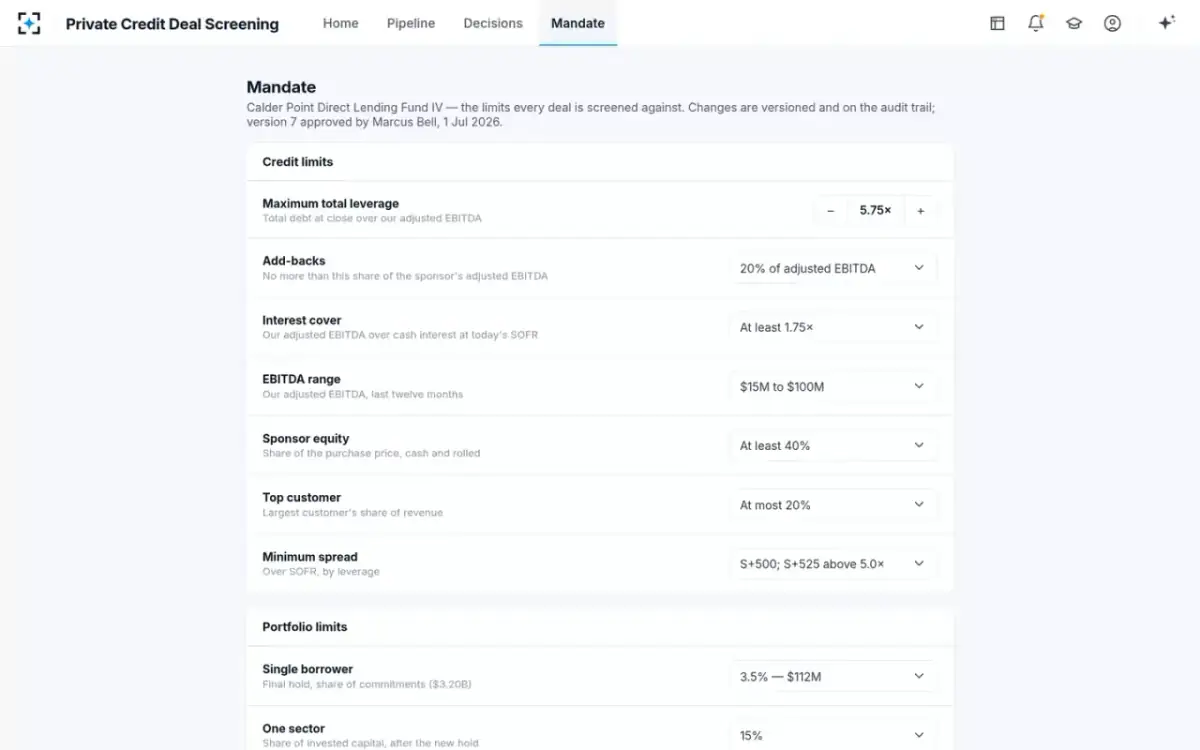
A deal-screening tool that tests every memo against a generic private credit mandate is grading your deals on someone else's homework. Your fund's own maximum leverage, add-back allowance, interest cover, sponsor equity floor, top-customer cap, minimum spread, hold size, sector and sponsor caps, excluded sectors and add-back policy are facts about your fund, set by your own investment committee, and a tool worth buying treats every one of them as a setting you own rather than a parameter it ships with.
In Private Credit Deal Screening, those settings sit on a single Mandate page, versioned and on the audit trail, with every change recording who approved it and when. A fund can move its maximum leverage in steps of a quarter turn, its add-back allowance between 15 and 25 percent, and its minimum spread across three bands, and the next memo that arrives is tested against whichever version is current, not a default a vendor shipped.
Group two: what happens to your deal data?
Private credit already operates with less public information than bank lending or the public markets, which makes a buyer's own data discipline matter more, not less. The Treasury's Financial Stability Oversight Council notes that a lack of secondary market trading and limited available information on borrower fundamentals can make timely valuations challenging and result in limited transparency into the sector. A fund operating in a market already short on outside transparency has every reason to ask hard questions about where its own deal data goes once a vendor has it.
The questions that matter here are concrete, not philosophical: does the vendor train shared models on your pipeline, where does the data physically live, is one borrower's confidential information ever used in replying about another deal, and what exactly happens to your records on the day the contract ends. A vendor that answers all four with specifics, in writing, is telling you something different from one that answers with a page about "enterprise-grade security."
Group three: who is accountable for a missed red flag?
Every deal-screening tool will eventually miss something, because every analyst eventually does too. The question that actually protects a fund is not whether a miss is possible, but who is accountable when it happens. NIST's AI Risk Management Framework makes accountability a named governance control rather than an afterthought: policies and procedures are in place to define and differentiate roles and responsibilities for human-AI configurations and oversight of AI systems. A vendor who cannot point to a named role at your desk that owns the outcome has not actually answered the question, however confident the demo sounded.
Bank supervisors expect the same discipline of the institutions they examine. The 2022 Shared National Credit review notes that banks that appropriately manage leveraged lending exposure employ risk management processes that adhere to regulatory safety and soundness standards and adapt to changing economic conditions. A fund buying deal-screening software is, in effect, extending its own risk management process into a new tool, and the accountability question is really asking whether that extension keeps the same discipline the rest of the fund already holds itself to.
Group four: can a person change what the AI proposed?
A tool that sorts an add-back, flags a risk or recommends a term sheet is making a proposal, not a ruling, and a fund should be able to overrule any part of it without friction. The harder question is what happens after the override: is the change simply applied, erasing the tool's original proposal, or is the change kept alongside the reason someone gave for making it. The second is what lets a fund answer, months later, why a treatment looks the way it does on a deal that is now in trouble.
Four things to score a vendor on, and what a pass actually looks like
| Dimension | What a pass looks like | What a vendor can’t dodge |
|---|---|---|
| Configurable | Every limit, cap and excluded sector lives on a settings page you control, not buried in the vendor's model. | Show you that settings page, live, on your own numbers — not a slide deck. |
| Auditable | Every figure, red flag and mandate test cites the document and page it came from. | Open the citation in front of you and show you the exact line it points to. |
| Accountable | A named person signs the recommendation and approves pursue; the tool never signs or sends. | Name the person at your desk who is accountable for a missed flag — not "the system." |
| Reversible | A person can change any proposed treatment, and the reason for the change is kept with it. | Change a treatment in a live demo and show you exactly where the reason lands. |
What the interagency third-party guidance expects you to ask
Buying deal-screening software is a third-party risk decision, and bank regulators have already written down what a disciplined one looks like. The 2023 interagency guidance on third-party relationships, issued jointly by the OCC, the Federal Reserve and the FDIC, outlines the third-party risk management life cycle and identifies risk management principles applicable to each stage of the life cycle, from planning and due diligence through contract negotiation, ongoing monitoring and termination. It also describes sound risk management principles to consider when developing and implementing third-party risk management practices, commensurate with the bank's risk profile and complexity as well as the criticality of the activity supported by the third party.
A private credit fund is not a bank, but the life-cycle logic applies without translation: due diligence before signing, monitoring during the relationship, and a plan for what happens at termination. The twenty questions above map onto the guidance's five stages, planning, due diligence and selection, contract negotiation, ongoing monitoring and termination, as the table below sets out; the termination questions are the ones a buyer is most tempted to leave until the last month of a contract instead of the first conversation.
The twenty questions, placed on the guidance's five-stage life cycle
| Life-cycle stage | Which questions belong there | What to have in hand before moving on |
|---|---|---|
| 1. Planning | Can it run on our mandate; can we exclude sectors and cap sponsors; does a mandate change apply the same day | A written list of the limits and approvals the tool must apply, from your own mandate |
| 2. Due diligence and third-party selection | Is every figure cited; has it been tested in a stressed market; how do we test it on our own memos | A replay on your own closed and passed deals, scored before the demo is forgotten |
| 3. Contract negotiation | Does it train on our data; where does it live; what happens at the end; can we export every citation | Training, residency, export and deletion terms written into the order form |
| 4. Ongoing monitoring | Who is accountable for a miss; what happens when tool and analyst disagree; is a changed treatment kept with its reason | A named owner, an override log, and a schedule to re-test on new deals |
| 5. Termination | Can we export every figure and citation; when is our data deleted | A tested export, not a promised one |
A red-flag answer and a good answer, side by side
The words a vendor uses often give away more than the feature list does. A vague, confident answer and a specific, checkable one tend to sound similar in a sales call and read very differently once they are written down next to each other.
The same four questions, a weak answer and a strong one
A red-flag answer: “Our model already knows what good private credit deals look like.”
A good answer: “Every limit is a setting on your Mandate page; nothing about your fund is hard-coded.”
A red-flag answer: “Your data helps us keep improving the model for every client.”
A good answer: “Your deal data trains nothing outside your own tenant, and that goes in the contract.”
A red-flag answer: “The AI flags the risk; you decide.”, with no person named before or after.
A good answer: “Your VP reviews, your Head of Underwriting approves pursue — the tool never sends or decides.”
A red-flag answer: “You can override anything, but we don’t keep a record of why.”
A good answer: “Any change is kept with who made it, when, and the stated reason.”
None of the right-hand answers require a vendor to reveal anything competitively sensitive. They require the vendor to be specific about something they should already know cold, because it is how the product is actually built, not a detail they have to look up.
What 'your mandate' should actually look like
Testing claims before you sign: what to demand
A vendor's own benchmark tells you how the tool performed on deals it was tuned against. What a buyer actually needs is how the tool performs on the buyer's own deals, which is a different question and the only one worth paying for an answer to.
Vague claims, and the specific version worth demanding
A vague answer: “In the cloud, secured to industry standards.”
A specific one: “In a tenant scoped to you; here is the data-residency clause in the order form.”
A vague answer: “We have a standard offboarding process.”
A specific one: “Export of every record and citation within 30 days, then deletion, in writing.”
A vague answer: “Our model performs well across market conditions.”
A specific one: “Replay it on your last twenty closed deals before you rely on it live.”
Demanding specifics before signing is not adversarial; it is the same due diligence a fund already applies to a sponsor's own numbers. A vendor confident in its claims should welcome a replay against twenty of a fund's own closed and passed deals, because that replay is the fastest way to prove the claims rather than merely repeat them.
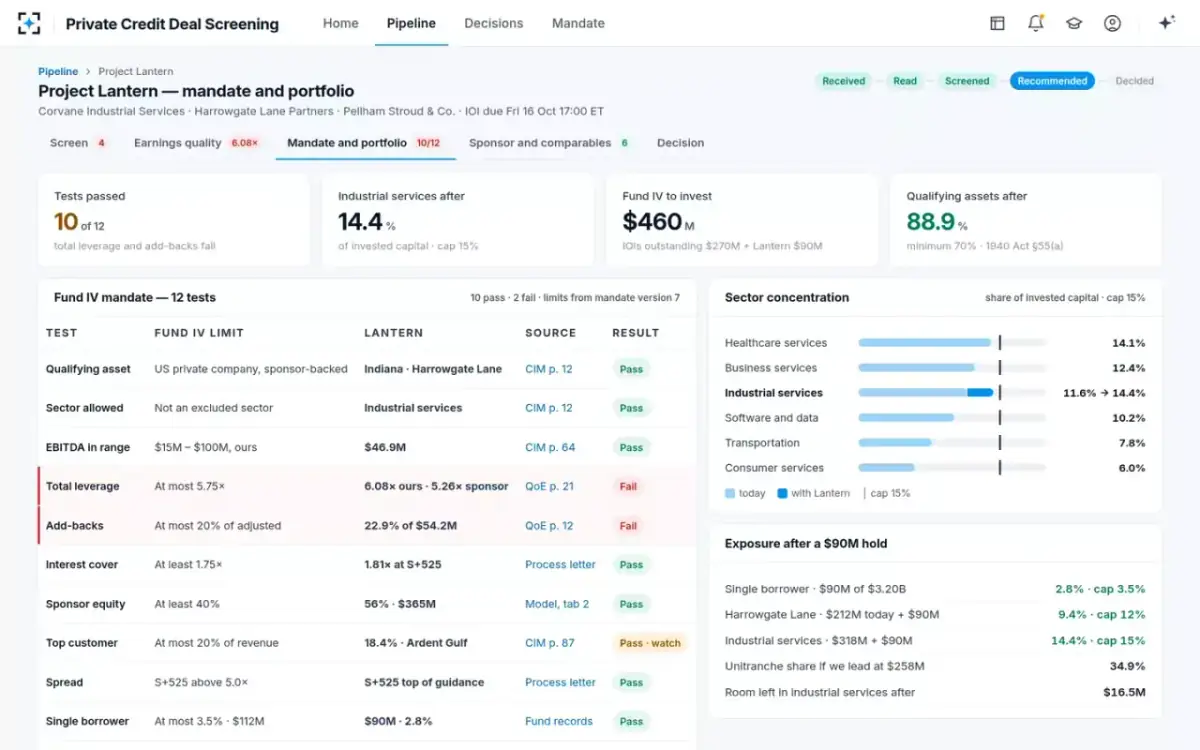
Mandate and portfolio tests, run live on a real memo
What to ask about after the contract, not just before
Most of a buyer's attention goes to the questions that matter before signing; a smaller, easily-skipped set matters for as long as the contract runs and after it ends. Ask how a mandate change is tested before it goes live, how often the vendor re-validates its own claims against new deals rather than the ones it was first tuned on, and what the export looks like if the relationship ends — not in a renewal negotiation, but today, in writing, as part of the order form.
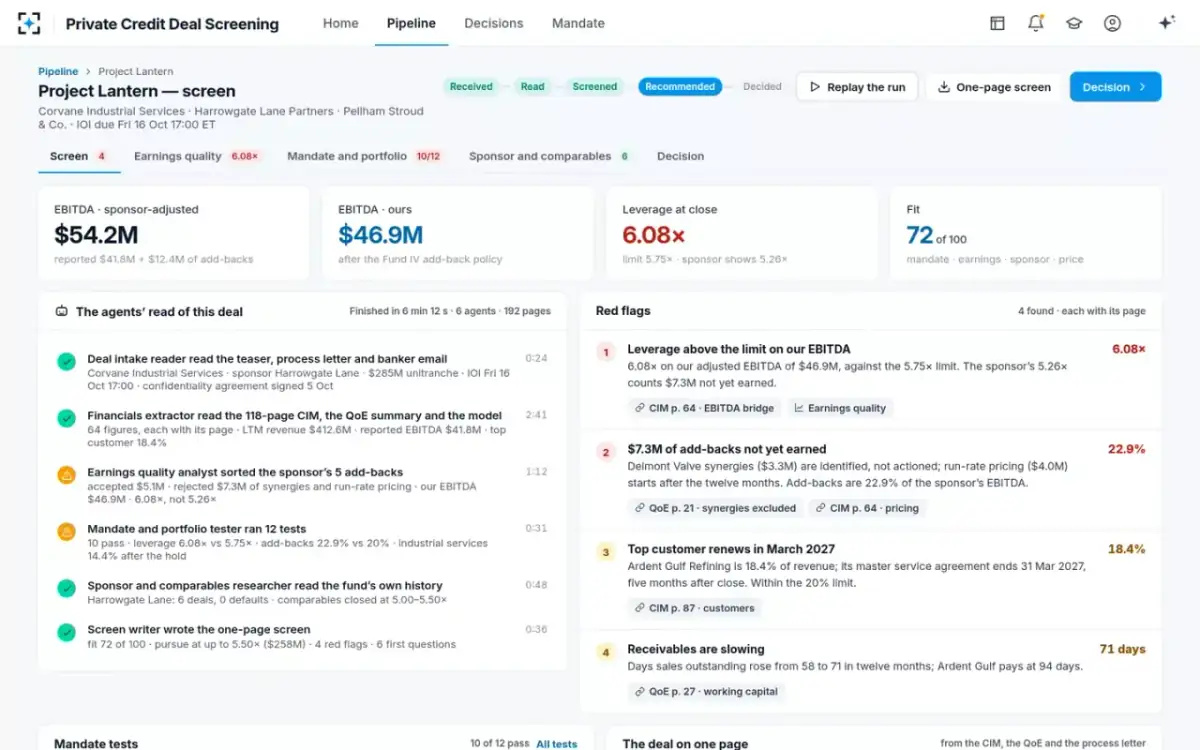
One-page screen, every figure with its source
A fund that asks these questions before shortlisting a vendor spends less time arguing about the tool later, because the hard conversations — about data, accountability and reversibility — happened on a sales call rather than during a live deal under an IOI deadline. Who actually screens a private credit deal, seat by seat is a useful companion read before that conversation, since it names who on your own desk should be in the room asking these questions. To see the Mandate page and the screens above on your own numbers, start from Private Credit Deal Screening.
Questions people ask
What questions should I ask a private credit deal-screening vendor?
Group them by what they protect: can it run on your own mandate rather than a generic one, what happens to your deal data, who at your desk is accountable for a missed flag, and can a person change what the tool proposes, with the reason kept. The twenty questions on this page sort into those four groups.
Can the software use our own mandate instead of a generic one?
It should. Leverage, add-back, interest-cover, sponsor-equity, top-customer, spread, hold, sector and sponsor-exposure limits, and the add-back policy itself, belong on a settings page the fund controls, versioned and on the audit trail, not hard-coded into the vendor's model.
Does the vendor train its models on our deal data?
Ask directly, and get the answer in writing. A fund's deal pipeline is competitively sensitive; a vendor that trains shared models across clients is, in effect, letting a fund's deal flow improve a tool its competitors also use.
Who is accountable if the AI misses a red flag?
A named person at your desk, not "the system" and not a vendor's support team. Both NIST's AI risk guidance and bank supervisors' own examination expectations treat clearly assigned human accountability as a control, not an afterthought.
Can we change an add-back treatment the AI proposed?
Yes, and the more important question is whether the change is kept with a reason or simply overwrites the original proposal. A kept reason is what lets a fund explain, months later, why a treatment looks the way it does.
What happens to our data after the contract ends?
Get the export format and the deletion timeline in writing before you sign, not negotiated for the first time when the contract is ending. A vendor with nothing to hide should be able to commit to specifics here on the first call.