Why should a fund track the deals it passed on? Because a pass is a credit decision exactly like a close, and a fund that only reviews the loans it made is reviewing half its own judgment. A loan that closes and performs badly shows up on a watch list within a quarter or two. A loan a fund passed on, that closed somewhere else and is now in trouble, shows up nowhere, unless somebody wrote down why the fund said no and went back to check.
Botminds' Private Credit Deal Screening keeps that record on every memorandum and looks back at it later. On a fictional sample fund, Fund IV, 27 passed deals are tracked this way, and four are now in some kind of trouble — a covenant waiver, a restructuring, or worse. The fund, its deals and the figures on this page are sample data from that fictional file, not a customer's result.
A close keeps its own record. A pass keeps none unless you make it.
A closed loan has a file, a covenant schedule and a rating that moves when performance changes; a declined deal usually has an email reply and nothing else. That asymmetry is not malicious — a pass takes five minutes and a close takes weeks of documentation — but it means a fund's institutional memory is built almost entirely from the decisions it said yes to, which is the half of its judgment that was, by definition, good enough to get funded.
The decisions worth double-checking are often the other half. A fund that passed on three similar deals in the same sector, all above the same leverage limit, has either dodged three bad loans or missed three good ones that another lender is now collecting a premium on — and without a record, nobody at the desk can say which.
What a kept pass reason actually records
A useful pass record is short and specific: not "declined — leverage," but the actual sentence an underwriter would say out loud to a colleague, tied to who said it and when.
The anatomy of a pass-log entry
| Field | What it captures |
|---|---|
| Reason | Why the fund said no — in the underwriter's own words, not a checkbox code. |
| Decider | Who made the call, by name, not by team. |
| Date | When the decision was made, tied to the same memorandum the reason refers to. |
| What happened since | A look-back entry added once the deal is known to have closed elsewhere, been amended, or needed a waiver. |
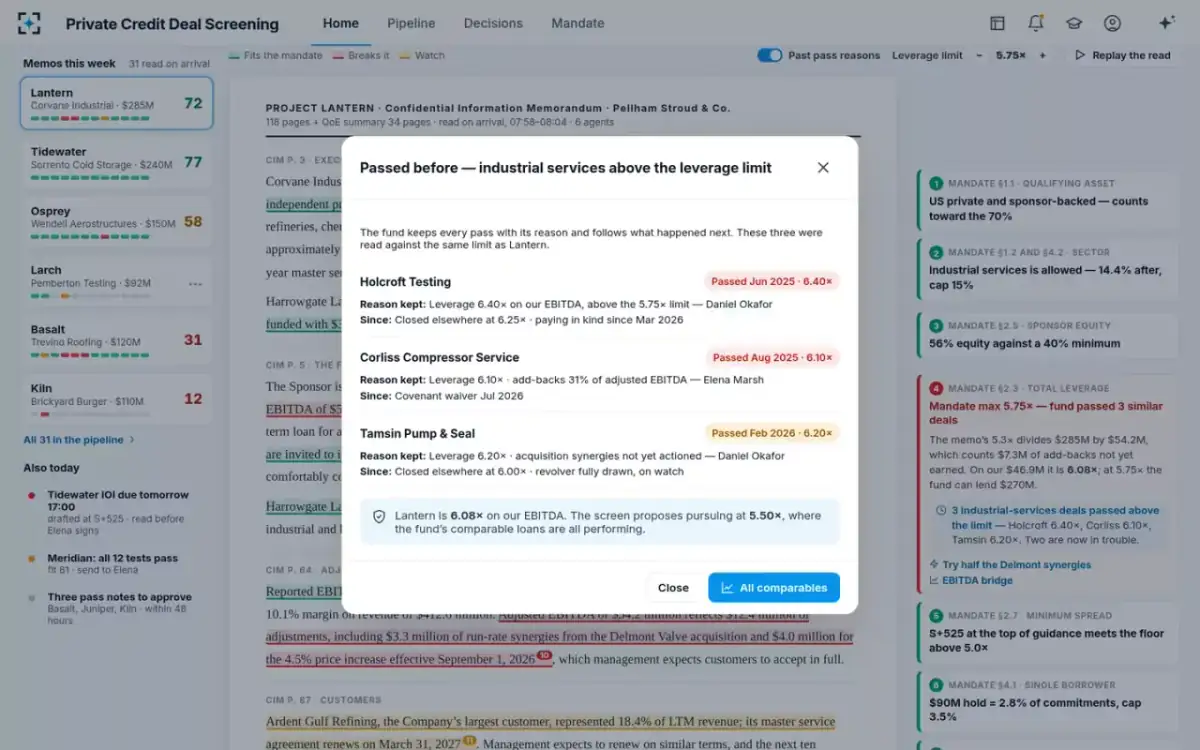
The fourth field, what happened since, is the one most pass logs never get to, because it requires somebody to go back months later and check. On Fund IV's sample book, three industrial-services deals were passed above the fund's 5.75 times leverage limit: Holcroft Testing at 6.40 times in June 2025, Corliss Compressor Service at 6.10 times in August 2025, and Tamsin Pump & Seal at 6.20 times in February 2026. Two are now in trouble and the third is on watch.
The look-back: what happened to a deal six, twelve, eighteen months later
Holcroft Testing closed elsewhere at 6.25 times and has been paying interest in kind rather than in cash since March 2026, a sign its cash flow has stopped covering its debt service as planned. Corliss Compressor Service needed a covenant waiver in July 2026. Tamsin Pump & Seal closed elsewhere at 6.00 times and has fully drawn its revolver; it is on watch, a reminder that a look-back is a running check, not a one-time verdict.
Five passes tracked after they closed elsewhere, and where each stands
| Deal | Passed | Reason kept | What happened since |
|---|---|---|---|
| Holcroft Testing | June 2025 | Leverage 6.40× on the fund’s EBITDA, above the 5.75× limit; Daniel Okafor | Closed elsewhere at 6.25×; paying interest in kind since March 2026 |
| Corliss Compressor Service | August 2025 | Leverage 6.10×, add-backs 31% of adjusted EBITDA; Elena Marsh | Covenant waiver, July 2026 |
| Wexley Auto Glass | October 2025 | Leverage 6.30× | Closed elsewhere; on non-accrual since June 2026 |
| Brisco Packaging | November 2025 | Add-backs 29% of adjusted EBITDA | Covenant reset, August 2026 |
| Tamsin Pump & Seal | February 2026 | Leverage 6.20×, acquisition synergies not yet actioned; Daniel Okafor | Closed elsewhere at 6.00×; revolver fully drawn; on watch |
Passed before, and what happened since
Reading the pattern across passes, not just one
One passed deal that later struggled could be a coincidence; several passed for the same kind of reason, all of which later struggled, are a pattern worth naming before the next one lands on the same desk. Across Fund IV's 27 tracked passes, the four now in trouble were all passed for leverage above the limit or add-backs above the cap. That does not prove the limits are right, since a passed deal that defaults elsewhere was priced by someone else, but it is evidence the two tests are catching something real.
Why the sample fund passed, 169 passes in 90 days
Reading the pattern also means noticing what did not go wrong. Of the 27 tracked passes, most closed elsewhere and are performing normally, which is itself useful information: a fund whose passes were routinely wrong would be leaving good loans on the table as often as it was dodging bad ones. The question a pass log answers is not whether the fund should stop declining deals near its limits, but which specific limits, in which specific sectors, are earning their place in the mandate rather than simply being inherited from the last version of the policy.
27 passes tracked; four tell a pattern
27
deals passed and tracked since the fund began keeping pass reasons
4of 27
are now in some kind of trouble — a waiver, payment in kind, or worse
2of 3
industrial-services deals passed above the leverage limit are among them
When a new deal rhymes with an old pass
A pass log is only useful if it surfaces itself at the moment a new deal needs it, not when someone remembers to go looking. On Project Lantern, Fund IV's own sample deal, the mandate tester's leverage flag carried a margin note linking straight to the three prior industrial-services passes — the same test, the same sector, the same kind of number — with who decided on each and what has happened since.
How a new leverage flag finds an old pass
Agent
Mandate and portfolio testerFlags the limit a new memo is approaching — on a new deal, total leverage above the mandate maximum.
Agent
Past pass reasonsLinks the margin note to every prior deal passed for the same reason, with who decided and what happened since.
A person decides
The underwriterReads the pattern before recommending — not just this deal's own numbers, but what happened the last three times the fund saw the same problem.
That link is what turns a pass log from an archive into a working part of the screen. An underwriter reading Lantern's leverage flag does not have to remember, or go dig up, that the fund has been here before three times in the same sector; the pattern is already attached to the exact flag that raised it.
What the research says about relationship and repeat-sponsor lending
Tracking outcomes is not only useful for the deals a fund declined; it is part of how direct lending works even on the deals it accepts. NBER's survey of private debt funds finds that more than 76% of US general partners see lending relationships, "repeated transactions with the same PE sponsor", as an advantage of sponsored deals, because they lower information costs and provide a strong pipeline of quality deal flow — a fund's history with a sponsor, kept and read back, is doing useful underwriting work on its own, whether the deal in front of it is a close or a pass.
The same logic explains why direct lenders can afford to specialize the way they do. Research on the industry's lending technology notes that direct lenders write collateral claims more focused on the continuation value of firms after default, especially when the firms operate in intangible capital industries — a lending style built on understanding how a specific kind of borrower performs under stress, which is exactly the kind of knowledge a fund accumulates by tracking what happened to the deals it said no to, not only the ones it closed.
The failure mode: passing for the wrong reason, repeatedly
Supervisors have warned that the loans in this part of the market have not been tested by a downturn. The 2022 Shared National Credit review found that leveraged loans "continue to have weak structures" and that "the performance of these leveraged loans has not been fully tested in a stressed economic environment that may contribute to higher default and lower recovery rates". In a market like that, a fund's reasons for saying no are hypotheses that have not been through a cycle either.
That is the failure mode a pass log guards against. A reason that sounds prudent but predicts nothing, a sector view inherited from a bad year, say, costs the fund good loans every time it is applied, and nobody notices because the cost is a deal that went elsewhere and performed. A reason that is predictive, as leverage and add-backs look to be on the sample book, earns its place. Only a log that tracks outcomes can tell the two apart, and it has to be read the other way too: a fund should also count the passes that closed elsewhere and are performing, because those are the loans its limits cost it.
Building a pass log that survives staff turnover
The quiet reason most pass logs never get built is that the person who passed on a deal is often the only one who remembers why, and that knowledge leaves the desk when they do. A log that is just a spreadsheet nobody updates after the first few entries fails the same way a verbal memory does, only slower: it is accurate for the first few months and then quietly stops being maintained once the person who cared about it moves to another fund or another desk.
The look-back step is the part most likely to be skipped for a mundane reason: somebody has to notice, months after the fact, that a passed borrower closed with another lender and has since needed a waiver or a restructuring. That is not information a fund already has; it comes from the same sponsor and comparables research a live deal draws on, from syndication data and from the ordinary conversations a deal desk has with the bankers it works with every week. A pass log that is never revisited is really just a list of declines, not a record of judgment tested against outcomes.
A pass with a kept reason, and a pass with none
A pass with a kept reason: The fund can see exactly why it passed, and check whether that reason held up.
A pass with none: Nobody remembers whether leverage, the sector or the sponsor was the real objection.
A pass with a kept reason: The new deal's margin note links straight to the old one, with who decided and what happened since.
A pass with none: The pattern has to be reconstructed from memory, if anyone who made the first call is still at the desk.
A pass with a kept reason: The reasoning survives the person who wrote it.
A pass with none: The reasoning leaves when the underwriter who passed on it does.
Every pass and pursue, with its reason
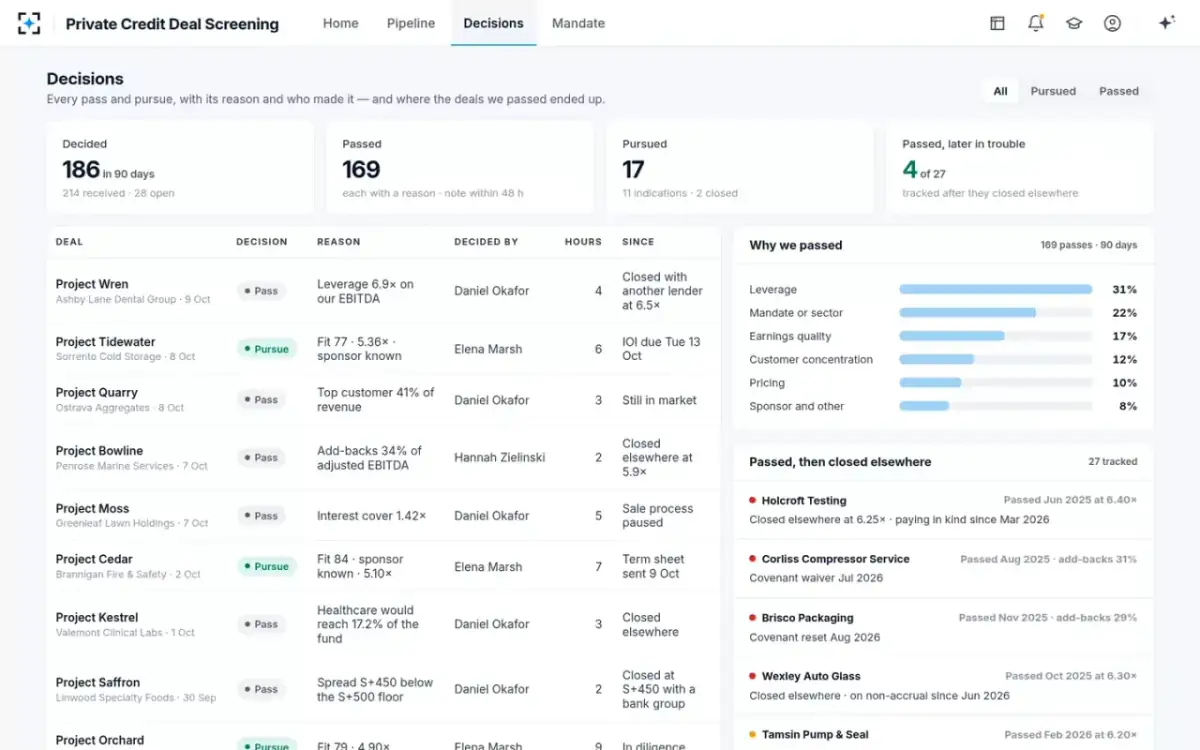
What makes a pass log survive turnover is the same thing that makes any record survive it: the reason lives with the decision, not with the person, and the look-back is something the fund's own tools do on a schedule rather than something that depends on someone remembering to ask. Why a clean deal can still break a fund's concentration limits is the other half of this fund's own memory — what the book looks like with a deal in it, rather than what happened to the ones it chose not to add. To see a pass tracked alongside a close, start from Private Credit Deal Screening.
Questions people ask
Why should a fund track the deals it passed on?
Because a pass is a credit judgment exactly like a close, and a fund that reviews only the loans it made is reviewing only the half of its decisions that, by definition, already looked good enough to fund. Tracking passes is the only way to learn whether the other half of the fund's judgment was right.
What happens to deals a lender declines?
Most close with another lender, if the deal was fundable at all. Without a look-back, the fund that passed never learns whether that other lender's bet paid off or went bad — information that would otherwise tell the fund something about its own leverage limit, sector view or sponsor read.
How do you know if a pass decision was right?
By checking what happened to the deal afterward, not by re-arguing the decision at the time it was made. A pass that later needed a covenant waiver or a payment-in-kind arrangement elsewhere suggests the original reason for declining was sound; a pass on a deal that went on to perform cleanly is worth asking harder questions about.
What is a past pass reason, and why would a new deal need one?
It is the recorded reason a fund said no to a prior deal, kept with who decided and what happened since. A new deal needs it when it trips the same test — the same leverage limit, the same sector, the same sponsor pattern — because the fund's past reasoning and outcome are directly relevant to the decision in front of it now.
Do private credit funds learn from their declines or only their closes?
Learning from closes happens on its own, because a closed loan generates a file and a performance record automatically; a declined deal generates neither unless someone deliberately keeps one. That is why learning from declines has to be built: a reason kept with every pass, and a look-back on a schedule.
What does it mean if a deal you passed on later needed a covenant waiver?
It is evidence, not proof, that the fund's original concern was justified — the borrower's performance drifted enough, after closing with another lender, that the new lender had to renegotiate terms. Tracked across several similar passes, that pattern is one of the more reliable signals a fund has that a particular limit or sector concern is doing real work.