How much does it cost to review one confidential information memorandum is rarely written down anywhere on a direct lending desk, because the hours are scattered across several people and several days rather than booked to one line. A first-pass screen on a full CIM, with its quality-of-earnings summary and model behind it, takes an associate and a Vice President roughly fifteen and a half working hours between them, on Botminds' estimate set out below — reading, keying figures, sorting add-backs, checking the mandate, and writing up the result. Multiply that by how many memoranda a desk actually receives, and the real number is larger than most heads of underwriting expect before they add it up. Private Credit Deal Screening, Botminds' agentic solution for this work, is built to cut that number sharply; this guide shows how to build the cost honestly first, so the return it needs to earn back is a real one, not a vendor's headline.
Where the hours of a first-pass screen go
A first-pass screen is not one task; it is six, and they do not take the same kind of time. Reading the CIM and its quality-of-earnings summary is the largest block, followed by keying the figures into a screening template, sorting the sponsor's add-backs and recomputing leverage, checking the deal against the fund's mandate and portfolio limits, researching the sponsor and comparable deals, and finally writing the screen and the first diligence questions. On Botminds' estimate for a full CIM with its QoE summary, that adds up to roughly fifteen and a half hours of work before a Vice President signs anything.
A first-pass screen's hours, by task: before and after agents read on arrival
By hand — 15.5 hours total
- Reading · 39%
- Keying · 19%
- Add-backs and leverage · 13%
- Mandate and portfolio · 6%
- Sponsor research · 10%
- Writing the screen · 13%
With agents — 1.4 hours total
- Reading · 14%
- Keying · 7%
- Add-backs and leverage · 21%
- Mandate and portfolio · 7%
- Sponsor research · 14%
- Writing the screen · 36%
The shift is not evenly spread. Reading and keying, the two most mechanical tasks, shrink the most in absolute terms — from nine hours to three tenths of an hour between them. Writing the screen shrinks the least in proportion, because drafting the questions and the terms still ends with a Vice President's own words and a signature, and that part of the job was never going to disappear.
What a credit analyst-hour actually costs, by published wage data
A loaded hourly rate can be built from published figures. O*NET puts the 2025 median wage for credit analysts at $40.15 an hour, $83,510 a year; the Bureau of Labor Statistics puts financial analysts, closer to a Vice President's research-and-recommend work, at $103,570 a year, or $49.79 an hour. Both are medians across all employers, and a private credit desk may pay above them, so treat them as a floor. Wages are not the whole cost either: in June 2026 wages and salaries "accounted for 70.0 percent of employer costs" in private industry, with benefits the rest (BLS, Employer Costs for Employee Compensation), so dividing by 0.70 adds benefits, before bonus and overhead, which each fund sets from its own books.
From published median wages to an hourly cost with benefits
At $57.36 to $71.13 an hour, the 15.5 hours a first-pass screen takes by hand on this estimate come to roughly $890 to $1,100 before anyone has decided whether the deal is worth pursuing; with agents reading first, the 1.4 hours of review cost $80 to $100. That is a floor: a Vice President's hours inside the total cost more than an analyst median, and the figure carries no bonus or overhead.
Sizing the CIM you are paying someone to read
The page count is what turns an hourly rate into a real cost, because it drives the reading hours. On the fictional sample file in Private Credit Deal Screening, Project Lantern, the CIM ran 118 pages and the quality-of-earnings summary 34 more, with the model behind both: 192 pages to get through before the first figure could be keyed.
192 pages, read two ways
6min 12s
for six agents to read Project Lantern’s 192 pages and write the one-page screen
100%
of that week’s memos read the day they arrived: 31 of 31, 1,914 pages
64
figures pulled from the CIM, the QoE and the model, each with its page
What 192 pages becomes: one screen, every figure cited
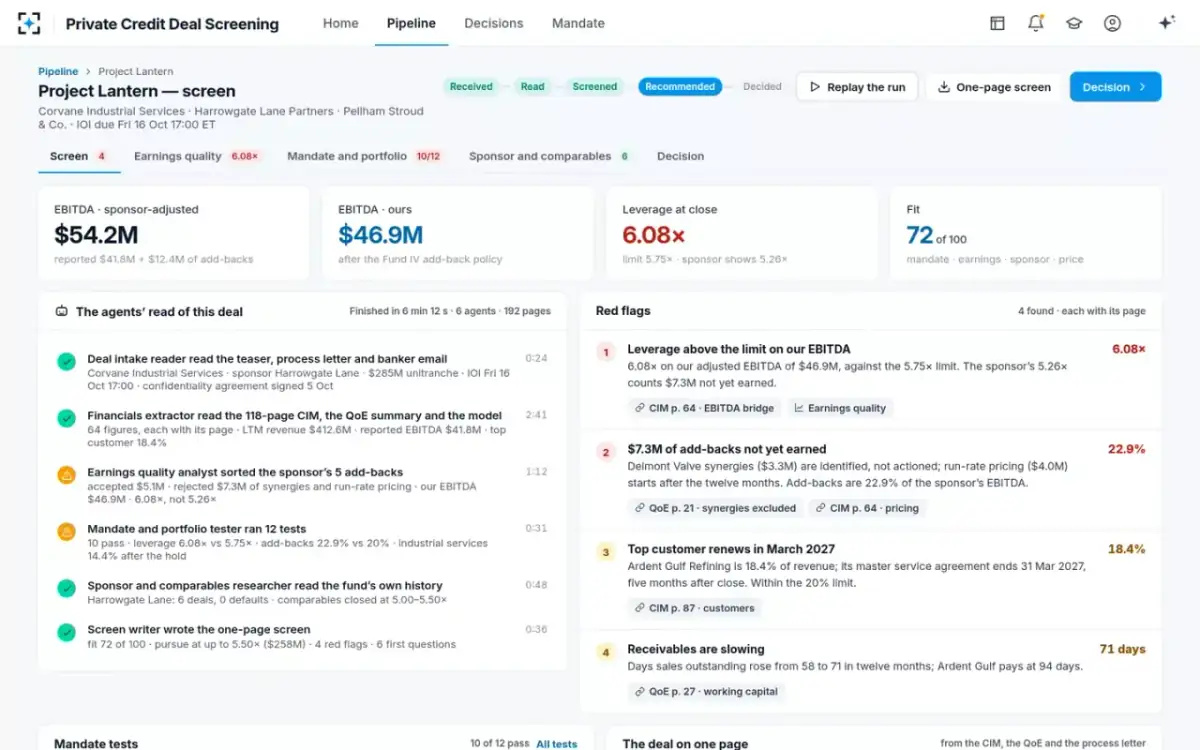
A desk that wants its own number should start here, with its own page counts, not a rule of thumb: pull the last ten memoranda the fund screened, note the combined page count of the CIM, QoE and model for each, and multiply by the loaded rate per page the fund's own reading speed implies. That figure, not an industry average, is the baseline a screening tool's time saving should be measured against.
The return nobody prices: the deal you didn't have time to read
A direct lending desk reads many memoranda for every deal it closes, and under deadline a first read covers the summary, the model and the pages that look important, not every page. Most of the cost of under-reading a memorandum never shows up as a loss on a bad loan; it shows up as a good deal passed over because nobody had the hours to find the reason to pursue it on page 87.
That missed-deal cost is not hypothetical money. Research on why firms borrow from nonbank lenders at all found that, controlling for firm and loan characteristics, "nonbank loans carry 190 basis points higher interest rates, suggesting that access to funding, rather than prices, is why firms borrow from nonbanks" (NBER Working Paper 26458, Chernenko, Erel and Prilmeier, from hand-collected credit agreements of middle-market firms in 2010–2015). Borrowers who choose a direct lender are telling the market that access and speed are worth a premium to them; a desk slow enough to lose that borrower to a faster competitor is losing a deal priced for that premium, not a commodity transaction to a lower bidder.
Thirty-one memos, all read the day they arrived
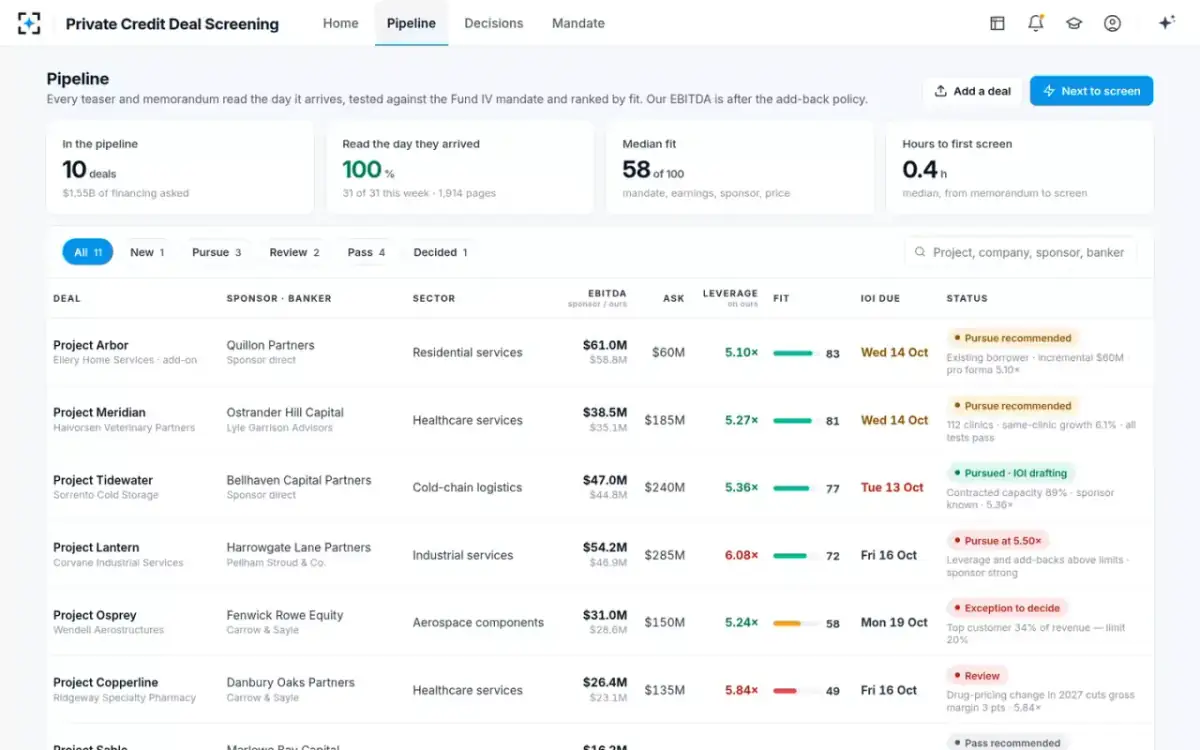
The other return: the deal you stopped before two weeks of diligence
The second return runs the other direction: not a deal found sooner, but a deal stopped sooner. A memorandum that is going to fail a mandate test or carry an unacceptable leverage number once the sponsor's add-backs are properly sorted is cheapest to pass on the day it arrives, and most expensive to pass on after two weeks of diligence, legal fees and a sponsor relationship that now expects a yes.
A memo read closely from day one, against one skimmed under time pressure
Skimmed, under time pressure: Taken close to face value; the add-backs behind it are not fully tested until later, if at all.
Read closely, from the day it arrives: Tested against the fund’s own add-back policy immediately, so the real leverage number is known on day one.
Skimmed, under time pressure: Found, if at all, deep into diligence, after legal and accounting costs are already sunk.
Read closely, from the day it arrives: Flagged against the mandate before the deal team spends a diligence dollar on it.
Skimmed, under time pressure: Competes for attention with every other memo the desk cannot read closely that week.
Read closely, from the day it arrives: Surfaces because every memo gets the same first-pass read, not just the ones that look promising from page one.
A formula you can fill in with your own numbers
Put the cost and both returns into one formula, and a desk can price its own ROI rather than borrow someone else's. The terms below are the ones to fill in with a fund's own figures, not the illustrative ones on this page.
ROI = (hours saved × loaded rate) + value of deals not missed − software and change cost
Hours saved
(hours by hand − hours with agents) × memos screened per year
Use your own desk’s reading, keying and write-up hours, not the figures above.
Head of underwriting
Loaded rate
Median or actual hourly wage ÷ 0.70, plus your own bonus and overhead
The 0.70 is the BLS private-industry wage share of employer costs; your finance function has the rest.
Finance
Deals not missed
Extra memos read closely × your own close rate × average deal margin
Price only the memos that go from skimmed to closely read, not every memo in the pipeline.
Head of underwriting
Software and change cost
License, implementation and the review time underwriters still spend
The remaining hours in the split above are real cost, not zero — count them.
Finance
What changes the answer most
Two things move this formula more than any other input: how many memoranda the desk actually receives, and what a deal that passes the screen goes on to cost. The first is the desk's own count; the Financial Stability Oversight Council's 2025 report describes private credit funds as having "experienced substantial growth in recent years", and a desk whose deal flow has grown faster than its headcount reads a smaller share of it closely. The second is larger than most desks assume: in a survey of private debt fund managers, Block, Jang, Kaplan and Schulze found that "the average U.S. private debt investor spends 100 hours conducting due diligence per deal". At the loaded rates above, that is $5,700 to $7,100 of staff time per deal pursued, before legal and accounting fees, which is why a screen that stops a bad fit on day one is worth more than the hours it saves on the screen itself.
What "faster" is worth when deal flow, not headcount, is the constraint
The formula above prices hours and dollars, but the real constraint on most growing desks is neither; it is how many memoranda a fixed team can get through in a week without under-reading most of them. Daniel Okafor's Monday on Project Lantern is the ordinary case this solves for: his memo arrives already marked up against the mandate, so the hour he would have spent on a first read becomes an hour spent on the deals his desk's current headcount would otherwise never reach.
The hour a Vice President gets back
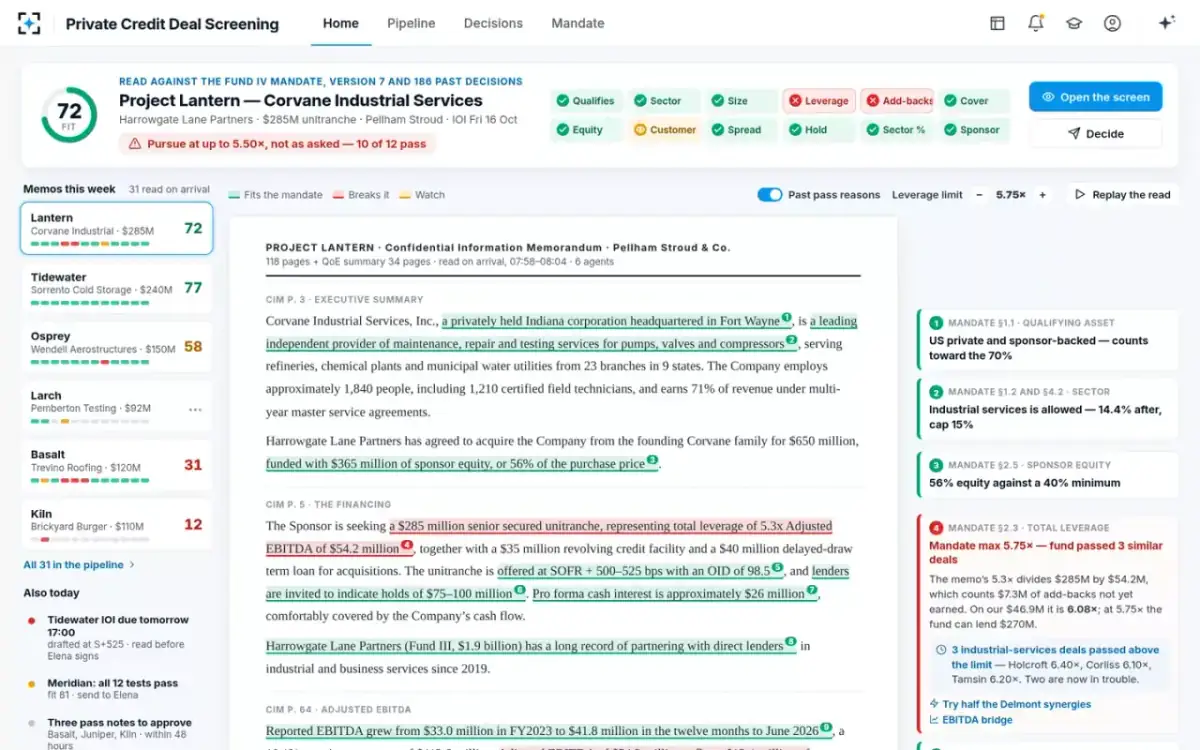
Priced this way, the ROI question stops being "how much time does this save one person" and becomes "how many more of the memoranda already arriving can the same desk read closely." For a desk whose deal flow is the binding constraint, that second number is usually worth more than the hours line in the formula above, even before a single deal's outcome changes.
Questions people ask
How much does it cost to review one CIM?
Using published median wages for credit analysts ($40.15 an hour) and financial analysts ($49.79), with benefits added from BLS cost data, a 15.5-hour first-pass screen by hand costs roughly $890 to $1,100 in staff time, before bonus, overhead or any diligence that follows. Build the figure from your own desk's hours and rates for an accurate number.
What is the ROI of AI deal screening software?
Hours saved times your loaded rate, plus the value of deals you now read closely that you used to skim or miss, minus the software and the review time underwriters still spend. The second term is usually larger than the first and harder to measure, which is why a serious ROI case prices it separately rather than folding it into a headline percentage.
How many hours does a first-pass deal screen take by hand?
On a full confidential information memorandum with its quality-of-earnings summary, roughly fifteen and a half hours by the solution's own published estimate: six for reading, three for keying figures, two for sorting add-backs and recomputing leverage, one for checking the mandate, one and a half for sponsor research, and two for writing the screen.
How many CIMs does a fund actually read closely?
Fewer than arrive, on most desks: memoranda come in faster than a fixed team can read them in full, so a first read under deadline covers the summary, the model and the pages that look important. Counting how many of last quarter's memoranda got a full read, against how many were skimmed or passed unread, is the fastest way for a desk to find its own number.
What is a loaded hourly rate for a credit analyst?
O*NET's 2025 median wage for credit analysts is $40.15 an hour. Benefits add about 43% on top in private industry (wages are 70% of employer compensation costs, per BLS), giving about $57 an hour before bonus and overhead. A desk may pay above the all-employer median, so use your own payroll figures where you have them.
Does faster screening mean more deals closed, or fewer missed?
Both, and they should be priced separately. Faster screening lets a desk read closely the memoranda it used to skim, which surfaces deals that would otherwise have been missed; it also lets the desk stop a bad fit sooner, before diligence costs are sunk, which is a different saving from either the labor hours or the missed-deal value.