How accurate is AI at classifying EBITDA add-backs is the question every credit risk and model validation team asks before an underwriting tool touches a live deal, and it is also the question most often answered badly, with a single accuracy percentage that hides more than it shows. An add-back is not right or wrong the way a date on a page is; it is right or wrong against a written policy, and "accurate" only means something once you say which of several distinct failure modes you are measuring. Botminds' Private Credit Deal Screening has an earnings quality analyst sort every sponsor add-back into accept, haircut or reject, cited to the page it came from — and this guide sets out the measures a fund should demand before trusting that sort on a deal it has not already decided by hand.
The worked example is Project Lantern, a fictional 118-page memorandum run through Fund IV's sample instance of the solution, where the earnings quality analyst sorted five of the sponsor's claimed add-backs. The fund and the deal are invented; the four measures below, and the research on what a bad add-back costs a lender, are not.
Why "is the AI accurate" is the wrong question
A single accuracy number collapses two very different mistakes into one figure, and a lender should care about them in opposite proportions. Accepting an add-back that should have been rejected — a false accept — inflates the fund's own EBITDA and understates leverage, which is the error that gets a loan funded that should not have been. Rejecting an add-back that should have been accepted — a false reject — understates EBITDA and can turn a fundable deal into a pass, which costs the fund a deal rather than a loss on one. Both lower a simple accuracy score by the same amount; only one of them can put money at risk. A fund that asks a vendor for "how accurate is it" and accepts one number back has let the vendor choose which of those two costs to hide.
Four measures: match rate, false accept, false reject, page-cited rate
Four measures, taken together, describe what an add-back classifier is actually doing. Match rate is the share of add-backs the classifier sorts the same way an underwriter already decided, on deals the fund has already closed, passed or amended — the top-line number, but only useful alongside the other three. False-accept rate is the share of add-backs the classifier accepted that the fund's own policy, applied by a person, would reject; it is the number that should worry a credit risk committee most, because it is the one that inflates EBITDA and understates leverage on a live deal. False-reject rate is the mirror image: add-backs wrongly rejected, which costs deal flow rather than credit quality. And page-cited rate is the share of classifications that point to a specific page in the memorandum or the quality-of-earnings report, because a sort with no citation cannot be checked by the person signing the screen, whatever its match rate says.
The four measures, as formulas
| Measure | Formula | What it catches |
|---|---|---|
| Match rate | Add-backs classified the same as the signed file ÷ total add-backs tested | Overall agreement with what underwriters already decided |
| False-accept rate | Add-backs the AI accepted that the signed file rejected ÷ total add-backs tested | Add-backs that would inflate EBITDA and understate leverage |
| False-reject rate | Add-backs the AI rejected that the signed file accepted ÷ total add-backs tested | Legitimate add-backs wrongly stripped out, costing deal flow |
| Page-cited rate | Classifications with a document and page citation ÷ total add-backs tested | Whether a reviewer can actually check the sort, not just trust it |
Building a test set from deals you already screened
The only honest test set is deals the fund has already decided, because only those have a signed answer to measure against. A fund replaying a classifier against deals nobody has judged yet is measuring plausibility, not accuracy — it has no way to know which of the classifier's answers are right.
How a fund turns its own past deals into a test of the sort
Agent
Pull the dealsTake every past deal the fund has already screened and decided — closed, passed and amended — with its CIM, QoE and the add-back treatment an underwriter actually signed.
Agent
Re-run the sortHave the earnings quality analyst classify the same add-backs again, under today’s policy, without seeing the underwriter’s original answer.
A person decides
Compare line by lineAn underwriter checks every add-back where the agent’s sort and the signed file disagree, and records which one was right and why.
A person decides
Score and decideThe match rate, false-accept rate and false-reject rate are totalled across the set, and a risk owner decides whether the result clears the fund’s own bar.
A useful test set does not need to be large to be informative, but it does need to be varied: add-backs across several sponsors, several industries, and several sizes, including the small, boring ones most likely to be waved through by a tired reviewer and the large, aggressive ones most likely to be contested by a sponsor's banker. A set built only from the fund's cleanest deals will show a flattering match rate that says little about the deal where it matters.
What the research says a bad add-back costs a lender
The cost of getting this wrong is not theoretical. A Federal Reserve Bank of St. Louis working paper that tracked the rise of non-GAAP EBITDA add-backs in syndicated loan agreements found that these add-backs "increase the likelihood of loan delinquency and default, and also increase the likelihood of the borrower experiencing a ratings downgrade" (Federal Reserve Bank of St. Louis Working Paper 2022-029A, Faria e Castro, Gopalan, Pal, Sánchez and Yerramilli, "EBITDA Add-backs in Debt Contracting: A Step Too Far?", September 2022). Across 4,940 syndicated credit agreements from 1995 to 2019, the authors estimate that each additional add-back raised the probability of the loan becoming 60 days delinquent within three years by 4.2%, against an unconditional probability of 1.3%. A false accept is not a rounding error on a spreadsheet; it is, on the paper's own evidence, a measurable increase in the chance the loan goes bad.
The 2022 Shared National Credit review gives the same warning from the regulators' side of the desk, noting that leveraged loans "continue to have weak structures," with "layered risks that include some combination of high leverage, aggressive repayment assumptions, weak covenants, or terms that allow borrowers to increase debt" (Board of Governors of the Federal Reserve System, OCC and FDIC, Shared National Credit Program review, February 2023). An EBITDA add-back that should not have counted is one of the most common ways "aggressive" leverage gets built into a loan that looks, on its face, like it clears the fund's own limit.
Where add-back classification goes wrong by hand, too
None of this is an argument that a person reviewing add-backs by hand gets it right every time either. A desk receives more memoranda than it can read closely, and under deadline a first read covers the summary, the model and the pages that look important, not every page. A fact buried on page 87 of a 118-page memorandum, as Project Lantern's top-customer renewal was, or an add-back next to a plausible-sounding justification, is exactly the kind of fact a rushed first read is most likely to accept at face value — the same failure mode a classifier has to be tested against, not a mistake unique to software.
The honest comparison, then, is not AI against a careful, unhurried analyst with unlimited time; it is AI against the read a desk actually has time to give most memoranda. A classifier with a page-cited rate near 100% and a disciplined false-accept rate can beat that real-world baseline even without beating an idealized one, which is the comparison a pilot should measure, not the comparison a sales conversation usually assumes.
What one file's scorecard already shows, and why it isn't enough
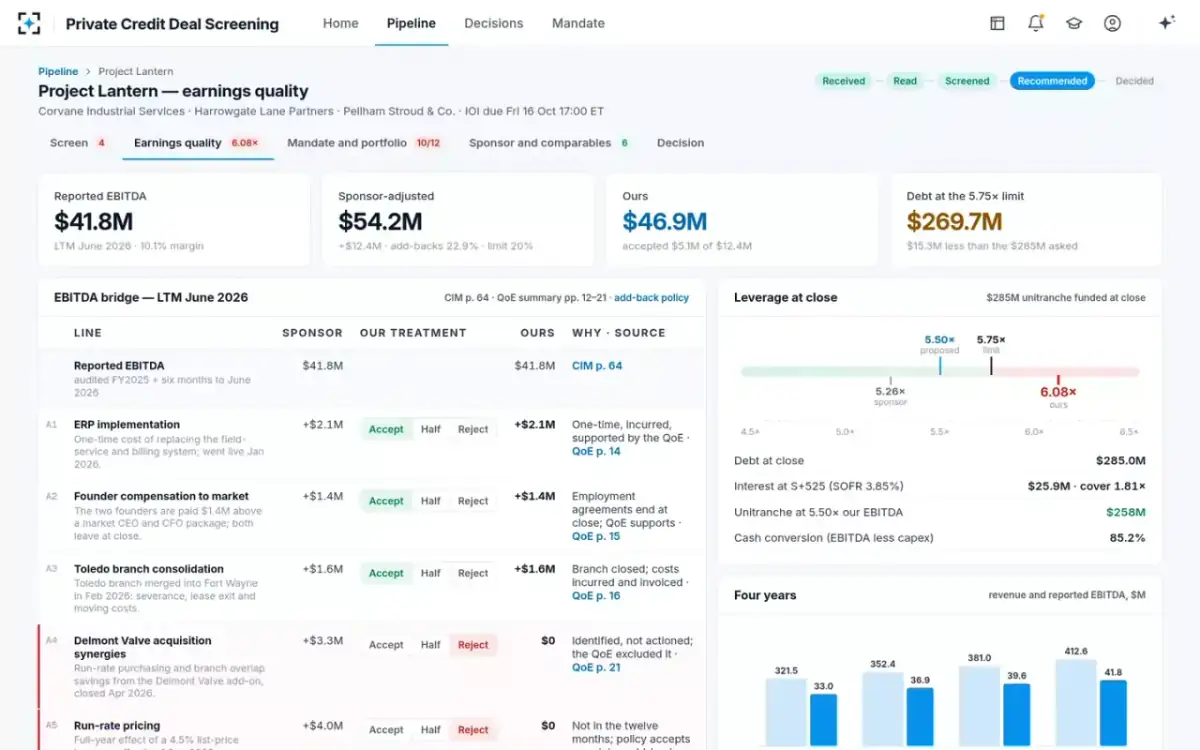
Project Lantern is a single file, not a test set, but it shows what the four measures look like applied to one real sort. The earnings quality analyst classified five of the sponsor's claimed add-backs: it accepted the ERP implementation cost, founder-pay normalization and the Toledo branch consolidation, $5.1 million in all, each with a page in the quality-of-earnings report behind it; and it rejected $3.3 million of Delmont Valve synergies, because they had been identified but never actioned, and $4.0 million of run-rate pricing that had not yet shown up in the trailing twelve months. Daniel Okafor, the Vice President, signed the screen without changing any of the five.
One file, five add-backs, zero overrides
5/5
add-backs where the Vice President’s signed screen matched the agent’s sort
$5.1M
accepted, each cited to a page in the quality-of-earnings report
$7.3M
rejected — unactioned synergies and run-rate pricing not yet earned
Five add-backs on one deal cannot answer how accurate is AI at classifying EBITDA add-backs for a fund's own book; the sample is too small, and a single sponsor's style of add-back is not every sponsor's style. What it can show, honestly, is the shape of the record a larger test needs: a citation for every classification, and a clear reason recorded for any underwriter who overrides one. Piloting AI deal screening on your own closed deals sets out how to turn that shape into a real, scored test across twenty or more of the fund's own past files before relying on it live.
The sort a test scores: each add-back, its treatment and its page
What a person changes, and why the reason is kept
When an underwriter disagrees with the agent's sort, the product's rule is specific: a person may change the treatment, and the reason for the change is kept with it, not discarded once the number is updated. That rule matters for measuring accuracy as much as for any single deal, because every override an underwriter records is, in effect, a free addition to the fund's own test set — a labeled example of where the classifier's sort and a person's judgment diverged, and why.
A synergy add-back the policy rejects, next to one it would accept
Rejected: identified, not actioned: $3.3 million of Delmont Valve synergies, named in the sponsor’s model as expected savings from the acquisition.
Would be accepted: actioned, and earned: The same category of synergy, once the cost actions behind it — headcount, system consolidation — have actually taken place.
Rejected: identified, not actioned: Fund IV’s add-back policy allows acquisition synergies "only once actioned, at 50%."
Would be accepted: actioned, and earned: Once actioned, the policy allows half the synergy’s value, not the full projected figure.
Rejected: identified, not actioned: The sponsor’s own memorandum describes the savings as expected, not yet realized — the "actioned" test fails on its face.
Would be accepted: actioned, and earned: A dated invoice, payroll record or system cutover showing the action taken would clear the same test.
Setting a pass bar before you rely on the sort
A zero in the test set is not a zero in the world. If a test of n add-backs finds no false accept, the statistician's rule of three (Hanley and Lippman-Hand, JAMA, 1983) puts the upper bound of a 95% confidence interval on the true rate at about 3 ÷ n, which is why the size of the test set matters as much as its result.
How many add-backs a clean test must cover to bound the false-accept rate
A measure nobody has committed to acting on is not a test, and the bar has to be set before the scores come in, not after. A workable starting point separates the two error types rather than averaging them: a false-accept rate low enough that a model risk reviewer is comfortable with the EBITDA inflation it implies, typically held much stricter than the false-reject rate, since a missed deal is recoverable and an over-levered loan is not; a page-cited rate close to 100%, because an uncited classification cannot be checked regardless of whether it happens to be right; and a defined review step for every disagreement between the agent's sort and a signed file, so the test set keeps growing with every live deal rather than staying frozen at whatever size the pilot used.
What to demand from any add-back classifier before a live deal touches it
- A false-accept rate measured on its own, not averaged into one accuracy score.
This is the error that inflates EBITDA and understates leverage — the one that costs money, not deal flow.
- A page-cited rate near 100% for every add-back sorted.
An underwriter has to be able to open the page a classification rests on, not take the sort on faith.
- A test set built from add-backs your fund has already decided, across several sponsors and sizes.
A set built only from the easy deals will not tell you how the classifier handles an aggressive sponsor.
- A kept reason on every override.
Each disagreement between a person and the sort is a labeled example; losing the reason loses the lesson.
- A written pass bar, set before the test runs.
Scores agreed on after they come in are a rationalization, not a bar the tool had to clear.
The signature that sits between the sort and the fund
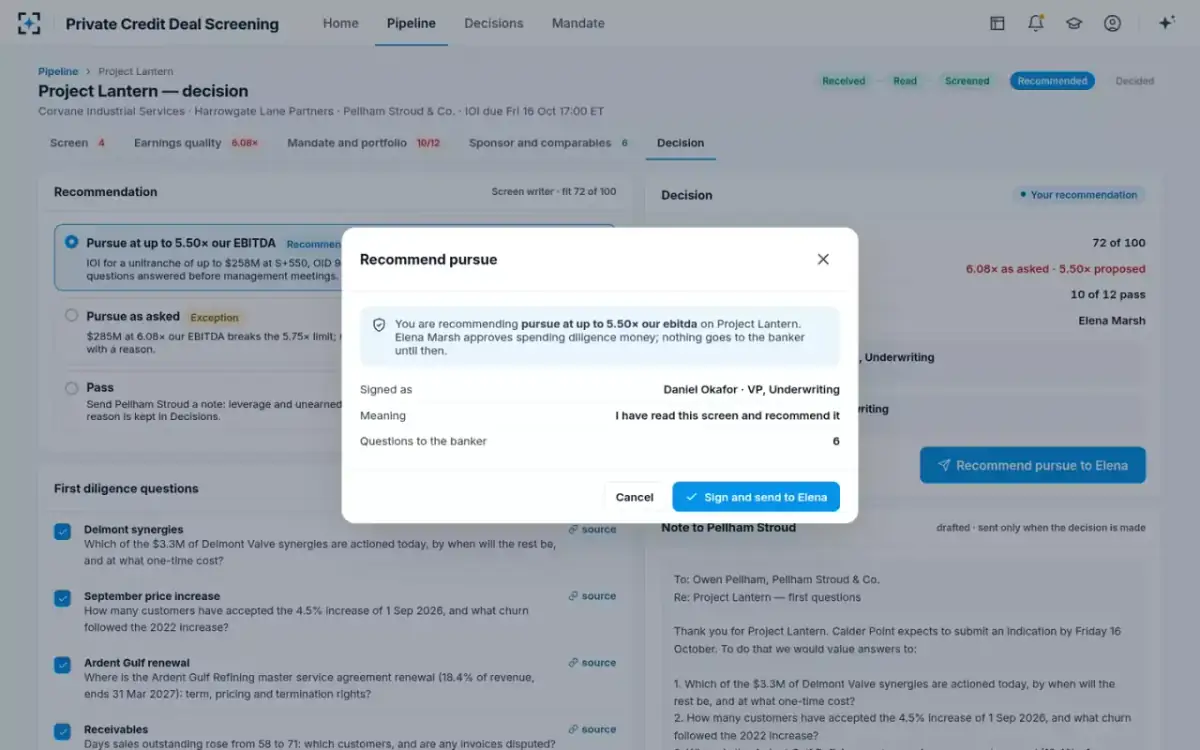
Private Credit Deal Screening's own design — a cited sort, a kept override reason, and a Vice President's signature between the sort and anything the fund relies on — is built to make exactly this kind of measurement possible. Whether any classifier, this one included, clears your own fund's bar is a question only your own past deals can answer, which is the first thing any serious pilot should run.
Questions people ask
What does it mean for AI to get an add-back right?
It means the classification matches what an underwriter, applying the fund's own written add-back policy, would have decided — not that the add-back is objectively true or false. The same add-back can be right under one fund's policy and wrong under another's, which is why "accurate" only means something measured against a specific policy, on deals a person has already decided.
Can AI replace a quality of earnings review?
No, and the product is built on the assumption that it will not. An earnings quality analyst can sort claimed add-backs against a written policy and cite its sources, but the quality-of-earnings review itself — verifying the underlying figures with the company's accountants — stays diligence work for a person or a specialist firm to do once a deal is pursued.
What is a false add-back acceptance?
An add-back the classifier accepted that a fund's own policy, applied by a person, would reject — commonly an unactioned synergy or a run-rate price increase not yet earned. It is the costlier of the two error types, because it inflates the fund's own EBITDA and understates leverage on a deal the fund may go on to fund.
How do you build a test set for add-back classification?
Pull deals the fund has already closed, passed or amended, with the add-back treatment an underwriter actually signed off on, across several sponsors, industries and sizes. Re-run the classifier against the same add-backs without showing it the signed answer, then score the match, false-accept, false-reject and page-cited rates against that signed record.
What happens when AI and an analyst disagree on an add-back?
The person's judgment wins, and the product keeps the reason for the change with the record, not only the corrected number. That kept reason is also what makes the disagreement useful afterward: it becomes a labeled example for the next round of testing, rather than a correction that disappears once the screen is signed.
Do EBITDA add-backs actually predict loan performance?
Published research says yes, in the direction a lender would expect: a Federal Reserve Bank of St. Louis study found that heavier use of non-GAAP EBITDA add-backs in loan agreements raises the likelihood of delinquency, default and a ratings downgrade on the loan. That is the research case for measuring an add-back classifier's false-accept rate carefully, since every false accept is, in effect, one more unverified add-back riding into the fund's leverage number.