Private equity KPIs come in two layers. At the portfolio company, sponsors track revenue, EBITDA reported and adjusted, margin, cash, net debt, leverage and the covenant ratios, plus a few sector measures. At the fund, investors track IRR, multiple of invested capital, DPI and TVPI, which are built from the company figures through the valuation. The list is well known; what separates a reliable KPI from a guess is the trail behind each number, from the line on the company's own page to the figure in the investor report. Botminds' Private Equity Portfolio Monitoring keeps that trail for every KPI, and this guide follows one of them, a single quarter's EBITDA, through every hop.
The figure belongs to Ferrante Imballaggi, a fictional Bologna packaging company owned 64% by a fund of the fictional sponsor Quillfield Capital, in the solution's sample data for the third quarter of 2026. Its EBITDA was €4.1M against a €5.0M budget.
One quarter's EBITDA, in four numbers
€4.1M
reported EBITDA on page 7 of the company's Italian quarterly report
−18.0%
against the €5.0M budget, explained by three drivers on page 9
14 of 14
KPIs re-derived by a second, independent reading, all agreeing
€19.6M
trailing twelve-month EBITDA that went into the valuation, replacing €20.1M
What KPIs do private equity firms track?
Private equity firms track operating KPIs for each portfolio company and return KPIs for each fund. The operating set is usually revenue, gross margin, EBITDA reported and adjusted, capital expenditure, cash, net debt, net leverage and the covenant ratios defined in each company's facility agreement, with sector measures such as recurring revenue, same-store sales or utilisation added where the investment case depends on them. The fund set is IRR, multiples of invested capital and the cash ratios DPI, RVPI and TVPI.
The two sets are connected by the valuation, and that connection is why the operating KPIs carry so much weight. A company's trailing twelve-month EBITDA, multiplied by the multiple the valuation team uses and less its net debt, becomes the equity value in the fund's NAV, which becomes the unrealised part of IRR and TVPI. An error in one company's EBITDA does not stay at the company.
Company KPIs and fund KPIs measure different things, and one feeds the other
Portfolio company KPIs: Revenue, EBITDA reported and adjusted, margin, cash, net debt, leverage, covenant ratios.
Fund KPIs: Gross and net IRR, gross and net multiple of invested capital, DPI, RVPI, TVPI.
Portfolio company KPIs: The company's own monthly and quarterly reporting, in its language and accounting standard.
Fund KPIs: The fund's cash flows and its NAV, which rests on the valuation of each company.
Portfolio company KPIs: The portfolio monitoring analyst maps; an operating partner approves.
Fund KPIs: Fund accounting and the valuation committee; the auditor once a year.
Portfolio company KPIs: Adjusted keyed as reported; a units slip; a restated prior quarter missed.
Fund KPIs: Unrealised value built on a company figure nobody can trace to its page.
What are the most important private equity KPIs?
The most important KPIs are the ones the investment case runs through, and research on what private equity investors say creates value points to revenue and cost first. In the survey of 79 private equity investors by Gompers, Kaplan and Mukharlyamov, increased revenue was a source of value after the investment "in roughly 70% of the deals"; reduced costs rose in importance after closing, "rising to 47% of deals"; and almost 60% of respondents cited facilitating a high-value exit (NBER Working Paper 21133, published in the Journal of Financial Economics, 2016).
That ordering gives a monitoring team its priorities. Revenue and EBITDA against budget measure whether the value-creation plan is working. Cash and leverage against covenant measure whether the capital structure gives it time to work. Everything else is supporting detail, and a template that asks for fifty KPIs from every company dilutes the attention the first six deserve. For the full map of a template, see the portfolio company reporting template guide.
One EBITDA figure, six hops from the company's page to the LP report
A KPI is trustworthy only if every hop it takes is owned by someone and leaves something behind: a page reference, a second reading, an approval, a locked input. In the solution, Ferrante's EBITDA took six hops between 2:41 p.m. on Friday, October 16, when the company's CFO uploaded its report, and the draft of the fund's investor report.
Six hops for one KPI in Private Equity Portfolio Monitoring, and who owns each
Agent
Intake agent readsReads the 24-page Italian report, page by page, and detects the company, the period (third quarter 2026), the currency and units (euro millions) and the accounting standard (Italian GAAP, OIC).
Never: guess a period or a unit
Agent
Mapping agent mapsMaps "EBITDA" on page 7 to reported EBITDA, €4.1M, and the footnoted "EBITDA rettificato" to adjusted EBITDA, €4.5M, with a confidence for each value.
Never: write a value under 95% confidence without a person
A person decides
The analyst confirmsSofia Lindgren confirms the adjusted line, which the agent read at 93%, and submits the 14-KPI set for approval.
Agent
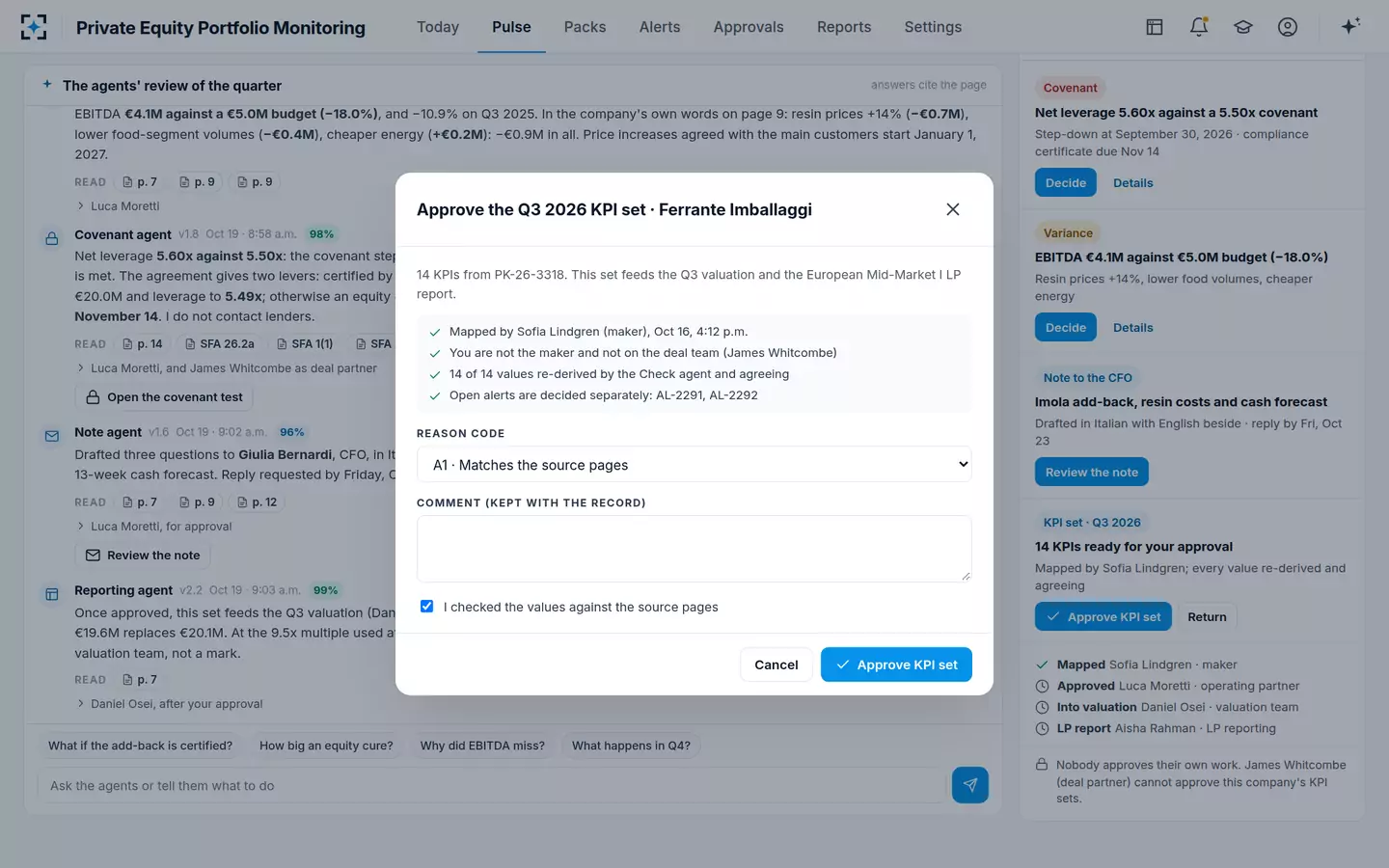
Check agent re-derivesRe-derives all 14 KPIs by a second path without seeing the first answers: net debt 121.2 − 11.4 = 109.8; leverage 109.8 ÷ 19.6 = 5.60x. All 14 agree.
Never: settle a disagreement itself
A person decides
The operating partner approvesLuca Moretti, neither the analyst nor on the deal team, approves with reason code A1, "Matches the source pages", and his attestation.
A person decides
Valuation accepts, LP reporting publishesThe Head of Valuation accepts the set as a locked input; the LP reporting manager publishes the company section the Reporting agent drafted from accepted figures only.
Two things in that chain are easy to miss. The second reading is independent: the Check agent works from the page without seeing the first agent's answers, which is what makes agreement mean something. And no step can be skipped by seniority. The person who mapped the set cannot approve it, and a deal partner cannot approve figures for his own companies. A KPI that arrives in the valuation has, by construction, been read twice and seen by two people.
Adjusted EBITDA in a portfolio company report: why it needs a condition, not just a number
Adjusted EBITDA in a portfolio company report is reported EBITDA plus the items management, or the facility agreement, treats as non-recurring or non-cash. The number alone is incomplete, because most adjustments come with a condition: a cap, a time limit, or a certification by the company's CFO. A KPI set that stores €4.5M and loses the condition has stored a figure the covenant may not accept.
Ferrante's adjustment shows the condition at work. The €0.4M added back is the cost of moving a production line. Its facility agreement lets non-recurring costs back into Consolidated EBITDA up to 5% of trailing EBITDA, €0.98M here, if the CFO certifies them in the compliance certificate. Certified, the add-back lifts trailing EBITDA to €20.0M and brings leverage to 5.49x, inside the 5.50x covenant by 0.01x. Uncertified, leverage stays at 5.60x and the covenant is breached. The solution keeps both lines apart (in its settings, a fixed rule), and the Note agent drafted the question to the CFO, in Italian with the English beside, for the operating partner to approve and send.
How are portfolio company KPIs verified?
Portfolio company KPIs are verified by deriving each one a second way, from a different part of the same report or from its components, and comparing; a disagreement goes to a person with both pages open. Checking a KPI against last quarter or against budget is a reasonableness test, not verification: a wrong figure can be perfectly reasonable.
The SEC's examiners have seen what unverified underlying data does further down the chain. Its 2022 risk alert described private fund advisers whose performance calculations rested on inaccurate data, including figures from the wrong time periods and projected rather than actual results (SEC Risk Alert, Jan. 27, 2022). A period error is precisely what a second reading catches and a reasonableness test does not.
The verification also has to survive the people who check it. For a registered adviser, Rule 204-2(a)(16) requires keeping the working papers that demonstrate how any performance it presents was calculated (17 CFR 275.204-2). A KPI verified in an analyst's head is not a working paper. A KPI with its page, its second reading and its approver is.
The approval in Private Equity Portfolio Monitoring shows the checks behind the KPI set
Explaining a variance in the company's own words
A KPI against budget is half an answer; the other half is why. The variance that matters for Ferrante is EBITDA 18% under budget, and the company's report explains it on page 9. The solution's Variance agent takes the drivers from that page and nowhere else, so the explanation the operating partner reads is the company's, cited, not a model's guess.
Why EBITDA missed budget by €0.9M, in the company's own words
How do KPIs feed the valuation?
In a multiple-based valuation, the company's trailing twelve-month EBITDA, or another earnings measure the valuation policy names, is multiplied by a chosen multiple to give enterprise value; net debt is deducted to reach equity value; the fund's share of that equity is the mark. The KPIs are therefore inputs to the formula, and each one moves the mark by its own lever.
Ferrante's quarter shows the size of the lever. Its trailing EBITDA fell from €20.1M to €19.6M. At the 9.5x multiple the solution's screen notes for this company, half a million euros of trailing EBITDA is about €4.75M of enterprise value before any change in net debt, and the fund owns 64% of the equity. That is our arithmetic to show scale, not the sample's mark, which is the valuation team's to strike.
Supervisors want investors to see those levers separately. The FCA's 2025 review praised firms that added a "value bridge" to investor reporting, showing "how much change was attributable to a portfolio company's underlying earnings, the valuation multiple used, cash proceeds and exchange rate changes" (FCA, Private market valuation practices, March 2025). A value bridge is only as good as its earnings line, and the earnings line is the monitored KPI. How the valuation itself is struck belongs to Botminds' Private Markets Valuation, and how private equity values companies walks through it.
What happens when a portfolio company restates?
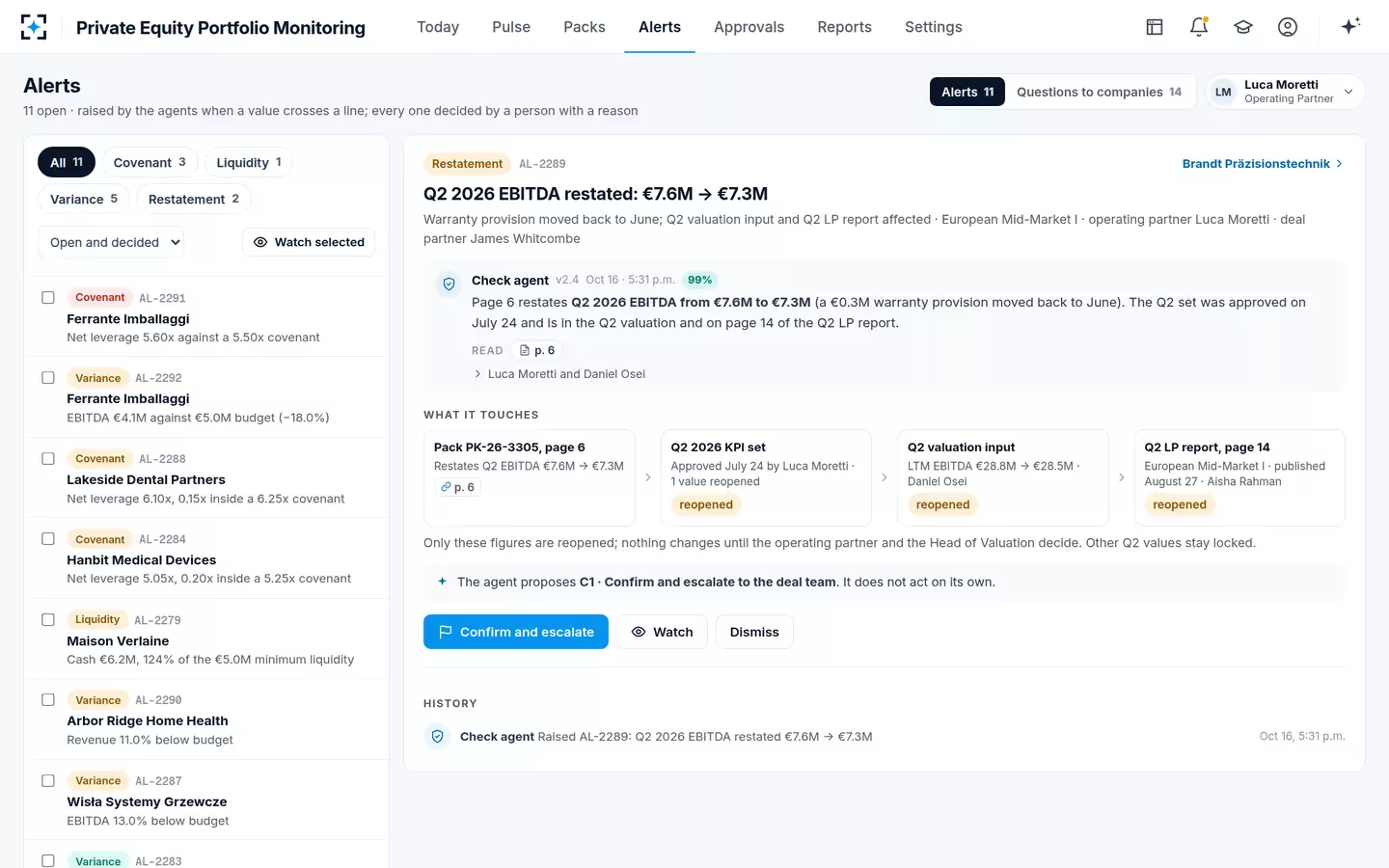
When a portfolio company restates a prior period, every figure built on the old number is wrong until someone decides otherwise: the prior KPI set, the trailing twelve-month total, the valuation input and any investor report already published. The right response is to trace exactly what the restatement touches and reopen only that, under a person's decision.
In the sample, Brandt Präzisionstechnik's third-quarter report restated its second-quarter EBITDA from €7.6M to €7.3M, moving a €0.3M warranty provision back to June. The Check agent flagged it because the change exceeded the sponsor's 1% restatement threshold, and traced four places it reached: the company's report, the second-quarter KPI set approved on July 24, the second-quarter valuation input (trailing EBITDA from €28.8M to €28.5M) and page 14 of the fund's second-quarter LP report, published August 27. Those four were reopened; every other second-quarter value stayed locked until the operating partner and the Head of Valuation decided.
A restated quarter, and the four places it reaches
The restatement is also where tracing pays for itself. Without lineage, a team that learns of a restated quarter has two bad choices: re-check everything built on the company that quarter, or hope nothing important used the old number. With lineage, the answer is a list. How restatements and other alerts should reach the people who decide is the subject of the portfolio monitoring dashboard guide.
What each hop leaves behind, so the figure can be checked later
| Hop | Left behind | Who can be asked |
|---|---|---|
| Read | The company's original page, its language, units, period and accounting standard | Intake agent, versioned |
| Mapped | The template field, the source line, the confidence, and any person's confirmation with a reason | The analyst |
| Re-derived | The second path and whether it agreed | Check agent, versioned |
| Approved | Approver, reason code, attestation and the independence checks | The operating partner |
| Accepted | The locked input and the KPI set it came from | The Head of Valuation |
| Reported | The investor report page and the accepted figures it was drafted from | The LP reporting manager |
What is DPI in private equity, and why it is not a company KPI
DPI, distributions to paid-in capital, is cash returned to a fund's investors divided by the capital they have paid in; RVPI is the remaining value, the fund's NAV, over paid-in capital; TVPI is the two together. DPI is the only one of the three that does not depend on a valuation, which is why investors watch it closely late in a fund's life.
None of them is a portfolio company KPI, but RVPI and TVPI rest on the company KPIs through the NAV. A sponsor that cannot trace Ferrante's €19.6M of trailing EBITDA to page 7 of its report cannot fully explain the unrealised part of its own TVPI. The SEC's vacated quarterly statement rule would have required a statement of contributions and distributions alongside IRR and multiple for illiquid funds (88 FR 63206, vacated 2024); the investors who asked for it still want the same thing under their fund agreements.
Questions people ask
What is the difference between a KPI and a covenant metric?
A KPI is a measure the sponsor chooses to track; a covenant metric is defined by the company's facility agreement and tested against a limit. Leverage can be both, but on different definitions: in the sample, the agreement's net leverage of 5.60x is computed on its own definition of net debt and EBITDA, which is not always the company's reported ratio.
How often should private equity KPIs be updated?
Monthly for a short set of operating figures where the company reports monthly, and quarterly for the full set used in valuations and investor reports. Covenant-sensitive companies justify monthly attention: a company a tenth of a turn from its limit tells the sponsor more in its monthly accounts than in a quarterly report weeks later.
Who should approve portfolio company KPIs?
Someone other than the person who mapped them, and not a member of the company's own deal team. In the sample, operating partners approve KPI sets for the companies they cover, with a reason code and an attestation, and deal partners cannot approve figures for their own companies.
What is a value bridge in private equity reporting?
A value bridge breaks the change in a holding's value into its causes: the company's earnings, the multiple applied, cash proceeds and exchange rates. The FCA highlighted it as good practice in investor reporting in March 2025. It only works if the earnings line is a verified KPI.
Can a KPI change after it has been approved?
It should not change silently. In the solution, an approved value is never changed by an agent; a restatement or a correction reopens only the affected figures and needs a person's decision, kept with its reason. The original approval stays on the trail.