A portfolio company reporting template is the standard set of figures a private equity sponsor asks each company it owns to send every month or quarter: revenue, EBITDA reported and adjusted, cash, net debt, the covenant ratios, headcount and a short commentary, each in a fixed unit and period. The spreadsheet itself is the easy part. What makes a template work is the map behind it, which says for every cell how the fund defines the figure and where it sits in each company's own accounts. Without that map, the same EBITDA cell can hold three different numbers across a portfolio. Botminds' Private Equity Portfolio Monitoring keeps the map per company, reads each company's reporting in its own language and accounting standard, and fills the template with every value cited to its page.
The examples below come from the solution's sample data: Quillfield Capital, a fictional sponsor with 120 portfolio companies across eight funds and programs, closing its third quarter of 2026. The rules and research are from regulators and peer-reviewed studies, linked where they appear.
Why one template has to fit very different companies
27,682
private equity funds reported to the SEC on Form PF at the end of 2025
10+
portfolio companies in many private equity funds, and "hundreds or more" in some, in the SEC's words
3
languages in the reporting of just three companies in one sample fund: Italian, German and Dutch
What should a portfolio company reporting template include?
A portfolio company reporting template should include five layers: who and when (company, period, currency, units, accounting standard), the three statements in summary, the fund's KPIs with their definitions, the covenant figures on the facility agreement's own terms, and a short management commentary. Most templates get the second and fifth layers right. The first and fourth are where the errors live.
The identity layer looks clerical, and it is the one that breaks comparisons. A template that does not force the company to state "EUR millions, quarter ended 30 September, Italian GAAP" leaves the analyst to infer it, and a thousands-and-millions slip or a calendar mismatch passes straight into the fund's numbers. In the sample, a Korean company's reporting switched from thousands to millions between pages. The solution raised it as an exception rather than guessing.
The commentary layer has a regulatory echo in Europe. Where an EU fund controls a non-listed company, AIFMD Article 29 requires the fund's annual report, or the company's own, to give a fair review of how the company's business developed and where it stood at the period end, the important events since the year end, and "the company's likely future development" (Directive 2011/61/EU, Article 29(2)). Control means "more than 50 % of the voting rights", and small and medium-sized companies are excluded. A template that already asks for drivers, events and outlook each quarter makes that annual section an assembly job rather than a scramble.
The fields a portfolio company reporting template should force, not invite
- Period, currency, units and accounting standard on every sheet
Stated by the company, not inferred by the analyst. A change between pages is an exception, never a guess.
- Reported EBITDA and adjusted EBITDA as two separate lines
With every adjustment listed, sized and explained. One cell called "EBITDA" invites the wrong one.
- The fund's definition beside each KPI
Group revenue after intercompany eliminations, net debt including or excluding leases: written once, applied to every company.
- Covenant figures on the facility agreement's terms
The agreement's Consolidated EBITDA and net debt, not the income statement's, with the test date and the limit in force.
- Prior periods as restated, flagged
A changed prior quarter rarely announces itself; the template should make the company say so.
- Drivers, events since period end, outlook
Three short answers in the company's own words, citable later.
The map matters more than the spreadsheet
The spreadsheet holds values; the map holds the reasons those values can be trusted. For each KPI the map sets down the fund's definition, the line or note in each company's reporting that supplies it, the unit and period, the accounting standard, and any adjustment between the two. It is what lets a second person check a figure in two minutes instead of re-deriving it from scratch.
For a registered adviser, the evidence behind reported performance is not optional. Rule 204-2(a)(16) requires advisers to hold on to whatever books and working papers back up, or demonstrate the arithmetic of, any performance figure they present outside the firm (17 CFR 275.204-2). Company KPIs feed valuations, and valuations feed the performance a fund reports. A template with no map leaves that chain of working papers in analysts' heads and email folders.
SEC examiners have also seen what happens when the data underneath goes stale. The Division of Examinations reported private fund advisers that "utilized stale performance information in presentations to potential investors" (SEC Risk Alert, Jan. 27, 2022). Staleness usually enters at the template: a company's figure carried forward because the new quarter had not been mapped, with nothing on the cell to say so.
One company's KPIs, each mapped to the line it came from
| KPI in the fund template | Fund definition | Where it sits in the company's reporting | Q3 2026 | What goes wrong |
|---|---|---|---|---|
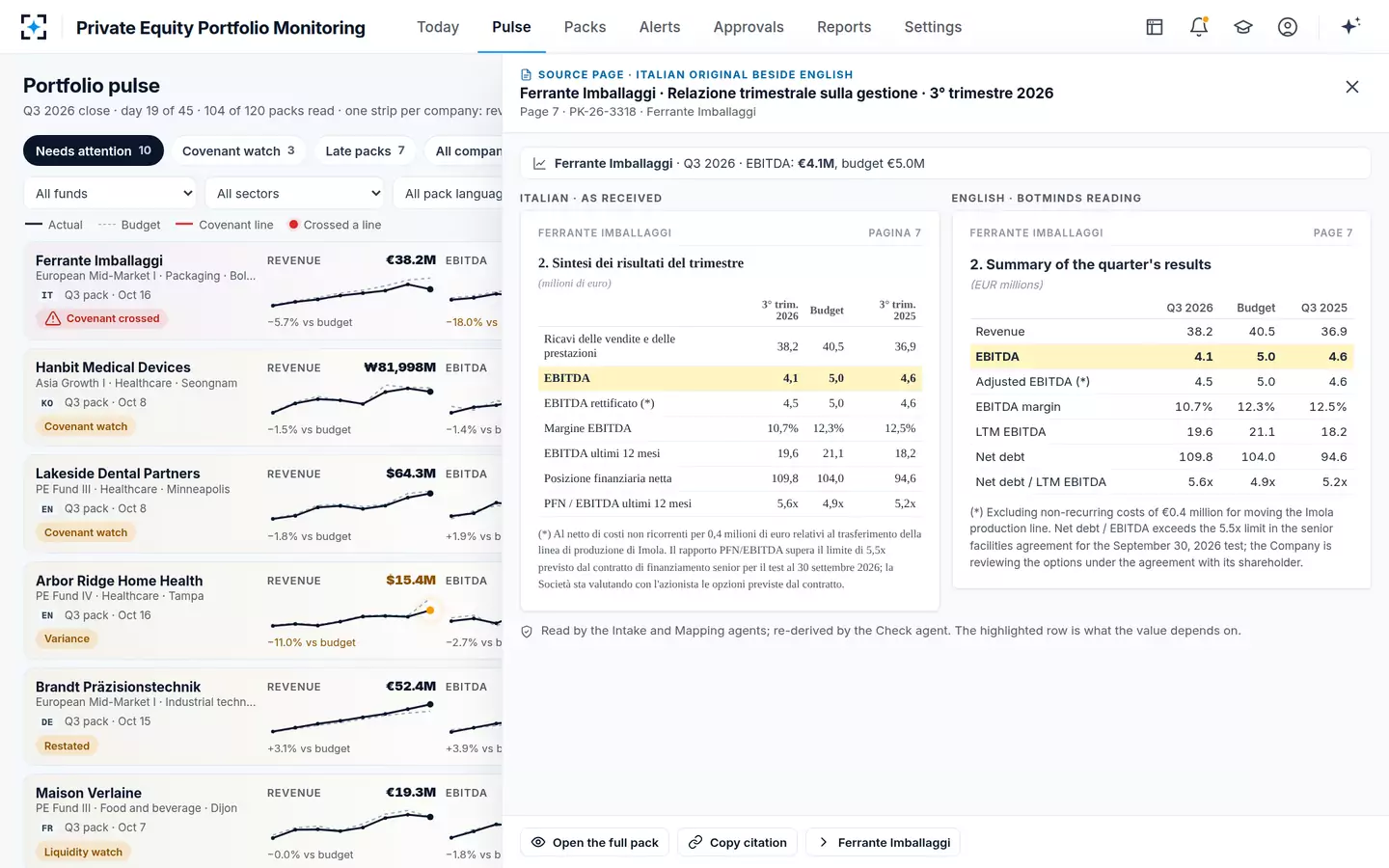
| Revenue | Group revenue after intercompany eliminations | "Ricavi delle vendite e delle prestazioni", page 7 | €38.2M | A segment note added up before eliminations gives a different total |
| EBITDA, reported | As in the company's accounts | "EBITDA", page 7 | €4.1M | Keyed from the adjusted line by mistake |
| EBITDA, adjusted | Reported plus items the facility agreement allows | "EBITDA rettificato (*)", page 7, with its footnote | €4.5M | The €0.4M one-off loses its footnote and its condition |
| LTM EBITDA | Last four quarters, reported | "EBITDA ultimi 12 mesi", page 7 | €19.6M | A restated earlier quarter is not carried in |
| Net debt | Financial debt less cash, on the agreement's definition | "Posizione finanziaria netta", page 7 | €109.8M | Leases counted one way by the company, another by the agreement |
| Net leverage | Net debt ÷ LTM EBITDA, unrounded | "PFN / EBITDA ultimi 12 mesi", page 7 | 5.60x | The company prints 5.6x; the covenant is 5.50x |
What is the difference between reported and adjusted EBITDA in a reporting package?
Reported EBITDA is the figure the company's own accounts produce; adjusted EBITDA adds back items management, or a credit agreement, treats as non-recurring or non-cash. In a reporting package both belong on separate lines, because each feeds a different decision: reported EBITDA the trend and the valuation's view of earnings, adjusted EBITDA the covenant test the facility agreement defines.
Nothing in securities law defines adjusted EBITDA for a private company. Regulation G begins: "Whenever a registrant, or person acting on its behalf, publicly discloses material information that includes a non-GAAP financial measure", the registrant must present the comparable GAAP figure and "a reconciliation" (17 CFR 244.100). A privately held portfolio company is not a registrant, so the definitions that govern its adjusted EBITDA are the ones written into its facility agreement and the sponsor's template. The reconciliation discipline is still worth borrowing: a template that asks for adjusted EBITDA should ask for the bridge from reported, item by item.
The gap is rarely academic. Ferrante reported €4.1M for the quarter and €4.5M adjusted. On the reported figure, its leverage was 5.60x against a 5.50x covenant. If the company's CFO certifies the €0.4M one-off under the agreement's add-back clause, leverage falls to 5.49x. The same company is in breach or inside its covenant depending on which line the template captured, and on a condition, the CFO's certification, that a single cell cannot hold. How a sponsor works that decision is the subject of the equity cure guide.
Research on covenants explains why the template should carry the agreement's version too. In a large sample of private loan agreements, Dichev and Skinner found that "the extensively–used leverage variable is a relatively noisy proxy for closeness to covenants" (Journal of Accounting Research, 2002). A leverage ratio computed from the income statement is not the covenant's leverage ratio; a template that conflates them reports headroom for a test nobody runs.
Private Equity Portfolio Monitoring shows the page as received, as read, and the line the value depends on
How do you handle a portfolio company that reports under a different accounting standard?
Map it; do not translate it. Keep the company's figures under its own standard, keep the standard as a field, and define in the template the few adjustments the fund needs to compare across companies, such as group revenue after eliminations or net debt on one definition. Re-stating a whole set of accounts into IFRS or US GAAP each quarter is an audit-sized job no monitoring team can do, and it is rarely what the fund's KPIs need.
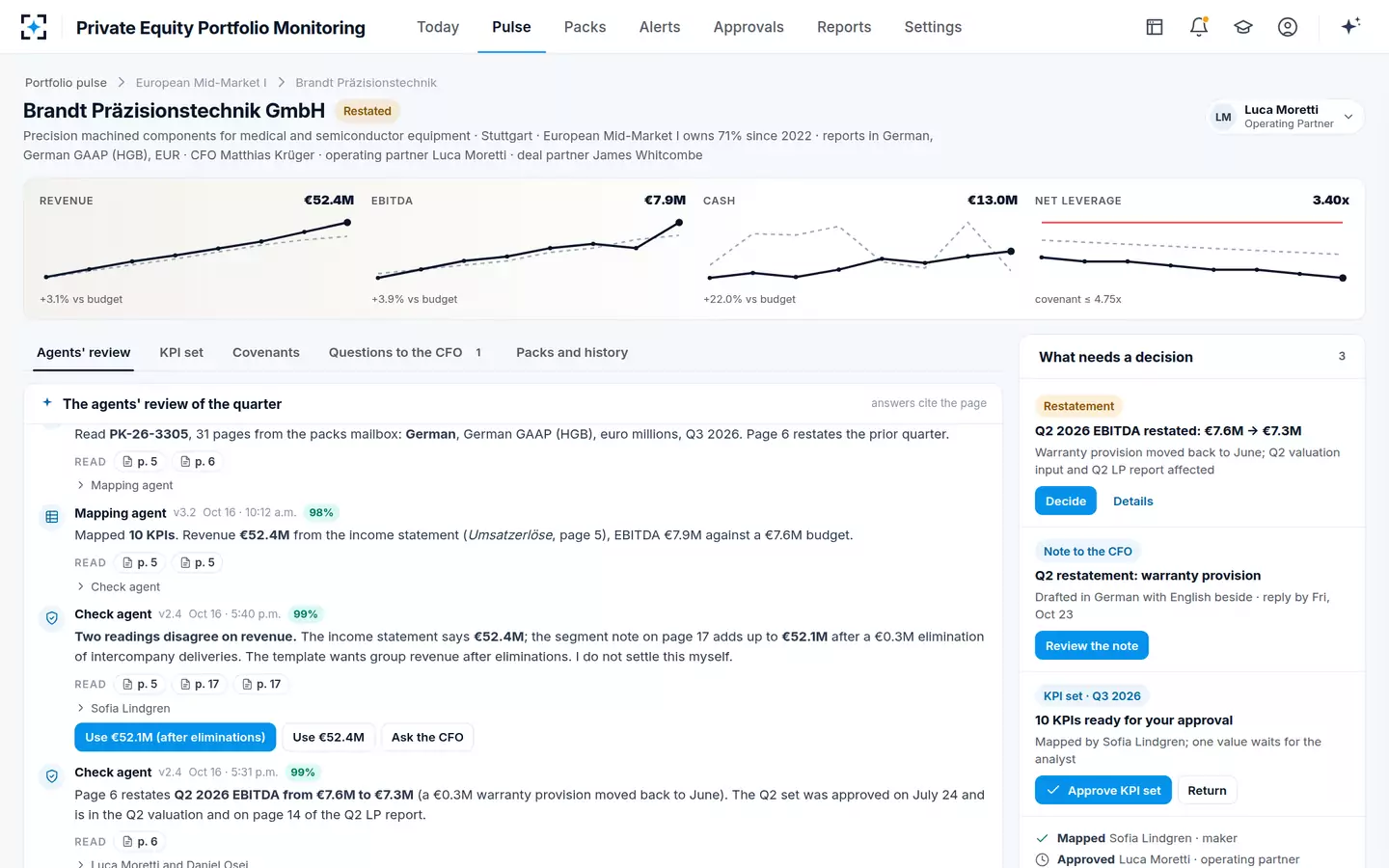
The trap is that two lines in the same report can both look like the answer. In the sample, Brandt Präzisionstechnik reports in German under the German Commercial Code (HGB). Its income statement shows revenue, "Umsatzerlöse", of €52.4M on page 5. Its segment note on page 17 adds up to €52.1M after a €0.3M elimination of deliveries between group companies. The fund template asks for group revenue after eliminations, so the right figure is €52.1M, and the reason belongs in the map: the next analyst who maps Brandt should not have to rediscover it.
Two readings of revenue in Private Equity Portfolio Monitoring, both cited, for a person to choose
How often do portfolio companies report to their sponsor?
Most portfolio companies report to their sponsor monthly in summary and quarterly in full, with annual audited accounts; the frequency is set in the shareholder agreement or the sponsor's reporting policy, not by a regulator. The quarter is the unit that matters most, because it is when valuations are struck and covenants are tested.
Supervisors have observed the same rhythm on the valuation side. In its 2025 review of private market valuation practices, the FCA found that the industry had settled on valuing quarterly, and firms argued those cycles fit because "valuations are aligned with financial reporting frequency for the underlying asset" (FCA, Private market valuation practices, March 2025). The company's quarterly reporting is therefore the clock for everything downstream. A template that arrives late, or arrives without its map, pushes the valuation and the investor report back with it.
Monthly reporting earns its place for covenant-sensitive companies. A company two-tenths of a turn from its leverage limit tells the sponsor more in its October management accounts than in its quarterly package six weeks after September. Many sponsors ask for a short monthly set (revenue, EBITDA, cash, net debt) and the full template at quarter end; the map is the same, only the fields differ.
What did the SEC say about uniform reporting templates?
The SEC noted, in 2023, that industry templates exist and that they are unevenly used. In the release adopting its private fund adviser rules, it wrote: "Certain investors and industry groups have encouraged advisers to adopt uniform reporting templates to promote transparency and alignment of interests between advisers and investors." It added: "In 2021, 59% of LPs in a survey reported receiving the template more than half the time" (88 FR 63206, Sept. 14, 2023). That release's rules were later vacated in full by the Fifth Circuit, as the guide to private equity reporting requirements sets out, but the observation about templates stands as the SEC's description of the market.
Two things follow for the company-level template. First, the templates the SEC described sit between the adviser and its investors. The template between a portfolio company and its sponsor is the sponsor's own design, and its definitions are the sponsor's to write. Second, whatever the investor-facing template asks for has to be traceable to the company-level one. If the investor report shows a company's EBITDA, the company template must say which EBITDA, from which line.
A template as a spreadsheet, and a template as a map
Spreadsheet only: A number someone typed.
Spreadsheet with a map behind every cell: A number, its definition, its page, its unit, its period and who confirmed it.
Spreadsheet only: One EBITDA cell; the company decides which to send.
Spreadsheet with a map behind every cell: Two lines, with the adjustments listed and sized; covenant EBITDA on the agreement's terms.
Spreadsheet only: Rediscovers each company's quirks from last quarter's file.
Spreadsheet with a map behind every cell: Reads the company's map: which line, which note, which elimination.
Spreadsheet only: Overwritten, or missed.
Spreadsheet with a map behind every cell: Flagged against the approved figure, with what it touches downstream.
Spreadsheet only: Rebuilt from email.
Spreadsheet with a map behind every cell: Answered from the cell: the page, the reading, the approval.
Who fills in the portfolio company reporting template, and who checks it?
The company's CFO or finance team fills in the template; the sponsor's portfolio operations analyst maps and checks it; an operating partner or a portfolio manager approves it before it reaches the valuation and the investor report. The roles are usually clear on paper. In practice the analyst re-keys most of the template from the company's own management report, because companies send what their board papers already contain, not what the sponsor's template asks for.
That is the honest reason so many templates fail: they ask a CFO to restate their own reporting into someone else's format each month, and the CFO sends their own format instead. A sponsor has two choices. It can push harder for the template, or it can accept the company's own reporting and keep the map on its side. The second is what the portfolio monitoring analyst spends most of a quarter doing by hand.
Private Equity Portfolio Monitoring takes the second route. Its Intake agent reads each company's reporting in the language and standard it arrives in; its Mapping agent fills the fund template from the company's stored map, with a confidence for each value; its Check agent re-derives each KPI by a second path without seeing the first answer. A value under 95% confidence goes to the analyst; the analyst who mapped a KPI set cannot approve it. In the sample, Ferrante's 14 KPIs were mapped and re-derived the afternoon its report arrived, 14 of 14 agreed, and the one judgment call, whether a €4.5M figure was adjusted EBITDA, went to a person.
Building the map for a new company in four steps
A map is built once per company and maintained each quarter, and the first quarter is the expensive one. Done well, it turns every later quarter into checking rather than rediscovering.
First, collect two or three past quarters of the company's real reporting, not its template submissions, and the facility agreement. Second, for each fund KPI, find the line, note or calculation that supplies it, and write down any adjustment: eliminations, lease treatment, the add-backs the agreement allows and their caps. Third, test the map on a past quarter whose figures are already approved; every difference is either a mapping error or a known adjustment to write into the map. Fourth, agree with the company's CFO which items they will flag each quarter, such as one-offs, restatements and changes of accounting policy, so the template's exceptions arrive as answers rather than surprises.
The map is also what makes a monitoring change safe. When a fund adds a KPI, or a company changes its chart of accounts after an add-on acquisition, the change is made to the map and tested on a past quarter before anyone relies on it. The KPIs that flow from the map into valuations, and what a single figure goes through on the way, are traced in the guide to private equity KPIs.
Questions people ask
What is a portfolio company in private equity?
A portfolio company is a business in which a private equity fund holds an investment, usually a controlling stake. Each one reports its results to the sponsor, which uses them to monitor performance, test the company's loan covenants, value the investment and report to the fund's investors. In the EU, a fund holding more than 50% of a non-listed company's voting rights takes on extra disclosure duties under AIFMD Articles 26 to 30.
What KPIs do private equity firms ask portfolio companies to report?
The common core is revenue, EBITDA reported and adjusted, margin, cash, net debt, capital expenditure and the covenant ratios, plus a few sector measures such as same-store sales or recurring revenue. What varies more than the list is the definition: whether revenue is after intercompany eliminations, and whether net debt includes leases. Write the definition beside each KPI.
Should the template be in English?
The template's definitions should be in the sponsor's working language, but the company's reporting need not be. Asking a German or Italian finance team to restate its management accounts in English each month adds a translation step that introduces its own errors. Keeping the original and mapping from it preserves the page an auditor or examiner will want to see.
How do you handle a company that restates a prior quarter?
Flag the restated figure against the approved one and trace what it touches before anything changes. In the sample, Brandt restated its second-quarter EBITDA from €7.6M to €7.3M, which moved its trailing twelve-month EBITDA from €28.8M to €28.5M and touched one valuation input and one page of a published investor report. Only those figures were reopened, and only a person could change them.
How many KPIs should a portfolio company template have?
Fewer than most have. Every KPI needs a definition, a mapped source and a check each quarter, so each one carries a real cost across a portfolio. In the sample, a mid-sized European company maps 14 KPIs for the quarter; a fund can add sector measures where they drive the value-creation plan, not because a peer collects them.
Is the portfolio company template the same as the investor reporting template?
No. The portfolio company template runs from the company to the sponsor; the investor template runs from the sponsor to its limited partners and summarises fees, expenses, performance and holdings. Under AIFMD II, EU managers must also disclose to investors each year all fees, charges and expenses borne by them, which belongs in the second kind. The company template should still feed the investor one, figure for figure.