The portfolio monitoring process in private equity is the quarterly cycle that takes each portfolio company's reporting and turns it into approved figures for the valuation, the covenant oversight and the investor report. It has six steps: collect the companies' reporting and chase what is late; map it into the fund's KPI template; check it against budget, prior periods and the balance sheet; test covenants on each facility agreement; put questions to company CFOs; and hand approved figures to valuation and investor reporting. By our estimate, half of an analyst's quarter goes to the first two steps, which are the least analytical. Botminds' Private Equity Portfolio Monitoring was built to take those steps, and most of the third and fourth, off the team, leaving the decisions with people.
The figures for the sample sponsor below are from the solution's sample data on Quillfield Capital, a fictional firm with 120 portfolio companies in eight funds and programs. The day counts are our estimate for one of its analysts, not a measured result; the method for measuring your own is set out below.
The scale behind one sponsor's quarter close
120
companies reporting in the sample sponsor's third-quarter close; 37 reports in nine languages arrived over one weekend
1,412
monthly, quarterly and annual reporting packages a year across those companies
~20
working days of one analyst's quarter close by hand, for about 30 companies (our estimate)
45
days from quarter end to the sample's house deadline for its investor reports
What is the portfolio monitoring process?
The portfolio monitoring process is collect, map, check, test, question and hand over, repeated every quarter for every company, with a lighter monthly version for the companies that report monthly. Each step has an owner and an output; the process is only as fast as its slowest company and only as reliable as its weakest check.
Collecting is less trivial than it sounds. Companies report through a portal, by email and into data rooms, each in its own format, language and accounting standard, and some are late. Mapping turns each company's own report into the fund's template. Checking ties the figures to budget, to prior periods and to the balance sheet, and catches restated prior quarters. Covenant testing applies each facility agreement's definitions. Questions go to company CFOs about anything unexplained. The hand-over delivers approved KPI sets to the valuation team and the investor reporting team.
There is a seventh step that teams often skip: tracking what portfolio companies pay the sponsor and its affiliates. The SEC's examiners have reported advisers that disclosed management fee offsets yet had no adequate procedure for tracking the fees their portfolio companies paid (SEC Risk Alert, June 23, 2020). The companies' own accounts are where those payments appear first, so the monitoring team is the natural place to capture them, even though the fee calculation belongs to fund accounting.
How long does quarterly portfolio reporting take?
In the sample, a quarter close runs 45 days from quarter end to investor report, and most of the early weeks are spent waiting for companies. No regulator sets the calendar for a US private equity fund's quarterly report; the dates come from the fund's agreements, the companies' reporting deadlines and each facility agreement's compliance certificate date. In the sample, the house target for investor reports is day 45, November 14, which is also the day Ferrante Imballaggi's compliance certificate falls due under its facility agreement.
One company's quarter close, to scale: most of it is waiting
- Quarter closes; company prepares its reportdays 0–16
- Checksdays 16–23
- Valuation preparationto day 36
- Report, certificateto day 45
One company's afternoon in Private Equity Portfolio Monitoring, action by action
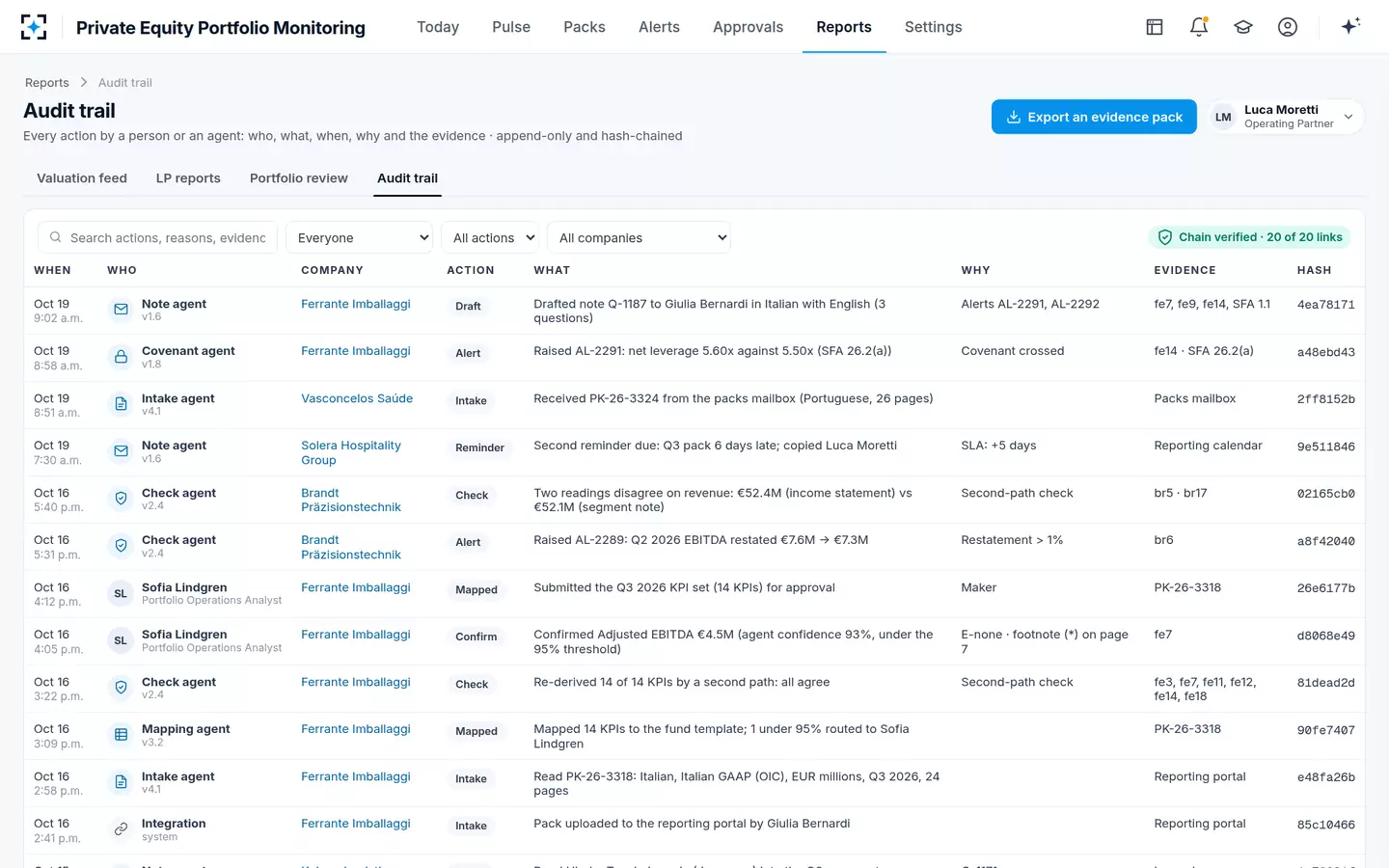
Valuation cadence explains why the close cannot simply be stretched. The FCA's 2025 review found that firms valued most private assets quarterly and argued that more frequent valuations "might present challenges, given the resource-intensive nature of valuing private assets" (FCA, Private market valuation practices). The monitoring close feeds that quarterly valuation; a day lost waiting for a company's figures is a day taken from the valuation team.
Where the twenty analyst-days go
On our estimate, one analyst's quarter close for about 30 companies takes 20 working days by hand: four collecting and chasing, six retyping and mapping, three checking, two testing covenants, two on CFO questions and three on valuation inputs and the investor report section. With agents reading, mapping and re-deriving, the same close takes about five days of the analyst's time.
Where a quarter close's 20 days go, by hand and with Private Equity Portfolio Monitoring
By hand · 20 days (estimate)
- Collecting, chasing · 20%
- Retyping, mapping · 30%
- Checking · 15%
- Covenants and CFO questions · 20%
- Valuation, LP report · 15%
With agents · 5 days (estimate)
- Collecting, chasing · 20%
- Retyping, mapping · 20%
- Checking · 10%
- Covenants and CFO questions · 20%
- Valuation, LP report · 30%
Two things change shape, not just size. The mapping that remains is confirmation of the values the agents were unsure of, such as a line read at 93% against a 95% threshold. And the valuation and investor report step grows as a share, because it is where people review figures rather than produce them. That is the intended direction: less time making numbers, the same or more time deciding whether they are right.
How do you measure the time spent on portfolio reporting?
Measure it for one quarter, by step and by company, before buying anything. No regulator or independent study publishes how long private equity monitoring takes, and the SEC's own judgment, when it considered collecting company-level data on Form PF in 2023, was that "the costs associated with collecting this information may be far higher than collecting information at the fund itself" (88 FR 38146). Your own log is the only benchmark that counts.
The method is simple. Ask each analyst to log half-days against the six steps for one full close, with the company named. At the end, total the days by step and divide by companies. Then sort companies by days: the expensive ones are usually those reporting in another language or format, those that restate, and those near a covenant. That list is also the case for or against automation, because it shows whether the time sits in steps software can take.
Count two things the log will miss. Calendar delay, the days a company's report sits unread because the analyst is busy with another, does not show up as effort but delays everything downstream. And rework: a figure corrected after approval costs the analyst, the approver and sometimes the valuation team a second pass.
What does portfolio monitoring cost a GP?
Portfolio monitoring costs a GP roughly the loaded cost of its analysts' days, plus the time of the operating partners and valuation staff who review their output. Firms do not publish their pay, so the nearest public figure is the BLS median for financial and investment analysts, $102,740 in May 2025 (BLS Occupational Outlook Handbook), and the BLS finding that wages and salaries are 70.0% of private employers' compensation costs, benefits the other 30.0% (BLS Employer Costs for Employee Compensation, June 2026).
Pricing a quarter close from public wage data and your own day counts
| Step | Calculation | Sample sponsor |
|---|---|---|
| 1. Employer cost of one analyst a year | Median pay ÷ wage share of compensation: $102,740 ÷ 0.70 | about $147,000 |
| 2. Cost per working day | ÷ 250 working days (our assumption; use your own calendar) | about $587 |
| 3. One analyst's quarter close by hand | 20 days (our estimate) × $587 | about $11,700 |
| 4. The whole close, four analysts | × 4 analysts | about $47,000 a quarter |
| 5. Analyst time released with agents | 15 days × 4 analysts × $587 | about $35,200 a quarter |
Two cautions keep the arithmetic honest. The BLS median covers financial analysts in every industry, so a private equity firm's own pay will differ; use it. And released analyst time is not cash saved unless the team is resized or redeployed. The usual case for monitoring software is the second: four analysts who now spend their quarter on judgment, covenant early warning and CFO conversations, rather than five or six hired to keep up with a growing portfolio. The software's own price has to be set against that; vendors do not publish prices, so ask for one priced on your company count and reporting volume.
Which steps of portfolio monitoring can be automated?
Reading, mapping, re-deriving, variance explanation, covenant arithmetic and drafting questions can be automated; approving figures, deciding what a restatement reaches, contacting lenders, choosing a cure and publishing to investors should not be. The line follows a simple test: a step can be automated if its output can be checked against a page, and should stay with a person if it commits the firm to something.
Days the agents take off one analyst's quarter close, step by step
In Private Equity Portfolio Monitoring the line is written into the agents' limits. The Intake agent never guesses a period or a unit; the Mapping agent never writes a value under 95% confidence without a person and never maps an adjusted figure into a reported one; the Check agent never settles a disagreement; the Covenant agent never contacts lenders or decides a cure; the Note agent never sends without the operating partner's approval; the Reporting agent never publishes. A fuller split of tasks between agents and people is in the guide to portfolio monitoring tools for private equity.
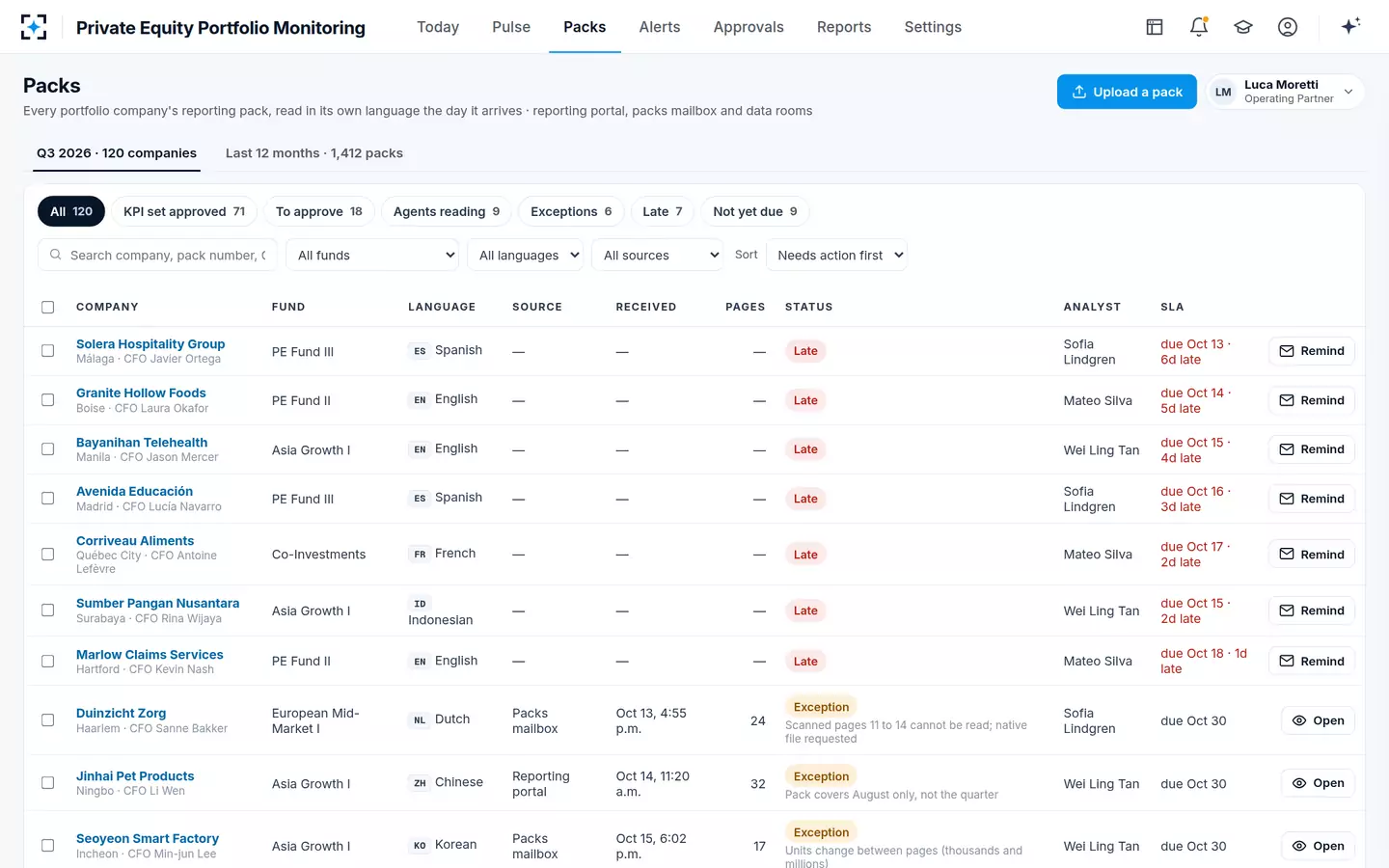
The quarter's queue in Private Equity Portfolio Monitoring: who is late, what is being read, what needs a person
Why test covenants before the compliance certificate?
Because a sponsor's options shrink as the certificate date approaches. Testing on the day the company's report arrives gives the deal team weeks to choose between a certified add-back, an equity cure, a waiver request or a conversation with the lender; testing on the certificate date leaves only the last two. Research shows why the lender's reaction matters: in a study of US firms, Chava and Roberts found that investment falls sharply after a covenant violation, because lenders can threaten to call the loan and use that leverage to steer the company (Journal of Finance, 2008).
Current conditions add urgency. The Federal Reserve's May 2026 Financial Stability Report found that "the median ICR for leveraged loan borrowers stayed near its historical low", where ICR is the interest coverage ratio (Federal Reserve, Financial Stability Report, May 2026). Thin coverage means less room before a covenant bites. In the sample, Ferrante's leverage covenant was tested the day its report arrived, 29 days before its certificate; the equity cure guide follows what the sponsor did with that time.
How many analysts does portfolio monitoring need?
As many as it takes to close the quarter on time with every figure checked, which depends more on how standard the companies' reporting is than on how many companies there are. No public ratio exists. In the sample, four analysts cover 120 companies, about 30 each, reporting in more than a dozen languages, and the estimate above implies each spends about 20 days on a close by hand.
The useful planning question is what happens when the portfolio grows. A fund that adds 20 companies in a year adds, on the sample's estimate, about 13 analyst-days per close by hand, two-thirds of an analyst. With the reading and mapping automated, the same growth adds about three days. The difference decides whether the team grows with the portfolio or stays the size it is.
Questions people ask
What is the difference between portfolio monitoring and portfolio reporting?
Monitoring is the continuous check on the companies: their results, their covenants, their figures. Reporting is what the sponsor tells its investors, quarterly and annually, built from the monitored and valued figures. Monitoring comes first, and its errors flow into reporting unless they are caught at the hand-over.
Should portfolio companies report monthly or quarterly?
Quarterly in full, and monthly in summary for companies where the sponsor needs earlier warning, typically those near a covenant or in a turnaround. Monthly reporting multiplies the collecting and mapping steps by three, so it is worth automating those steps before asking for more frequent reporting.
What slows the portfolio monitoring process down most?
Late company reporting and re-keying. In the sample quarter, seven companies were late on day 19 and six reports were exceptions, such as unreadable scanned pages or a report covering one month instead of a quarter. Each late or exceptional report holds its company's KPI set, and through it the valuation.
Can a smaller GP run portfolio monitoring in spreadsheets?
Yes, at a cost that grows with the number of companies, languages and covenants. A GP with a dozen domestic companies reporting in one format can manage with a well-kept template and a second reviewer. The case for software appears when companies report in several languages or standards, or when covenant-sensitive companies need testing the day their figures arrive.
How do you shorten the quarter close without cutting checks?
Move the reading and keying off people, and make every check independent rather than sequential. In the solution, a company's report is read, mapped and re-derived the afternoon it arrives and covenant-tested the same day, so the waiting is for approvals and CFO answers, not for an analyst's turn.